




1. Here at Mbird HQ, we’ve spent the last couple weeks knee-deep in Law and Gospel. Doubtless some would say that’s how we’ve spent the last eighteen years! But I’m talking specifically about the breathtaking Law and Gospel Issue of our print magazine, which should have reached subscribers’ mailboxes this week. As CJ mentions in his (fantastic) opener, the issue was a daunting one to put together. The theme is so dear to us as an organization — one of our “first principles” tbh — that we didn’t want to, well, get it wrong.
The irony is pretty rich, I realize. Thou Shalt Do Law & Gospel Justice At All Costs kind of undermines the message we’re hoping to get across in the issue itself. I’m happy to report the self-consciousness was short-lived; by God’s grace the floodgates of inspiration opened, and the excitement made it onto the page. See here, here, and here. Grab yourself a copy today.
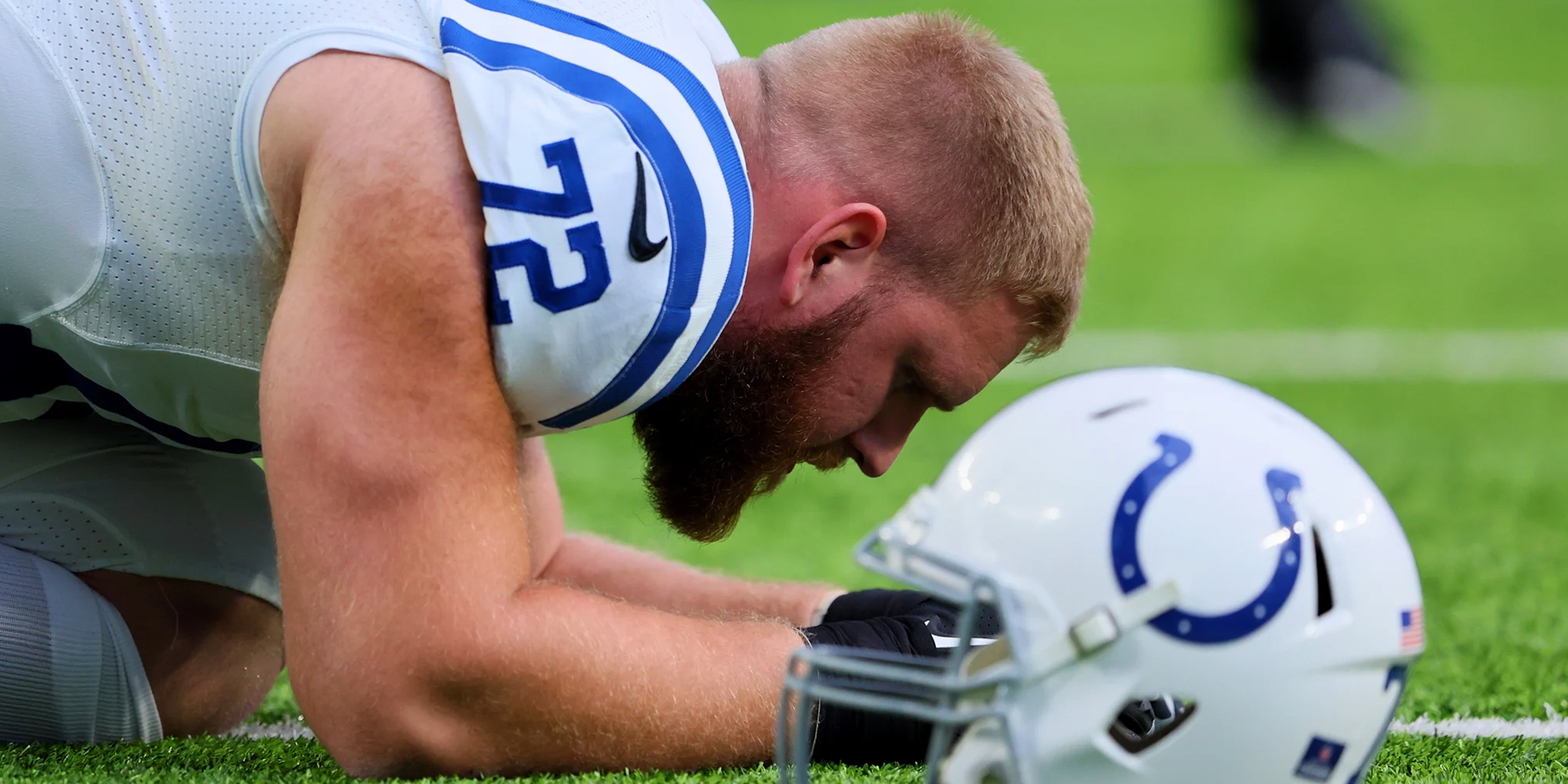
Maybe you’re unconvinced though. Maybe “Law and Gospel” still sounds a bit heady or antiquated or boring or something. Those looking for a reminder of what’s at stake would do well to read CNN’s powerful profile of Indianapolis Colts lineman Braden Smith. The piece details how the form of OCD termed “Religious Scrupulosity” sidelined Smith last season, causing him and his family real misery.
“Religious Scrupulosity” describes what happens when the brain latches onto the law of God in a doom loop of internal condemnation. In such situations, the word of the gospel is drowned out entirely. There’s a physiological element here but also a theological one. When the law and the gospel are not properly distinguished — and it sounds very much like they weren’t in the “do more, be better” faith of Smith’s youth — the former (law) almost always swallows up the latter (gospel). Add clinical OCD to the mix, and you have a frightening mix.
Thankfully, God intervened in Smith’s spiral via the love of his wife Courtney and the help of some Mexican meds:
“I was having a court case in my mind all the time – pleading myself to the jury – because my mind all the time would be like: ‘You know, God can hear your thoughts,’” Smith told CNN Sports.
“I’m still dealing with OCD, still have obstacles to conquer each and every day,” he said. “It’s part of my life. I can’t run or hide from it. And I can’t fight it either, per se, because the more that I fight, the more that I play into its hand and I just having to accept it for what it is. The OCD always wants you to do more and more and more. That’s something that’s been preached my whole life is doing more. But at this point, I almost have to do less. I have to rest more in it. I have to rest in that love and that grace vs. trying to do more, trying to fight my OCD.”
Previously, Smith describes not “living” his faith “all the way,” taking it in “bits and pieces.” In 2024, though, his life began to revolve around it. In his mind, his OCD took that journey “in the most literal sense.”
“Especially when you hear a verse like: ‘Loving God with your all your heart, mind, body and soul,’ I took that literally,” Smith explained. “Every thought I have has to be perfect and in order to do the things the right way, my mind was telling me all the things that I needed to avoid. And so, naturally, it starts off as a single thought, and then it starts multiplying all these bad thoughts you’re not supposed to have.”
As he explored his own journey into religion, he found a fixation with conducting himself the way literally written in scripture. That, he now understands, is “impossible” for a regular person. Striving for perfection only exacerbated the sense of guilt.

2. Speaking of favorite themes, therapeutic overreach has become an undeniable one in our cultural discourse of late. I’m not talking about an overvaluation of talk therapy when it comes to treating mental maladies. I’m talking about the encroachment of therapy-speak into all avenues of life. Indeed, if the lingua franca of the Internet seven years ago was that of power (in which everything boiled down to oppression and victimhood), today that language has been supplanted by therapy-speak (in which everything boils down to trauma and pathology). It’s difficult to talk about this phenomenon without sounding callous or out of touch, especially since psychology really does explain a LOT.
And yet, like power before it, therapy-speak cannot and does not explain everything. For example, it cannot account for spiritual realities. This incapacity is what energized the latest installment of Freya India’s Girls Substack “Nobody Has A Personality Anymore.” Buckle your seat belt:
Some say young people are making their disorders their whole personality. No; it’s worse than that. Now they are being taught that their normal personality is a disorder. According to a 2024 survey, 72% of Gen Z girls said that “mental health challenges are an important part of my identity.” Only 27% of Boomer men said the same.
We have lost the sentimental ways we used to describe people. Now you are always late to things not because you are lovably forgetful, not because you are scattered and interesting and secretly loved for never arriving on time, but because of ADHD … You are the way you are not because you have a soul but because of your symptoms and diagnoses; you are not an amalgam of your ancestors or curious constellation of traits but the clinical result of a timeline of childhood events. Every heartfelt, annoying, interesting piece of you, categorised […]
We can’t talk about character either. There are no generous people anymore, only people-pleasers … There are no hard workers, only the traumatised, the insecure overachievers, the neurotically ambitious.
The world is also becoming more complicated; we want control and certainty. We take comfort in the causes of things. And yes there are young people helped by diagnoses, who can’t function and find relief in being understood, but fewer than we think. Many more have been convinced that the point of life is to classify and explain everything, and it’s making them miserable.
At some point we have to stop analysing and seeing through things and accept the unknowable. All we can ever really achieve is faith. Some humour at ourselves, too … My worry is that after a lifetime spent trying to explain themselves, solve their strong feelings, standardise their personalities, and make sense of every experience, a generation might realise that the only problem they had, all along, was being human.
Lots to digest there, and as always, it’s worth noting that the enthusiasm for therapy-speak must be understood in part as a measure of the pain and confusion that many young people feel today. It is grounds for compassion rather than disdain or superiority–even when it’s annoying. But I’m sympathetic with India’s core point: We will not be saved by explanation. The inward gaze has limits and liabilities (galore). A diagnosis is a poor substitute for a personality. Sin does not reduce to trauma any more than grace reduces to unconditional positive regard.
Alan Noble posted a helpful reflection on it all, counseling, “As we approach our mental health, we shouldn’t do so with a spirit of mastery and thorough scientific explanation, but with resonance with that infinitely and beautifully complex thing that is our mind.”
3. In my talk at the Mbird NYC conference this year, I described what relief looks like for someone of my demographic: a heavy rain storm during the hours of 2–4 a.m. on a Saturday morning. A downpour during those hours doesn’t impact anyone’s sleep, nor does it coop a family up inside all morning. What it does is cancel almost every youth sports game scheduled for the day. Gotta protect those fields! A storm is an act of grace, setting weary parents free from the increasingly insane treadmill to which so many of us are chained.
Cue Jason Gay’s “Confessions of a Very Mediocre Youth Sports Parent” in the Wall Street Journal, which had my head nodding numerous times with lines like, “A youth sports parent basically spends his or her time praying for less youth sports.” He goes on:
You quickly learn that youth sports has become a big business, designed not for kids, but for adults. Much of it leans into the idea that a parent isn’t doing enough for their young athlete: they’re not teaching them the right drills, they’re not buying them the right equipment, they’re not placing them on the right team and on and on. It’s a market that preys on parental guilt, gets exacerbated by the high cost of college and the (generally ludicrous) idea that athletic proficiency is a smart way to hack a scholarship, and it collectively puts a pressure on youth sports that’s far higher than when you or I were children.
It’s really hard to find a parent who doesn’t think the youth sports economy is out of whack, that it’s gotten too busy, expensive and crazed, and don’t get us started on travel teams versus recreational teams, or reserving three nights at a musty hotel for the Fest/Showcase/Jamboree, but at the same time, no one’s quite sure how to step off the carousel. Again: this is because the youth sports industrial complex sells the idea that you might be letting your kids down, and it takes a bold act for a parent to reject that.
There’s a none-too-subtle little-L law operating here. To fulfill all parental righteousness (and safeguard your child from future doom), thou shalt do everything in thy power to set thy kid up for extracurricular success. Thou shalt ensure they never fall behind the ever-retreating goalposts of hyper-specialization. Basically thou shalt never let them down in any way (and certainly not harbor any supplanting needs of your own). It’s an absurd picture of what it looks like to love one’s offspring, a petri dish of acceleration and performancism and therefore a cash cow. If there’s a silver lining, it’s what Gay identifies:
The good news about youth sports is that there’s always a stabilizing influence: the youth. Despite a lot of unnecessary spending and adult energy, the boys and girls on the field tend to have the right priorities. They want to have fun, and make friends. They’re happy if they do well, and sometimes sad if they don’t, but within 10 minutes on the drive home, they’ve forgotten the game and are antagonizing me to stop somewhere for french fries.
See also: Kathryn Jezer-Morton’s “What Do Parents Get Out of Competitive Youth Sports Culture?” from last July, in which she draws out the overt #seculosity dimension of youth travel sports. Suffice it to say, I think Malcolm Gladwell was 100% right when he said that, if it takes longer to get to a game than it takes to play that game, something has gone wrong.
4. In humor, some amazing headlines this week. The Hard Times hit super close to the bone with “New Study Finds that Everything You Thought Was Three Years Ago Was Eight Years Ago.” The Babylon Bee’s “Man Very Particular About Which Version Of The Bible He Buys And Doesn’t Read” made me chuckle, and so did Reductress’ “Woman Apologizes to Dead Bug as if Her Guilt Will Purify Her.”
Finally, the Onion struck gold with “Unconditional Love Given To 15-Year-Old Who Just Called Mom A Bitch In Middle Of Hollister.”
5. “Americans Are Tired of Choice,” writes by Gal Beckerman in the Atlantic, reviewing a new book by historian Sophia Rosenfeld, The Age of Choice, which sets out to explain how freedom came to be synonymous with having an endless number of choices, “and how wrapped up our sense of self is with the ability ‘to make one’s own personally satisfying choices, with a minimum of impediments, from among a range of options.'” The phrase Rosenfeld uses to describe this dominant and near-unassailable view of freedom is a provocative one: choice idolatry. Beckerman writes:
The 20th century only further solidified the idea of choice as the paramount freedom, which also meant shedding some of the guardrails of earlier eras. Many economists came to perceive an individual as the sum of their preferences, a choosing machine, Homo economicus, acting rationally and always maximizing the collective good through their own self-interest.
At the same time, paradoxically, the 20th century provided much reason for skepticism about how much control humans really have over their choices. Freud revealed the subterranean sources of our desires; advertisers manipulate our taste for breakfast cereals as well as presidents. In this century, at least to a behavioral psychologist such as the late Daniel Kahneman, even the question of free will seems unsettled. This insecurity is particularly glaring in a world of proliferating algorithms that serve us more of what they predict we will want and AIs that offer to do the thinking for us.
If choice has indeed become an end unto itself, absent a set of principles for actually making choices, then something has gone awry.
“Freedom could be reconfigured as the chance to do what one ought rather than simply what one desired,” Rosenfeld writes. Releasing ourselves from choice idolatry doesn’t have to mean letting someone else decide for us. It means separating good choices from bad, understanding these categories as the ones that matter, delineating them alongside our fellow citizens.
6. Let’s end on a more devotional note, albeit a solemn one. You’ll want some Kleenex close by for Esther Maria Magnis’ “The Strange Love of a Strange God,” translated from the German and published in Plough. Magnis writes with extraordinary vividness and penetration about her father’s death from cancer when she was a teenager, a tragic event which shook her family (and faith) to the core. You really have to read the whole thing, but here’s the ending:
I had to see a psychologist. Not that it helped. My problem was not only grief. Since turning my back on God, I felt my life was a meaningless coincidence. And since it was already meaningless, why endure suffering? Questions like this cannot be answered by therapy. They can only be suppressed with medications, pushed off, if you’re lucky, until you find yourself lying in bed in an old people’s home someday, staring at a wall all day long, which is what I was already doing…
We humans are needy. Helpless. Little. And particularly vulnerable when we love. Because loving never just stops after the person you love is dead. Even if it seems, at a first glance, that your love has lost its object. Even if you sob every morning and seem inconsolable. Love does not die.
There’s something strange about that, and not just in a needy way, but in a beautiful way too. In a way that lets you wonder… I suddenly found this love more amazing than cancer. More sovereign, even if it made me go weak. Even if it was love that made me suffer so much. There was something great about it – foreign – unmanipulable. This strangeness of love began to fascinate me. I was given a new apprehension of God. Of his strangeness. And it changed everything.
Don’t worry: this piece is not going to end with, “And then I let go of my evil hatred, stopped smoking, and started going to church every day.” It wasn’t like that.
But I did turn back to God. And shortly afterward, my younger brother Johannes was diagnosed with cancer. He was only twenty-three. It was a malignant melanoma. Very small, but very nasty. He died of it, ten months later. I can’t really say who died, and who he was to me. I might be able to find words for the horror, but not for my brother.
And yet, I can say this: his faith in God was so great that it carried us all with him. He was not afraid. There was a peace in his prayers that I don’t understand. Comfort. It was like the love I had and still have for him and for my father. A love that won’t let me go, and won’t die, and seems as otherworldly as what I’ve written here.
Strays:
- “Men, Where Have You Gone? Please Come Back,” writes Rachel Drucker in the New York Times in a moving piece about mass male retreat from the world of dating. “I remember when part of heterosexual male culture involved showing up with a woman to signal something — status, success, desirability. Women were once signifiers of value, even to other men. It wasn’t always healthy, but it meant that men had to show up and put in some effort. That dynamic has quietly collapsed.”
- “The History of Advice Columns Is a History of Eavesdropping and Judging” by Merve Emre in the New Yorker. “It is a curious accident of language that ‘advice’ contains within it the etymologically unrelated word ‘vice,’ from the Latin vitium, meaning ‘fault’ or ‘sin.’ Yet the accident is suggestive.”
- Finally, for those with summer road trips on the horizon (who’ve already started the awesome new season of Terrible Parables), thought I’d share some of the interviews about The Big Relief I’ve had the pleasure of doing this past month.
- This Undivided Life podcast with Troy McLaughlin
- Choosing Cheer with Nicolet Bell
- You Have Permission with Dan Koch
- Oh, and here’s a longer video one I did with Dave Herring for Christianbook’s Edified podcast:








Re: “Men, Where Have You Gone? Please Come Back”
It’s not just single women wondering where the men are.
My single, 24-year-old son has had the opposite problem of attending dozens of different meetup events and finding them attended almost exclusively by men. I’ve run out of ideas of what to tell him to do or where to go to meet single women his age.
He’s tried the dinner with a half-dozen strangers thing, only for every table ratio to be four men to two women—and the women don’t seem interested in a long-term relationship.
He’s done hiking groups, book clubs, groups for the job field he is in, and every one is packed with men but few women, who are often already in a relationship.
So, it seems incongruous to hear the opposite lament. Ladies, where are YOU hiding? Where are you expecting to meet eligible men? Because the men are out there. And they are truly trying.
I wonder if #3 and #4 are somehow related. Meaning, the over therapized milieu we find ourselves in started actually in the 90s and 2000s – and produced a generation of new parents who had spent a lot of money “finding out what’s wrong with them”. And the answer was seldom “a world that breaks your heart and a value system designed to exhaust and not nourish you”…it was, “because your parents didn’t meet every single need and desire you had as a child (based on your current world view that was honestly not even operative 35 years ago)”. So what do we do when this is the root of all our malaise? Raise a generation of anxious children whose every need to desire (real or imagined) is met by parents who will do anything not to feel like they made the same mistakes as their own.