




Now hitting mailboxes, our new issue spotlights one of Mockingbird’s foundational theological principles. With a special wraparound cover unlike we’ve ever had, this issue is one for the ages.
Order your copy here, and find subscription options here!
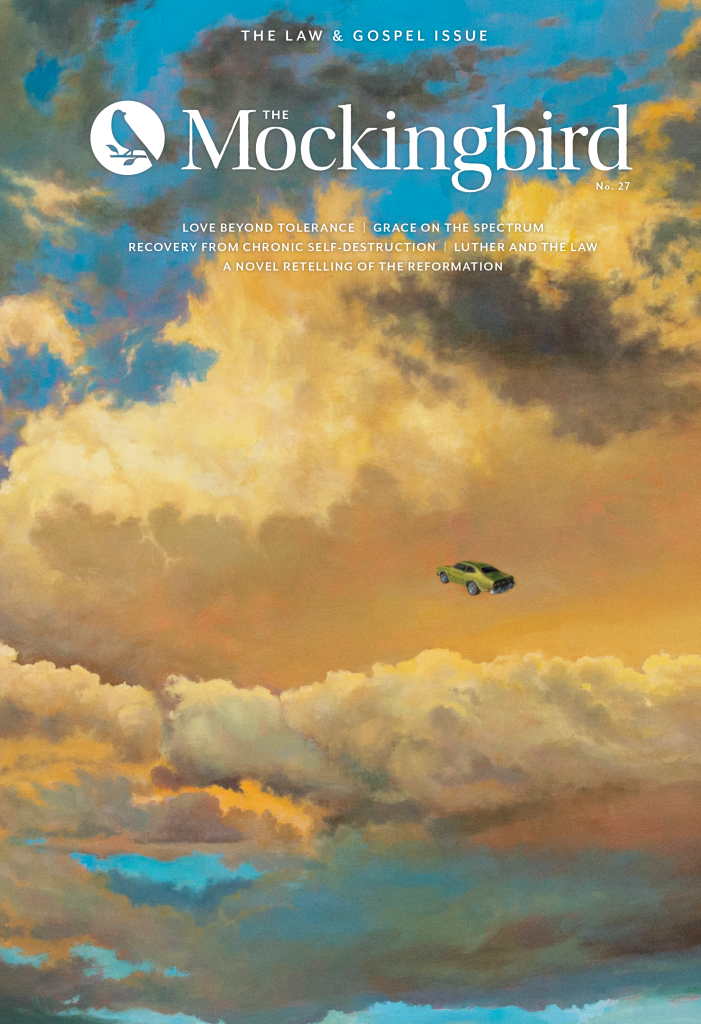
Cover art by the insanely cool Wayne White. Escape, 2024. Oil on canvas, 36 × 60 in.
For eighteen years people have been asking us, “What is Mockingbird?” If you’re wondering, this issue is a fantastic place to start. Are we a religion-meets-pop-culture platform? An “arts and faith initiative”? Some have argued that we are “hyper-grace antinomians,” neglecting Christian ethics and tradition. To the contrary, our guiding distinction between the law and the gospel has a long, storied history in the Christian church. Communicating this distinction — exploring its contours and demonstrating why it matters — is a big part of what Mockingbird does, certainly why it was founded.
Most associated with Martin Luther, the law/gospel distinction also precedes him. You find it all the way back in Augustine, and Paul before that. Paul, for example, wrote, “the letter kills, but the Spirit gives life”; Augustine maintained that the law “commands more than liberates; it diagnoses illness but does not cure.” Indeed, he went on to say that the law worsens one’s “illness,” so as to inspire that person to “seek the medicine of grace.”
To certain ears, all this may sound very doctrinaire, antiquated, possibly … dull? But like many a good thing, it’s better than it appears. Other near-synonymous frameworks are judgment and love, pressure and relief, expectation and acceptance, demand and promise. Observing these forces — how the former kills and the latter brings life — casts a fresh light on faith. It acknowledges the rigid standards to which we are held (and hold ourselves) and the way that indiscriminate, free-flowing grace forgives flubs big and small. It enables us to be sober-minded about the human condition and, at the same time, to have hope. It places a premium on inefficient things — among them, art, poetry, beauty, and play. It enables us to experiment — to get things wrong. It enables us, in other words, to engage seriously with pop culture, to appreciate both arts and faith, and to drive home the power of grace to almost alarming degrees.

Illustration by Aubrey Swanson Dockery.
In this issue, writers seek this medicine in all areas of life: Stephanie Phillips writes about grace in parenting a child with autism; Bryan Jarrell grants freedom to the grieving; Lindsay Holifield describes a gracious approach to recovery from an eating disorder; and Sarah Condon, in her advice column, reckons with family divisions (heads up, the law stings!).
As for how the distinction appears in scripture, the scholars Sarah Hinlicky Wilson, Todd Brewer, and Jennifer Powell McNutt have you covered, with essays on Luther, the Epistle of James, and Mary Magdalene. Chad Bird writes about the many faces of Genesis’s extraordinarily human characters, and the litigator William McDavid describes the relationship between the theological and the legal.
We have interviews with theologian Jonathan A. Linebaugh, author Amy Mantravadi, and filmmaker Nicolas Ma. As for poetry, we have stunning contributions by Spencer Reece, Shane McCrae, and Jenny Hykes Jiang. For the ministers among us, Aaron Zimmerman lays out how to preach an effective law/gospel sermon, which David Zahl then gamely demonstrates in his closer.
Too much of the church has muddled the law and the gospel, leveraging anxiety and power to coerce, leaving would-be believers disillusioned, angry, or perplexed. It is true that making this distinction is an art — one that, according to Luther, only the Holy Spirit really knows well. But if there’s one thing we can say for sure, it’s that the gospel does not traffic in fear.
If the gospel leaves you with any question at all, it ought to be the following. As David Zahl puts it in his new book, The Big Relief: “What would you do, what risk would you take, what would you say, if you weren’t afraid?” That’s the question that inspired us to put this issue together. May it inspire you in turn.
See a preview of the interior pages here.
Table of Contents
ESSAYS
To Be, Rather Than to Seem
Stephanie Phillips
For Invincible Sins
Sarah Hinlicky Wilson
Recovery Came Softly
Lindsay Holifield
The Law According to Lawyers
William McDavid
The Good Christian Funeral
Bryan Jarrell
She Who Hangs Out in Cemeteries
Jennifer Powell McNutt
People Exegesis
Chad Bird
More Than an Epistle of Straw
Todd Brewer
Whole Lotta Love
Aaron M.G. Zimmerman
—
INTERVIEWS
Jonathan A. Linebaugh
Amy Mantravadi
Nicholas Ma
—
POETRY
An Excerpt From the As Yet Untitled Sequel to
New and Collected Hell
Shane McRae
Pomegranate | And She Spoke of Many
Things Saying Behold a Sower
Jenny Hykes Jiang
Three Poems
Spencer Reece
—
LISTS & COLUMNS
Dear Gracie…
Sarah Condon
Is It Law or Is It Gospel?
Sam Bush
The Unexpected Gospel of the Mundane
Sarah Condon
On Our Bookshelf
The Confessional
—
SERMON
One Louder
David Zahl
FIND OUT MORE








[…] mailboxes this week. The issue was a daunting one to put together for the reasons CJ mentioned in his (fantastic) opener. Namely, the theme is so dear to us as an organization–one of our ‘first […]