




1. As tempting as it might be to lead with a reflection on the spectacular images from the newest interstellar binoculars, the Christianity Today’s article on Johnny Cash and masculinity is too good to bury. Because, beyond fictional male role models, real life examples of non-toxic masculinity rarely make the front page news — particularly within Christianity, whose ideals of masculinity often seem to better reflect cultural values than, say, scripture. Against the backdrop of the strongman leader of today, Hannah Anderson sees Johnny Cash as someone worth imitating. Not because he was a moral, or even particularly upstanding, person, but because he was right about the most important thing — a sinner saved by grace:
While Cash celebrated a kind of rugged masculinity, he was also a deeply-flawed man. His life was marked by infidelity, alcoholism, and drug abuse. He was no pastor.
And yet, Cash had a singular advantage — something the current rhetoric around masculinity misses. He knew he was a deeply flawed man. He knew he was a man in need of grace. So while he sang about the temptations that are common to all, he didn’t justify or excuse his own participation. Instead, his discography rings with confession, grief, and cries for redemption. […]
It’s hard to know how much of Cash’s public persona translated to his private life, and if you read through his body of work, you’ll likely find more than one objectionable lyric. Like the United States itself, he was a man of deep challenge and contradiction.
But what you will also find is a vision of masculinity that is honest and humble. You’ll find a vision of masculinity that embraces the complexity of the human condition while refusing to blame-shift, whine, or deflect responsibility. You’ll find a vision of masculinity that knows its need of grace.
In a word, you’ll find a real man.
2. Speaking of gender conventions, the Conversation ran an article by psychologist Katheryn Waddington on the history and misunderstood utility of gossip, which has usually been deemed a specifically female proclivity. Of course, men gossip just as much as women, but then we just call it “guy time” or “shooting the breeze.” What’s going on here?
There was no negative meaning attached to gossip until around the time of the European witch hunts in the 16th to 18th centuries. Gossip was a catalyst for accusations of witchcraft and sorcery, leading to inhumane use of medieval instruments of torture. The “scold’s bridle” was designed to punish and prevent women from speaking. Thus, gossip’s negative reputation and stereotype as “women’s talk” began.
Paradoxically, at the same time, gossip as men’s talk spread throughout the 17th and 18th centuries in English coffee houses. As exclusive resorts of the educated and rich, they were places where learned men (there is little evidence of women in coffee houses, unless as servants) and their male students came to demonstrate their wit and intellectual talents. Here, the myth that women gossip but men have serious conversations was born.
Side note: Waddington notes the history and etymology of gossip, but the religious (i.e. Christian) background I think fills in the gaps. I’d argue that the specific association of women with gossip comes from 1 Timothy 5:13 and its discussion of young widows who are said to be “idle … gossips [or tattlers in the King James] and busybodies, saying what they should not say.” From there, it’s a hop, skip, and a jump away to … baseless gender stereotypes.
For my money, the Greek word in question probably better means “slander” (i.e. untrue accusations!). So perhaps gossip isn’t all that bad? Cue Waddington:
Popular stereotypes of gossip overemphasise the negative judgements made in gossip, but it can be associated with compassion, empathy and noticing suffering. Gossip is a way of expressing emotions, both positive and negative, a way of “letting off steam” and an emotional reaction to perceived social injustice. […]
The pandemic has also shone a spotlight on the benefits of gossip. Almost overnight, lockdowns removed opportunities for the casual conversations that constitute gossip — conversations in the coffee queue, and before or after meetings. As many people return to the office, they may realise how important these little moments of gossip are to social bonds and cooperation.
3. A quick one on the value of curiosity in higher education: “What if We All Practiced More Curiosity?”
A practice of curiosity that fosters connection between people with opposing worldviews may seem like a drop in the bucket in a vast sea of insular, divided, and polarized thinking. But the act of asking others — especially presumptive antagonists — to share their story, and reciprocating with one’s own, is a radical and transformational process.
Which reminds me of Sam Bush’s excellent article on the same topic: “There is something to be said for an appetite for the unknown. To admit the limitations of one’s perspective is usually the only way to gain more of it.”
4. When you weigh it in the balance of what seems to be the urgency of a world falling apart at the seams (you know, like it did twenty, forty, and seventy years ago), curiosity can seem like a frivolous exercise that actually gets in the way of accomplishing anything. Like trying to sympathize with a toddler protesting they aren’t tired. But nothing could be further from the truth.
In fact, I’d wager that life would be far better for everyone if we all engaged in a little more frivolity, engaged in few more pointless activities. So argues Gloria Liu this week in the Atlantic:
We live in a culture that is highly motivated by the pursuit of money, prestige, or approval (usually in the form of social-media likes), Catherine Price, a science journalist and the author of the book The Power of Fun: How to Feel Alive Again, told me. Traditional self-improvement goals, such as cutting out sugar or keeping a gratitude journal, are utilitarian and, most important in this context, not much fun.
Pointless goals, in contrast, are meant to be enjoyed. They trick us into doing the things we love, which can also put us in a flow state, where we’re deeply satisfied, present, and absorbed in the task at hand. (If you must justify the time, Price says, know that flow states can also boost creativity and serve as an antidote to the constant hijacking of our attention by our work, our devices, and our kids.) […]
At first, the inherent unimportance of these pursuits coupled with the grueling commitment required to attain them seem at odds: Why set a target and spend so much effort on something that doesn’t matter? But a good meaningless goal is an act of protest against the self-optimization hamster wheel. It subverts the cult of productivity by sneakily leveraging the tools of productivity. We live in a culture that is highly motivated by the pursuit of money, prestige, or approval (usually in the form of social-media likes), Catherine Price, a science journalist and the author of the book The Power of Fun: How to Feel Alive Again, told me. Traditional self-improvement goals, such as cutting out sugar or keeping a gratitude journal, are utilitarian and, most important in this context, not much fun.
Pointless goals, in contrast, are meant to be enjoyed. They trick us into doing the things we love, which can also put us in a flow state, where we’re deeply satisfied, present, and absorbed in the task at hand.
The pointless, perhaps even excessive or wasteful, is precisely the venue of grace, where the law of expectations and utility stops and the freedom of creativity can begin. To state in bluntly (but not hyperbolically), video games might be a worthwhile “self-care” investment.
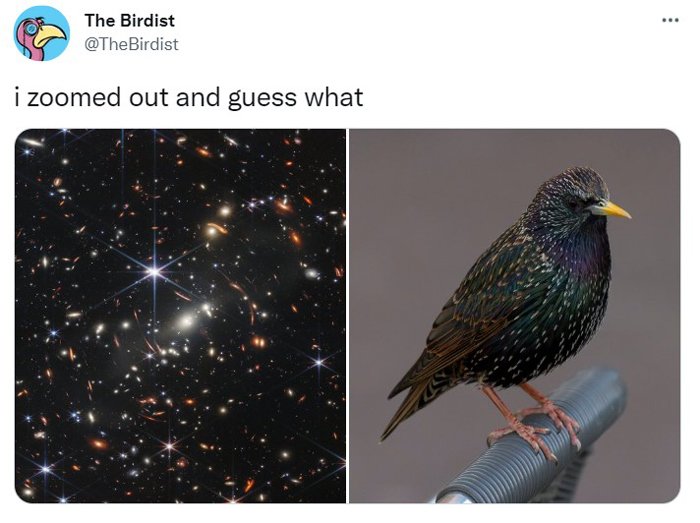 5. In humor this week, the fancy pics of space made for some hilarious memes and the Washington Post’s had “James Webb Space Telescope Images Ranked by how Good They Look to Eat.”
Elsewhere, it’s hot outside and NewsThump warns: “Heatwave Could Lead to Months Worth of Tedious Conversations in Just 24 hours.” Consider yourself warned.
6. This next one by Anne Lamott is a profound treatise on prayer posing more as a political tirade (oh, editors…). So I’ll zoom past the politics of this next one and cut to straight to the good stuff:
How do people like me who believe entirely in science and reason also believe that prayer can heal and restore? Well, I’ve seen it happen a thousand times in my own inconsequential life. God seems like a total showoff to me, if perhaps unnecessarily cryptic. […]
I wake up praying. I say a prayer some sober people told me to pray 36 years ago, because when all else fails, follow instructions. It helps me to not fixate on who I am, but on whose. I am God’s adorable, aging, self-centered, spaced-out beloved. One man in early sobriety told me that he had come into recovery as a hotshot but that other sober men helped him work his way up to servant. I pray to be a good servant because I’ve learned that this is the path of happiness. I pray for my family and all my sick friends that they have days of grace and healing, and I end my prayers, “Make me ever mindful of the needs of the poor.”
Then I put on my glasses, let the dog out to pee and start my day. I will have horrible thoughts about others, typically the Christian right or the Supreme Court, or someone who has seriously crossed me, whose hair I pray falls out or whose book fails. I say to God, as I do every Sunday in confession: “Look — I think we can both see what we have on our hands here. Help me not be such a pill.”
It is miserable to be a hater. I pray to be more like Jesus with his crazy compassion and reckless love. … God sees beyond each person’s awfulness to each person’s needs. God loves them, as is. God is better at this than I am. […]
Especially when I travel, I talk to so many people who are absolutely undone by all the miseries of the world, and I can’t do anything for them but listen, commiserate and offer to pray. I can’t turn politics around, or war, or the climate, but in listening, by opening my heart to someone in trouble, I create with them more love, less of a grippy clench in our little corner of the universe. […]
Do I honestly think these kinds of prayers were heard, and helpful?
Definitely.
7. On the more theological side of articles this week, James Walden wrote “Deconstruction and the Theology of the Cross” for Mere Orthodoxy, an ingenious mashup of Martin Luther and Exvangelical deconstruction, which makes it pretty much the best thing I’ve ever read on deconstruction.
Deconstructive readings are not a replacement of conventional or “first readings,” but rather supplement them as a deeper “second reading” analyzing the discrepancies, inconsistencies and tensions within a text, tradition or institution. As such, deconstructive analysis is not interested in simplifying (though that too must be done), but rather complexifying the narrative. The reason is not to be ornery, to problematize for the sake of making problems, but to unearth infidelities – in our case, to uncover theologies of glory – within the tradition in which one is operating. […]
It honestly acknowledges our limits and deficiencies (personally, historically and institutionally). If it subverts our “faith,” it is in the interest of the integrity of our faith. It is ever open to correction, redirection, reconsideration, repentance. That is to say, it is ever open to Christ’s future, in order to become more faithful to his past (life, death, and resurrection). And before the glory of resurrection must come the anguish of crucifixion.
Strays:





re: #3
Be curious, not judgemental.
– Walt Whitman, via Ted Lasso
[…] July 9-14 […]