1. Barbenheimer is finally here and, judging by the early reviews, the hype was warranted. The side-by-side contrast between the bubbly blonde children’s toy and the brooding scientist who invented a world-destroying weapon has been the occasion for a good deal of humor. But beneath this very clever marketing gimmick is a thematic link between the two, one that’s, dare I say, strangely Augustinian.
For Oppenheimer, the Romans 7-Frankenstein parallels are obvious, examining the psyche of its conflicted protagonist. As David Sims notes in the Atlantic:
Murphy, with his frost-blue eyes fixed in a permanent thousand-yard stare, keeps the viewer (and the people around him) at arm’s length. But as the years pile on, it’s obvious how the guilt has stacked up too. The film lets reality start to crack around Oppenheimer as a result, turning the Trinity test into a haunting, invasive specter he can never quite shake. […] After racing his way to scientific progress and achievement, Oppenheimer is confronted with an amoral world he had previously ignored; that existential horror, and the way it echoed into the 21st century, is the real hammer wielded by this tale.
It seems there were more than a few chain reactions set off at Los Alamos. For more on internal conflict of Oppenheimer (the man, not the movie), see this essay published in the Bulletin of the Atomic Scientists.
Barbie‘s Augustinian credentials are as overt as they are unexpected for a movie about a doll. As noted by Alissa Wilkinson in Vox, screenplay writers Gerwig and Baumbach clearly had Genesis 3 on their minds.
The Barbies live in Barbieland, an analog for the Garden of Eden, where every day is a sunny and perfect day — especially for our heroine, Stereotypical Barbie (Margot Robbie). […] One day, in the middle of a party, Barbie suddenly starts thinking about death, for no reason at all (especially because she’s a plastic doll and one that is, as you probably know, virtually indestructible). When a tragedy strikes — I won’t ruin it — Barbie is forced to leave paradise and go to the real world, and Ken hitches a ride. When they get there, they discover that they’re suddenly self-conscious and aware of being looked at (this movie’s version of Eve and Adam discovering their nakedness).
A colorful adventure about a lost paradise, destroyed by the knowledge of good and evil? A biopic about a man wracked with guilt for the almost Adamic evil he has unleashed upon the world? I guess the only question is which film to see first.

2. On the subject of lost innocence, over at LitHub Janet Manley offers an insightful and much-needed review of the children’s literature genre (which parallels the Babylon Bee’s take on Bluey). Kid’s books, it turns out, are much more about what adults think children should and want to read, rather than children themselves. As a for-instance, Manley features a graphic of nine books about grandma’s garden (“These are books for Grandma to buy and give her grandkid”).
I can’t say I disagree. My seven-year-old was once given a Ruth Bader Ginsberg children’s book, which to this day sits on the dusty shelf next to a book of Rebel Girls, both of which have never been finished.
We toggle between confronting children with the reality of the world (note the bleak realm of climate fiction for young readers) and with blanketing them in fluffy chickens. […]
“People in publishing often talk about ‘child-friendly’ books, which suggests something consoling, sweet and kind of nostalgic. But that’s a smokescreen, because those qualities attract parents and teachers more than children,” says Natalia O’Hara, author of Hortense and the Shadow and other books with her sister, illustrator Lauren O’Hara (of the forthcoming Madame Badobedah and the Old Bones). “Children like sweet and safe stories but they also like dark, bleak, unsettling or horrible stories. Children are like everyone else, they want stories that reflect the whole contradictory tangle of their lives.”
To speak to a young audience the children’s author needs to find a way to beat back their own adultness. To paraphrase Catherine Lacey quoting Rachel Cusk, “Can an [adult] — however virtuosic and talented, however disciplined — ever attain a fundamental freedom from the fact of his own [adulthood]?” […]
Once you attune your eyes to the adult baggage, you can see stories sagging under its weight everywhere.
The answer lies, for Manley, for writers to avoid paternal didacticism, to let kids be actual people. But there also doesn’t seem to be any way around the fact that adults are the ones buying all these children’s books, who will inevitable buy books they think should be read to children. And if there’s one thing adults are good at when it comes to children, it’s offering an innumerable number of “shoulds.” The alternative to such law would be a patient forbearance that enables freedom, the kind so many children experienced in Dorothy Martyn’s unguided, grace-filled play therapy sessions.
My seven-year-old does have a Jesus Storybook Bible she occasionally reads. But her favorite part isn’t necessarily theologically rich portions I’d choose for her. Instead, she loves stinky feet:
3. If there aren’t many reviews of children’s literature, the same can said for the visual arts and the practice of art criticism. Writing for the Point magazine Sean Tatol offers a defense of the practice of art criticism in ways that have broader, more profound implications. Unlike movies, TV, books, restaurants, or the quality of your Seamless delivery, assessments of the value of art have slowly gone the way of the buffalo. At a time when algorithms and websites aggregate ratings far and wide for the hungry consumer (Democracy at work!), art appreciation has devolved into a thorough subjectivism (the painting speaks to me) independent of any notion of objective value or beauty. The art expert possesses a well-earned soapbox, but lacks an audience.
Being stuck in thought negates engagement and enjoyment, so it’s natural that we approve of art as the product of courage and creativity and distrust criticism as so much foul-tempered grumbling. This criticism of criticism inevitably emphasizes that art is subjective, which, according to experience, it is. No two people will have the same exact experience of a work of art. However, to treat art as completely subjective represses the role that thinking plays in our subjective experience, and in particular the process of judgment (which is part of our experience). Once we make any judgment at all we are aspiring to be objective, or at least correct, to the best of our knowledge. This objectivity may not be fully achievable, but if we are to think critically, or at all, the attempt is necessary.
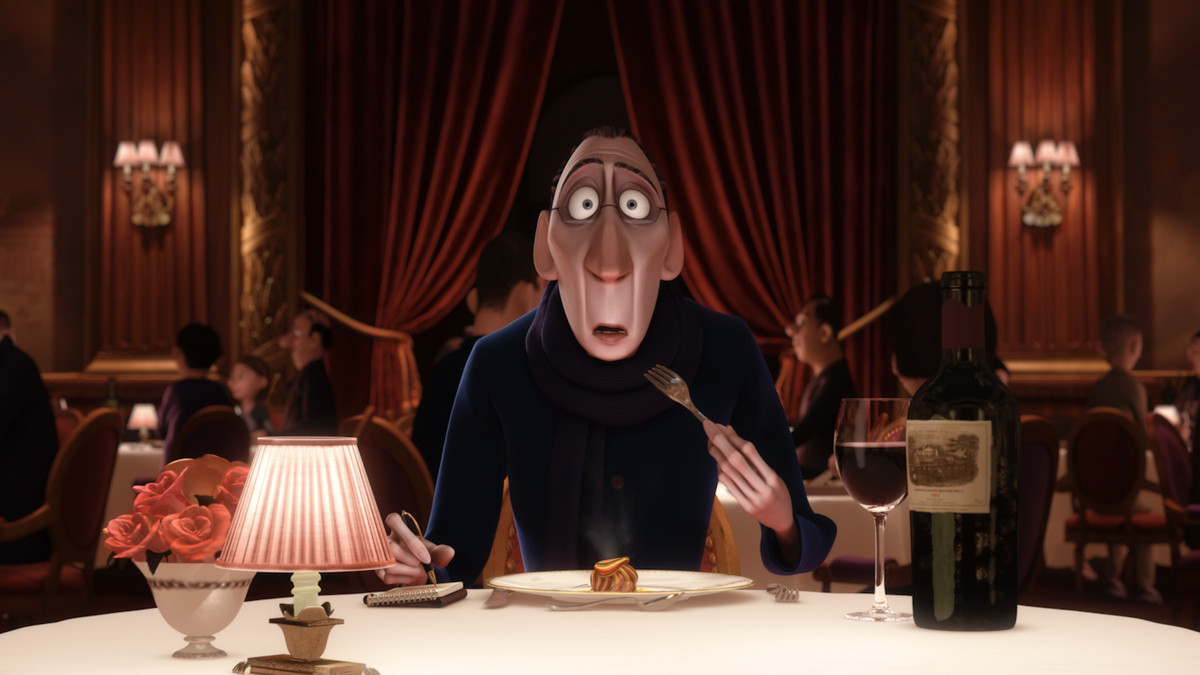
If not a kill-joy (cue Ratatouille’s Anton Ego), what, then, is the role of the art critic? Here, Tatol argues quite convincingly that criticism makes the experience of art better, not worse.
Good writing about art serves to elevate and enrich the experience of good art and to clarify the inadequacies of bad art, to put words to the nonverbal aesthetic language that the critic has built. More particularly, a critic’s recognition of artistic quality does not simply put art into words but brings new qualities into being. The subjectivity of art extends beyond the artist’s own intentions, so a critic can discover new ways of seeing art in their criticism in the same way that artists find new ways of seeing the world in their art.
I’m eliding over much here for the sake of brevity, but where Tatol lands is just as interesting as the process of the argument itself. He closes by inquiring about the nature of art itself, particularly the way that much of the esteemed art today is not lauded for its excellence, but because its political salience:
The problem is not political art or “wokeness” as such, but rather with the way that treating activist slogans as sufficient criteria for good art — and any artist who peddles those slogans as an adequately accomplished artist — dismantles the function of art: the struggle toward expression, to eloquently articulate qualities that are beautiful, emotive or otherwise engaging. The problem is with a way of seeing that reduces art to a resolved formula, when in fact it is precisely the opposite. Art is actually always about insufficiency, the personal desire to achieve something greater than what is possible, to capture the universal in the particular. Just as objectivity is an elusive ideal of thought, art aspires to an impossible, singular finality, whether in a painting of an apple in all its appleness, an assemblage that fully resembles nothing but itself, or an abstraction that shows the face of God.
To be clear, Tatol does come across as a bit of a curmudgeon, particularly with his jabs at Marvel Movies and Harry Potter — though “curmudgeon” may be a title he condones. Even still, his broader points about subjectivism (“I enjoyed it, so it must be good”) and political utility mirror broader cultural trends, what some call a post-truth society and the necessarily ubiquitous perspectival hermeneutics. But while philosophers like Hans-Georg Gadamer and Paul Ricœur further hastened such a “subjective turn,” they equally emphasized that interpretation of art and the truth of art are indissolubly linked — and essential. That, as Gadamer argues, “it is only by being pictured that a landscape becomes picturesque” (Truth and Method, p.142).
To put this in theological terms one’s experience of God is irreducibly personal, unverifiable, and far more profound than a creedal formulation. But this experience is never mysterious or detached from God himself and, as such, must accord with Truth and become subject to thinking about God as he is revealed elsewhere.
4. With that philosophical soap box out of the way, it’s time for for some laughs! Actually, hold on … because Reductress offers a relevant skewering of subjectivism with their, “I Put Myself First and Everyone in the Checkout Line Yelled at Me.” Ok, now the philosophizing is done with. Sorry, kidding again — check out the Onion’s post-truth research: “Last Factual Piece Of Information Deleted From Internet.” That’s it. I promise.
In church humor, this church musician couldn’t agree more with the Babylon Bee’s “Strange Increase In Volume Of Congregational Singing Noted When Worship Leader Slips In Old Hymn“:
“You can only take so much of today’s songs,” said churchgoer Brad Armstrong. “Singing repurposed U2-style songs with endless bridges gets old after a while. When Luis busted out ‘It Is Well With My Soul,’ it was almost like the Spirit of God descended on the congregation. We were truly in awe of God and how great He is. If I didn’t know better, I’d say there’s a reason old hymns have stood the test of time for hundreds of years.”
Elsewhere, “God Holds a Casting Call for the New Testament” and “Woman Suffering From Impostor Syndrome Actually Just Bad At Her Job” has a real zinger of a ending.
5. Sticking with some funny business for a quick-hitter, the Wall Street Journal highlighted a study that showed how humor can make people more productive, which, apart from the obviously instrumental, money-making ickiness of it all, is still a needed endorsement of more frivolity!
It is common knowledge that a sense of humor can help individuals reduce anxiety during tough times. But new research shows that anxiety-reducing humor can also be good for business at a new company.
The study found that these startup teams generate better sales when they use humor to defuse the tension of uncertain situations, such as when a new company unexpectedly enters their sales territory. That is because coping humor lets those teams interpret uncertainty in a positive light (as a challenge to overcome) rather than negatively (as a threat to be feared).
I guess Michael Scott was on to something?
6. Writing for the New Statesman, Rachel Cunliffe reviews Tara Isabella Burton’s new book Self-Made: Creating Our Identities from Da Vinci to the Kardashians — a book I’m very much looking forward to reading. The question of identity, though certainly not a modern invention (see also St. Augustine), has certainly take on a more profound significance with modernity. What was once readily known — I am a child of God, a sinner redeemed by the death of Jesus — take becomes more acute when God is left out of the equation.
It’s a remarkable journey we humans have been on, from pawns in an omnipotent deity’s masterplan to not just authors of our own destinies, but artists and inventors so accomplished we are essentially gods. The heights of self-aggrandisement Burton encounters are dizzying. As well as Dürer, who brazenly paints himself in a pose usually reserved for Jesus, her cast includes Regency dandy Beau Brummell, who fashioned himself into a celebrity sensation; Civil War abolitionist Frederick Douglass, whose faith in self-cultivation became part of America’s foundation myth; and the followers of an “Extropian dream” — a 1980s philosophy that held the revolution in technology would soon enable individuals to transcend their own humanity and create a new reality. It all puts the 2013 song “I Am a God” by Kanye West, coincidentally once married to Kim Kardashian, in perspective. […]
Burton does not condemn outright the modern urge for self-expression. Bounding from one historical anecdote to the next, she reveals the human ingenuity that is unleashed when God’s plan for us is taken out of the equation. But nor does she allow her readers to ignore the “dark underbelly” of this seemingly liberating trend: the notion that “if we do not manage to determine our own destiny, it means we have failed in one of the fundamental ways possible”. A society that lionises self-made men (and it is, for the most part, men) has little sympathy for those who for whatever reason do not manage to make quite as much of their lives.
What’s more, in obsessing over how to actualise our true selves into being, we may lose sight of what is real. In her final chapter, Burton explores how a belief in self-creation has spawned a global influencing industry worth $13.8bn; 86 per cent of Gen Z say they would post content online for money, while “social media star” is now the fourth most desirable career choice for teenagers. Influencer culture takes the message that one’s true self should be cultivated and promoted to its logical conclusion: if your personal brand has always had social value, as Beau Brummell demonstrated, why not capitalise on its monetary value too?

7. To close out this week on a high note, Chris Castalo’s “Why Mercy Triumphs Over Judgment” in Christianity Today couldn’t be more a perfect use of the Law-Gospel distinction:
Bitter anger and opposition to the darkness — what some today might call the outrage of cancel culture — must never become our normal mode of operation as Christians. Instead, God ultimately calls us to pursue redemption, “for the anger of man does not produce the righteousness of God” (James 1:20). It is God’s kindness that leads us to repentance (Rom. 2:4), and “mercy triumphs over judgment” (James 2:13). “The wisdom from above,” after all, “is first pure, then peaceable, gentle, open to reason, full of mercy and good fruits, impartial and sincere” (James 3:17). […]
Aleksandr Solzhenitsyn strikes this note when he writes, “A society which is based on the letter of the law and never reaches any higher is taking very scarce advantage of the high level of human possibilities.” Even worse, such a society deprives itself of its most profound need for mercy. […]
God is full of mercy, and he bestows this fullness on his children. It is no accident that when the Lord of glory appeared to Moses on Mount Sinai and revealed his divine character, he chose to say of himself, “The Lord, the Lord, a God merciful and gracious, slow to anger, and abounding in steadfast love and faithfulness” (Ex. 34:6).
It’s stunning. Of all the qualities God might have stressed — his holiness, sovereignty, or almighty power — he chose to highlight his tender heart of compassion. As mercy is of central importance to God, so it must be for us. “Be merciful,” Jesus says, “even as your Father is merciful” (Luke 6:36).
We are merciful not because God started the process and then leaves us to finish it by the power of our wills. Rather, each step of the way, God melts our self-reliance and feeds our faith until we desire him above all. It is a project of mercy in which Christ continually says, “Come to me, all who labor and are heavy laden, and I will give you rest” (Matt. 11:28). The Lord leads us with “cords of kindness” and with “the bands of love” (Hos. 11:4).
And when we truly experience God’s mercy, we are driven to share it with others.
Strays:
- If you’re walking away from the church, there are three heresies about Christianity you should leave behind as well.
- I found this history of the open floor plan fascinating (paging Mbird’s resident architect, Duo Dickinson!).
- On Esteeming Natural Theology.
- Mbird contributor Ian Olson has launched a YouTube channel for fans of horror films and the Book of Common Prayer.
- And finally, Mockingbird is headed to the Twin Cities this fall, September 20-30!