




There’s been plenty in the news over the past two weeks to merit global attention. The train wreck in East Palestine, Ohio is an environmental catastrophe. The war in Ukraine is hitting the end of its first year. Facebook is upping its pay-to-play game while the Supreme Court weighs in on matters of internet speech. All important news items, to be sure, but plenty of eyes were on Wilmore, Kentucky over the past two weeks as the town’s small Christian university broke out into a bona fide Christian revival. After an otherwise normal campus chapel service ended, a handful of students stuck around to continue praying and singing. The Atlantic shares the details:
The chapel speaker that day, Zak Meerkreebs, had exhorted the students to “become the love of God by experiencing the love of God,” and closed with a prayer asking God to “revive us by your love.” According to the students, as they stayed and prayed, an unexplainable, surreal peace descended upon the room. As minutes stretched into hours, many students who had gone to class returned to the auditorium when they heard what was going on. They would eventually be joined by faculty, staff, and community members who trickled in to participate in worship and prayer.
As word got out, more people joined, and the event didn’t stop, even at night. Over the next two weeks, the school of roughly 2,000 people hosted 50,000 pilgrims from across the globe, straining the campus’s ability to function and functionally shutting down the surrounding town of Wilmore. Earlier this week, the school moved to wind down the revival, transferring events off campus to local churches and sectioning off the chapel to students only. Organized revival events concluded Wednesday night.
1. So what exactly happened to people who attending the revival? The testimonies coming out from the event are beautiful. Here’s one testimony from Anna Lowe, an Asbury student who wrote for the campus newspaper, the Asbury Collegian:
After my 1 p.m. class on Wednesday, I felt called to go to Hughes. Lately, my heart has been incredibly hardened. It was full of frustration due to so many situations in my life that I felt unheard and unvalued. For the sake of complete transparency, it had even been impacting me physically with a tightening in my chest, a bodily response from being unable to access my emotions. When I arrived at Hughes, my immediate inclination was to take photos and record what was happening through interviews, as my job typically requires. In my heart, I felt an outer nudge to be still. And so that’s what I did.
Nothing immediately happened to me or changed in my heart. A beam of light did not cast itself upon me, and thank goodness, the Lord did not immediately smite me out of existence even though I deserved it. I did not let the lack of immediacy deter me, even though I thought about leaving. All that mattered at that moment was our Creator. The transfer of my focus nudged me to ponder how infinitesimally small we are. The situations that enraptured my mind were mere specks on the horizon compared to eternity.
My heart shifted, and a resentment that had followed me for months was lifted by the grace of God alone. Walls of bitterness and agitation released themselves from my mind. I felt them cast out of my mind and heart to the point where I have almost completely forgotten the prior feeling. Knowing myself, I am confident this shift is not of my own volition. I was set and satisfied in my resentment, but God had different plans for me.
This moment of absolute peace shifted my reality. My conversations with friends are deeper. Reconciliation is genuine and pure in heart with no intent to harm. God-prompted, open discussions are strengthening beliefs in ways I never could achieve on my own.
Amen. I mean, who doesn’t want that kind of inner peace and emotional release? Other testimonies are of a similar nature. Students coming forward to confess sins to one another and reconcile. Students without a faith background having sudden and transformative epiphanies of God’s love. One student asked for prayer because he was having trouble finding a job. People started throwing down money from the balcony for him. Other students shared with the gathering how they had been freed from the psychological burdens of drug abuse and sexual assault. Most people reported a palpable sense of God’s presence and a singular peace about life that accompanied that presence. This is the sort of activity that went on for over two weeks.
2. I wasn’t there to share this with you firsthand, but these testimonies are easy to find online. Crucially, this is the first American revival to come along in the age of the internet and social media. This also means that the event has caught the attention of everyone online. Armchair theologians, skeptics, activists, doomsday prophets, exvangelicals, and everyone in between. Many of my evangelical friends rejoiced that, after decades of prayer for revival, a unique movement of the Holy Spirit is happening, sparking hope it could happen in their community too. On the other hand, angrier and darker Reddit communities took the opportunity to smear the event, posting previously filmed videos of far-right political rallies and claiming the event at Asbury was a culture war rally. Others still debated whether the event was a true revival, using language of “outpouring” or “awakening” instead.
Richard Beck at Experimental Theology rightly notes that the internet’s hot takes on the event say more about the authors than the event itself:
Not surprisingly, the news and social media commentary about the Asbury Revival has been all over the place. Over the weekend, I shared some texts with my good friend Sean Palmer, observing that how you see the Asbury Revival will depend a great deal upon your epistemological assumptions. Revivals are either social psychological phenomena, or outpourings of the Holy Spirit. Your view is either enchanted or disenchanted.
Beyond epistemology, there’s also your degree of cynicism about church and evangelicalism. Some of us look upon revivals with hurt, jaded, or suspicious perspectives.
Beck’s point about enchantment or disenchantment is helpful, and so is his acknowledgment about hurt. An artificial attempt at a revival with emotional manipulation and “anxious seat” tactics can leave lasting scars, especially when they are done with an emphasis on shame and condemnation. Still, the Rorshach-test of hot takes inspired by the event can be tiring in their own right, as Nadia Bolz-Weber articulated:
A simple search will bring up predictable critiques from both liberals and conservatives questioning the righteousness of what is happening in that chapel — based on very different criteria, but in a very similar spirit. I swear that social media should just be called “Joy Stealers Anonymous.” Analysis has its uses, but I’ve been left over the past couple days wondering: can we just absorb something with an open-hearted awe and curiosity for one [expiative] minute?
I actually wonder if exhaustion from culture wars, purity codes and the idolatry of ideology on all sides have led these young people to seek revival in the simplicity of constant prayer and singing in the first place. Yet it feels like the YouTube comments and think pieces ABOUT the revival are smearing it all back onto them.
Not to be too snarky, but the online hubbub around the event gives it more credibility in my eyes. It sounds just like a movement of God to offer unconditional love and healing to brokenhearted sinners while scoffers on the left and the right sit back and question the whole affair. But again, I wasn’t there.
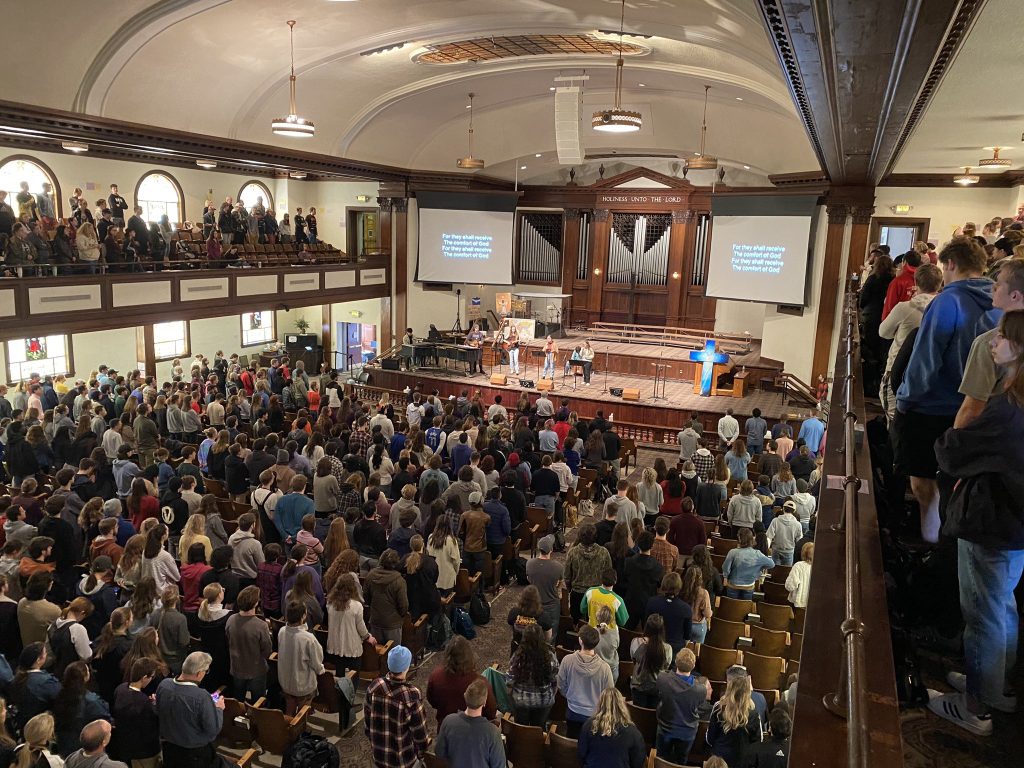
3. In fact, part of the event’s mystery is that, for those who aren’t there, the event didn’t look particularly appealing, at least by worldly standards. Simplicity was the name of the game. Historians have noted how some past revivals had famous preachers, produced music, and dramatic atmospheres meant to heighten the emotional stakes of the event. One pastor noted that the events at Asbury were the complete opposite — not just “low production value” but “no production value.”
Some of us, for example, might imagine a beautiful old stone college chapel, or others a stripped down non-denominational sanctuary with modern AV capabilities. Others might imagine full choirs, others might imagine a light and sound experience. None of this defines the school’s Hughes auditorium, which, with apologies to the Asbury community, is not exactly a shining example of faith and architecture. The music was led by students, usually a piano or guitar, the preaching and leadership stayed on campus. “No celebrities but Jesus” was a rallying cry at the event.
Even the initial sermon that catalyzed the revival was considered lackluster by the preacher himself! Zak Meerkreebs had zero expectation anything would come from the sermon, according to the Free Press. “Meerkreebs told me he was certain that he had ‘totally whiffed’ the sermon, and immediately got off stage and texted his wife, ‘Latest stinker. I’ll be home soon.'”
In the smartphone age, it’s easy to see how this is the case: any hint of celebrity or production automatically cancels the event’s “authenticity,” rendering it insignificant. In the past, a big name like Billy Graham or Charles Finney helped fill the pews. At Asbury, the speakers didn’t even bother to share their last names.
In a recent episode of PZ’s Podcast, our own Paul Zahl recounts a conversation about Asbury that he had with his doctoral advisor, Jürgen Moltmann. The famed German theologian had traveled to Wilmore to give lectures at the seminary next door. When he returned, Paul recounts a brief conversation about the lecture. “What is Asbury?” Paul asked in German, to which Moltmann replied: “Asbury Kentucky is merely a gasoline pump,” a reference to the college’s small town rural campus. Paul’s point in telling the story was not to diminish the seminary and university, but to point out that God uses precisely those things which are unexpected, off the radar, and non-sequitur in life to accomplish his will and purpose. (Just like a guitar solo produced by Joe Meek, of course!)
God uses foolish things to shame the wise, so they say. And this revival broke all the rules about how to start a revival.
4. Just because the revival was simple and unplanned doesn’t mean it was in any way unstructured. Christianity Today offered a unique glimpse behind the scenes of the exhausting logistical measures taken to keep the event going for two weeks. Someone had to clean bathrooms, organize queues, direct traffic, and order the musician rotation. Lots of someones, in fact, over a 24 hour period. Jesus wasn’t the only person to lay down his life for this event to take place, which can either add or detract from the mysticism, depending on your perspective:
By evening the crowd had grown to about 3,000, and the university had to set up overflow rooms. At the same time, an uncoordinated infrastructure of support began to appear. An Asbury student set up a table and started handing out tea and coffee. She said Jesus told her to. A woman in Indianapolis baked chocolate chip cookies for a full day and then drove down to give them away. A professor went and got cases of bottled water.
Pizza appeared, unbidden, along with homemade potato soup, cake, a table of protein bars, and what one volunteer called “all the Chick-fil-A.” Someone volunteered to start organizing housing and put up signs with QR codes that people could scan to start the process of finding a place to sleep.
The article goes on to describe how bad actors tried to invade the event, and how Asbury leaders made sure to hold the microphone so that nobody could wrestle control of it under the guise of a testimony. They even went so far as to turn down visits from major cable news personalities and other religious figures who offered to attend, believing the event would be compromised by any hit of culture war politics. Here’s my favorite part:
Wesleyans … have a long tradition of figuring out how to nurture an outpouring of the Spirit. Once in 1804, the school’s namesake had 20 watchmen carry long peeled rods to protect a camp meeting from frontier ruffians. “The work of God is wonderful,” Asbury wrote another time, when some people showed up to try and take control of a revival in Delaware. “But what a rumpus is raised!”
What a rumpus indeed.
5. Still, one of the hardest takeaways from a big unexpected revival like this is that sin doth persist. Anna Lowe, the student I quoted above, continued to write about the dangers of revival and the challenges that face the campus as the event draws to a close.
Revival is a gift from God. He takes the initiative, which means we must be careful when assigning credit for what is taking place. Across campus, there is already a toxic stigma of “revival shaming.” I’ve heard things such as, “How many hours have you been here? I’ve been here all day. I am sooo exhausted. I even skipped class.” What do you notice in these comments? Jesus is usually not mentioned. We must be careful with self-centered responses based on who is “showing up for Jesus” and who is not. […]
But I have been to many a summer camp in my life, some fully present, others not as much. One concept constantly discussed before, during and after each camp is the idea of a “Jesus high”: an adrenaline rush from lack of sleep, excitement from newfound knowledge and the fulfilling promise of the Holy Spirit.
The most dangerous aspect of this Jesus high is that it wears off.
Once the dust settles, there is exhaustion from lack of adrenaline, agitation from disagreements and overall burnout from the lack of community encouragement. And eventually, I forget everything I learned until I am reminded again in this toxic and tiring cycle.
Yours truly wished he had Ms. Lowe’s wisdom when he was an undergraduate at an evangelically oriented Christian college. The best and only way to understand a Christian revival is to recognize it is a gift, freely given, from a beloved God to undeserving sinners.
6. The moment that revival ceases to be a gift, it becomes a work and a law and an avalanche of judgment and condemnation. If orchestrating a revival is a work of our own, then one might be tempted to suggest those who don’t attend are somehow complicit in the revival falling apart. If revival is something we have crafted, then we will try to replicate it time and again to diminishing returns and exhausted spirits. If God only shows up because we have created the perfect space and the perfect set of circumstances, then anything outside that very limited window becomes suspect and anathema. The songs and ceremonies of the revival become sacrosanct, and we miss the Holy Spirit’s next gift because it looks and feels different than what we expected. But as Ms. Lowe rightly articulates, if revival is a work, we’ll get caught up in a toxic and exhausting search for the next big thing. We’ll become enmeshed with the gift instead of treasuring the gift giver’s love. In this holy instance, the gift is merely temporary, but the love is forever.
In my sophomore year of undergrad, my friend Tim and I set off for a Jesus High road trip. Starting in Richmond Virginia, we drove 14 hours overnight to St. Louis, Missouri for the longstanding Urbana mission conference. After three days there, we jumped back in the car and drove down to Atlanta, Georgia for one of the annual Passion conferences. The Jesus High from that trip was real. World class music, fascinating talks, calls to seek out God in whatever your vocation was going to be. At one of those conferences, I think I may have committed my life to overseas mission work.
But the real encounter with God happened on the way home on I-85 in Durham, North Carolina. I missed the work zone speed limit signs, and a police officer caught me driving 85 in a 55. He had such a thick southern accent that I could barely understand him, and knowing I was potentially on the hook for a reckless driving felony, I was stuttering out of fear. It felt like an eternity as he read me the riot act, asking me if my mother knew I drove so dangerously and demanding to know how I’d return to North Carolina to face the judge. Learning I was returning home from a church conference didn’t help my cause at all — the officer asked me straight up how I could call myself a Christian while I was endangering other drivers. The law was in full accusation mode.
So when the officer let me go without a ticket, I experienced grace in a way that the conferences didn’t offer. It was a Jesus High road trip non-sequitur a note from God outside of my plans, telling me that conferences and revivals won’t be enough. The Christian word for this, historically, is the word “consolation.” A consolation is a gift of comfort from God to get you through the hardships of life until the new heavens and new earth arrive and revivals are obsolete. I don’t remember a single talk or spiritual moment that happened at either conference. But even 15 years later, I can still hear the officer’s thick southern accent as he came to his conclusion: “Alright son, I’ma let chyou go.”
7. So what, then, do we make of the events that have taken place in Asbury? A whole bunch of people are testifying they received a gift of grace and consolation from the Holy Spirit at an impromptu, low-fi revival that got started on a small Christian College campus. Most write-ups on the event noted that students and faculty had been praying for a revival on campus to happen for years, and it seems those prayers are answered. The result has been worldwide attention on a small Kentucky town and a renewed revelation of our age’s disenchantments. Putting aside whether we believe their testimony, who wouldn’t want what they’re experiencing for themselves? Relief, reconciliation, inner healing, inner peace, total trust in God for the needs of life? Lord knows I could use a consolation or two from the stressors of work, parenting, bills, yardwork, housework, and all of life’s other demands.
So maybe, then, since I wasn’t there, it would be good to add revival to my list of prayers as well.
Strays:
- NYC Conference Speaker Sarah Hinlicky Wilson is over at Christian Century exploring grace, hands, and Levitical leprosy.
- Lemorna Ash will send you back to the Bible again with her essay, “Could I Become a Christian In a Year?“
- Three quick doses of humor: “Welcome to the Comfort Zone,” “Man who failed at giving up booze in January about to fail at giving up chocolate for Lent” and the Ringer ranked the top thirty-one fictional bears.
- Reminder: prices go up on Tuesday for #MbirdNYC23 — sign up this weekend for the best early-bird rates!








Wow, what grace. Thanks for this round-up post, Bryan.
So good Bryan
I love this so much. Grace and consolation indeed. Journey on. Thank you.
Gosh, well done, Bryan! This is so edifying (and fascinating) to read.
Best writing on Asbury I’ve read. Thank you!
[…] also on Mbird: A Revival in a Disenchanted Age, Why I Abide in Ministry, Weird, Out-of-Touch, Merciless … and Absolutely Essential, and Granola […]