




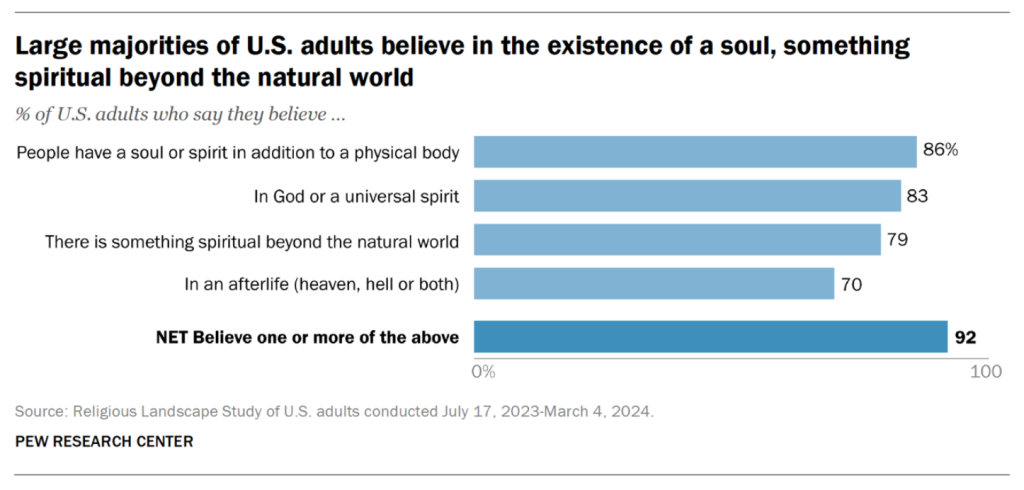
1. This was the week that Pew released its latest Religious Landscape Survey. The last of such studies came out in 2014, making this a major refresher for our understanding American spirituality. For more than ten years now, we’ve made much of the rise of “the nones” — a designation for people with no religious affiliation. This time, as Ruth Graham puts it at the New York Times, “Christianity’s Decline in U.S. Appears to Have Halted.” Christian affiliation is, for now, stable; the rise of the “nones” “has either slowed or stopped completely,” says one political scientist, “and that’s big deal.” Graham unpacks lots of noteworthy tidbits (“The gap in religiosity between men and women is far smaller … Among 18- to 24-year-olds in Pew’s survey, the gender gap is small or nonexistent”); but for our purposes it’s the conclusion that most resonates:
Regardless of how many Americans identify with specific religions — or no religion at all — in the future, the survey depicts a fundamentally spiritual population. More than 80 percent of survey participants believe humans “have a soul or spirit in addition to their physical body,” and believe in God or a universal spirit.
Most paths to religion are highly personal.
Justin Springhart, 32, began attending Orlando Grace Church in Florida, a nondenominational church, a few years ago after having drifted away from religion. When his brother died of a drug overdose, he found he was so closed off from his own emotions that he couldn’t cry at the funeral.
When his personal trainer invited him to a church service, he felt at home as soon as he walked in the door.
“It just felt like this is where I need to be to grow as a man, to grow in Christ, to grow as a leader,” Mr. Springhart said. “As someone who couldn’t cry at his own brother’s funeral, I weep about how much my God loves me.”
I can’t imagine a more personal story than a grieving person being invited to church by his personal trainer. There’s not a pre-packaged doctrinal statement or political argument in sight, except that God is a lover.
2. At present, the epitome of depersonalization might just be AI. In the guise of a social response, what you really get is a bland, inhuman slab of energy-demanding data. A series of unintentionally creepy Apple Intelligence ads want you to know that AI can write a virtuous email for you. Not only can a bot handle your boring missives, but it can also take care of your morally tricky ones, and make you look like a better person. In an excellent critique, Charles Freiberg, says:
We should stop and ask ourselves whether we should even want such a tool. The commercials clearly pose this technological innovation as desirable, and it’s certainly true that exercising restraint and navigating social norms can be difficult. We embrace convenience in virtually every area of our lives — why not workplace decorum? … What happens when we no longer need to take a step back and practice the skills of navigating social relationships with wisdom and grace?
Automating a tedious task and eliminating your co-workers’ rude emails with artificial intelligence may appear desirable, but it may also automate an important opportunity for cultivating virtue — especially for those who spend much of their time writing emails. Automation is not free; it may come with the loss of our own abilities to navigate social graces.
Freiberg is pointing toward an under-acknowledged problem with AI: not that it will overthrow the government (though given this week’s toe situation, one wonders) but that it is claiming imaginative and moral capacities. There is an urgent conversation to be had about what happens when people outsource the responsibility to speak their own words, but I don’t have the wherewithal to start it here. Maybe copilot can help me …
For some humor on the topic, here’s an ode to the typo: “Now that that clown ChatGPT is feeding a constant stream of slop to the internet, maybe you can appreciate what I’ve always known — that grammatically perfect writing that is devoid of voice sucks ass.”
3. I enjoyed
This situation is, in some sense, our fault, as the whole system runs on our own choices. But those choices don’t always feel free. Hayes distinguishes between voluntary and compelled attention. Some things we focus on by choice; others, because of our psychological hardwiring, we find hard to ignore. Digital tools let online platforms harness the latter, addressing our involuntary impulses rather than our higher-order desires. The algorithms deliver what we want but not, as the late philosopher Harry Frankfurt put it, “what we want to want.”
Getting what we want, not what we want to want: it could be the slogan of our times. Hayes notes that it’s not only corporations that home in on our baser instincts. Since social-media users also have access to immediate feedback, they learn what draws eyeballs, too. Years ago, Donald Trump, Elon Musk, and Kanye West had hardly anything in common. Now their pursuit of publicity has morphed them into versions of the same persona — the attention troll. And, despite ourselves, we can’t look away.
To want what we do not want: The. Slogan. Of. Our. Times! But also, of all times. Such a slogan is really only earth shattering in a society built upon the presumption that ordinary people exercise an intelligent reasonableness in life’s most crucial moments. (Which is incidentally the same kind of society that does super well with AI.) As far attention goes,
… distraction is relative: to be distracted from one thing is to attend to another. And any argument that people are becoming distracted must deal with the plain fact that many spend hours staring intently at their screens. What is doomscrolling if not avid reading? If people are failing to focus in some places, they’re clearly succeeding in others.
Could it be that people aren’t paying attention less, they’re just paying attention differently? Immerwahr cautions against “élitism” when instructing people on what’s worthy of their attention, which, fair. (“Consider what the attentionistas want people to focus on…generally, it’s fine art, old books, or untrammeled nature — as if they were running a Connecticut boarding school.”) Nevertheless most of what we’re paying attention to isn’t worthy of our attention! And we are being compelled to engage with it. But if we’re paying attention to drivel, it might only be because we’ve been enabled to do exactly what we want.
4. At least there’s lots of good humor this week! A funny (and mysterious!) news story appeared in the Wall Street Journal about a school principal accused of making off with someone’s $25 Amazon gift card in her “sticky fingers,” an accusation which has prompted a public hearing with more than 1,400 pages of testimonies and costing (so far) $24,800. Podcast coming soon, surely.
Also, Heather Havrilesky wrote about living in the shadow of a perfect hipster goddess. Very good for a laugh.
Two links from the site Points in Case: “Things I Found on My Solo Trip in Lieu of ‘Myself’” and (this one hits too close to home), “Miss You Man! Wanna Grab a Drink Sometime in the Next 30 Years?” From the Hard Times: “Overworked Emotional Support Dog Now Requires Its Own Smaller Emotional Support Dog.”
Going biblical, try “Scholars Say Thorn in Paul’s Flesh May Have Been Neighbor’s Leaf Blower.”
5. Literary-wise, here is an exceptional piece by Langdon Hammer about Elizabeth Bishop’s relationship to the religion of her upbringing. It’s a study on the effects of religious condemnation and earnest attempts to seek better alternatives away from the church. All this is reflected through her poem “Over 2,000 Illustrations and a Complete Concordance” and a family Bible. Toward the end of the poem, Hammer interprets:
… worldliness is no consolation for the emptiness Bishop has discovered. She turns back to the Bible at the end of the poem as if it might be possible really to go home again and start over. Following the steps of an improvised spiritual exercise in which the activity is merely seeing, rather than prayer, she gives herself instructions: “Open the book. (The gilt rubs off the edges/of the pages and pollinates the fingertips.)/Open the heavy book.” That gilt rubbing off the book and pollinating her fingers — it’s a beautiful image. The homophone implies that to touch the book is to become guilty. Yes, to be born into a Baptist family can be punishing. Even living as Bishop does outside the family and the church, unbelieving, it is possible to feel guilt; in fact, living this way, it is very hard not to feel guilt. But pollination is generative, and the way the heavy book stains her skin is tender and magical, an anointing, giving her golden fingertips. By implication, she will pass that bit of glitter on to whatever she touches — or writes about — next.
What Bishop sees when she opens the book is hard to define. As Ashbery remarked in 1969, the conclusion of “Over 2,000 Illustrations” is “undescribable and a continuing joy, and one returns to it again and again, ravished but unsatisfied.” “Ravished but unsatisfied”: reading the poem over and over seems to have produced in Ashbery the same experience of seeing that it describes. In 1997, he read “Over 2,000 Illustrations” as his contribution to a group reading of poems in New York City. When he reached the last stanza, Ashbery, not normally a sentimental man, in public anyway, began to cry.
Why couldn’t we have seen
this old Nativity while we were at it?
—the dark ajar, the rocks breaking with light,
an undisturbed, unbreathing flame,
colorless, sparkless, freely fed on straw,
and, lulled within, a family with pets,
—and looked and looked our infant sight away.
6. Reviewing Vincenzo Latronico’s new novel Perfection, philosopher Agnes Callard ruminates about the perils of perfection: “Millennials,” she says, “are stuck in the paradox of utopia, living lives so good that they’re bad.” She proposes a thought experiment: does anyone really want to live in the clean quiet of a perfect world? If not, how much imperfection is needed to make life acceptable and interesting?
This is the paradox of utopia: why strive for social progress if the endpoint of those efforts is a hollow and sterile world bereft of meaning or purpose? Why do we work so hard to solve problems we would prefer remain unsolved? […]
A cadre of humans thrown into a wilderness will be forced to stick together for warmth and security, but, given the resources to move into giant mansions where each family member has their own wing, they will. You can blame this on capitalism, but only in the sense that capitalism makes us rich, and wealth supercharges our power of artificing.
Another anthropological study about what we actually want, and what our species actually is. Toward the end of the piece, Callard introduces what (to me) was a new term: “the normative picture.”
Usually, the quality of a picture — be it a drawing, or a photograph, or a painting — lies, at least in part, in its ability to accurately capture an independently existing reality. A normative picture is, by contrast, a picture that tells you what reality is supposed to look like. Reality succeeds if it matches the picture, rather than vice versa. Social media is filled with normative pictures, and [hypothetical Millennials] spend their lives, first, producing such pictures, both on behalf of their work clients, and so as to populate their own Instagram accounts, and, second, consuming them, which is to say, wrangling their lives so as to make them match the aforementioned pictures. The normative picture tells you that you have not quite arrived at utopia, because this — this image of two glasses of Campari on a table overlooking a vineyard backlit by the sunset, “laptops usually somewhere in the frame to prove they weren’t on holiday” — is what utopia looks like. The normative picture reassures you that perfection still has to be struggled for, that there is still work to do, which means that complete happiness could, in fact, be yours, if only you could close that last little gap.
7. Continuing on the philosophy/literature train, here is a thorough look at philosopher Roger Scruton’s views on religion, especially in relation to art. Scruton’s biographer Mark Dooley argues that “while art may offer us “intimations” of the sacred, only religion can reconcile us to it”:
The consolations of art and culture are real and essential to human flourishing. They may even bring you to that exalted state that Scruton describes when he writes: “Sometimes, listening to a Bach fugue, a late quartet of Beethoven, or one of those infinitely spacious themes of Bruckner, I have the thought that this very movement which I hear might have been made known to me in a single instant.” Such moments are, he says, “precious to us. When they occur it is as though, on the winding ill-lit stairway of our life, we suddenly come across a window, through which we catch sight of another and brighter world — a world to which we belong but which we cannot enter.” And yet, in so many ways, Roger lived, not only as if he had caught sight of that other and brighter world, but as though he had indeed entered and made it his own, if not his home.
Re: the closeness between art and religion, I stumbled on this interview with Maggie Rogers and hadn’t realized she’d been to divinity school. Less surprisingly, she says that people flocked to her as a spiritual guide once she became a successful musician.
8. Lastly, I was quite moved by this personal story “Singing Myself Back to Life” by Susan H. Swetnam. She recounts how, following the death of her husband, spells of depression left her feeling an insurmountably different from her parish, and the way singing in the choir brought a sense of literal and figurative harmony to the scene:
I still admit to being skeptical about whether that kind of “harmony” is possible. We’re so divided, so suspicious, so sure of the righteousness of our own melodies. Yet I cannot help but take comfort from my personal history. Who am I to doubt? Once so wounded, so quick to take offense, so estranged — I was drawn back in, by the grace of the Holy Spirit, to join the communal song.
And so I dare to pray that the synodal process might in truth “gather us from among the nations,” in the words of Psalm 96, that all our voices may find concord as they sing the praises of the God we share.
Strays:
- The Atlantic homepage pulled up C. S. Lewis from their Archives. Here’s The Efficacy of Prayer from 1959.
- The Pearl of Great Price: Man wants to search dump for lost hard drive with bitcoin fortune – here are his odds of finding it.
- The science of gifts.





[…] That is, if you believe in Him. As it seems many of us do. As noted earlier this year, Christianity is not [currently] declining in America. At the New York Times, journalist Lauren […]