




1. Raise your hand if you’re feeling acute Internet fatigue! I know I am, and we’re not yet to February. Over-online-ism is not an easy affliction to alleviate short of total “appstinence,” but since you’re here already, allow me to share the most effective medicine I came across this week, the brilliant essay by Barrett Swanson, “High and Dry,” published in Harpers. Yes it’s long, but it’s also hilarious and diagnostic and full of colorful characters. Also abounding in compassion and just so well written. I’d say a break from hot takes (that will be vapor by this time next week) is more than called for, wouldn’t you?
The essay details Swanson’s trip to the Bonnaroo music festival in Tennessee as a person twelve years sober. Bonnaroo, as you may recall, has become something of an East Coast Burning Man, albeit with more jam bands and less tech wizards. Imagine a makeshift city in a field, built with the sole purpose of hosting a week-long tie-dyed extravaganza of good vibes and bad dancing. The city has different sections and sub-populations, its own economy and norms (Thou Shalt Radiate Positivity, for instance), but is basically a Dionysian fête.
Swanson was there to spend time with the Soberoovians, a ragtag group of recovery-focused attendees who set up tents and hold twelve step meetings right in the middle of the epicurean goings-on. Like this guy:

Excerpting the thing feels a bit criminal, but I suspect your attention span is under as much stress as mine at present, so here are a few tastes of why we might highlight this on Mockingbird:
It may well be that our endless sacraments of self-care and communal transformation are nothing more than the symptoms of a deeply noxious culture, one that is desperately trying to heal itself through the ablutions of mass catharsis. Of course, I did not have much hope that Bonnaroo would offer spiritual nourishment in the Ehrenreichian sense, but I was curious about the Soberoovians, who seemed to occupy a curious place at the festival and appeared to commit their lives to a different set of values. Their sobriety felt less like escapism than it did a perceptual advantage, and in the end, it turned out that they alone could properly diagnose us.
Transcendence, in the end, is not the festival’s ambition. Instead, it is to profit off a national attitude of paralytic disenchantment, an accretive, widespread feeling that late-capitalist life in this country is vacuous and without meaning, and that for reasons that pass understanding we have all come gradually to believe that our ultimate spiritual undertaking is not the cultivation of personal integrity or a system of other-directed ethics but the attainment of weekend frivolities and a glitzy, remunerative profession. It is a tacit but profound sadness — a national epidemic — one you can see in all the intoxicated faces that are roaming around this campus. It is a humiliation of consciousness in which we see ourselves as nothing more than a herd of citizen-consumers, as the poet Virginia Konchan has called us, instead of taking ourselves to be the possible children of God […]
If nothing else, this week has furnished me with fresh evidence of all the variegated ways in which we are suffering at this moment. And yet while most of us have chosen lives of evasion, it’s the Soberoovians to whom I look for spiritual instruction, because right now, in front of me, they are somehow still here and still defiantly alive, despite having endured what Chekhov once called the long, long days and the long, long nights. They have learned to make a heaven out of Hades, not through positive attitudes or craven intoxication, not through good spirits, but through the daily un-fun spadework of other-directed commitment.
2. Not gonna lie: reading the entirety of Swanson’s essay was tougher than I’d like to admit. I’m not talking about the content, which was ceaselessly absorbing, but the form. Taking in an entire extended essay in one swoop feels almost transgressive at this point, kind of like the graduate level version of watching a movie without your phone. I’m so glad I did! But I’m also aware that I used to do such things all the time. Or at least, I didn’t mark them as accomplishments in the same way. Cue Chris Hayes’ piece in the Atlantic on how “You’re Being Alienated From Your Own Attention.” Come for the dispiriting but undeniably accurate assessment of modern life, stay for the novel description of how the law condemns us all. In this case, as the difference between what we know we should pay attention to versus what we actually do pay attention to.
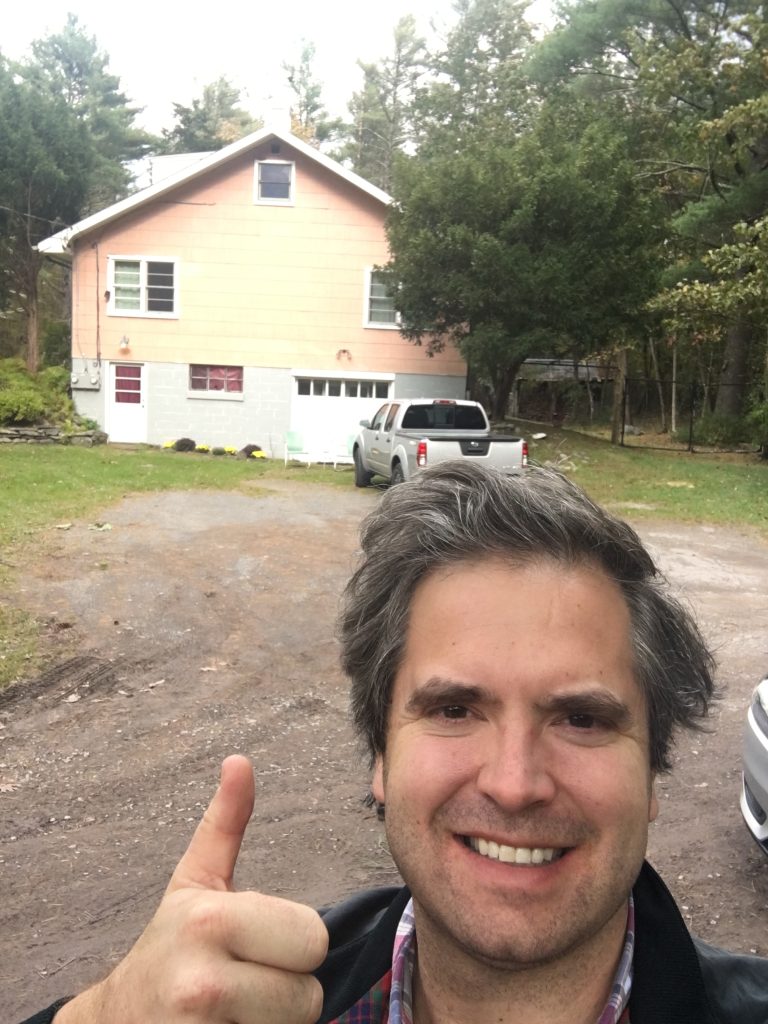
Big Pink in 2018 (see item 5)
Attention is a kind of resource: It has value, and if you can seize it, you seize that value. This has been true for a very long time. Charismatic leaders and demagogues, showmen, preachers, great salespeople, marketers, advertisers, and holy men and women who rallied disciples have all used the power of attention to accrue wealth and power. What has changed is attention’s relative importance. Those who successfully extract it command fortunes, win elections, and topple regimes. The battle to control what we pay attention to at any given instant structures our inner life—who and what we listen to, how and when we are present to those we love—and our collective public lives: which pressing matters of social concern are debated and legislated, which are neglected; which deaths are loudly mourned, which are quietly forgotten. Every single aspect of human life across the broadest categories of human organization is being reoriented around the pursuit of attention. It is now the defining resource of our age.
Attention now exists as a commodity in the same way labor did in the early years of industrial capitalism. What had previously been regarded as human effort was converted into a commodity with a price.
Attention is the stuff of consciousness itself, where we choose to place our mind’s focus at any given moment. And yet it can always be wrenched from us seemingly against our will by the wail of the siren, the bark of a dog, or the flash of a prurient image on our phone. The more competitive an attention market it is, the more it will select for involuntary methods of capturing attention. Think of Times Square with its blinding lights, or a supermarket checkout counter. More and more, our entire lives have come to resemble those spaces.
Public discourse is now a war of all against all for attention. Commerce is a war for attention. Social life is a war for attention. Parenting is a war for attention. And we are all feeling battle weary … You hear complaints about the gap between what we want to pay attention to and what we end up paying attention to all the time in the attention age.
3. The Hard Times satirized the trend Hayes identifies with its “How I Stopped My Addictive Cigarette Habit by Spending 18 Hours a Day on Instagram.” Elsewhere in humor, Reductress made me laugh with “What a Waste! This Woman Is on a Long Train Ride but Her Life’s Pretty Good Right Now.” But McSweeneys had the top pick with “A Marriage Proposal Spoken Entirely in Office Jargon.”
4. One of the cultural artifacts that’s commanded my attention this week (other than the, er, Commanders!) is the second season of Severance on Apple TV. I’ve only watched the premiere thus far but thought Eric Schwitzgebel’s observations on “‘Severance,’ ‘The Substance’ and Our Increasingly Splintered Selves” in the NY Times to be trenchant, especially in light of the divided attention Hayes described above:
It’s a striking coincidence that two much talked-about current works of popular culture — the Apple TV+ series “Severance” and the film “The Substance,” starring Demi Moore — both explore the bewildering emotional and philosophical complications of cleaving a second, separate entity off of yourself. What is the relationship between the resulting consciousnesses? What, if anything, do they owe each other? And to what degree is what we think of as our own identity, our self, just a compromise — and an unstable one, at that?
… increasingly, we choose to splinter ourselves. The person you present on Instagram or Facebook is wittier, prettier, more accomplished than the person your spouse or roommate knows. Your 500 “friends” never see your pre-coffee-uncombed-depressed-in-bed self (unless sharing that self is your social media personality — in which case that becomes the curated, theatrical fragment of you). In the 1800s, Karl Marx talked about the alienation of labor; today people talk about not “bringing their whole self” to work. Many of us strive to be one person here, another person there, another person there.
People have always presented themselves differently in different social contexts. But social media, Zoom, photo-editing software and responses filtered through large language models raise our fragmentation to new heights. “Severance” and “The Substance” amplify these fissures through radical new technologies that irreconcilably divide the characters’ home selves from their career selves… Today they read as dystopic science fiction. Too soon, we may remember them as prophetic.
5. Speaking of prophets, this week I’m mourning the death of Garth Hudson, the last surviving member of The Band and the only person I know of to successfully make the transition from Anglican organist to rock legend. Alan Jacobs posted a touching tribute to soft-spoken Garth over on The Homebound Symphony. And I defy you not be moved by the man piecing together a version of “That Old Rugged Cross” last year in the eldercare facility in which he was living:
6. Next up, a contrarian essay on Aeon, “Psychodynamic Nonsense,” in which therapist Niklas Serning parses how abandoning aspects of psychodynamic theory has made him a better therapist. What apparently changed his mind was the overwhelming evidence of nature’s power over nurture. According the science he cites, DNA trumps family-of-origin-stuff pretty much all of the time, despite what Serning was taught in his psychology seminars. That said, his journey sounds less like a journey away from psychotherapy and more like a journey into, well, pastoral care. The final paragraph has particular Mocking-resonance:
Two decades into my career, I … increasingly reject everything that I learned. Instead, I practise the art of ‘being for another’, an idea that arose in conversation with my colleague Sophie de Vieuxpont. I’m a mentor, a friend in an asymmetrical friendship, and a sounding board and critical ally assisting people as they go through the complexities, absurdities, devastations and joys of life. Along the way, over years of practise, I lost faith that awareness was always curative, that resolving childhood trauma would liberate us all, that truly feeling the feelings would allow them to dissipate…
Isn’t it a bit arrogant that so many in the West assume that this new, unevidenced theory – that suffering stems from childhood – should be universally true, or even true for us? How does the psychodynamic therapist, faced with their suffering client, feel resolute that they should dredge up the past, when philosophical traditions from across the world say the answer lies in the here and now? The Buddha, Lao Tzu, Aristotle and Jesus didn’t mention a word about childhood’s irreversible stain on the human condition – they saw us as individuals living through choices in the now […]
If we were all doing brilliantly now, and if all the therapies that we pay so much money for worked as well as they claim to, maybe we could feel more confident in dismissing all of that. But they’re not, and surveys of happiness indicate that many Western women – therapists’ main customer demographic – aren’t doing brilliantly either […]
I believe that the true therapeutic work is to battle resentment. Resentment is the core of all my ills, the pain itself isn’t. Resentment arises when we are in pain but believe that we are entitled to not feel pain. This is complicated to engage in, especially since it borders on rights and politics. If I feel that I have the right to publish this article in The New York Times or have the right not to be offended by critical reviews of it, then the pain of being rejected by The NYT and reading vicious takedowns of my sage wisdom will be infinitely multiplied. My entitlement will make my basic pain so much worse. I also believe that forgiveness and gratitude are the greatest allies that we have to battle entitlement and resentment.
7. Writing in the Wall Street Journal, Alison Wood Brooks gives a name to an all-too-common mode of non-listening, AKA anti-therapy, AKA thinly disguised ego-centrism. “Boomerasking” is when you pose a question that you’d like to answer yourself. Guilty as charged:
Like the looping arc of a boomerang, boomeraskers ask a question, let their counterpart answer and then immediately bring the focus of the conversation back to themselves. They try to achieve two conflicting goals at once: to show interest in their partner and to disclose something about themselves. But they fall short of achieving either goal […]
Asking sincere questions, listening to others’ answers and following up on those answers may be the easiest and most powerful pathway to shared understanding and interpersonal connection. Boomerasking ruins the magic. Failing to follow up on your partner’s answer, and answering the question yourself instead, makes others feel like you don’t care about them—and probably didn’t care about them when you asked the question to begin with.
8. We’ll end on an uplifting note with one from our friend Chad Bird, “The Dumpster Sermon” on 1517. Chad recounts how, during his years as a truck driver, he once encountered a couple rifling through a dumpster behind a convenience store where he was parked. The lady introduced herself and asked if he might be able to help them get something to eat. Chad buys them a pair of sandwiches and is then thunderstruck as the man, who had just emerged from the dumpster itself, expresses his gratitude for the way God always seems to provide for them. “Jesus been good to us that way,” are the words that come out of his mouth. It’s not unlike some of the Soberoovian utterances Barrett Swanson relates in the lead-off item. Chad continues:
Every time I think of that dumpster sermon, I remind myself that wisdom lurks in the outer places. Rich gratitude sprouts from the impoverished and forgotten … In low places profound faith flourishes. And from those low places resounds the voice of God from the lips of his people.
Thank God for people who have never read a word of Martin Luther or John Calvin, who assume the Diet of Worms is an eccentric weight loss plan, but whose lives are inked through and through with the theology of the cross. They drive tractors, flip burgers, shingle roofs, and, yes, dig through dumpsters.
The same God who had nowhere to lay his head sleeps with them under interstate bridges. The same God who was blackballed by the religious highbrows of his day sits and mourns with those who have been broken by the church. The same God who died between two crooks hangs out with cons and ex-cons today … He is a God of surprises, whose ways shock us into expanding our horizons. The laborers in his vineyard may wear suits and ties, boots and jeans, or leather and tats. But they are all his laborers. Or more precisely, his children.
God’s family is full of the prim and proper as well as the down and out. Always has been, always will be. For our Father’s family is founded on the grace of God in Jesus Christ, not our goodness.
Speaking of God’s family, here’s a brand new video about mine, Christ Episcopal in Charlottesville, where Mbird is headquartered. I’m so proud to call this place home and especially grateful for the articulation of the church’s purpose in the final minute:
Strays
- Friend and nutritionist Courtney Bascom has started a wonderful newsletter about Grace and Food which I highly recommend, especially for anyone interested in Intuitive Eating and its relation to our favorite subject. Sign up here.
- Greatly enjoyed Richard Beck’s series on Theological Worlds
- Fans of melancholy Scottish power-pop rejoice! Salvation is coming and here is its prayer:





David, such treasures this week, thank you!
[…] Resource. On this site we’ve gotten good mileage out of Hayes’ recent writing (see here, here, and the Mockingcast) about how the market/economy (and consequently life) revolves around […]