




It was the start of freshman year of High School, and the pecking order hadn’t been established yet. Tim was bigger than the rest of us, already practicing with the basketball team and making friends with upperclassmen, so he had a bit of a head start. Tim came at me between classes in one of those early days — loud voice, belittling tone, looking to put me down so he could lift himself up. Classic athlete bullying behavior. But this was a gifted high school program, and so jock bullying wasn’t taken laying down. The next day, I made a fake profile of him in the computer lab, and during the middle of English class, the fake profile asked our teacher out on a date. The message “Dear Mrs. Plumb — Will you go out with me? Love Tim” popped up on the teacher’s projected screen for everyone to see. Mrs. Plumb, who was not very tech savvy, read every word out loud, bemused and confused. “That’s not me!” Tim panicked, his face turning as red as his hair as the class laughed. That’s right Tim. There will be none of that jock bullying here. The nerds run this high school.
As much as the cult movie Revenge of the Nerds provided a generation with anti-bully schadenfreude, I’m not sure the 1984 film could be made today. Put aside the sexist and racist jokes that were offensive long before #MeToo and #BlackLivesMatter: The real reason that Revenge of the Nerds can’t be made in 2022 is because, in the great 80’s culture war between jocks and nerds, the nerds won.
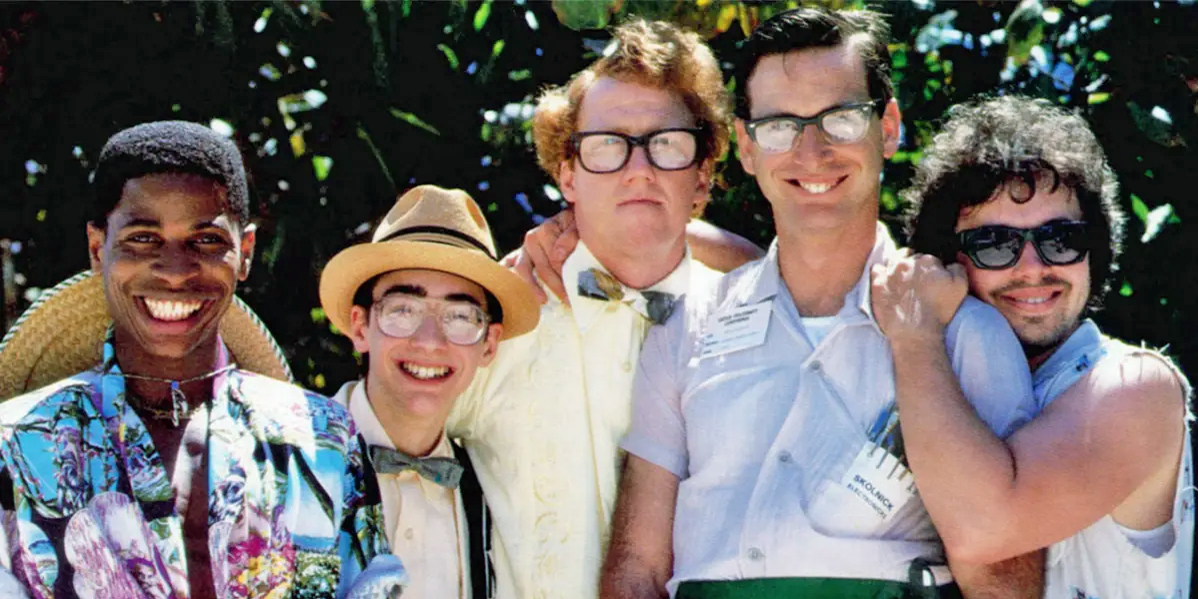
Once tech wizards like Steve Jobs and Steve Wozniak and Bill Gates made their millions and billions in the tech world, it was all over for the jocks. Sure, the great 90’s athletes like Michael Jordan and Ken Griffy Jr. had their fame, but all those computer wiz kids written off as geeks by pop culture were suddenly making good money as young adults. While record-setting athletes were being booed out of their profession for steroid use, the humble nerds of the world offered online shopping, crowd sourced encyclopedias, and the ability to instant message your distant family and friends.
One might think that the world is a better place now that the nerds are in charge. The jocks built a world with a rigid social structure — the athletic and beautiful ran the show. That social structure is falling apart. Beauty and brawn are out — smarts and skill are in. It’s done wonders for our pop culture — we have Stranger Things and Game of Thrones and two additional Star Wars trilogies, which is nice. Smartphones and the internet are pretty cool too. It was the nerds that gave us two-day shipping and the technology to work-from-home during the pandemic. Athletes can entertain us, but they’re not reusing rocket boosters to make space travel economical.
Still, in the great jock/nerd power dynamic flip, there are plenty of problems that assault our social fabric. To the surprise of many, our nerd rulers seem just as prone to bullying, sexism, and harassment as the jocks once were.
Take, for example, the increasing awareness of toxic fanbases. There’s the well-publicized racism against actors of color in the new Star Wars franchises, and the anger surrounding black elves in the new Lord of the Rings series is just as gauche. Growing up in school, we were taught about the perils of segregation in sports. Recall, for example, Negro League baseball and how Jackie Robinson broke the baseball color barrier by joining the Dodgers roster. Jocks could be racist, we knew that. But racism and Star Wars? What in the Billy Dee Williams is going on here?
We could also look at nerd culture’s relationship with sex too. In Revenge of the Nerds, the “good guy” nerds take an illicit photo of the fraternity president’s girlfriend, and use it to win the campus’s pie selling contest. As underdogs in the 80’s, we might have let that gag slide. Nowadays, we all recognize this as a grave tragedy. See also the rise of incel culture and the violence and misogyny it breeds. And when the billionaires like Elon Musk can’t find love, Jeff Bezos has a high profile divorce, and Bill Gates has his own infidelities publicly exposed, it’s evidence that the cheerleaders aren’t flocking to their brains in opposition to the brawn of the jocks.
One major lightning rod for this kind of nerd bullying resentment is Marvel’s new offering She-Hulk. [spoilers ahead] The protagonist of the show is, in many ways, the antithesis of a nerd. A young, spunky, attractive lawyer in Los Angeles happens upon Hulk powers, and it complicates her dreams for a #girlboss career and tanks her anemic dating life.
After the series premiere, toxic bloggers came out of the woodwork to pan the show, complaining how it deviated from the comics and made light of respected hero tropes. From day one, however, the writers of the show anticipated toxic fan hate, and made the decision to confront it head on.
The show’s big twist is that the supervillains in the show are plot fodder: the real bad guys in She-Hulk are the toxic fans. The bad guys pulling the strings behind the scenes are Marvel’s equivalent of misogynistic redditors and 4-Chan users, weak men who are resentful of She-Hulk’s professional and heroic successes. In fact, most of the nerdy men in the show are viewed in a bad light. Self-indulgent Tinder matches, sexist co-workers, online haters, and detached bosses make Jennifer Walters’s life that much harder. Even Bruce Banner (Jennifer’s uncle cousin and the original Hulk) struggles to understand how his niece can control her Hulk powers, a sly bit of subterranean sexism that betrays a belief that women can’t control their emotions.
The series goes so far as to even invert the traditional Marvel movie final act super-fight-spectacle that wraps up every loose plot string. Instead of smashing the nerd villains, She-Hulk breaks the fourth wall and demands the show’s writers give her the ending she wants, not the ending that the Marvel nerds are expecting. In many ways She-Hulk is the inverse of Revenge of the Nerds — the smart, strong, beautiful, professional woman is the hero in control, and the nerd men are the baddest of the bad guys who can’t get what they want.
It’s gotten to the point that sociologists have started to investigate this trend. In 2015, a group of researchers attended DragonCon in Atlanta, a well known fandom and gaming convention that draws tens of thousands of attendees each year. After surveying a few thousand attendees, the researchers found evidence that the more a person engaged with “geek culture,” the more likely they were to have a narcissistic personality. Moreover, those who identified as “geeks” were more likely to have depression and a “neurotic” personality, characterized by an inability to cope with stress and difficulty controlling emotions.
That’s not to suggest that “geeks” are abnormal to the human condition: Lord knows we all have our own problems with depression and self-centeredness and neuroticism. Instead, I think it goes to show that the new boss is the same as the old boss. Jocks and geeks together are fallen creatures, with a set of problems and struggles that overlap in sobering ways. Our hope can’t be placed in the “changing of the guard” as they say. Nerds can be narcissists too. Geeks can be bullies, just like I was to Tim back in freshman year.
In fact, it’s not too glib to say that Jesus himself had to deal with his own toxic fans. It turns out many of them didn’t like the whole death-and-resurrection storyline he was working on during his earthly ministry. One of Jesus’s super-fans, who was so enamored by Jesus that he left his job to follow him, pulled Jesus aside to quietly correct him about the direction his ministry was going. “Hey, Jesus,” one imagines Peter saying in Mark 8, “I don’t know if you know the source material all that well. According to the prophets, the messiah isn’t supposed to die and rise again, he’s supposed to kick out the Romans, or conquer the world, or at the very least, usurp Herod and become the real king of the people. That’s what the people are expecting. Ditch this whole die-and-rise-again bit and give the people what they want.” In a very She-Hulk, fourth-wall-breaking kind of way, Jesus publicly and unceremoniously rebukes Peter, calling him Satan and in no uncertain terms letting him know that God is the writer. The fans are going to have to take it or leave it.
And so, since neither nerd or jock, nor disciple for that matter, can control providence, we all try to control each other. Whoever happens to be at the top of the cultural pyramid at any moment will inevitably lord it over the rest. Racist and sexist nerds are another example of why we all need to lower our anthropology. None are righteous, and the sooner we acknowledge that reality, the more we can enjoy the stories that others write for us.








Love this piece! I loved the show! But, urm, I’m going to be that toxic fan by saying Bruce Banner and Jennifer Walters are cousins, not uncle and niece. Sorryyy!
(An aside: Bill Bixby, the original Hulk actor from the ’70s, went to my high school in San Francisco — he’s a lot older though)
Good article and I appreciate the broad point. However, there is a counter argument that big multi-million dollar companies are commandeering much loved stories and characters and creating a narrative whereby anyone who dislikes the ‘product’ is a troll. Racism should rightfully be called out but I’m not sure that Disney are on the side of the angels here. If anyone is at the top of the cultural pyramid I don’t think its someone who is heartbroken because Kathleen Kennedy ruined Star Wars.
Fixed! Thanks for the correction (and the kind words!).
Aaron, I think you’ve put your finger on something real here, too. Yes, there might be randos out there decrying “black elves” in ROP, but to use those as a smokescreen to quash any critique is pretty cynical (that’s not what Bryan’s doing here, but as you say, the studios engage in it with abandon). The real critique lies in the complete garbling of the source material into a mishmash of nonsensical plot points and absurd character development. It’s not “toxic” to wish that the producers had actually, y’know, read Tolkein before making the show.
To Bryan’s larger point, though: I think there’s no doubt that the nerds won the ’80s culture war and that they are as human, vulnerable, and prone to sin as anyone. Hopefully that will make us suspicious of present-day narratives that require moral purity for the ‘underdogs’ as a precondition for supporting them. This doesn’t mean that particular injustices can’t or shouldn’t be called out. It just means that the church’s gift is to remind us that, in the full accounting of it all, we have *all* sinned and fallen short of the glory of God, and thus stand in need of God’s grace: women and men, nerds and jocks, gays and straights, Republicans and Democrats, etc. etc.
@Aaron – I totally agree with your point. I think the sequel Star Wars trilogy and Book of Boba Fett are tragedies, and it has nothing to do with the race or sex of the actors. And I bet some toxic fans are just Russian disinformation trolls in disguise trying to ruin the digital social fabric. Bad actors are all around here, from fans and studios deflecting honest criticism. The hermeneutic of suspicion here is somewhat justifiable, but I guess I’ve run into enough of the toxic fans in my world that I thought the topic deserved some merit. Not all criticism comes from a defect of character, but some of it does!
[…] On this front, cheering for a perennially bad sports team is a bit like being a Christian who goes to church, whose failures over the course of millennia are plain to see. Fairweather fans are fine for a season, but the line between church fandom and toxic fandom is a thin one. Even for his most devoted followers, God will be a disappoint at some point. Just ask St. Peter. […]
The problem with the fact that the nerds won is that the jocks never pretended that they were going to save the world. The nerds think they will. (Call it “superhero thinking”) Yet, as it stands, that nerd hubris may very well be hurting more than helping.
@Pierre
You’re absolutely right in that the toxicity here isn’t the fanbases but the people who get their hands on a treasured IP and feel compelled to deconstruct it to serve whatever agenda(s) they bring to the lore. In doing so, they poison the oasis, then they move onto the next IP that want to deconstruct, leaving a wake of destruction wherever they go.
The most telling part of this is that they can’t seem to make anything from scratch; they can only go into existing properties with a winning track record and mess with them. Sorry, but the fans are right in most cases. Please, please stop maliciously tinkering with our youthful memories to serve an agenda the original creators would never have endorsed.