




Every morning I work out to forestall the degradation of my 68-year-old-body. I often pass the hours by watching cable television as I use various machines in our barn. In forestalling death in those early morning hours, I may just be encountering heaven at the same time.
The Andy Griffith Show premiered on television in 1960, when there were just three broadcast stations. Based on Griffith’s memories of his hometown, Mount Airy, North Carolina, the show is both a time capsule and a projection of the fantasies of the day. The show centered around a central character, Sheriff Andy Taylor, an almost pastoral presence in the town comprised of clueless, hairbrained, but ultimately loving cohorts. Sheriff Taylor’s life centers on his son, Opie, whose mother previously died, perhaps during his childhood.
Television shows offer up mirrors that reflect what we want to see. Griffith’s audience was The Greatest Generation — my parents. 1962 was the high-water mark of the Greatest Generation, creating a place of stability and comfort in the years following the terrors of the Great Depression and World War Two. By 1962, decades of struggle were in the rearview mirror, and the beginnings of future upheaval were unpredicted. The nostalgia for a time beyond the present is somehow perfectly presented in black and white.
Consequently, the town of the show portrays a world many today would find absurdly stilted, if not repugnant. Everyone has a job and there is next to zero ethnic, religious, or financial diversity in the town. It is a rural town where women, men, and children are fully stereotyped and completely scripted. There are two types of love: “married” and “courting” romance between men and women: each following two roles: “homemaker” (unless you are a teacher or a nurse) and “breadwinner.”
But despite these retrospective grotesqueries, there is something transcendent that shines through, especially now.
Serious human troubles — domestic abuse, alcoholism, lying, vainglory, even theft and criminality — arise in nearly every show. Each problem is isolated to a single episode’s tight script. By the end, every foible and mistake of the residents of Mayberry find perfect resolution, an Edenic harmony restored once again.
In one episode, Otis, the “town drunk,” buys a car — and without today’s drunk driving laws and moralities, Andy finds a way to dissuade the car’s use, while accepting Otis’ drinking — despite the fact that it’s a dry county. By contrast, Andy’s overzealous deputy (Barney Fife, played by Don Knotts) tries (unsuccessfully) to use sleep-suggestion to end Otis’ drinking. Throughout nearly the entire series, Otis would show up every Friday night “with a snoot-full,” unlock his cell, fall asleep, wake up the next morning, and let himself out.
A married couple in town never stops fighting, to the point they come into the Sheriff’s Office yelling at each other — “She threw a chicken at me!” (clearly before PETA) — and Andy threatens throwing them in jail. That threat leverages Andy’s effort at forcing them to feign politeness. It is an untenable peace between the continuously brawling couple, so labored and debilitating that Andy accepts that the forced truce must be replaced by honestly expressed anger — codependent dissonance.
Whether it is public, unapologetic drunkenness, loud marital dysfunction, or any other human failing, Sheriff Andy Taylor accepts the faults of Mayberry while simultaneously seeing beyond them to the humanity underneath every behavior. There is never a mention of God’s forgiveness, but it is there, in every 25-minute episode. There is never a religious parable, never a word of the saving grace of Jesus — just the loving acceptance of who the residents of Mayberry are. Perhaps a squint into heaven.
In Mayberry, church is Sunday, Sunday is the Sabbath, everyone is Christian, so everyone goes faithfully to the Church of Ambiguous Denomination. The show has had a second life in reruns, but also in articles and several Bible studies. In his book, The Way Back To Mayberry Joey Fann notes, “Its a secular show, but you know these are God-fearing, church-going people.”
At the core of the show there is a central, fundamental, loving reality: Sheriff Andy Taylor’s abiding charity toward everyone — whether it be the town drunk, an ex-con, a irate stranger screaming at everyone to get his car fixed on a Sunday, or his own son who repeatedly lies about his school grades.
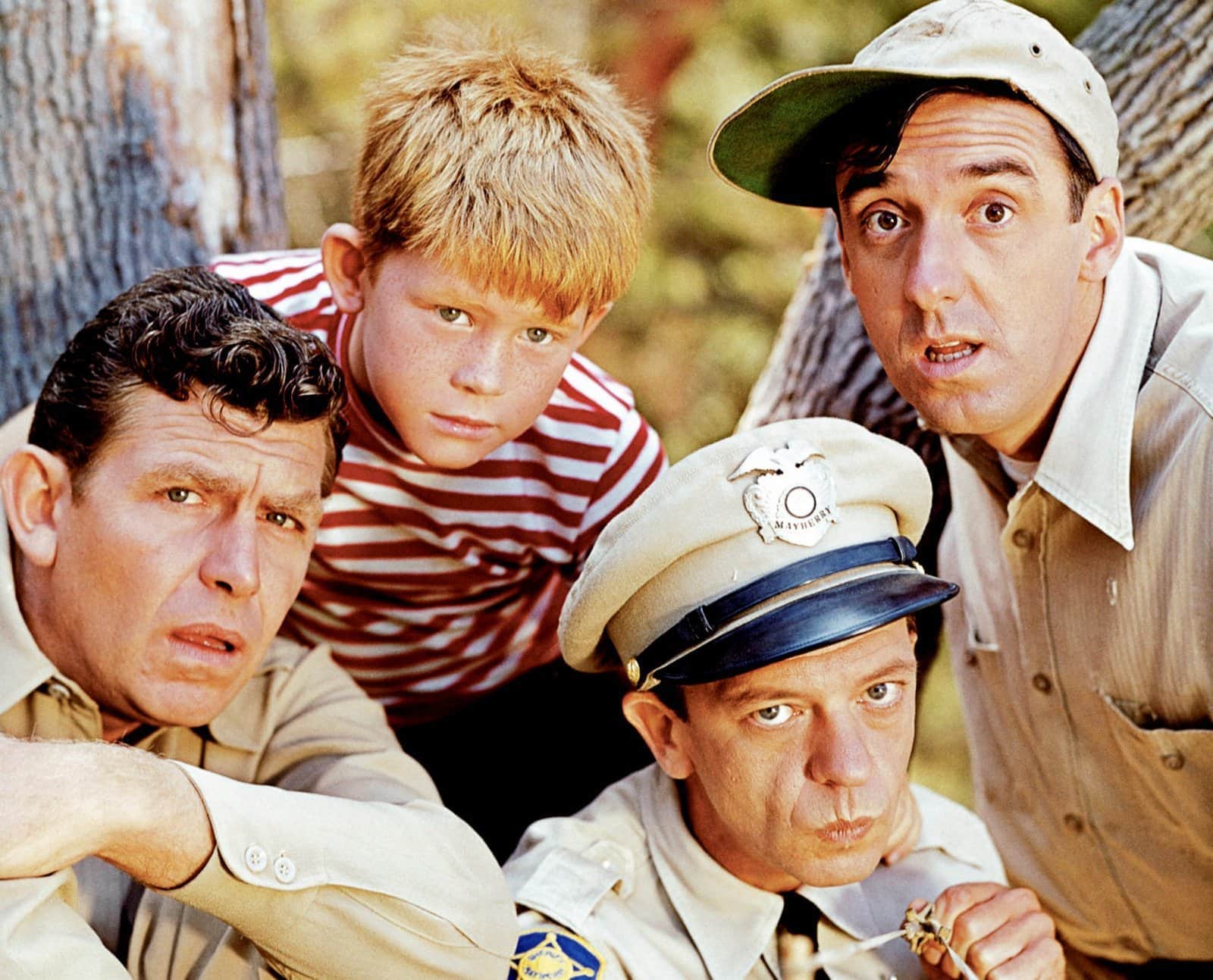
The actor, Andy Griffith, was a devout Christian. As he faced his own mortality, Griffith was clear about it: “I firmly believe that in every situation, no matter how difficult, God extends grace greater than the hardship, and strength and peace of mind that can lead us to a place higher than where we were before.” A 50% owner of the show, Griffith created and maintained Mayberry, and I think he envisioned it to be the kind of place that revealed a peak of heaven on earth.
Living in the bizarro world of midcentury TV life is the completely fantastic dimension of life depicted by the 21st century movie Pleasantville, where inevitable reality and cynicism derail the Andy Griffith Show’s 1960’s prism of heaven. But the Andy Griffith Show was always meant to be more ideal than actual. Heaven on earth can be both fully human and miraculous in the world we see on screens.
In the movie “Field of Dreams,” Kevin Costner’s dad seeing his son after decades, in full angel status, asks his son “Is this heaven?” as he surveys his son’ farm and family. “No, it’s Iowa.” Then son asks his angelic father, “Is there heaven?” “Oh yeah,” murmurs his long dead dad. “It’s the place dreams are made.” Kevin Costner then replies for all of our hopes, as he surveys his family and the farm, “Then I guess this is heaven.”
Mayberry might just be heaven.
It is a place where our flaws may be absurdly sanitized from violence, fear and profanity, but those flaws are nevertheless unconditionally accepted. Who wouldn’t want to live in a world where the local policeman (and judge) happens to be the most compassionate human in the town? In a place without war, partisan elections, or terrors that keep one up at night, our common humanity is easier to know. In Mayberry everyone lived in the gentle love of understanding. A place where there is no death, no disease, no self-loathing — where we are human, but are loved.
That self-serving projection fully embodies my inability to see beyond myself. My limiting humanity renders “Heaven” and “Hell” impossible for me to even begin to understand beyond the stereotypes of Mayberry. The words of saints and Jesus, fully ascribed to our almighty God, offer up the ultimate fate of the dead. But each of us hears those words in our own version Mayberry or Iowa. We are human, so we push at finding the truth we cannot know, here. I have no other option other than to tune into our own Andy Griffith Show and see the peace that passes all understanding — in Jesus. It’s all I have been given.








Beautiful, thank you.