Back in April 2020, Dr. Kate Bowler sat down with the New York Times to speak about prayer, fear, and the negative effects of positivity. When asked about the soul of the country, she responded, “I think it’s painful for everyone to know that there’s just not a lot of room between anybody and the very edge.” I’ve always admired Dr. Bowler and the way her work pulses with humility and acknowledges the mystery of God. I agree with her diagnosis of reality but it wasn’t until 16 months into the pandemic that her diagnosis became my reality, when my dormant anxiety and depression began to flair.
No positive thinking would pull me out of the pit of despair. Still, despite knowing its flaws, I grabbed for the ladder of positivity. Looking for relief, I would run through my list of blessings: the birth of our firstborn, our ability to travel to family, our living in a great neighborhood, in a highly vaccinated region, surrounded by friends. I exercised, journaled, went to therapy, wept through church, confided in loved ones, took time off work. Try as I did, the sum of all good things did not result in comfort. In fact, my unsteady brain began to file these blessings and practices under “guilt.” Despite my impressive list of ways I was fighting my depression and anxiety, I felt like I had nothing to show for it. In fact, the algebra of life began to tally all of the bad things I thought led to my anxiety and depression. I was at my wits’ end. And yet, in the words of Michael Gerson,
“…[Y]ou reach the breaking point and do not break. With patience and medicine the fog in your brain begins to thin. If you were like I was you encounter doctors and nurses that know parts of your mind better than you do; there are friends that run into the burning building of your life to rescue you and acquaintances who become friends; you meet other patients from entirely different backgrounds that share your symptoms creating a community of the wounded.”
Over the last few months, I too have known this community of the wounded. They have nursed me back to health. They’ve shown up with meals and shoulders to cry on. They are often unexpected and provide a comfort that can only come from another. As Eric Youngblood says in his article for the new Mockingbird publication on age, I have experienced “the cameo(s) of Christ’s ubiquitous comfort brokered through others.”

During a particularly trying time this past summer, this comfort was brokered through my one year old son. One night, I held him as he cried before bed. My anxiety had been pulsing in my chest for weeks. I believed I was a tangled ball of inadequacies in my work and life, suffering from pandemic blues, longing for normalcy. But my son didn’t know that as tears rolled down his creaseless cheeks and his screams reverberated in my ear. Instead he offered me an invitation to join him. And so I did. And we cried; him in my arms, me in his arms. To this day I can’t decide who held who at that moment. I hope I’ll never know. All I knew was that Jesus was near, and that was enough. That is always enough.
It’s hard to categorize what I felt that night with my son. The Bible leads me to believe that it could’ve been joy, but I don’t know. That feels too offensive, unthinkable. Does my category for joy include hot tears and gritted teeth and moans for healing? Can joy share the stage with grief? I’d be quick to refute that joy is just the evolved version of happiness, but it’s hard to imagine joy walking with a limp. Henri Nouwen says that “joy is not the opposite of sorrow, it never denies sadness, but transforms it into fertile soil, for more joy.” I guess the kicker is that we don’t know how long that transformation takes.
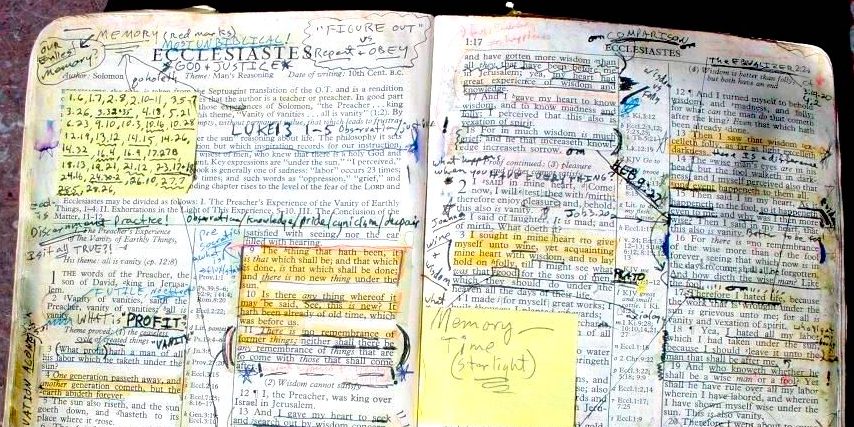
My mom shared that Nouwen quote with me over a text message. She is one of the longest standing members in my community of the wounded. I can count on at least a few texts like these from her each month. Needless to say, going through the ringer increased those texts ten-fold. I always enjoy (and am impressed at) the variety of them. Our message history is full of URLs incorrectly pasted, screenshots of screenshots, and off-centered live photos opened up to passages in her weathered Bible. What has come as the deepest comfort in our communication has been actually seeing her Bible through the stop motion of her live photos. She has had it longer than I can remember. I can imagine it now, resting by the chair in my childhood living room. I know how it feels and smells and can recall the times we had to double-back to church when she forgot it. Some pages are stained with coffee. Others with dirt and tears. The dog-ears outnumber the right angles. There are underlines with every color of the rainbow and the margins are filled with her handwritten footnotes. For as many times as God’s Word has been a comfort for my mom, it has also been her punching bag. It has been her sparring partner and sanctuary in her own seasons of depression. It has been her solid ground from which she mourns and rejoices. For me, seeing it now after all of these years, it is the image of a field full of fertile soil.
Since Advent began, the lyrics of “Joy To The World” have been running through my head. For so long, I’ve thought singing for joy was the acceptable response to Jesus’ birth. I’ve often sung thinking about my own feelings towards Jesus and wondering if I’m as grateful as I should be for what he’s done. But what I’m learning is that this joy that we sing of is actually less about how we feel and more about what God has done. It is a declaration of our new reality in Christ. And that God’s gift to an anxious and hurting people is joy in human flesh despite how we might feel about the matter.
Here is Michael Gerson again: “At the end of all our striving and longing we find not a force but a face. All language about God is metaphorical but the metaphor became flesh and dwelt among us.” For me, that reality is a joy I cannot readily discard. It’s certainly not a joy that will ever discard me but instead draws near through infants and the aging and the community of the wounded. It is a joy that is with us to the very end.