




Contrary to popular belief the Bible is full of dinosaurs. And I’m not talking Leviathans or Behemoths. From Genesis to Revelation, dinosaurs appear in the biblical narrative — that is, of course, if you’re counting birds as the only surviving descendants from the monstrous beasts of primeval past. Which perhaps you do or perhaps you don’t. The church’s history in connection with dinosaurs, the age of the earth, questions of origins and the study of science overall have obviously been tense over the years. The topics are heatedly debated, causing division and in some cases, seem to bring about a loss of all respect and credibility from those outside the church.
To be clear, I’m in no way attempting to provide an answer to the floating questions around such topics. I’ve visited the Creation Museum, consulted the “Answers in Genesis” and listened to the Bill Nye debates. In college I took my Physical Anthropology Lecture and Lab course. I ventured into the ancient Near East with John Walton, angling my eyebrows at the “Sons of God” until I developed a headache. I’ve done the “Are ‘days’ really days?” question numerous times. And somehow I eventually found peace In R.R. Reno’s adaptation of Origen’s “purposeful beginning” interpretation and sufficiently obfuscated my theological responsibility of these thorny issues but that’s neither here nor there.
When it comes to these topics it’s not uncommon to find yourself tossed to and fro among the waves crashing on the shore of origins. Tom Holland has noted not only how he himself was haunted by these troubling thoughts but how these concerns even shaped the history of paleontology.
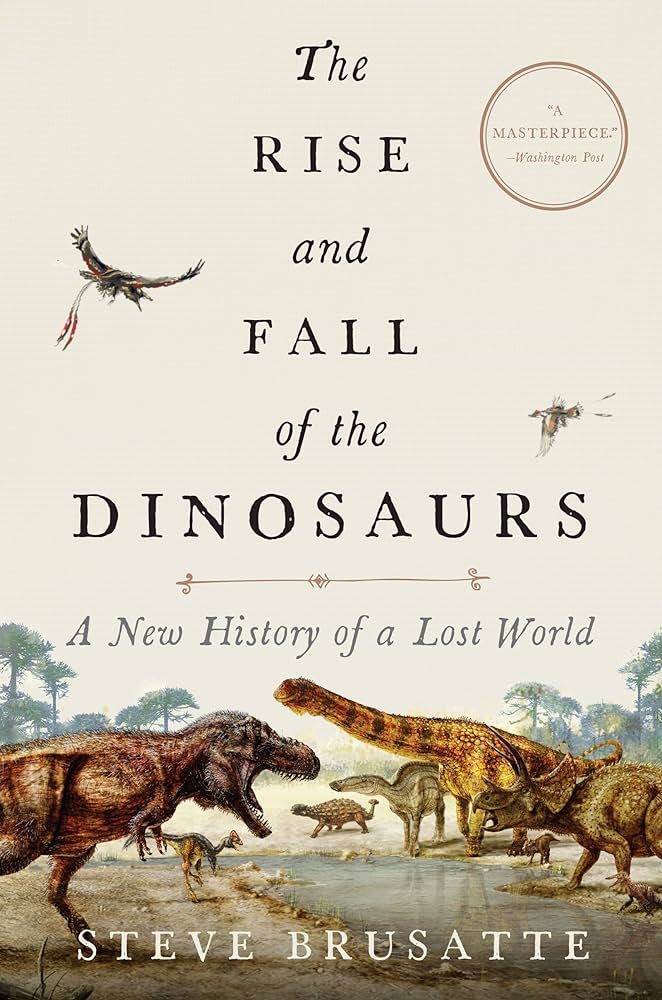
It’s difficult to not be drawn into the gripping story of the dinosaurs. Interest in dinosaurs seems to be wired into a child’s DNA and often sticks with us as we grow in age. There’s something within the narrative that’s inherently intriguing and mysterious. A world unknown to us and yet simultaneously under our feet. In The Rise and Fall of the Dinosaurs by Steve Brusatte this story is penned beautifully. It’s a cyclical story, a repetitive series of rising and falling, death and resurrection if you will, as Mbird contributor Michael Nicholson has noted in his helpful article on a similar topic: “That story, the history of nature, records a spiral chronicle of creation and extinction, of birth and life and death, that lasted millions of years, however we may gloss the causes, the details, and the sequence.”
This type of story isn’t foreign to us. The Old Testament itself is a recorded theological history of the rising and falling of God’s people. We’re well aware of this cycle of life and death, of adaptation and sanctification in a lifelong journey of being shaped and molded into a final form. Maybe there’s more than debates and division to be found when it comes to the subject of dinosaurs.
But for all the rancor, none of the paths seemed to point me to the death and resurrection of Christ. No gospel fruitfulness found. It appears, for the most part, an ideological mission to either prove the Bible can be trusted or that modern science cannot — sometimes an argument for both/and. Surely, these conversations are worthwhile, but within the daily life of the church can the story of the dinosaurs be more than a heated debate? Is there a good word embedded in the fossils?
Brusatte’s book is dense with terminology, eras within eras and numerous dinosaur names in italics that have certainly gone in one of my ears and out the other. But for all that, as a dinosaur laymen myself, the work he’s produced is accessible for the dinosaur illiterate like me. He explains and informs in such a way that draws you into the history of dinosaurs not as some distant past that shouldn’t be bothered with but rather in a way that conjures up the imagination. A recurring character, perhaps the main character one could argue, is death itself. By the way Brusatte describes the world, death not only reigns over the timeline of the dinosaurs but it’s a guiding force (although, he clearly states he doesn’t think there is any guiding force involved in evolution). It’s embedded in the earth we stand on.
As those who profess a world riddled with death, the idea of the ground below us being tainted with this enemy seems profound. Fossilized bones along with the primitive feathered remnants of corpses hidden between layers of ash and molten rock like some earthly Rosca de Reyes recipe. Then there’s the idea there might even be a case for microevolution as a natural theological image of sanctification. Perhaps the birds are an image of this, after everything they’ve been through to get where they are, and maybe there’s even a hint of that sentiment in the call from Jesus to “consider the birds”. Through all their years of sanctification, they’ve learned to neither toil or stress. But I’m neither scientifically qualified nor theologically endowed enough to make such a claim without the proper authority. Although, qualifications aside, I must admit, the imagery is quite fun to play with.
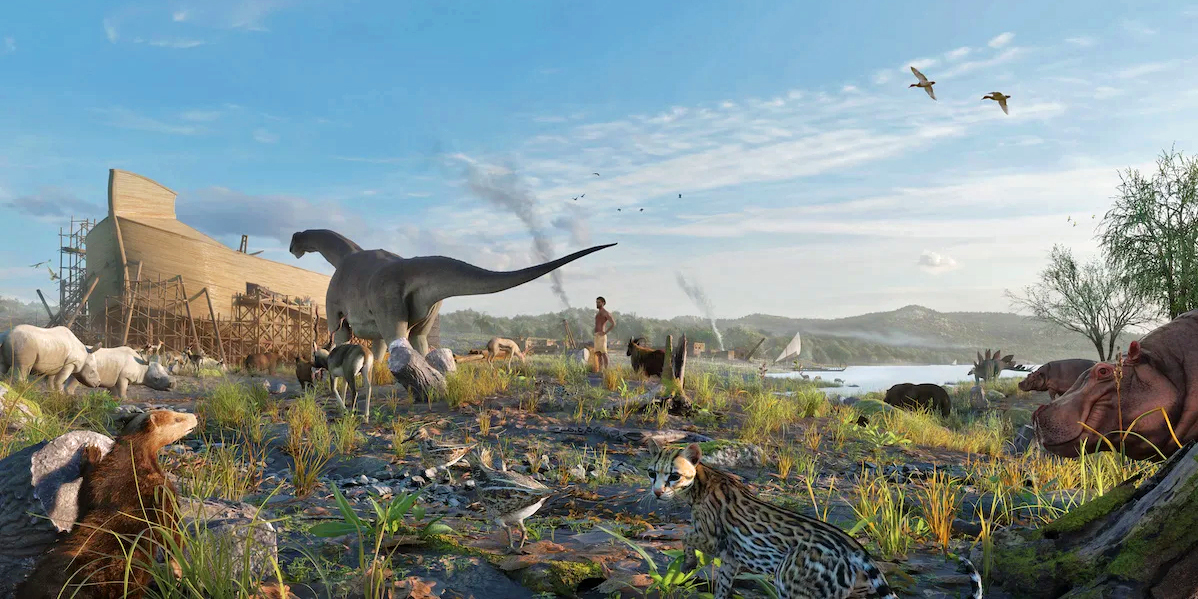
It’s not as if the world of paleontology is restricted to only the secular class. And while there have been extremes of fundamentalism which attempt to join the utmost literalness of the Genesis account with dinosaur history by envisioning Velociraptors on Noah’s ark, there are also those that have been monumental and respected contributors to the field of paleontology. Mary Schweitzer has brought forth significant research on Tyrannosaurus rex blood cells. Jordan Mallon, in Adam-like fashion, has named numerous new fossil species: Plioplatecarpus nichollsaw, Basilemys morrinensis and Spiclypeus shipporum. And then there’s the infamous and renowned Robert Bakker, AKA “the dinosaur heretic” (now vindicated). Bakker was influential in the production of Jurassic Park and is supposedly the inspiration for the character of Robert Burke — in spirit and physical appearance. Brusatte writes of Bakker’s works:
There was almost a religious feel to some of these writings, perhaps not a surprise, given that Bakker also dabbles as an ecumenical Christian preacher and is renowned for his high-energy lectures, delivered in the style of an evangelist testifying to his congregation. (p. 77).
Bakker didn’t see biblical controversy in the artifacts he studied, he saw something more. To borrow a phrase from the 19th century Scottish geologist, Hugh Miller, he saw The Testimony of the Rocks — or bones, to be precise. To Bakker, paleontology isn’t just a career or focus of study. It’s a calling. To quote him from an interview, it’s a call to “bring to life the dead bones. To bring them to life for all of society, for everybody, not just for the specialist, for the three other people who can read your technical papers.” When asked an absurd question in the same interview, Bakker replied with a sobering answer:
Al Page (interviewer): “On a dig have you ever been tempted to sing ‘the leg bone’s connected to the thigh bone’?
Bakker: No, but I read to my field crew from Ezekiel 36 and 37. And if you haven’t read that, you go back and get your Gideon bible and you read those two chapters of the prophet Ezekiel.
Al Page (interviewer): And that sets you up for being a good paleontologist?
Bakker: It does, indeed.
You see, as Brussatte notices, there is something religious about Bakker’s writings. It’s likely because he views his work as a spiritual vocation. In one sense he does paleontological work and in another, he brings life to dead bones. Or to put another way, he plays with resurrection. Ezekiel’s vision sees not only Israel’s restoration in Christ but the ultimate end of restoration for the entire world in the resurrecting act of God’s son and thus, the resurrection of His people. Bringing to life the bones of ancient beasts is but mimicry and imitation of the one our faith is in. A practice in what we yearn for, for what we hope all reality comes to in it’s fulfilling concluding moment.
The reconstruction of the towering behemoths before us in museums doesn’t have to be a point of constant turmoil in debates but rather points to our culminating hope in Christ. An incomplete and insufficient image, undoubtedly, but an image nonetheless of the one who was pulled from his earthly grave and given life to not only his dead bones but his flesh and blood as well, of which we now partake. While certainly questions will abound and answers remain distant as we seek truth, Bakker provides a way in which to hear good news in an area of which seems without. For in ages past, the dinosaurs wrought fear in the hearts of men, but in this age we stand in awe, wonder and joy in the shadow of their resurrection.








I love this so much! I’ve read ‘Rise and fall of the Dinosaurs’ and the follow up ‘Rise and reign of the Mammals’ twice – and both have filled me with awe, wonder and a deep gratitude for everything that has had to come before so that I can live my life right now. And if God loves me, then God can only have loved the T rex, and the spinosaurus, and the cynodonts and the rest of them just as much because they paved the way for me. So if that doesn’t humble me and make me love my fellow human more I don’t know what will, we are all products of billions of years of life and death and resurrection. Dinosaurs make me curious about God, and I’m glad you can see them in the Bible! your theological point about consider the birds is hilarious. Of course Jesus with his ‘eternal God’ hat on knew they were evolved dinosaurs who had moved past the whole ‘king of the world’ stage and were now content with the freedom of flight and simplicity of eating bugs. There is a lesson there for sure. Thanks again for a great article that made me smile a lot.
i’m glad you enjoyed it, thanks for the kind words and the read. i agree, there is much awe to be had with the dinos. the mammals book is on my list, can’t wait!