




It’s that time of year. Elves, reindeer, and jolly, white-bearded men with jiggling bellies. Pine trees with glittery ornaments, front door wreaths swaying in the wind surrounded by blinking candy cane lights. Wise men, a baby in a manger, a flickering star in the night sky. And who could forget the one-horned mythical beast, the unicorn.
Okay, maybe you aren’t seeing Christmas unicorns out there in the real world. However, I propose that this fantastical creature be part of your Christmas celebrations. As bizarre as it might sound, the shared history of the church and the unicorn is irrefutable. To this day, if you find yourself in St. Peter’s Basilica, you will see a female figure bringing a unicorn’s horn in one hand to meet with a rose in her other. You may begin to scratch your head and wonder how in the world a unicorn ended up in the church’s symbolic deck of cards.
In the modern age, the idea of a unicorn actually existing seems foolish. It’s like saying dragons are real. Who would suggest such a thing? Our ancestors did not think as we do. While there are surviving sculptures of this wondrous creature from the eighth century B.C., our first written account is from the fourth century B.C. A Greek physician named Ctesias writes:
There are in India certain wild asses which are as large as horses and even larger … They have a horn in the middle of the forehead that is one cubit … Those who drink from these horns, made into drinking vessels, are not subject, they say, either to convulsions or to the falling sickness … the most beautiful that I have ever seen … This animal is exceedingly swift and powerful, so that no creature, neither the horse nor any other, can overtake it.
Other well-known historical figures like Aristotle, Julius Caesar, Pliny the Elder, and Aelian make mention of this monokerōs. The modern reader looks back upon these works and suspects a rhinoceros afoot. But for those who keep their whimsical imagination active, perhaps some symbolic play may be up for grabs. The medieval church was certainly fit for the task.
Legend has it, somewhere between the third and second century B.C., a group of 70 or 72 Jewish scholars translated the Hebrew Old Testament into Greek to create what we call the Septuagint (from the Latin septuaginta, meaning “seventy”). When these scholars came across the word re’em which meant “ox”, they were at a loss — their culture’s wild ox went extinct in the region. So for an unknown reason, besides God’s comedic stylings, the scholars chose monokerōs (“single-horned creature”) instead. So Numbers 23:22 reads: “God, who brings them out of Egypt, is like the glory of the unicorn to them.” Thus, when Jerome translated the Septuagint into Latin during the end of the fourth century A.D., unicorn, or unicornis, was officially in a version of the Bible. You can still order leaves of old medieval Bibles today with the translation in it.
Naturally, this led theologians to ascribe the imagery of the unicorn to Jesus. Basil the Great opined, “Christ is the power of God, therefore he is called the unicorn because the one horn symbolizes one common power with the Father.” Saint Ambrose chimed in with the rhetorical question: “Who is this unicorn but the only begotten son of God?”
But where the entry of “unicorn” into the church’s lexicon truly flourished was through the influence of the Physiologus. In this ancient gathering of stories, moral lessons were drawn from real and mythical animals. One finds that the seemingly untamable unicorn could indeed be tamed by a pure virgin. Historian Adolfo Salvatore Cavallo explains how this works: “Attracted by her scent and her purity, the creature would kneel, place his forelegs and head on her lap, and fall asleep.” If you know anything about Christianity and virgins, a certain someone likely comes to mind. Over time these ideas joined together, and eventually in the ninth century, after recalling the virgin’s sway over the unicorn, a bestiary states: “In this way Our Lord Jesus Christ, the spiritual unicorn, descended into the womb of the Virgin and through her took on human flesh.” Another one says:
[The unicorn] is very swift because neither principalities, nor powers, nor thrones, nor dominions could keep up with him, nor could Hell contain him, nor could the most subtle devil prevail to catch or contain him; but, by the sole will of the Father, he came down into the virgin womb for our salvation.
The unicorn thrived in Christian symbolism and art through the Middle Ages, prancing and galloping around the medieval mind. And it certainly helped that narwhal tusks were passed off as unicorn horns. Unfortunately, the party was eventually ended at the Council of Trent in 1563, when the Catholic Church officially deemed such play unfavorable. Then the killjoy of the modern scientific era continued to rain on the parade by shutting down the myth of the unicorn and definitively stating no horn could grow on the skull of a “cloven-hoofed creature,” considering their skull was divided in the center leaving no place for a horn. But such declarations cannot stop humanity from its incessant need to play with such symbolism. We cannot sever ourselves from our history with such images. They are present and persist for the very reason we need them to express our deepest longings.
The Death of the Unicorn is our culture’s latest iteration pertaining to the myth of the unicorn. The film is about a father and daughter who are on a retreat with an extremely wealthy family. When the father-and-daughter duo accidentally run over a unicorn and kill it, they find out the blood and horn have medicinal value (medieval magic). The wealthy family latches onto this and begins plotting every which way to replicate and monetize the unicorn’s offerings. This pits the father and young, passionate, idealistic daughter against one another as she sees the legitimate wonder and beauty of the unicorn. The unicorn becomes a symbol against capitalism, greed, and destruction of the environment. This means the young maiden in this retelling is not pure due to her virginity but rather her unstained morality as she stands against the sins of the wealthy. She is spared from the revenge of the unicorn because of this, and resurrection is bestowed upon her father for the sake of her purity. Writer and director Alex Scharfman describes his take: “When you get into medieval unicorn mythology, there’s a certain level of class commentary that comes with it.”
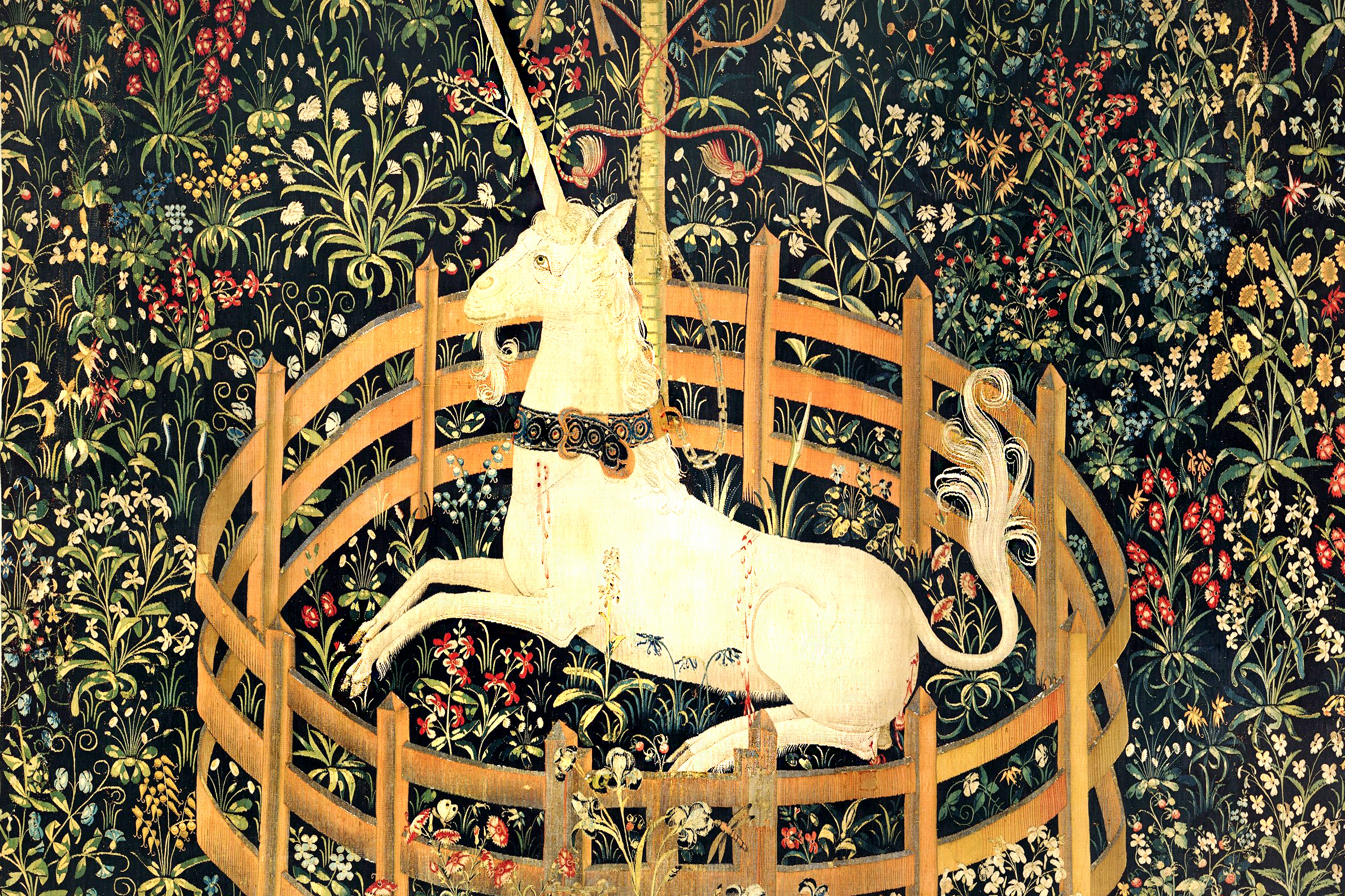
While I certainly take issue with certain aspects of capitalism and don’t support greed with my words (I can’t speak for my heart), I feel the modern adaptation of the myth loses the punch previously packed. In my research, albeit brief and mainly pulled from The Met’s two works on The Unicorn Tapestries, I didn’t find anything discussing class as the interpretive method for the unicorn. The movie utilizes the famous Unicorn Tapestries from the Middle Ages where the beast perhaps enjoyed its peak in the theater of theology. These tapestries are discovered by the daughter who learns the maiden’s trick to lure the unicorn. There are numerous tapestries that include the unicorn, but three stand out: The Hunt of the Unicorn as Lover, The Mystic Hunt of the Unicorn and The Hunt of the Unicorn as an Allegory of the Passion.
According to the latest research, the tapestries were a possible wedding gift to a royal couple. This background gives way to what takes place in the Unicorn as Lover tapestry. A unicorn is hunted not for reasons of greed but rather because it is the symbol of love and chastity. It’s a story of a lover being chased down. The creature is then captured, kept in captivity, and tied to a pomegranate tree, which symbolizes marriage and fertility. Surrounding the contained unicorn are roses, violets, carnations, and Madonna lilies — all symbols of the Virgin.
The other two tapestries are directly related to Christ. The Mystic Hunt of the Unicorn depicts what researchers think to be Adam and Eve around an apple tree with a young maiden (presumably Mary) who is wooing a unicorn. It is a stitching of the redemption story encapsulated in simple potent imagery. The Hunt of the Unicorn as an Allegory of the Passion is profound, a series of tapestries which tell the story of Christ. The unicorn is hunted; it dips its healing horn into the fountain of creation to purify it; then it is killed, and a wreath of oak branches is wrapped around its neck while surrounded by holly trees. These are common pagan symbols of death and resurrection. (Much more is said about the rich and dense imagery in these tapestries, and I would encourage a read of the Met’s work for a deeper dive.)
The Death of a Unicorn is a biting critique of modern capitalism and pharmaceutical profiteers, but it is perhaps a case of presentism. And that’s all fine and dandy. Utilizing universal symbols to produce new meaning is a necessary facet of our humanity. But exchanging a symbol of God’s grace and incessant pursuit of sinners for a tale of morality and deservedness is a deal we should not be willing to make. For in the unicorn, we have not a challenge to rise to the occasion in our stances against great evils but rather an offer from God of himself. The mighty, seemingly hidden God has made himself known as our horn of salvation. And while it may be deemed a Christmas heresy, Rudolph might have a worthy challenger for guide of the sleigh. Or if you find this a bridge too far, the least we can do is question our typical understanding of the unicorn as Sharfman suggests:
I love that idea that we’ve been so inundated with these corporatized versions of these characters that if we were to encounter the ancient deity version of it, we’d actually have no framework for this. We don’t even know.
In our modern age, we have lost contact with our ancient framework. May I suggest that this Christmas we welcome the unicorn back into our world. Not as the commercialized, prancing, cutesy one but rather as the symbol of the Almighty in helpless babe. The Ancient of Days wrapped in birthing clothes, crying in a manger. As a favorite Christmas song of mine puts it: “Hands that set the stars in place, shaped the earth in darkness, cling now to a mother’s breast, vulnerable and helpless.” It’s absurd, ridiculous even; “foolishness,” as the Apostle Paul states. About as silly as a mythical one-horned untamable beast. And yet, we proclaim it proudly. It’s not so often the God above takes on human flesh. In fact, it is quite a unique event, one in which the Creator of all comes to be with his creation. To humbly serve and suffer alongside them, offering them life while he gives his death. Among the gods and offerings of this world, Christ truly is a unicorn.








Such fun! Love this.