




Recently, I’ve been pondering this question: Are dragons real? It sounds like an absurd thing to ask, and perhaps it is. But, on the other hand, our world is full of dragons. Nearly every culture has a relationship with the infamous beast. With differing shapes, sizes, and combinations of mismatched animal body parts, we see mythical stories and artwork revealing the dragon to be integrally related to humanity. Even in today’s world, Game of Thrones found itself as one of the most-watched shows in the twenty-first century due to stellar screenwriting, brilliant acting, and certainly the dragons. The show aired in over 170 countries, dragons being a worldwide phenomenon. Speaking of countries … Malta, Bhutan, and Wales have dragons on their flags to this day. Dragons, while maybe not real in the sense of physical reality, seem ever present and relevant today.
Another signpost signifying the presence and interest in dragons today is $2 billion-plus success of the How to Train Your Dragon franchise. With three animated films, four Netflix shows, and a new live-action rendition of the original film, the franchise is a train on the tracks that does not appear to be slowing down anytime soon. In addition to the visual entertainment, Universal Studios has opened a new theme park with How to Train Your Dragon boasting of its own themed land within it. And even more fascinating is the metanarrative of the new live-action film, which grossed higher than all its predecessors.
There are numerous ways to glean something valuable from this film as its layers go deep. Is it a story about a father and son grieving, learning to rebuild their relationship after the loss of a mother/wife? Does the movie implicitly question today’s masculinity standards and unspoken requirements? How about a classic coming-of-age tale, where adolescents learn to tame their wildness? Or perhaps we have a love story on our hands, the typical youthful male attempting to impress the beautiful popular girl? Are rivalry, tribalism, and vengeance questioned? Yes to all the above. However, first and foremost, this movie is unequivocally about dragons.
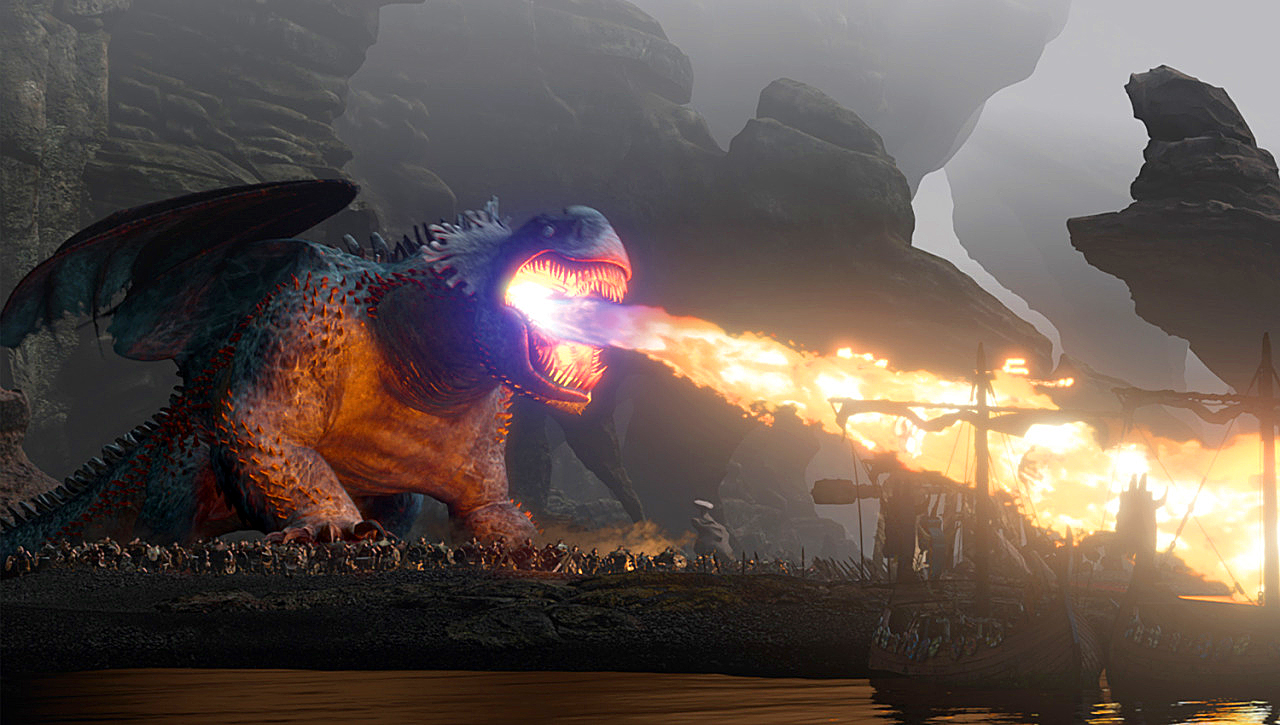
The Vikings in How to Train Your Dragon are in a longstanding, ancient battle with the beasts. The oversized reptilians seemingly terrorize, steal sheep, and burn down the human city with no remorse. This, without a doubt, contributes to the reciprocating acts of the Vikings to seek and destroy the varmints’ nest. This pursuit of the enemy is what the tribe defines as their purpose. That is until someone questions this generational spat. Hiccup is a young boy who has something wrong with him: all of him. This, at least, is what the other characters suggest when looking upon his scrawny and unimpressive appearance. He brings nothing to the table when it comes to the warfare in which the Vikings pride themselves. And yet, he strives to belong. He feels the unshakable pull we all feel, to prove oneself, to earn your place at the table. He’s burdened by the law, a heavy load upon his shoulders, weighing down his entire being.
But on the brink of his defining moment, the chance to kill his first Night Fury dragon, the uncatchable legend, he chooses another route. He chooses to, as my pastor calls it, question the stereotype. This leads Hiccup on a long journey of bonding with his new dragon acquaintance, Toothless, and eventually he learns what’s directing the villainous actions of the dragons. And, of course, apropos for any dragon movie worth its salt, what’s behind the enemy is none other than a bigger dragon.
After healing the divide between Viking and dragon, Hiccup is able to train his other adolescent friends how to ride and tame their dragons, leading them to a battle against the Great Dragon, the True Dragon if you will. It’s a brutal sky conflict that leads to Hiccup’s risky maneuvering and what for onlookers appears to be the end of his mortal life. But to the surprise of all, he is alive and well — well with only one leg, that is. A sacrifice deemed worthy as he’s now transformed his Viking world from a chaotic, violent, and broken hellscape into a home of peace and contagious joy where Vikings willfully ride dragons.
The Vikings do not undergo this ancient battle alone. It’s an enmity nonexclusive to the Norse people, shared with all humanity. As stated above, the world’s cultures have always dealt with dragons, these symbols of raw chaos, untamable power, and the unknown. This is spelled out in the Christian faith tradition as well. Our word “dragon” goes back to the Greek word for snake. Hence, history has shown dragons sharing the appearance or at least a portion of their appearance in a serpentine manner. We have the Leviathan, the all-powerful dragon-like monster that God informs Job only he can keep at ease. There’s the human-hungry sea dragon or sea monster that swallows Jonah right up. And of course, who could forget the ancient serpent in the Garden of Eden. Most familiar, and perhaps most avoided due to the nature of the difficult text, is the treacherous dragon of Revelation. The one behind it all, behind sin and death, our True Dragon. And, spoiler alert, we know how it ends for him. So suffice it to say, while humanity is all too familiar with dragons, we are supremely aware of the presence and effect of dragons in our real life.

But it isn’t just scripture; dragons also appear in the tales of Christian saints. In addition to a passion for a clean home and a brother who was brought back to life, Saint Martha of the Gospels is a dragon tamer. Medieval bestseller The Golden Legend finds Martha fleeing persecution by heading to France, where she tackles the paganism around her in the form of a dragon eating the inhabitants of her city. With some holy water and the sign of the cross, this dragon is nothing for the saint. Turn some pages in The Golden Legend and you’ll find yourself with Saint George, the infamous dragon slayer. Georgie finds himself in Libya, where city folk are being fed to a dragon for appeasement. Throw a princess in there, a knight with a lance, a slain dragon, some conversions, and you have yourself a legend. This noble achievement led to Saint George becoming the patron saint for knights and soldiers.
Does the question still sound silly? Are dragons real? Symbolist and icon maker Jonathan Pageau thinks we should look at it differently:
What if dragons or else monsters in general are simply not the same type of “thing” as dogs or cats or apples? What if the way a dragon exists has less to do with the difference between a tiger and a rabbit and more to do with the difference between a friend and a stranger? The difference between a friend and a stranger is not a measurable, reproducible phenomenon, yet it is one of the most real experiences a human being has … I am saying dragons exist, or rather almost exist. They are as real as a stranger is real, as an alien is real, real in ways that show us the very limits of existence itself.
Believe it or not, you’ve encountered dragons. Perhaps like Hiccup and his young companions, you’ve also realized your need to learn how to tame a dragon, slowly bringing order to chaos and drawing out a better flowing unity in your life. Or, as James puts it, you’ve had to tame your tongue. Paul describes it as training his body like an athlete to discipline his dragon. Maybe you currently have dragons in your life, those deemed “enemy” and stereotyped. Look outside (or down at your phone) — tribalism is running rampant and affecting relationships, communities, and countries. It might be that you find yourself up against a dragon. I’ve seen friends suffer through the throes of addiction, which has all the hallmarks of ravaging from a fearsome dragon. Parenting little tykes, maintaining the messiness of marriage, and extending the life of your career is not dissimilar to a fire-breathing hydra.
Dragons are real, and I believe that’s why a film like How to Train Your Dragon is resonant with the masses. There’s something about an unexpected anointed one who reaches past stereotypes, meets the winged sinners on the outskirts, and brings reconciliation to all. A sacrifice offered and a new world made. One where wolf and lamb lie together, the cow feeds with the bear, the young child puts his hand into the viper’s den, and Vikings ride dragons. This story appears to draw hearts and minds, comforting those who have been burned by the world’s plentiful provisions of dragons. For throughout all of history we’ve been burned. St. Cyril of Jerusalem wrote to his catechumens way back in the fifth century about this inevitable truth:
The dragon sits by the side of the road, watching those who pass. Beware lest it devours you. We go to the Father of Souls, but it is necessary to pass by the dragon.
But there’s a deserved asterisk here. There’s good news, which we certainly call our dragon story. We don’t pass by alone. We walk with the Dragon Slayer, the Holy Hiccup. As ones who’ve heard that three-word cry of victory: It is finished. So go, pass by the dragon, whichever one may find you. We know in the end, all will be well.





Loved this!