





Spoilers below.
Early in the final episode of The Good Place, we find Jeff the doorman sitting at the gate between Earth and the afterlife. Jeff has an affinity for frogs, and as the episode progresses, he accumulates more of them — plastic frogs, plush frogs — until he barely registers any interest in them at all. Only when given a real frog does Jeff truly light up. Mr. Jumpy Legs, he calls it.
This episode is all about eternity. And while frogs can be awesome, it should be obvious that no frog will entertain Jeff forever. It begs the question of what Jeff really needs: Mr. Jumpy Legs or what Mr. Jumpy Legs represents (relationship, life, the Real Thing). Unfortunately the show doesn’t bother parsing this out, probably because it dares not guess what the Real Thing really could be. Necessarily, the conclusion is despairing: Mr. Jumpy Legs will die, or Jeff will get bored of him, because nothing lasts forever.
Though critics have unanimously called it “transcendent,” The Good Place finale is a tortuous hourlong special, made especially bad by the fact that the show has been otherwise so good. The problem is not that this episode lacks humor. In fact, it is very funny. Tahani’s bucket list, for example, includes “burp the alphabet” and “problematically objectify Eleanor” — both of which she promptly checks off. Elsewhere, Michael raises a dog named Jason, and Derek is rebooted 151 million times, and Judge Gen is binging The Leftovers and nearly wipes out 2% of humanity when she learns that Carrie Coon never got any awards. The jokes come nonstop, despite, along with them, a constant flood of tears.
I should also mention, the finale comes hot on the heels of one of the show’s greatest conclusions, developed over episodes ten and eleven, which is the idea of endless reboots: every time you fail, you get another chance. As many as you need. Over the course of many lifetimes, this could sound a lot like reincarnation. To me, it sounds like grace. As one critic interprets it, “Everybody deserves a chance to…f*ck up, learn, change, f*ck up again, and keep on trying.” The show has often teetered on the brink of preachiness, but even when a lesson is given, as here, it is conveyed in the classic tone of the sitcom: warmly.
But things get muddy in the penultimate episode when at last our friends arrive in the (real!) Good Place, where there are large flying puppies and endless parties decorated according to your specific tastes. Here, you have the opportunity to visit any time and place and have any experience or thing you want.
Oh, and you have endless time.
Which is problematic, we discover, via the airy Hypatia of Alexandria, “Patty,” who explains that eventually everything gets…boring. In eternal satisfaction (which one critic calls, oxymoronically, “tedious bliss”), you start to lose brain functioning capabilities. Patty, having enjoyed herself for thousands of years, can no longer remember basic words. In a panic Tahani realizes, “We’ve invented cosmic Coachella!”
Once again, the Good Place seems a lot like a Bad Place, only this time it’s final. There will be no further adventuring, no loops through the Interdimensional Hole of Pancakes. It’s over: we have arrived in eternity where we’re offered 100% satisfaction guaranteed, forever, and it is a nightmare — for which a solution comes swiftly: time must be cut short, our characters decide. A party is only good because it ends, and life is only good because of death. If you are going to enjoy yourself to the max, then you must understand it will not last forever, so they wish up a door to nonexistence. Anyone can walk through “whenever you’re ready.” Problem solved!
What?
All along, The Good Place has asked two main questions: How do you change for the better? And how do you get into the Good Place? They are not the same question, and the show answers the first one well. You change for the better with friendship, dangerous adventures, endless second chances, and the occasional leap—no, fall—into faith. Eleanor, Chidi, Tahani, and Jason have also learned some ethics, and that didn’t hurt. You could graph the kindness exchanged between them, see it increasing gradually over time, spiking for dramatic self-sacrifices for the wellbeing of others. But as for the second question, the show couldn’t answer it, because it couldn’t begin to guess what a truly good place would even be.
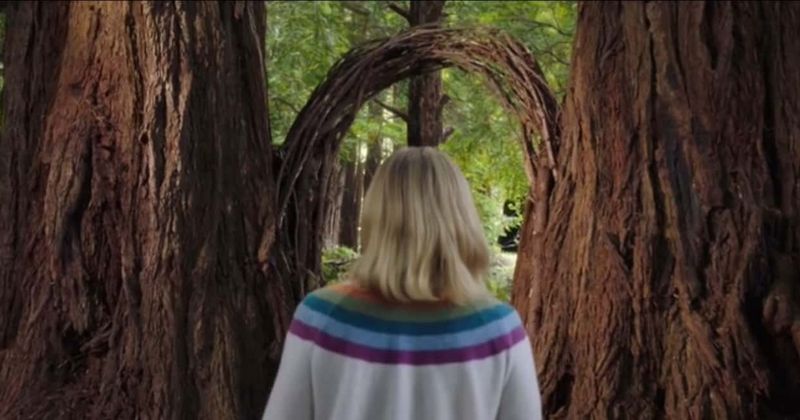
Recently show creator Mike Schur admitted, “The second you conceive of any system of what happens after you die, you then realize, oh, there’s a million flaws with this.” Here I will point to a few of them. The main one is that the Good Place still sucks; in it, you suffer heartbreak, ennui, and the excruciating capacity to do what you want for all of time. Jason plays the perfect game of Madden. Tahani gets the approval of her parents. Chidi reads every book he ever wanted to. There is fortune, health, friends, family, material comforts aplenty. Go to Paris, visit your childhood home, eat at restaurants where the menus offer “literally anything you could possibly imagine.” It is a fever dream of wish-fulfillment. Awash in “self-will run riot,” these characters lack any semblance of freedom. They are trapped in a universe where, in Camus’ words, “freedom has no meaning except in relation to its limited fate.” Suddenly, we’re in the sitcom of The Myth of Sisyphus — an essay for which a sitcom seems cruelly inappropriate, because the topic of it is suicide.
It would be crass to draw that parallel exactly. Really, there is no exact parallel. First of all, the characters have already died, several times over. (What they are now is unclear. Spirits? “Ghosts,” as Pillboi suggests? Never mind, it doesn’t matter.) What matters is that these characters choose to end their existences. The show calls it freedom. Speaking of the door in the woods, Tahani says, in the worst line she was ever given, “You don’t have to go through it if you don’t want to, but you can.” In other words, feel free! But, actually, not really, because all you’ve been given is this grim either/or: endless shrimp, or the disappearance. What I would demand is neither.
At times, the show implies that meaning is found in other people, in relationships, even if for a finite time — meaning is found, say, in Mr. Jumpy Legs, the real frog, not the plush one. That outward-facing perspective is useful, but friendship is not the Real Thing, only a fingerprint of it. Actual friendships let us down. They can become toxic with envy, comparison — plus moments of real happiness, mutual love and support. But at the show’s end, even this is taken away: these characters go out alone. Each has to make his or her choice to abandon loved ones for oblivion.
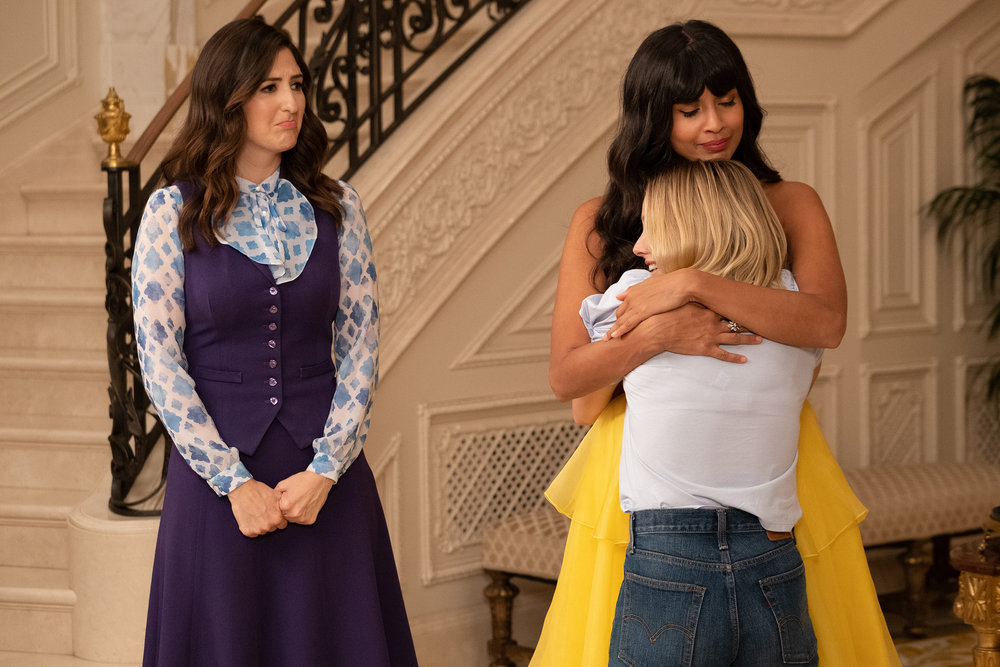
There was nothing left for Chidi to live for. He had begun reading The Da Vinci Code. Tahani and her sister grew bored of their parents’ love. Jason said something mystical about the air in his body being the same as the air outside of his body, but he, too, was probably just bored. “The Good Place went out on its own terms,” Sam Adams writes, ridiculously, at Slate; “choosing your own ending is both a reward you earn and a gift you give.” Setting aside the many problems in that sentiment alone, it doesn’t even work for the the show. The characters had control over when to walk through, but they did not choose their endings, not really: there was nothing else for them. Eternity was bleak, and after four seasons, and thousands of Bearimies, they finally accepted that. “Suicide,” Camus wrote, “is acceptance at its extreme. Everything is over and man returns to his essential history. His future, his unique and dreadful future — he sees and rushes toward it.”
Despair means literally “down from hope” — there is no reason to go on. The door in the woods represents a will to not exist. Anyone with depression will be all too familiar with this way of thinking, and it’s a bad one. Worse, here, it’s disguised as a fine one. Camus claimed that existential philosophers like Kierkegaard, even Kafka, confronted absurdity, then tried to escape it. The Good Place attempts to escape absurdity by dressing it in sentimentality, then calling self-immolation freedom. Later in the same review, Adams concedes that this seems an iffy way to end things:
Introducing a painless exit from the afterlife allowed The Good Place to punt on some of its biggest questions, like who created the universe (the highest-ranking figure we ever meet, the nearly-omnipotent Judge Gen, still feels like she’s enforcing someone else’s rules) and what happens after we die (the second time). The idea that going through the door would simply allow a person’s energy to rejoin the universe — as Eleanor took the fateful step, she dissolved into otherworldly fireflies that wafted down to Earth — felt more like New Age goop than moral philosophy.
It’s not an obstinately religious question — it’s a good one. Who is Judge Gen? And why does she have so much authority and not, say, Janet? More importantly, whose Law is she judging? (If not “whose,” then “from what”?) Arriving at the Good Place, narcissistic Tahani relapses: “The Good Place,” she sighs; “it’s the me of places! I got in. I can say stuff like that again.” One begins to wonder, why was “being good” so important in the first place? Don’t ask too many questions, I guess — it’s a sitcom!
Instead of exploring these questions, the show simply decides “eternity” must be boring. Smugly, TV critic Hank Stuever agrees:
I am reminded of raising my hand 40 years ago in Sister Joan Mary’s religion class in sixth grade and expressing this very concern: If we die and go to heaven, do we really have to stay there forever? Won’t we eventually get bored? Eternal bliss sounds like an awfully long commitment. (Sister wasn’t pleased, to say the least.)
What Stuever’s remarks tell us is that these objections are childish. Eleven-year-olds are wondering them all the time.
When you envision “eternity,” you do a poor job if you only envision material reality times infinity. If you get to break one rule — time — then you get to break them all. An honest hope would have to involve more: not only endless time and opportunity but a deeper sense of fullness, full stop — or, better, nonstop. “Without ending or beginning.” A closed circle, complete but inexhaustible.
How do you show this on a sitcom? I don’t know. Maybe you stop while you’re ahead, and let viewers fill in the blanks. Or you do something highly symbolic. Or you don’t even try, because eternity is not reality. Everything ends. Even the Sun will burn out. Even the Earth will end. Eternity is only real with faith and hope; to speak of it without these convictions will lead, inevitably, to the spooky door in the woods because humanity is riddled with death. It clouds our eyes and minds. Our real problem, actually, is not that we are “bad.” It is that we are dying. We’re broken, as Christians say. One result of this is that we function poorly — you could say “badly” — like a car with three wheels veering constantly into the ditch. More mystically, I am “a stranger to myself and to the world,” as Camus has it.
With my eyes that see dimly, eternity can only appear as a mind-melting dance club, or a “gold” or “clear glass” version of Jerusalem (hat tip, the Bible). Were I delivered there as I am, or even slightly improved, I would be zombi-fied. I would devolve in less than one Bearimy. Our question, really, is not about eternity. It is still about us, and our insufficiencies, and whether we can be made whole. The show set off to ask how we can become good, but a better question would be, Where is this broken part of ourselves? Can it be returned to us, or, in more theological terms, redeemed?
That the universe is absurd is all too apparent to me, which is why I had wanted the show to offer something more, a creative loophole, but whatever. Indeed, as Michael assured us from the beginning, “every religion got things about five percent right.” I was not expecting them to go full “God.” But “choose your own exit” feels particularly empty, so I guess I have to stick with what I have, which is hope, because I’m too weak to go on like Sisyphus. The rock is too heavy. I need an escape, otherwise I’ll go crazy and jump headfirst through the door in the woods.
“Do not let your hearts be troubled,” Jesus told his disciples. And I hope he was speaking truthfully when he said, “My Father’s house has many rooms … I am going there to prepare a place for you.” Imagine, now, the endlessly multiplying universe of The Good Place, the portals, the time jumps, the Interdimensional Hole of Pancakes — a house with many rooms. Imagine that the universe may yet surprise you — there could always be more. Don’t imagine, though, any place without something unimaginable in it: something not-of-this-world, some missing dimension. Imagine “eternity” being genuinely eternal, not just long, but opening up constantly, not with endless vacations and favorite meals, but with, instead, the one Thing who has been all too conspicuously absent from the show since the very beginning.
“O God, the author of peace and lover of concord, to know you is eternal life…”







Maybe the unsatisfying conclusion serves as an indictment of Christian preaching and pastoral care. Our forebears had long been content to male heaven into a place of endless pleasures, of floating in clouds, of happy wish-fulfillment. Heaven is simply the best of this life made forever. We have a challenge now to present a clearer vision of something that ultimately remains an incomprehensible mystery. We should rage less at the fact that others do not understand the depths of God and rage more at our tradition’s simplistic, prosaic, and infantile popular preaching that left our culture with such shallow views.
And perhaps the lesson we should embrace from this is that pleasure is not the end goal. Pleasure runs out. Maybe people will realize this, and better preaching of the glories of God will find an entrance into hearts.
CJ – this is EXACTLY what I was thinking, and it’s the post I would have written if you hadn’t beaten me to it. But I’m glad you did, because yours is better than what I was thinking!
What a terribly unimaginative and troubling ending for a show whose hallmarks are creativity and thoughtfulness! A tremendous secular letdown, for sure. The inability to imagine “The Good Place” as giving fulfillment beyond monkeys driving go-karts and every whim fulfilled is the final problem of a secular moral philosophy. To me, it reeks of upper-middle-class self-justification to suggest that the goal in life is to experience every pleasurable dopamine inducing thing and then return to non-existence. As you said, any person experiencing clinical depression would watch that episode and know exactly what the solution to his or her troubles would be.
It is true that portraying a heaven of fulfillment beyond sensorial pleasure would be impossibly difficult to do in a sitcom, but The Good Place team had done such a good job of it so far, I was stoked to see how they would navigate it. Needless to say, I’m as disappointed (and frustrated at the critical response) as you are. As bad as the ending to HIMYM. Maybe worse?
It didn’t help that, alongside The Good Place, we have “Cal” from Watchmen telling his children that when they die they go into non-existence, and when he’s confronted by Angela about it, he shrugs it off. “What? It’s the truth,” he says without remorse. See also the final half of Bojack Horseman, where Bojack hallucinates with his family and friends about the terrors of non-existence. When did it become so brave (or so vogue) to embrace annihilation?
I think the embrace of annihilation comes from the beliefs of the creators of those shows. Mike Schur has said that he doesn’t think there’s an “afterlife” of the sort depicted on The Good Place, nor do either of the two philosophy professor/consultants for the show (Todd May and Pamela Hieronymi). I think their lack of belief and imagination just gets transfused into the storytelling. The fact that so many TV critics loved the ending probably – although I can’t say definitively – reflects their agreement with that sentiment.
I guess I didn’t mind the ending so much, but only because I felt like it worked as an analogy for our earthly lives. We live amid abundance and, in the western world, satiation to a degree unimaginable in human history. For all that we suffer and fail, there’s a lot to enjoy. Thus, the idea of an “ending” worked for me as an analogy for bodily death and the passing away of our former materialistic/earthbound selves. Eleanor’s pain in letting Chidi go takes on real emotive power if you think of it as her having to accept his finitude and death, and by extension, her own. Of course, you could argue that because this is all supposed to be happening in an afterlife that the analogy doesn’t make sense, but it worked for me.
First, thanks for putting into really well-written words what has been on my mind since the finale.
Entertainment Weekly did an interview with Kristen Bell about the series finale and I found this answer fascinating. https://ew.com/tv/2020/01/31/the-good-place-finale-kristen-bell/
EW: The time knife really cut both ways on that finale, offering bursts of happiness and satisfaction, but also some brutal, bottom-lining, that’s-the-way-the-system-works sadness. Which concept hit you the hardest: That even in the forever after we wrestle with mortality or endings or the great unknown? That the joy is in the mystery?
Kristen Bell: The fact that once you have everything you’re striving so hard to earn, it’s still not enough. That what you need to earn is the acceptance of the complex internal decision to let go. It was so beautiful how they made everybody mush in the Good Place because it’s true. There’s one line that really sums it up. “A vacation is only so fun because it has an ending.” If everything were bliss, would everyone be happy? I don’t think so. Part of the drive and the passion is why it’s the journey, not the destination. And I was very happy with the tough-love ending that happened.
This actually reminded me of another “unsatisfying” final season from last year: Game of Thrones (umm, spoilers?). In the behind-the-scenes feature on “The Bells” Emilia Clarke, who plays Daenerys, explained why Dany decided to torch King’s Landing she said it was because she had finally gotten everything she wanted; she had won, but it wasn’t enough.
I find it interesting that the theme of enough was mentioned by both these women who played one of the main protagonists in this massive TV shows that recently ended. This means that both shows were seeking to answer the question of enoughness and neither one found enough in the way either of their very different character trajectories.
In both shows enough isn’t found in ourselves, our goals, or each other. But neither show actually tells us what enough looks like either. Dany seems happy to have laid waste to King’s Landing but still wants to conquer more lands – she still is not enough unless she’s ruling the world. Sure, you work hard to find your peace with yourself, your actions, and each other on The Good Place. But it isn’t even enough to live with that peace. You even find enough-ness in The Good Place so your only option left is walking through the door.
The Bible passage I found myself reflecting on in light of what The Good Place put forward was Revelation 21 – the picture of a new heaven and new earth, no more tears and mourning and dying, and God making all things news and dwelling among God’s people. In contast to the ending of The Good Place I find immense hope in these promises – hope in everything being made new and by being God’s I am enough.
Also, the Atlantc now has a good write-up on this. https://www.theatlantic.com/culture/archive/2020/02/good-places-finale-made-heaven-look-hopeless/606001/ Again, it helps those of us who were very unsettled by the finale know we are not alone!
CJ, you really hit the nail on the head. “Heaven” isn’t just a recapitulation of earthly life.
THANK YOU! I’ve written this comment twice now and I simply can’t write it in a satisfactory manner without it being two pages long. Because I have oh so very many thoughts. And I just went in circles with this ending for hours. Which was the brunt of my second time writing this comment. But I assume you all know what I mean.
I tried to understand what the the characters would actually feel in that situation. Tried to actually engage with what was written. Found it ridiculous anyways. I tried to give the writers a break. A little grace. Gave myself the old “We’re all finite, imperfect beings who can’t comprehend eternity” speech. To say that they could never have gotten this right anyways. But… I mean. Just. Eck! Poor choices. A lot of them. Led to this being the ending they aired. I mean. You have to write it this way from the beginning of the season. Workshop it. Rework it. Workshop it again. Perhaps once they started shooting it it was just a sunk cost mentality. I mean. I’m looking for how on earth they got to this point. And again. Circles. Around and around. I know they don’t think like I do. Different presuppositions. And from a philosophical point, they ran into the Gordian knot that is the concept of ‘meaning.’ And a slew of other things. But. Like. Oy! Landing on non existence being preferable to existence…. The headache I have from making incredulous furrowed brows!
I think I’ve come up with one statement that I think is pithy and I wanna keep from my first attempt at this comment.
Did they really try to argue that you get so satisfied that you’re… no longer satisfied? I mean. Am I wrong? Is that not essentially what they ended up saying. I mean…. How do you get to the conclusion that being at peace means choosing to not exist? If that’s something you can only understand if you’ve been existing for a quadrillion bearamies, I think I’m ok with that. I’m good with my brain that is still expecting death. Again. Circles again. I’m not sure finite human beings who can’t help but be influenced by death can imagine outside of that paradigm. Not actually. You can think you can. You can attempt to. But I’m not sure you can. And that’s what I think the problem was here. I don’t….
I am at a loss….
This third attempt is going to just get longer and longer if I don’t stop now. You get the point I imagine. I don’t need to lay it all out for y’all. I definitely have the need to show that I’m a smart person who knows things and struggled with different things. But I think just showing my immense frustration is perhaps a better choice. It at least doesn’t insult everyone’s intelligence. It was emotional because you’re already emotional with all the endings. But then sitting there all this annoyance and rage and incredulity was just pouring out of me along with the tears and it was a bit of a rollercoaster. Sadly this is the shortest version of this comment.
Anyways. Thank you for a solid write up. It lets me know I’m not crazy.