




Long before it was known as Halloween, on October 31, 1517, Martin Luther posted to the bulletin board of his local church a list of 95 theses he wished to debate sometime soon. Earlier in that year the archbishop of Mainz had come through town selling indulgences, and the lowly university professor believed the practice to be a terrible blasphemy. Little did Luther know at the time, but his theses would soon incite revolutionary reform. What began as a dispute over indulgences struck to the core of who God is and what it means to be a Christian. For Luther and many who would follow in his wake, salvation comes solely by grace through faith: not by indulgences, papal degrees, penance, or good works of any kind. If the church believed it to be the sole arbiter of divine grace, Protestants argued that Christ was their sole mediator and advocate. A mere hammer and nails would spark a fire, from Germany to the ends of the earth. Reformation Day is a celebration of Luther and the warmth of the flames he lit on that October 31st day.
So is Reformation Day worth celebrating?
For some, the fires of the Reformation were more like an unruly and destructive wildfire. Instead of a day of celebration, it is a day of mourning what was lost. To them, Luther marks a decisive inflection point in Western history, from which we are all now currently suffering its consequences. With its emphasis on justification by faith alone, new and perhaps disastrous ideas spread like a contagion across the globe. To these critics of the Reformation, life seems to have been better before Martin Luther nailed his theses on the Wittenberg church door. Protestantism is to blame for individualism, iconoclasm, religious wars, democracy, disenchantment, and ultimately atheism. Whereas before everything and everyone had a place within a divinely ordered cosmos of mystery, the sacraments, the intercession of the saints, and the divine right of kings, now there is chaos. Because of Luther, we live in a post-Christendom world, with closed churches replaced by vape shops and dance clubs.
In his monumental book, A Secular Age, Charles Taylor argued that the transition from premodernity to modernity began precisely 500 years ago. Here, the proto-reformational movements that might have corrected the errors of high medieval Catholicism spilled out into the radical reforms of Martin Luther and John Calvin: “The Reformation as Reform is the central story I want to tell – that of the abolition of the enchanted cosmos, and the eventual creation of the humanist alternative to faith” (p. 77). Without Luther, there is no Nietzsche, Camus, Hume, or the French Revolution.
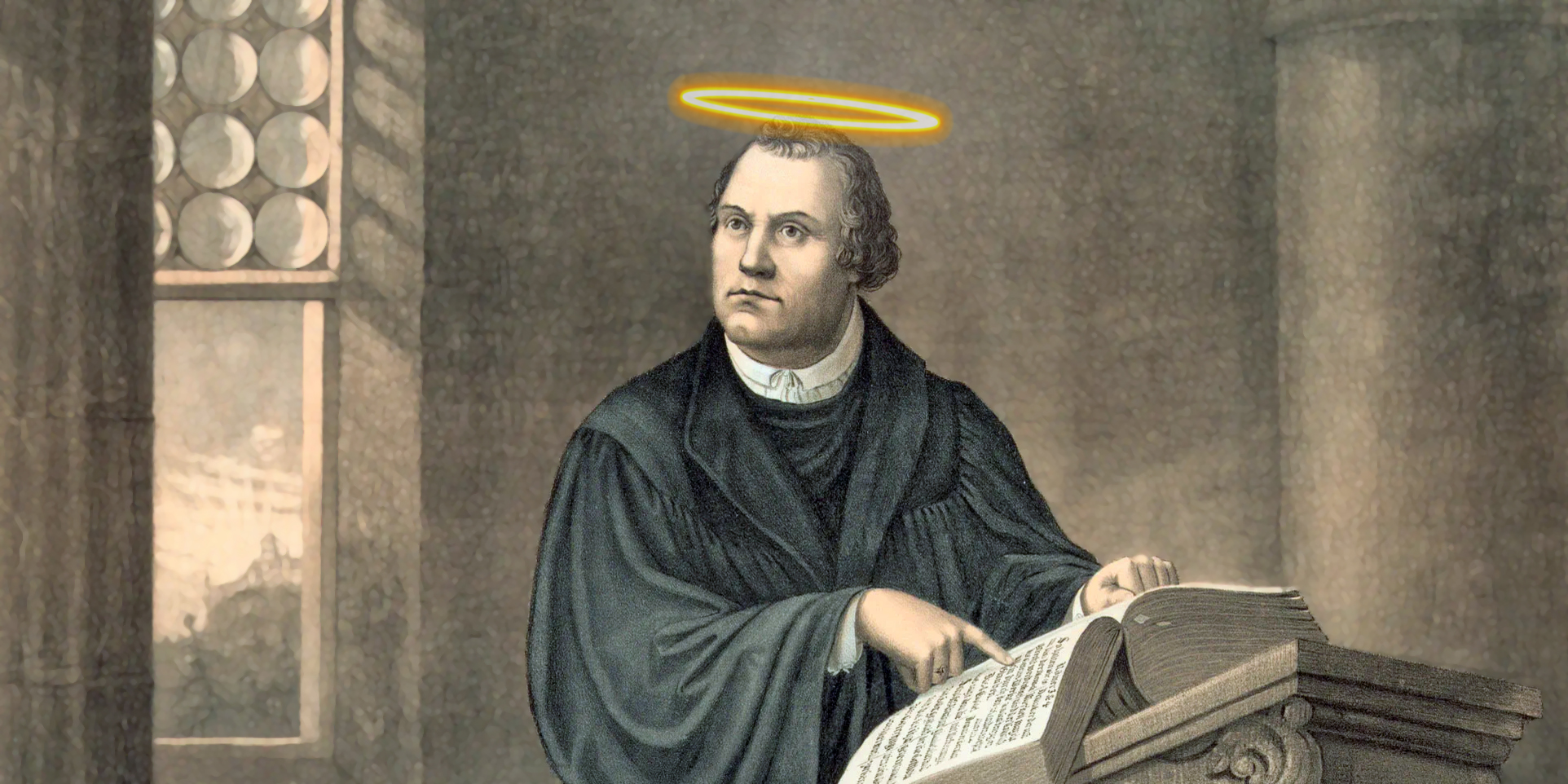
Now, that’s a lot to lay at the feet of one person, and some argue the chains of causation that link Luther and Nietzsche could be less direct than Taylor and others have asserted. But the meaning of history’s drama is not bound by the intentionality of its actors, just as the significance of scripture is not determined by the strict confines of the historical circumstances of its composition. Though Luther would indeed lament both modern atheism and individualism, he was nevertheless the first to embark down a path that made such destinations possible.
Outside of the death and resurrection of Jesus himself, any momentous event will inevitably lead to unforeseen pernicious outcomes. In 1888, the French inventor Louis Le Prince successfully created a device that was used to record two seconds of people moving around a garden. This breakthrough was followed by new iterations of cameras by Thomas Edison and others that were eventually first used in movies. Further innovations would spawn the age of television, when every house could see movie pictures right in their living rooms. Fast forward just a few decades and now cameras are everywhere: in our pockets, in our cars, on cyclists’ helmets, in doorbells, above baby’s cribs, and zooming around the atmosphere. Le Prince had no idea his invention would ever be used to drop bombs, let alone TikTok. Now, is Le Prince to blame for the crisis in teenage mental health? In an almost absurd sense, he is. The ability to see ourselves played back to us on screen fundamentally changes our self-understanding, giving rise to increased anxiety and self-consciousness that reaches a fever pitch in the digital age. Similar arguments could be made for Le Prince’s role in the creation of surveillance states, drone warfare, and the 2002 live-action film Pinocchio (which currently boasts a 0% rating on Rotten Tomatoes).
In this way, assessing history by the ripples emanating outward from an event suffers from a myopic limitation of data. Such a claim might seem odd, considering how distantly the chains of causality can be contrived. But to confidently say that Luther can be held responsible for twenty-first-century secular postmodernity overlooks the broader question of what might have happened had he never existed at all. What if Luther had been struck by lightning before ever becoming a monk? Or if Luther’s father convinced him to remain a lawyer? What if there were no Reformation Day to celebrate at all? Such questions certainly sound like the stuff of science fiction, but measuring the hypothetical world against what actually came to be far better reveals the measure of its significance.
Without Luther, the scope of reform in the sixteenth century would likely have been dominated by the ideas held by the Dutch priest, Erasmus of Rotterdam, a leading figure of the humanist movement from which Luther would launch his career. The elder, well-known Erasmus and the young Luther actually had a great deal in common. Erasmus too wanted to reform the church, even advocating in his 1516 Latin translation of the New Testament for further translations to be made in all languages. But the elder humanist simply wished to dispel Christianity of superstition and had no designs on altering its fundamental theological beliefs. To Erasmus, Luther was the “doctor of overstatement” while Erasmus himself remained judicious, measured, and far more practical. In this hypothetical world, the church would perhaps have seen small, incremental reforms. The broader landscape of Europe would be marked by less political upheaval precisely through the continuation of its existing hierarchies.

But whatever might have potentially been gained by way of social stability comes at the expense of Luther’s most innovative ideas. Without Luther’s singular blend of unparalleled genius, inconsolable despair, and dogged intransigence, the Augustinian renaissance sweeping across Europe would likely have proceeded along a more domesticated trajectory, one that never approaches Luther’s insight that the righteousness that saves is an entirely alien righteousness requiring no human cooperation.[1] Because while the issue of justification was indeed a hotly debated concern of many before and during Luther’s time, all remained committed to threading the needle between faith and works. Salvific grace might be given by God, but it does so as a continual process whereby humans are made more righteous. At a time when preachers exhorted their listeners to “use what God has already given you,” Luther proclaimed that God has already given you everything.
By placing righteousness before good works, Luther takes the existing paradigm of grace and turns it entirely on its head. Rather than something to one day achieve, salvation becomes good news of a belovedness already given, of a kindness shown to enemies, of a generosity shown regardless of whether it will be reciprocated. The life of the Christian was not spent living up to God’s call to holiness, but a radical freedom to love as God first loved us.
In ways that would frustrate his contemporaries, Luther wouldn’t follow through with every implication of his great insight. If one has already been justified by divine pronouncement, then one has no need of a church that positioned itself as the sole merchant of God’s grace. If one could learn about God by simply reading the Bible, then one didn’t need the dogma of the church to lead one astray or confirm what God has led you to believe. Those who came after Luther would abolish the Catholic Mass, destroy religious imagery, rebel against kings, and overthrow bishops. They would use the Bible to question long-held beliefs in ways Luther would have never imagined when wrote his 95 theses.
While many today will celebrate Halloween with candy and costumes and cosplay-horror freights, I think it fitting to commemorate Reformation Day in the same spirit, imagining what the world would actually look like if Luther had never darkened the doors of that Wittenberg church. As much as Luther’s ideas would spawn a world many find so lamentable, it is far more horrific to imagine a world in which the gospel Luther discovered while reading his Bible never sees the light of day. A world where the burden of sin is not relieved by God’s comforting word, but compounded, adding obligation upon obligation. Where divine love is withheld to those who are not worthy of it and the fear of damnation looms over every fork in the road. As confusing and disillusioning modern life can be, it is far, far better than it could have been.
[1] This holds true whether one examines roughly contemporary Dominican, nominalist, or Augustinian theologians. For an interesting Italian parallel to Luther dating to 1510 onwards, see Alister McGrath’s Iustitia Dei: A History of the Christian Doctrine of Justification, third ed. (Cambridge: CUP), p. 310-318.








We discuss the failures of virtually all historical and biblical figures. Come out and say he was a proponent of killing peasants during the uprising and a rabid antisemite who pushed to have Jewish people’s property confiscated, their civil protections, removed, and yes, their deaths. He never recanted these views or the books he published. Now is a good time for a real horror story about a man whom no one should applaud. Reform that.
Lutheranism for the win. You get the beauty of salvation by grace through faith in Christ AND you get the sacraments. Christ’s true flesh and blood for you.
Without diminishing Luther’s influence could we not just celebrate All Hallows Eve? We are all sinners and just leave it at that (once a year in this case)?
If not Martin Luther, then it might have been someone else. This whole argument leaves out the Holy Spirit.
Responding to Cheryl. You are quite right regarding Luther’s civil rights views. Yet Luther’s grasp of grace is what has led Christians out of such culturally embedded views. In Paul’s letter to Philemon, clearly a fellow believer, Paul does not chastise him for having held Onesimus in slavery. Nor does Paul question that Philemon has faith while continuing this abhorrent practice of slaveholding.
Our views of how people should behave are anachronistic and culturally formed. I’m sure there is a lot that we miss about ourselves that we ought to consider when standing in judgment regarding some of Luther’s failings.
That salvation isn’t good news for all people is such a sad indictment on the proclamation of the church.
“ The life of the Christian was not spent living up to God’s call to holiness, but a radical freedom to love as God first loved us.”
Thank you, Todd