




You might have heard by now, but a few days ago the sun was temporarily obscured by earth’s nearby satellite planet. With nearly half the country residing within striking distance of peak totality, the anticipation and fervor was sky high for what some deemed to be the ‘most extraordinary sight nature has to offer.’ Many marveled at the role solar eclipses have had throughout history, the enchanting experience of seeing day turn to night, or how rare such an experience is in the entire universe. Alongside the enthusiasm was an excessive paranoia. A host of conspiracy theories spread across the internet. Schools were closed for fear that students might accidentally blind themselves by beholding the spectacle without protective eyewear. When the day finally came, millions traveled to gaze at the splendor amid a carnival-like atmosphere complete with burgers, music, psychedelics.
The science of solar eclipses is fairly basic: the moon’s size and distance from the earth is the exact proportion as the sun’s size and distance, such that they both appear the same size in the sky. But the hysteria surrounding the event of a simple shadow was anything but simple. People have been worshipping the sun for millennia, and understandably so. Sitting at the bottom of (nearly) every ecosystem food chain, life on earth would not exist without the warmth and light provided by our celestial power source.
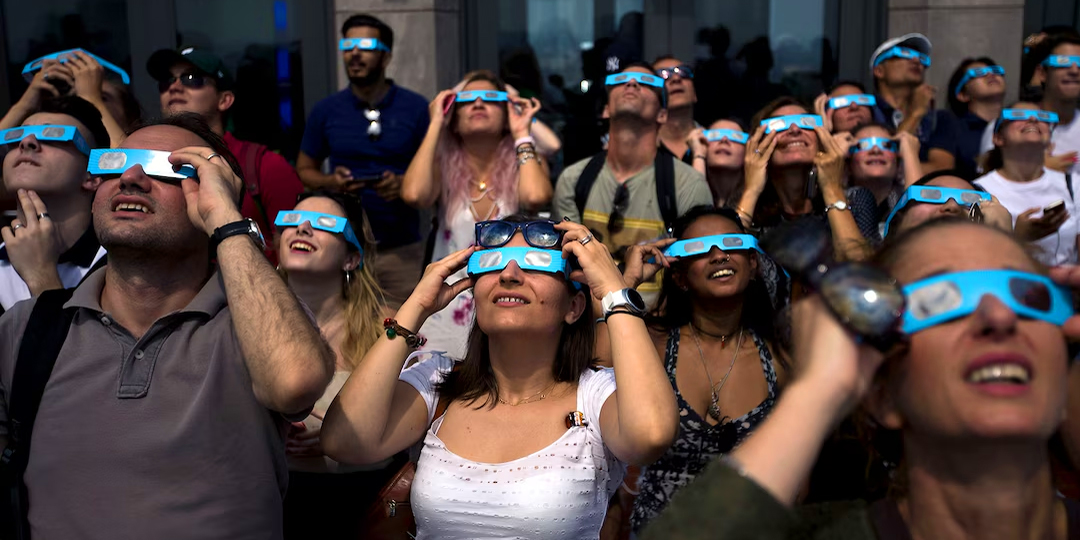
Even still, I’m unconvinced the hype was all that merited. No, I didn’t shell out $800+ for the gas, food, and Airbnb to possibly see four minutes of premature darkness and a sunglasses-filtered view of a glowing corona. I’m sure it was very ‘cool’ to see, but calling it “life-changing” strikes me as grasping at straws. If only it were possible to do so for so cheaply, so quickly. An eclipse is spectacular, in every sense of the word, but revelatory seems a bridge too far.
If there was any marvel on Monday, it was the way such a supposedly rational, scientific, post-enlightenment society gaped at a black sky and believed it briefly touched transcendence. We might not believe in Zeus, Thor, or for that matter God, but we still long for enchantment, to rise above the brutal, Newtonian causality of everyday life by peering behind the veil to a reality that is as inexplicable as it is real.
We might have unimaginable technologies, ubiquitous air travel, and the sum total of human knowledge at our fingertips, but there remains an insatiable desire to feel like there is more to life than what we’ve already made of it. These aren’t entirely unrelated. As the world has grown smaller, more rational, the greater the need there is for experiences that exceed the mundane. When the extraordinary becomes quotidian, enchantment must come from the increasingly exotic. Already climbed Mount Everest? I hear the views from space are breath-taking. Perhaps second only to a desire to be known and loved, the desire for enchantment touches most aspects of everyday life.
It’s no surprise, then, that enchantment is big business. Cruise liners aren’t just voyages at sea; they are an adventure of a lifetime. Movie theaters don’t just offer the entertainment of a big screen, but rebirth (see the above AMC ad). We read books about vampires, wizards, and larger-than-life superheroes. We scroll apps that provide both escape and enhanced versions of reality. The products we buy promise more than their mere utility: a better life, a better you, a better world.
Never one to be one-upped by Wall Street hedge funds, the church has likewise stepped up its enchantment game in a variety of ways. One approach has been to emphasize God’s superabundant presence within the ordinary, small things of life, a kind of medieval mysticism for middle-class suburbia. Everything, it is said, is sacramental: revealing God’s presence and character to the one who has eyes to behold him lurking ‘in, under, and with’ the unremarkable everyday occurrences. This view is not without scriptural warrant. As the psalmist David declared, “Where shall I go from your Spirit? Or where shall I flee from your presence?” (Ps 139:7). But if everything is sacramental in precisely the same way, nothing is actually sacramental. If God discloses himself equally everywhere, we are either overwhelmed by the ubiquity of a God who can’t seem to be pinned down or delighted to find a God who agrees with us entirely.
Another response to the competitive marketplace of enchantment pushes in the opposite direction. Rather than elevating the everyday to sacramental status, the church should become more extraordinary and less profane. Equating antiquity with authenticity, the answer to the crippling burdens of modernity is a return to more premodern forms of belief and practice — the weirder the better. In this way, traditional Latin Masses, mood lighting with fog machines, and Christian Solstice celebrations can be guided by the same aesthetic impulse: to provide an experience that enchants by being as distinct from everyday life as possible. But this approach readily confuses enchantment with irrationality by needlessly setting thinking and feeling at odds with one another. For example, the rise of evangelical sacramentality can be seen as an attempt to make Sunday morning worship feel more sacred precisely at the expense of the supposedly rational, logocentric preaching. When the sacraments are pressed in service of enchantment, they lose their cruciform character to become yet another theology of glory. When the church takes part in the enchantment arms race, it obscures the very thing that makes it so unique.
Christianity is very much weird and decidedly not modern, deserving of devotion and awe, but its glory and splendor always appears in the form of its opposite.
Standing outside and peering at strangeness of a midday twilight, I couldn’t help but think another solar eclipse that occurred some two thousand years ago. In the hours before Jesus gave up his spirit, we’re told that darkness covered the whole land for three hours. In the ancient world, crucifixion was intended by the Romans to be a public spectacle, a display of absolute Roman power. Crowds would gather to see the condemned have their life slowly drained from them. While the heavens might declare the glory of God, on that day God declared who he really was: a condemned criminal who died for the sins of the whole world.
I wonder which spectacle that day more drew people’s eyes. Was it the inglorious death of Jesus or the enchantment of the sky? Which event was more worthy of their fervor and devotion? While many marveled at the heavens and turned to behold the obscured sun, the world was being redeemed by the one from whom they hid their faces. Those who seek enchantment will rarely gaze at a crucified messiah.
God did not arrive in this world with his power and majesty, but in humiliation. Though we seek to be enchanted by the glorious or incomprehensible, by that which exceeds the doldrums of the everyday, God enchants our hearts through the very thing we would never choose ourselves. Through suffering and shame, weakness and need, and a man who forgives the world with his dying breath.








Todd this is a banger… Not just for the sake of being contrary, but the clamor for transcendence really betrays itself.
I recently read Alice Munro’s “the Moons of Jupiter,” about a woman very unimpressed with her visit to a planetarium, which simulates “the awe that people supposed they ought to feel. Awe—what was that supposed to be? Once you knew what it was, you wouldn’t be courting it.”
Thank you for this article. We do need to be re-enchanted and lift our hearts to the heavenly realms in order to return to earth and see the glory of beauty of Christ.
Todd – would be interested a whole essay unpacking this powerhouse of a sentence: “When the sacraments are pressed in service of enchantment, they lose their cruciform character to become yet another theology of glory.”
This was actually the first line I wrote for this piece and I’d love to flesh it out more at some point.