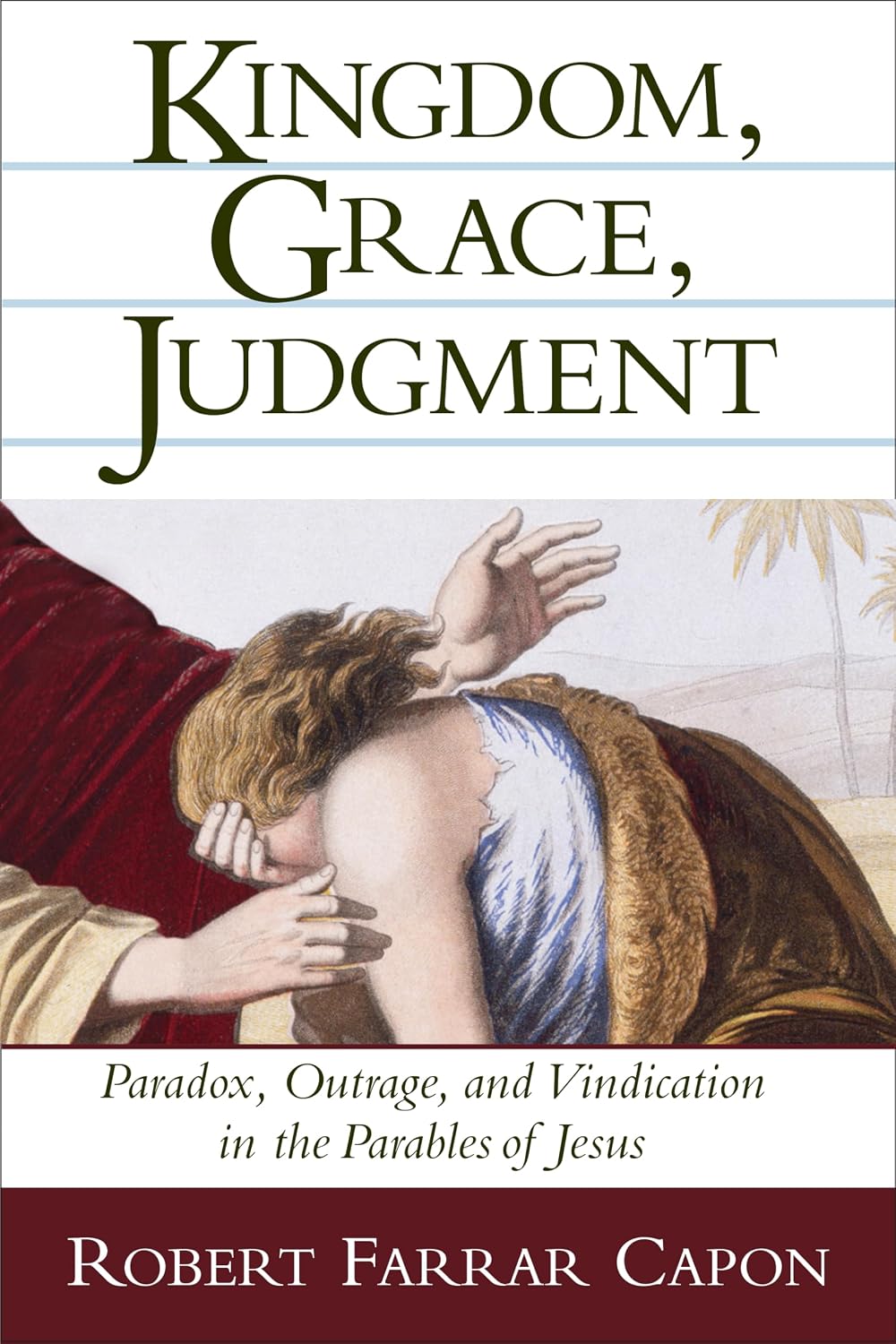
Welcome back to The Capon Corner, where we are diving into the deep dish that is the writings of Robert Farrar Capon. We’ve begun our feast with what is, arguably, his most ambitious and satisfying of offerings, Kingdom, Grace, Judgment — Paradox, Outrage, and Vindication in the Parables of Jesus; his three-volume book on the parables of Jesus which, I promise you, does not disappoint. As my favorite obsessive-compulsive private detective Adrian Monk would say, “You’ll thank me later.” For what so many books about Jesus’ parables fail to recognize, and what we will see under Capon’s tutelage, is that if we think we understand the parables on their face, it’s a sure sign that we’re doing it wrong.
And if we’re doing that wrong, well, it’s pretty safe to say we’re doing most everything about Jesus wrong. It’s a pretty remarkable thing, but if you inventoried your red-lettered Bible, you’d find that Jesus prefers to teach with parables (and that goes for John too, btw — but that’s a subject for another day). In those off-chance times we actually do see Jesus say something in non-parabolic form, they happen because Jesus’ disciples have relentlessly pressed him to please stop talking in parables and just get on with it already! And what happens is really quite funny, because when he does finally speak plainly — explaining, in the most literal fashion, that the Messiah must die and then be raised on the third day from the dead — the disciples are only the more confused! “What the heck are you talking about?” is the approximate Greek. Jesus’ reply is a simple, “Good grief.” (Lk 18:31ff; note: none of the earliest manuscripts record Jesus actually muttering “Good grief,” but the sentiment is clearly implied.)
What might be funnier is that at one point, the Gospels record a moment where the disciples try to feign “getting it.” It occurs not long after the parable we’ll look at today, in Matthew 13:51, where Jesus asks them whether they “understand all these things.” Capon compares it to a scene right out of high school, where the disciples — too embarrassed to say otherwise — mumble that “yes, they do,” only to, moments later, come back to him asking if he would “explain it just one more time.” Not for themselves, of course, but for the slower-witted guys in the back of the room. Yeah, those guys.
But in truth, we’re all those guys. Despite two thousand years plus worth of books and sermons on the parables, they’re no less mystifying to us than they were to them. And that, ironically again, is precisely where Jesus wants us. Jesus doesn’t do parables to help us understand. Jesus tells parables — by his own account and Isaiah the prophet’s — in order to un-hear us, un-see us, un-understand us, so that we might simply believe, and thereby receive, the kingdom of God. “The disciples’ relationship to the mystery of the kingdom,” and ours, says Capon, “is based not on their knowledge or performance and certainly not on their guesswork about God’s plans; it is to be rooted only in his promise. They are to believe only in the King. Everything else is out of their hands, beyond their ken, and both literally and parabolically, over their heads.”[1]
Last time out, I looked at “The Parable of the Publican and the Pharisee” in what Capon called “Jesus at his parabolic best.” This week I thought we’d rewind the tape a little and take a look at “Jesus at his parabolic first” in what is called “the parable of the Sower,” what Capon calls “the great watershed of the parables, out of which flow the whole body of Jesus’ parabolic teaching (Mt 13:1–9; Mk 4:1–9; Lk 8:4–8).”[2]
The parable is a familiar one, I trust. It goes basically like this: a man went out to sow seeds and proceeded to cast them about literally everywhere, in indiscriminate, seemingly careless and haphazard fashion, as if the sower of the parable turned out to be none other than everyone’s favorite British farmer, Jeremy Clarkson, on his Lamborghini tractor, zigzagging across England’s fields, byways, and pubs, scattering seed in a stunning display of unstrategic zeal! Some seed falls on the roads, some in his or his neighbors’ fields, others on village sidewalks, some in the thorns. And yet some manages to actually find, and root itself, in good soil. And that pretty much is the parable. All the seed does something but in varying degrees and for various durations.
The parable itself comes entirely out of left field (all puns intended), without even the hint of a preface. Each of the synoptic authors, Capon points out, “just begins with it, unadorned by any commentary … [Jesus] does not say what he is talking about; he simply launches into a seemingly straightforward story about a farmer whose scattered seed falls into four different situations.” And though, “obviously he is talking about something other than agriculture, as to what the other subject is … he gives not a single clue!”[3] Add to that what will become Jesus’ signature closing, quoting Isaiah: “He who has ears, let him hear.” Mic drop; Jesus out, much to the dismay of the disciples — and by extension, us — who pull him aside to ask him what on earth he was just doing back there?!
Jesus has an answer, an equally cryptic and not the least bit demystifying one. First, he says that “to the disciples has been given to know the secrets of the kingdom.” He then quotes Isaiah yet again, this time as a sort of explanation for why he has chosen parables as his didactic form of choice: “that they may look yet not see, listen, and yet not understand, lest they should turn again and be forgiven.” If ever there was a counterintuitive pedagogy, this is it. Isn’t the whole point of Jesus’ ministry repentance and forgiveness?! And as for the disciples being in on the secret, well, so much for that! The only thing Jesus seems to have succeeded in doing is in baffling them supremely. An unpacking, he decides, is in order.
Perhaps you think that unnecessary. “Haven’t we heard this parable since we were kids?” you say. I’d wager you have. And if I had to wager how you’ve heard it, I’d guess in one of three ways, just as I had: as diagnostic (an explanation as to why some people get saved and others don’t; answer: they weren’t good soil); as cautionary (you’d best be sure to end up as good soil); or as motivation (better get out there and spread that seed on the good soil). But each of these begin with a fundamentally erroneous assumption, Capon points out: “Whom do we usually identify as the Sower?” he asks. “We think it’s Jesus, don’t we? And we have in our minds an image of him — and then of ourselves as the church — going around sprinkling something called the word of God on places that haven’t yet received it. But … that makes no sense at all,” he goes on to explain, for “the primary meaning of the phrase the Word of God in the New Testament is … the one who was in the beginning with God and who is, in fact, God himself … the Word [then] has to mean the eternal Son … and do you see what that says? It says first of all that the Sower is God the Father, not Jesus.”[4]
And so right out of the gate, it turns out, we’ve already gone off course. Contrary to what we’ve been taught and naturally thought, the parable turns out, much to our disappointment, to not really be about us at all! “It means,” Capon says, “that on the plain terms of the parable, Jesus has already, and literally, been sown everywhere in the world — and without a single bit of earthly cooperation or even consent.” From us, or from anyone else for that matter. So much for all the aforementioned likely sermons we’ve heard. In tragic irony, we find our preachers — who unfailingly read parables the same way we do, as being first and foremost about us and what we must do — caught with their proverbial pants down. Just as the sermon is getting its real start, we have already “ended up just as [Jesus] said we would as a result of his explanation of the Sower … We see and hear and still don’t catch on.”[5]
Instead of the parable being about what we must do for the kingdom, “In short we find Jesus asserting that in himself — in his death, resurrection and ascension — whatever is necessary for the fullness of the kingdom has been accomplished, purely and simply by what he has done.” Capon continues,
From the parable of the Sower to the end of the New Testament, we are watching the opening of a bud into full flower … the Word is sown in the field of the world, he dies, rises, and vanishes (in ascension). His entire work proceeds as does the work of a seed: it takes place in a mystery in secret — in a way that as Luther said, can neither be known or felt, but only believed and trusted … the story as told rests squarely on the sole agency of both the seed and the Word … the seed [as seed] is fully in action in and of itself at every step of the story. Everything necessary for its perfect work is in the works from the start.[6]
This is what Capon is getting at by calling this parable “the great watershed” out of which all Jesus’ parables flow. The entire catalogue of them asserts repeatedly, to borrow from Capon’s summation of another parable, “the passion of the Finder to find.” Or as Lutheran pastor-theologian Jim Nestingen put it in preaching another parable, God’s relentless insistence that “he will have his vineyard!”
What we’re bothered by, Capon suspects, is the seed’s apparent abysmal performance. We could agree, with Meat Loaf, that “two out of three ain’t bad,” but here Jesus seems to be flirting dangerously close to the Mendoza Line, a whopping one for four! But Capon challenges our assessment standards:
Consider the seed that falls into the other three situations. In all of them — whether the rocky ground, in the thorny underbrush, or in the well-prepared soil — the seed actually does its proper, reproductive work: it springs up. True there are differences in the outcome … but what needs to be emphasized here is that the differences can never be interpreted as meaning that the operative power of the seed … is in any way dependent on circumstantial cooperation. Perversely though, we seem to enjoy that interpretation … Sure, we have said, “the Lamb of God has taken away all the sins of the world.” But then we have proceeded to give the impression that unless people did something special to activate it, his forgiveness would remain only virtually, not actually theirs … That unless they confessed to a priest, or had the sacrifice of the mass applied specifically to their case, or accepted Jesus in the correct denominational terms — or hit the sawdust trail, did penance, cried their eyes out, or straightened up and flew right — the seed, who is the Word present everywhere in all his forgiving power, might just as well not really have been sown.[7]
Capon concedes here, as he often does in this book on the parables, that we may feel he’s “just pulled a fast shuffle on us.” Perhaps so, but only for the purpose of diverting our seeing eyes and hearing ears from the story they so naturally long to see and hear; the one where the good guys are vindicated and the enemies of God get it in the neck. Instead, the overwhelming insistence of the parables from start to finish is the success of God’s kingdom, despite the resistance it faces — not even despite the fact, come to think of it, but somehow in mysterious concert with the resistance, like a divine jiu-jitsu move. Says Capon, “The idea that the Good News of the kingdom is proclaimed in a hostile environment is written all over the New Testament.” Indeed, Capon continues, “Antagonism is every bit as much the soil of the Word as is acceptance.”[8] Yet, “the first thing to be insisted on is that all the antagonism in the world has already been aced out. Not overcome by force as we would have done — not bludgeoned into submission or out of existence — but precisely aced out: finessed, tricked into doing God’s thing when all the while it thought it was doing its own thing.”[9]
As a case in point, Capon takes that which appears to pose the greatest threat to the seed — the birds which carry it away — and insists “but this is no place to get upset … Like the birds that nibble on the seeds and then pass them out of their bodies unimpaired, the devil has no power against the word. Nobody” he assures us, “not the Devil, not the world, not the flesh, not even ourselves can take us away from the love that will not let us go.”[10]
But the question keeps nagging at you, I suspect, as it does me; “Yes, but what about the good soil, how does the seed find it?” More to the point, “How can I be sure that the seed finds me; how does one become good soil?” Jesus has an answer for that too, as I’m sure by now you’ve come to expect he would — he makes it himself.
At this point I introduce another parable, and even as I do so I fear you may accuse me that, like Capon, I too am pulling a fast shuffle. But as he is good to point out, Jesus’ parables are part of a corpus, a body, a catalogue, and as the rest of the Bibles does, they take liberty to preach unto and interpret one another. Even as we here, in this Capon Corner of ours, pull the parables out one by one and turn them over, we do so not in isolation from one another but instead in light and lieu of the others. And so we turn then to another parable, what we have come to call “The Barren Fig Tree” (Lk 13:6–9). I promise to be quick here and cede the floor again to Capon; “Consider the story. A certain man has a fig tree planted in his vineyard and he comes to it looking for figs and finds none. So he says to his vinedresser, ‘three years I’ve been trying to get figs from this tree and it hasn’t produced even one. Cut it down. Why should it use up ground?!’ But the vinedresser says to him, ‘Let it be Lord (aphes, the Greek for “forgive it’), for one more year, till I dig around it and put on manure.’”[11] Watch how Capon finishes it:
The world lives, as the fig tree lives, under the rubric of forgiveness. It thinks, of course, otherwise … that salvation is a pat on the back from a God who thinks we are good eggs … but by the foolishness of God that is not how it works. By the folly of the cross, Jesus becomes sin for us, and he goes outside the camp for us, and he is relegated to the dump (Gehenna, often translated “Hell”) for us, and becomes the garbage, compost, offal and manure for us … and he sends our roots resurrection.[12]
Now if you’re thinking along the lines of all those sermons we’ve likely heard, you’re thinking, “Yeah, Jesus does send resurrection roots … for all the people who have the good sense or the good heart or the good whatever it is to accept him.” And to that I would say, I think you’re missing the point. The point of the parable is that none of us are any of that. There are no “good eggs,” as Capon points out. The fact is that there is no good soil — until Jesus makes it so. By him, and the mystery of the cross, the cursed ground, thorned and rife with stubborn resistance, is made into good soil. And so the parable turns out, Capon shows us, not to be at all about any of the things we with our blind eyes and deaf ears made it out to be. Instead, the savior of the whole world turns out to be just that; the one who comes to save the whole world.
You feel I’ve pulled a fast shuffle of my own? Perhaps so. But only at the encouragement of Jesus to do so, and to hold him to his word. Here is how Capon sums up the Sower; “The final concern … of the Word himself, is nothing less than the reconciled you and me that he longs to offer his heavenly Father. He did not become flesh to display his own virtuosity; he did so to bring us home to his Father’s house and sit us down as his bride at the supper of the Lamb. He wills us whole and happy, you see; and the parable of the Sower says he will unfailingly have us so.”[13] Amen, and so let it be.
Josh Schatzle is the Co-host of the podcast Lectionary After-Party (In Case You Missed It).
[1] Kingdom, Grace, Judgment, 41.
[2] ibid, 57.
[3] ibid, 57–58.
[4] ibid, 60–61.
[5] ibid, 61.
[6] ibid, 63, 68.
[7] ibid, 69–70.
[8] ibid, 70.
[9] ibid, 70.
[10] ibid, 71.
[11] ibid, 248–249.
[12] ibid, 250–251.
[13] ibid, 74.