




This essay appears in Issue 24 of The Mockingbird, now available to order in our store.
At the barbeque in Western Kentucky, the women ask me to pull my skirt tight, the better to see the shape of my stomach. They lean over plates of pulled pork and potato salad, turn their heads to the side and squint. They want to see if I’m carrying “low” or “high” in order to ascertain our baby’s gender. One by one, they submit their guesses. A former nurse describes an old trick: tie a ring on a string around the belly and watch how it swings. If it moves like a pendulum, back and forth: boy. If it circles? The child is a girl. Should we try it? But they’ve already moved on, to smaller plates of banana pudding and the ritual telling of their own stories: of children’s genders revealed and hidden, in the time before ultrasounds. The ring on the string was better than nothing.
These days, there are more exact measures, and my husband and I have known the gender of our child for weeks. A lab detected Y chromosomes in my blood; we are having a boy. We chose a name when my stomach was flat, before any external evidence of his existence.
We know so much about our baby, more than you would imagine possible for a person only seventeen weeks old. We know, at time of writing, that he is approximately the size of a pomegranate. We know that he is growing fingernails, and forming sweat glands. We know that he can hear our voices; he has already developed facial expressions, a firm grip, and kidneys. All this according to an app on my phone which, each Saturday, tells me I am another week pregnant and offers up a long list of fetal developments and maternal reminders: eat legumes, don’t skip breakfast, keep exercising.
“You formed my innermost parts,” marvels the psalmist; “you knitted me together in my mother’s womb.” It’s still marvelous, the process of being made. But it’s also much less mysterious than it used to be. An early ultrasound offers up a sign of life at only five weeks, as the sound of a heartbeat flickers through the exam room. The doctor uses a cursor on a screen, equivalent to a sesame seed, to measure his length. On a later ultrasound, we see our child’s brain, his stomach, and the four chambers of his heart. A few weeks from now, we’ll have a 3-D ultrasound, which, one of our nurses warns us, looks “a little creepy.” It’s so much to see, so early on: the curve of a forehead, the shape of a nose. Actually, it’s more than you ever see of anyone, if you count all those internal organs. “My frame was not hidden from you, when I was being made in secret, intricately woven in the depths of the earth.” The psalmist directed this sentence to God. But we now can see the revealed frame, and the shadowy depths of the earth, via push alerts and shapes on a screen, vials of urine and blood.
That knowledge, even so, is incomplete. For the first time in my life, I share my body with someone else — and it is that imposition of another will, more than any sickness or fatigue or physical sensation, that has weighed on me. Does he have thoughts or feelings or beliefs or conscious observations about his environment? Not yet, the app tells me — at least not now. Touch doesn’t even begin to develop until week eight.
Somehow, that doesn’t matter; it doesn’t matter if this person yet possesses what I’d recognize as a mind, a body, or even a soul. He has always been himself, either here-and-now or somewhere in the future. Time has collapsed in on itself. Where we are in the sequence of his development has no consequence.
As the weeks have progressed, I’ve felt more alert. I’ve flown on planes and walked long distances, and had more for lunch than just cheese quesadillas. And I’ve become used to this person growing inside of me. I’ve started to talk to him, silently. At fifteen weeks, the app alerted me that hearing had begun to form — but we’d already been having one-sided conversations for weeks.
***
The women in Palo Alto recommend products in preparation for the baby’s arrival. They send links to silver nipple cups, and pairs of pajamas, and a bassinet that rocks automatically and hisses with white noise. They offer what they wish they’d known about sleep sacks and bags for breast milk, strollers and car seats that click together. The personal endorsements should make shopping easy; no need to read thousands of reviews about buckles and odor control and safety standards. But when I go to make the registry, I still find myself unsure — and, surprisingly, indifferent — of what to select. I add a baby monitor and a bouncer, hoping they prove to be what I need five months from now. How, even with every assurance, can I possibly know?
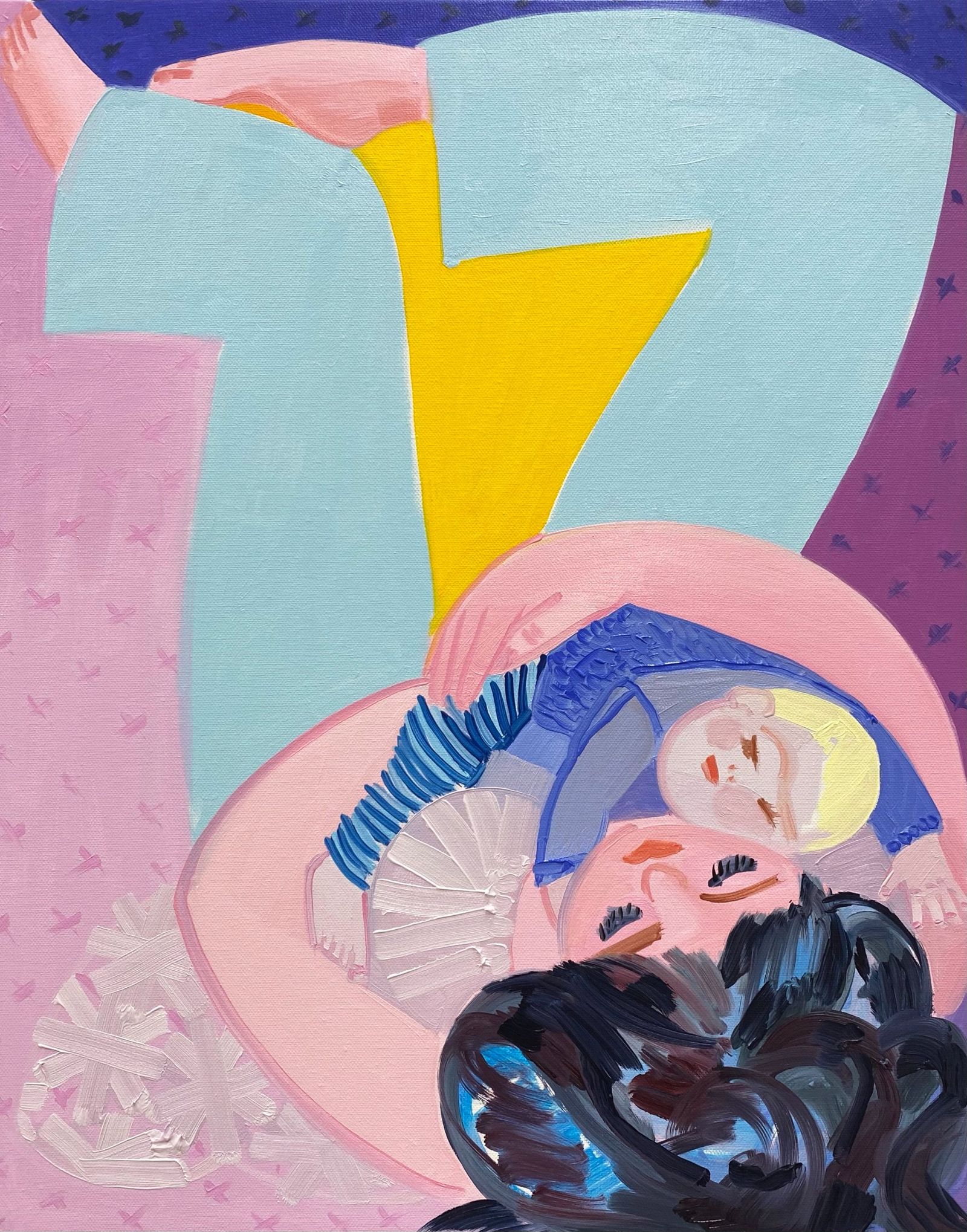
Madeline Donahue, Untitled, 2021. Oil on canvas, 20 x 24 in. Photo by: Corey Towers.
When I ask my mom for advice, she reminds me that I won’t be sure of what I need until the baby is here. Does he like pacifiers? Does he accept or reject a bottle? Does he sleep through the night, or fuss? I populate the registry with stuffed animals not knowing which one, if any, he’ll bestow his affections upon.
The doctors tell my son’s measurements and heart rate, which is slowing by the week in preparation for his entry into the world. They try to tell me something about his soul, too. The phlebotomist hears that I haven’t had morning sickness. “He’ll be kind to Mama,” she reassures as she sticks and resticks a needle in the bend of my arm. “Woah!” a nurse explains as she listens to his heartbeat. The sound of swishing fluid whooshes through the speaker. “Listen to him! You’ll have an active one!” (“Don’t you think they say this to everyone?” I ask my husband. “Who wants a sluggish baby?”) In the ultrasound, he is reclined on his back, hands behind his head, legs kicked up. “The perfect position,” the tech coos. “He’s exactly where he should be.” I feel a nonsensical pride: my son is obedient! He follows instructions! Together, the medical staff extrapolate the counters of a personality from physical characteristics, going on the only evidence we have.
How to shop for someone you’ve never met before? It’s not that I expect my son to tell me which sippy cup or onesie or baby bath he prefers. And yet, picking out patterns for his clothes and the books on his shelf and the toys in his chest still feels preemptive. Even more so these determinations of his personality: easygoing, obedient, sweet-tempered. These are my ideas of who my son will be. When I speak to him, I don’t hear anything back, and I won’t, for a long time. He’ll be born crying. He’ll have to make himself known gradually. I’ll have to rethink who he is, since he won’t be who I’ve imagined him to be.
This, then, is my relevant mystery: who exactly he is. This child, my son. And also who I am, his mother, a person who’s never existed before, a person who now gets flowers in May. The bouquet on the table represents an ontological shift — with knowledge acquired in a bathroom, I’ve become a mother. No matter what happens to the pregnancy, I’ll never not be one.
My friends call, my colleagues call. They ask questions about childcare. Will we have a nanny, an au pair, or send our son to daycare? Will I take leave, and will my husband, and for how long, and will one of us stop working entirely or “cut back”? As with the registry, the questions feel as baffling to me as predictions about what the weather will be like next year at this time. The state of my body, physical and mental; the state of my child, fussy or “easy.” Who can say which logistics will be best? What’s pitched as a decision about money and vocation also hinges, inextricably, on who the decision maker is: “What’s right for you,” as everyone soothes. Easy enough. But the me that is “you,” the mother with a child outside the womb, hasn’t yet been born.
“You search out my path and my lying down,” the psalmist writes, “and are acquainted with all my ways.” It’s all I want for my child: God’s acquaintance. I’ll always know my son partially, through a glass darkly. Only God sees to the depths of his life.
That acquaintance is also what I need for myself, as my body rounds out and my back aches and my hair comes in glossier. There’s that collapsing of time again: the God who knew me in the womb knows me now, at eighteen weeks, and nineteen weeks, and twenty weeks, and far into the future, in the days that were formed for me.








This is the best reflection on pregnancy that I have ever read. Love the dialog with the psalm. Thank you.
emotional reading this as we expect our first!