




The following appears in Issue 26 of The Mockingbird print magazine, now available to order!
“It is just smart theology and smart sociology for Christians to hold open the possibility that God heals today.” This line comes from Caleb Maskell, in Mockingbird’s 2023 Sickness and Health Issue. In that context, Caleb was weighing the sheer volume of healing testimonies that have never ceased since at least the beginning of Christianity. In an issue that reckoned with bodily decline, Caleb brought the punch of supernatural faith — a willingness to risk imagining that the impossible may yet unfold.
Issue 26 of The Mockingbird is now available!
Given the Spirit’s association in faith healings throughout history, we decided to once again seek Caleb’s insight about how and where the Spirit manifests in everyday life. Holding degrees from Princeton, Yale, and the University of Chicago, Caleb Maskell occupies the narrow sliver of the Venn Diagram between academic and profoundly faithful. He currently serves as the Associate National Director of Theology and Education for Vineyard USA, an international group of charismatic churches.
It was Caleb who suggested a dialogue with Andy Squyres — which was serendipitous, really, because we had already asked Andy to write a few original poems for the issue. Andy is a poet, musician, singer-songwriter, and all-around Renaissance man. He is the creator of the striking “metamodern devotional books” Poet Priest (in three volumes) and numerous albums. He speaks, as you will see below, with a hard-won authenticity from the earnest cries of his own heart. Caleb and Andy have been friends since 2016. Hosting them in conversation was an opportunity to witness ideas flowing unencumbered between two individuals holding the Spirit in high esteem, even as they maintain a keen awareness of life’s harsher realities. What follows is not quite like anything Mockingbird has ever published, but what is the Holy Spirit Issue for, if not to do something new?
Caleb Maskell: Why don’t we start with you, Andy? What did it mean in your life when you first encountered the Spirit?
Andy Squyres: Well, I was raised in a little Pentecostal church — the denomination was called the International Church of the Foursquare Gospel.
CM: Hallelujah.
AS: Yeah, my mom and stepdad got saved in the late ’70s and stumbled their way into this little church. I had no context for the spectrum of theological belief, but the expression of music there was exuberant: drums, guitars, bass. That’s ubiquitous in the church now, but it wasn’t always.
I remember going to church camp when I was around ten, and there were about four hundred kids on top of a mountain in a room. People began singing songs that weren’t on the page of the overhead projectors — adults were singing out in what they called the language of the Spirit: speaking in tongues, or glossolalia. It was nothing coherent to the ear, but the force and power of what was happening marked me.
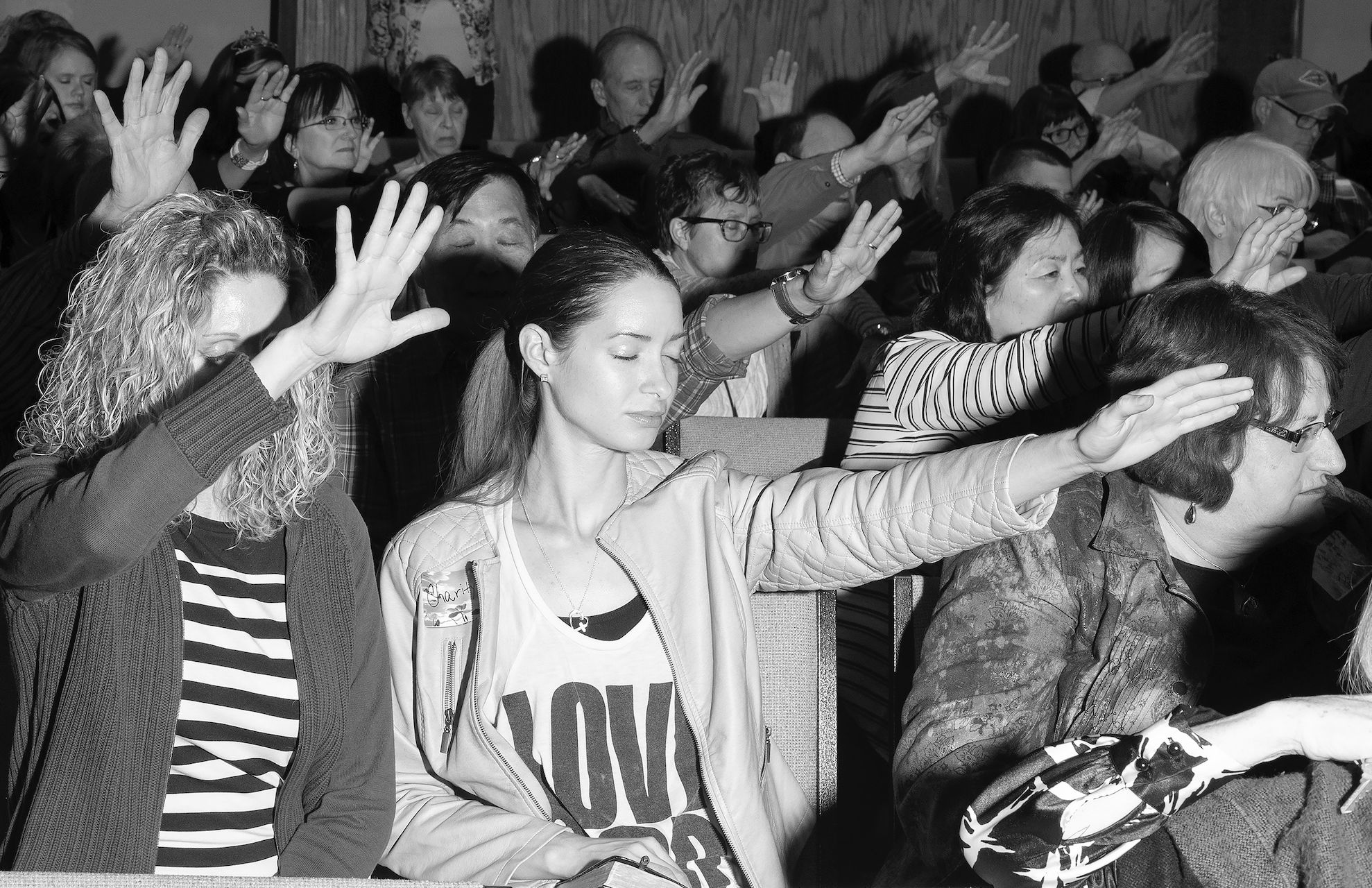
Antone Dolezal & Lara Shipley, from the series Devil’s Promenade.
I would eventually describe that as a movement of the Spirit. I can’t say I spoke in tongues then — maybe I didn’t even sing — but when you’re a kid, you don’t know that you’re putting bricks on a wall and building something. As I grew older, I began to learn the language of the Spirit.
We in our church said we preached the full gospel — there was the gospel where you got saved, but the full gospel was that you would have this secondary experience of being filled with the Holy Spirit. I believe that’s a fairly classic Pentecostal view, that there’s two parts to your conversion: you meet Jesus and then you meet the Holy Spirit. I’m not sure about the metaphysics of any of that …!
CM: I am going to call it a no. Haha.
AS: Well, you know, what’s funny is that even in our bad theology, and even in our misunderstandings of God, the genius of the Lord is that he’s still able to use those misunderstandings to bring you into a knowing of who he is.
CM: When you experienced the room with the singing and the Spirit, was it all power, or was it also beauty?
AS: I was so overwhelmed with the newness of it, like What the hell is going on here? If I can recall, I was having to work extra hard to keep myself in the room initially, because, yeah, it could have been insanity for all I knew.
CM: One of my favorite thinkers, Jacques Ellul, tells the story of reading the Bible as a teenager. I think he was also translating Faust at the time. He had this experience — not unlike what Martin Luther King Jr. described, where he felt God present with him at the kitchen table. Ellul’s sitting, doing his homework, when he feels the presence of God come into the room, and he literally flees. He gets on his bicycle and rides as far away from his house as he possibly can, because he realizes, If I’m encountering the living God in this moment, everything must change.
That’s what the New Testament, or the King James Version, calls awe. But it’s more like terror, connected to discovering the reality of God in a gut-level way.
AS: Yeah, the charismatic experience is fraught with weirdness. I’ve tried my best to manage that away. I’ve tried really hard to contextualize my life for my deep-thinking, intellectual friends. And I’m not trying to purposefully act like a fool, just for the sake of foolishness.
But I do have to own the fact that with the charismatic experience, there’s a certain amount of risk associated with what is just unexplainable. People who want to engage with it are going to; and for people who don’t want to, that’s fine too. But at this point of my life, I would be a salesperson for the Spirit, I believe in it that much.
CM: When you encounter God — whether as a Pentecostal singing in the Spirit or as a Roman Catholic adoring the Eucharist — you could call what happens an epistemic triangulation. All of a sudden, you’re not just in relationship to yourself and the things around you, but you’re actually living in a triangulated relationship with yourself, with the things around you, and with the presence of the living God as an active agent. Right? And because of that active reality, everything else gets called into question.
In the Vineyard, where I’ve spent my whole adult life, we often use the phrase naturally supernatural. I know a pastor who defines that as “only being as weird as you need to be in order to be obedient to God.” That’s a helpful way of thinking about it. Because if Jesus is who he says he is — the way and the truth and the life — then we better not put Him in a cage. We better make sure that when we say, “I’m trying to follow Jesus,” we’re actually trying to live in the manner that Jesus did, which was not only getting up early and being in prayer; it was not only knowing the scriptures; it was not only being kind to widows and orphans and defending the poor; but it was also actively paying attention to God’s leading, right? John 5:19: the Son only does what He sees His Father doing.
Learning to cultivate what you might call spiritual sight, or spiritual hearing, is what Jesus norms for the disciples. And the hilarious part about being a human is that you learn just as much from getting it wrong as you do from getting it right. The sheep hear the shepherd’s voice and they know when they’ve got it wrong because they find themselves stuck in a hole like in those internet memes.
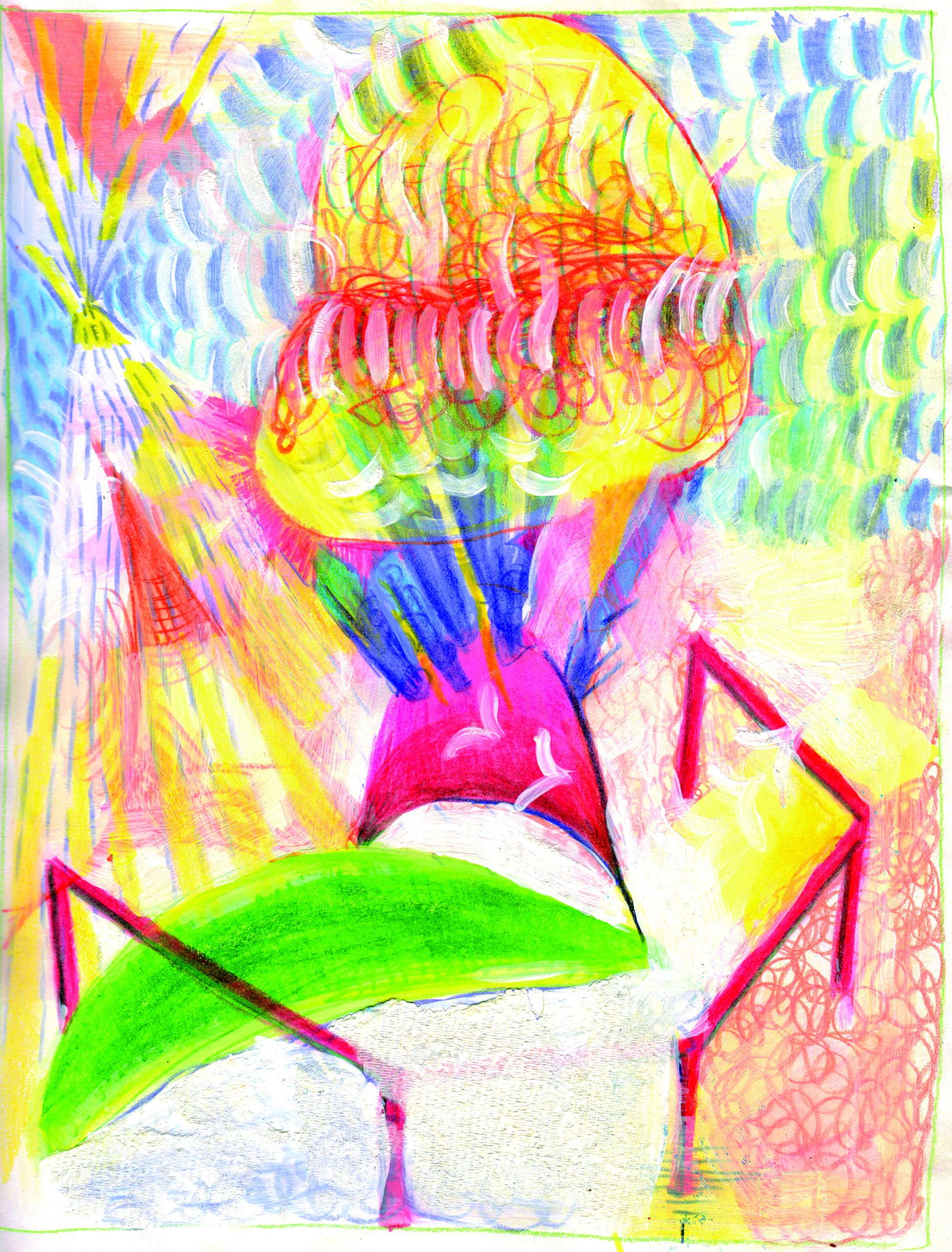
Illustrations by Melisa Gerecci
AS: Haha. Yeah, I wanna say for the sake of clarity that weirdness is not the criteria. It’s literally not about who can have the best prophecy, who can have the weirdest tongues interpretation. The Holy Spirit is moving in ways that are often weird to us, but isn’t prayer weird, too? Just the idea that you are talking to this unseen God is weird. Going to church and gathering in a building with other people, where you’re facing this one direction, and you’re all looking at this priest or pastor or musician — all of that is sitting somewhere on the spectrum of weirdness.
CM: Yes, and I think doing all of that is an acknowledgement of capital-R reality. When we call it “weird,” we are, in a sense, in denial of that Reality. The moment you confess the Apostles’ Creed, the moment that you say, “I’m a Christian,” you’re in a framework where Reality includes all of those possibilities. The quicker we come to terms with that, the better it goes for everyone.
AS: What about you, Caleb? How did you become a person who was hungry for the things of the Spirit?
CM: That’s a nice way to put it. As a teenager, I went to boarding school. At the time, I did believe in God already. I knew the Bible, because my parents had taught me the Bible. But my faith — to the degree you could call it “faith” — was rooted in ethics, in how do I do right and not wrong? How do I not do drugs and not organize my life around random desires? This included, at the time, how do I get into college? And how do I make sure that I’m not embarrassing myself?
One time my parents asked if I would go to the school Christian fellowship, and I said yes. It was in this classic New England prep school chapel, and I remember walking in through the back. I could feel something inside of me being drawn in a fundamentally and profoundly experiential way (which is to say, emotional and intellectual, right?) towards the front of the room: there’s a bunch of random guys with guitars and gals singing what I now know to be Vineyard worship songs. By the time I got to the front of that room, I was in tears.
Andy, it was like I had a hook in my jaw. It’s hard to describe, except that the compass of my life all of a sudden snapped into place. The thing that I was made to move towards was now in front of me.
That experience was different from “believing in God.” What happened to me in that chapel was, I think, a moment of encounter with the Spirit. You could call it something churchy, like a “divine appointment.” But I could tell my life would never be the same.
The following year after high school I did an internship at the Toronto Airport Vineyard. This is the famous Toronto Blessing Church. And boy, I learned a lot there. I think history will look back on that moment as one of the significant moves of the Spirit in the 20th century. I mean, it wasn’t the Reformation, it wasn’t the Athanasian Creed, but it was a significant event in which people from all over the world and from all different churches recognized that for whatever reason, in that particular place at that particular time, God was visiting in the power of his Holy Spirit.
I remember, Andy, watching literally thousands of people come through the door of that church. They weren’t hungry for church — they were hungry for God, and God would meet them in all different ways. That church got a reputation for physical manifestations of the Spirit, which is of course historic Christianity 101: when God shows up, people often do funny things with their bodies. What I mainly noticed was the degree of healing — emotional and, to some degree, physical. People were refreshed and renewed in ways that carried them forward.
There was beautiful music. Whenever you hear great new songs, assuming they don’t come from a hit factory, it’s probably because of the Holy Spirit. And man, I learned to pray, I learned to lead worship in that space. It was really something.
AS: It’s really good to hear these stories about the Toronto Blessing, because I’ve been acquainted with past renewals, revivals, whatever you want to call them. And when you get outside of those moments, you can become cynical and maybe ambivalent about them.
But hearing you talk about that experience reminds me of similar experiences, and I’ve recently allowed my heart to become hungry and thirsty again for an experience like that again.
Because I’ve lived for so long now without that kind of experience in my life, I’ve had to make sense of the world mainly by the power of my own intellect, which, up to this point, isn’t serving me very well. I mean, I’m grateful for my brain. I’m grateful for learning from other humans. I think reading books is really important! (Especially for Pentecostal people! We should not be suspicious of education.) But one of the things I’ve noticed is that there’s nothing like an experience with the living God that cuts through all of the questions, through all of the existential issues. And I think at the bottom of those existential issues is a fear of death, and the question: Am I loved by the one who says he created me?
And when you walk into an encounter with the living God, all of the questions fade away. Maybe they don’t go away permanently. Maybe you’ll have to come around and deal with them again. But an encounter with the Spirit does something for human beings that nothing else can do. It strengthens you in a way that you can’t even know you needed until you experience it.
CM: I would say that questions change depending on who’s in the room. If the actual living Jesus was in the room as you were asking significant intellectual questions, it would change the manner in which you asked them.
Now the Bible is clear that even when Jesus is in the room, he doesn’t solve every problem. But an encounter with Jesus always leaves you with the echo of God’s living presence.
In my story, I went straight from a year at the Toronto Airport Vineyard to the University of Chicago, and then to Yale for my MDiv, and a PhD at Princeton. That entire time was genuinely an intellectual quest — I was pursuing answers to questions that were really thorny for me, questions that originated in but had not been answered by my encounter with God as a 17-year-old, powerful as that was.
I can say this though: I was never afraid of questions, because I could always ask them in the presence of God.
AS: Looking back, would you say that that experience at the Toronto Vineyard was a preparation period for the however many years it took you to pursue these academic projects in your life? Can you see that moment feeding into your future?
CM: Yes, for sure. I had been given an inner well, and I could always draw on that well.
Andy, I left Toronto with two particular things. Number one, a great eagerness to study — I studied philosophy, theology, history, literature at University of Chicago. Number two, I had the expectation that I would be part of a church plant. Someone had given me a prophetic word about that. And ultimately it bore out in planting the Hyde Park Vineyard (about which anthropologist Tanya Luhrmann wrote her acclaimed book When God Talks Back).
And so that was always just the rhythm — it was a left foot/right foot thing; you know, the encounter with Jesus through prayer and community, and also the pursuit of academic study. One strengthened the other.
But how about for you? Talk to me about how life with a living God affects the way you write songs.
AS: Oh my goodness. So let me start with this little part of my story. I’m a part of a church that had an actual version of Toronto, from 2006 to about 2012 — we had what I would call an enduring manifestation of the presence of God — which was different then than it is now, okay? We’re not experiencing it now; we were definitely experiencing it then. It flowed; it has now ebbed. We have zero explanation for that. All we know is, this is what happened.
We used to have two services, and then on a Sunday morning in 2006, it was like the Lord Himself walked into the room. There was not a second service that day, because the first service did not end — everybody that was coming in for the second service came in and found all of this activity happening. People were falling under the power of God, people were praying for each other. It was a free for all.
What was interesting was that there was no precedent for that in this particular church. It wasn’t something that had been seen before and re-manufactured. It just happened. The intensity of it went up and down. You know, it wasn’t like white-hot intensity forever, but it peaked and valleyed over a number of years.
Right in the middle of that, in 2009, we had a tragedy. A dear friend from our church was murdered in his house in the middle of the night. It’s just a terrible, tragic story — I won’t get into the details now. But after that, as you can well imagine, all of our theology was tested. All of our thoughts about God were tested. All of our frameworks were brought under scrutiny — a kind of scrutiny that only severe suffering can bring, actually.
But our testimony now is that what the Spirit had poured out in those initial years was actually what spoke to us, whether we knew it or not, in the grief and the suffering that followed. It was like Joseph’s dream — there would be seven years of plenty followed by seven years of famine. Why didn’t God just stop the seven years of famine? Why did he send the dream for these people to prepare for it?
We don’t know how and why this stuff happens. But I’m very thankful for those years of fullness and provision, because they fed us during the years of famine. I didn’t have any answers, and our preacher didn’t have any answers. Thank God he didn’t try to give any. But it was then that I actually really learned to follow the Spirit the most. And it was during those years that I started to learn how to write songs.
It wasn’t until my heart was broken because of that loss that I stopped caring about the modes of Christian culture. I mean, if you’re in the church long enough, you learn the tricks, the Christianese — you learn all of the things that work well, all of the organizational agreements that we make with each other. You learn that these things will be talked about, and these things will not be talked about. We will highlight what’s encouraging, we will diminish what’s discouraging — for the sake of everybody, right?
But in grief, I started writing the poetry in my heart. And I actually had a word from the Lord. I was driving one day, and I heard the Lord say to me, It is now your time to write slave music. And I knew exactly what He meant, because I had just watched the Muscle Shoals documentary.
CM: Seen it, love it.
AS: Yeah, it begins with a story of a Native American woman who cannot hear the song of her river anymore, because she’s been taken from it — but she traces her way back. She needs to get to the river that is singing her song.
When I heard the Lord say that to me, I knew I was to make songs of the dirt, songs that were born from suffering, and I mean, I’m a white male — like, why should I be invited to this party? I don’t know. God does strange things. It feels a little presumptuous even to say this out loud, but whatever I could add to that way of storytelling, I was only able to because I knew about that river of the Holy Spirit.
It’s my rootedness in the orthodoxy of God that allows me to go out into the world and ask hard questions, whether through my music or my writing or just standing on the street corner talking to somebody.
If I’ve learned anything about the Holy Spirit, well, first of all, He’s unpredictable, and as soon as I try to formulate what He’s going to do, I’ve lost the plot. But I do know that the heart is one of connection — there’s a generous heart of connectivity, and the Holy Spirit is trying to make us aware that the isolation and the alienation that we all feel oppressed by is not real. That’s the lie He’s trying to steal us from. Sorry, I’m preaching.
CM: No, it’s good. What I’m hearing you describe is a fundamental connection between encounter with the Spirit and creative work. You could accuse Pentecostals of a lot of things, but not being creative is not one of them.
You and I have a mutual friend, David Ruis, who tells the story about planting a church in Winnipeg, in a very poor neighborhood where there were a lot of First Nations people. He and his wife Anita started hanging out with a bunch of folks who were addicted to sniffing glue, like huffing out of a bag. One day they decide it’s time to talk to them about Jesus. So they get everybody inside in a warm room, and some folks are high — these people are a real mess. But David kept trying to steer the conversation towards the Lord. He said, “Look, I don’t know if you guys pray, but we’ve been praying for you.” And one of the ladies in the group interrupts him and says, “What are you talking about? Of course we pray. How could we live our lives in this place, in this way, with these kinds of problems, if we didn’t pray?”
And David realized in that moment that the work of the Spirit, which had led them to that sacrificial work of church planting, was actually a response to the prayers of the very people he thought he was trying to reach.

AS: Beauty from ashes, man.
CM: Beauty from ashes.
So, we’ve talked a lot about suffering. It’s of course important to dispel the myth that suffering is removed by the presence of God and a desire for life in the Spirit. But do you think that life in the Spirit actually invites suffering?
AS: Well, it’s funny. For the better part of my theological formation, the preachers were talking about the power of the Holy Spirit as a defense against the kind of life that Paul led. Jesus and Paul had their experiences, but we have somehow got this force on our side, and if we pray the right prayers enough times, then we’re going to be able to steer clear of anything like that.
But a couple of weeks ago, I was standing in church — and I was actually anticipating this conversation — and I had this thought: I believe in the power of the Holy Spirit because I believe in the miracle of suffering. Those were the words that came to me.
I mean, I think there are ways to be good at life. And I think people should make good choices and not invite suffering. Like, I don’t wanna cheat on my wife, because that would be kind of inviting suffering.
CM: Right, there are times when we’re punished less for our sins than by our sins.
AS: That’s right. But then there’s that whole other category in life where there’s just so many things outside of your control. There’s a real power in owning that reality, just saying yes to it, receiving it in a way — not in your own strength, but in the acknowledgement that God is with us. And how is he with us? Well, according to the New Testament, he is with us in the Person of the Holy Spirit. And when that’s not just theoretical in your life, but engaged with on a regular basis, it may not be therapeutic, but I’m still going to say it’s helpful.
CM: I totally agree. For me, the presence of the Spirit is a life lived in God’s life — God constantly admonishing me towards capital-R reality. And I often experience God as interrupting my life. That means the Lord gets to choose the place and the time. You might have five dreams in a row, and they mean nothing; and then you have a sixth dream, and that dream brings the word of the Lord to you or to someone else through you — as long as you learn to respond, right? Or you might pray for people 99 times to be healed and, to quote Sufjan Stevens, “nothing ever happens.” But then you pray the hundredth time, and someone’s healed of colon cancer. In our church recently, someone prayed for a lady who was literally healed of colon cancer. I’ve got screenshots of this woman’s texts, which, it’s like, I still can’t even believe this is possible. But that’s what it is; God chooses to intervene and interrupt.
AS: I often talk about charismatic people as the people of perpetual disappointment. Because if you’re going to engage with that type of audacious hope and expectation, you will inevitably find yourself disappointed — that’s our cross to bear. The more prayers you pray, the more unanswered prayers you will have.
We all know this, and the way most of us cope is that we just don’t pray. But I just feel that I would rather ask God for everything and never get anything from Him than to never engage with Him at all. You can get to a place where you’ve completely tired yourself out with all of your useless prayers, but you don’t give up. You just decide, to hell with whatever John MacArthur is believing and hoping for, I’m gonna pray for this one last person, I don’t even care if it fails or not. And then the miracle happens. And you’re just going to have to live with it.
CM: The word of the Lord.








Wow. That is all I can say about this article. I feel every bit of this and am thankful for your honesty. I got saved in the 70’s in a Pentecostal church and I long for the demonstration in a church service that I experienced then. Blessings.