



The Friendship Issue will be shipping soon! Order your copy here.
It’s the spring of 2007, and I am sitting cross-legged on the ground singing chants in languages I do not understand in a monastery located in the middle of France. Sitting next to me is Janet, my best friend, or former best friend. We don’t know what to call each other now.

I met her in high school. Both Asian American, we instantly knew of each other, but it was our both being Christians that drew us to one another. She was a different kind of Christian, though, one who read devotionals and listened to Jars of Clay, and taught me that we shouldn’t date people who aren’t Christian because we would be unequally yoked. I was mesmerized by her type of Christianity. For me, God didn’t exist outside of Sunday School. My family went to church and occasionally prayed before meals, but otherwise, our religious identity was barely visible, unlike Janet’s. She taught me about a God who wanted to be involved in every aspect of my life, including my romantic life! Life suddenly felt more meaningful with this God, less lonely. By senior year she successfully rose to rank of best friend, and even when we went to different colleges, we called and updated each other regularly. She knew all the inside details about my college life, like the latest drama, and which classes I was struggling with. We’d end each phone call by praying for one another.
After graduation, we both signed up for a two-year Christian internship. The program was designed to ease recent graduates into adulthood through a tight-knit community of people who, like us, were trying to find jobs, build lives, and remain faithful Christians in the real world. Our fellow interns rarely saw one of us without the other. We were treated as a unit. Are “they” coming to the Saturday morning mission project? What did “they” think of Tuesday night’s Bible study? Were “they” signed up for the Saturday morning mission project? What were “they” going to do when the two-year internship ended?
Except I, not we, quit mid-way, to the shock of the interns, but even more to Janet.
My unease with this particular Christian subculture I had entered began brewing in college but nobody would have known it, being one of the more devoted, passionate ones. Articulate, too. From my high school youth group, to my college campus fellowship group, to this internship, I had always been invited to a leadership role. The articulation just had yet to make its way to expressing my discomfort. Maybe my growing skepticism toward biblical literalism was because I was being too heady, reading scripture intellectually rather than with the eyes of my heart. Maybe the irritation I felt when a fellow intern told me that my desire to eat healthier and lose weight was vanity-driven was indeed a symptom of my vain, sinful nature. And leaving them would create a cavernous emptiness in my life since they had shaped my worldview and my social life.
Still, one thing led to the next, and then, there I was packing my belongings into boxes as my roommates watched, mouths agape. How could I do this? Despite my composure and my certainty that leaving was something I had to do, or more accurately that staying was something I could no longer force myself to do, I wasn’t sure it wasn’t a me-problem. Like, maybe I wasn’t holy or dedicated enough.
But Janet, loyal friend that she is, kept reaching out after I cut ties with the community: taking me out to my favorite restaurant for my birthday, driving over two hours to see me on weekends, asking if I wanted to go to Taizé with her. Taizé, the ecumenical monastic community in France known for its simple chants, and for its miraculous ability to draw thousands of young people from around the world at a time when churches everywhere seem to be emptying. I had been talking about it since visiting with my parents the year before. It also helped that Taizé was nestled amid rolling green hills with free roaming cows and soft cream cottages with bright blue shutters.
Janet always seeks out a good adventure, and at the time of her asking, I’m living back in the suburbs with my parents and waitressing at a sushi restaurant. A week at Taizé, including room and board, costs less than my ordinary weekly expenses, and a round-trip ticket to Paris amounts to about one week’s wages. This is really not something I can say no to. And for kicks, because there’s really nothing else going on in my life, I tack on an extra four weeks as a young adult intern, with room and board provided in exchange for our work.
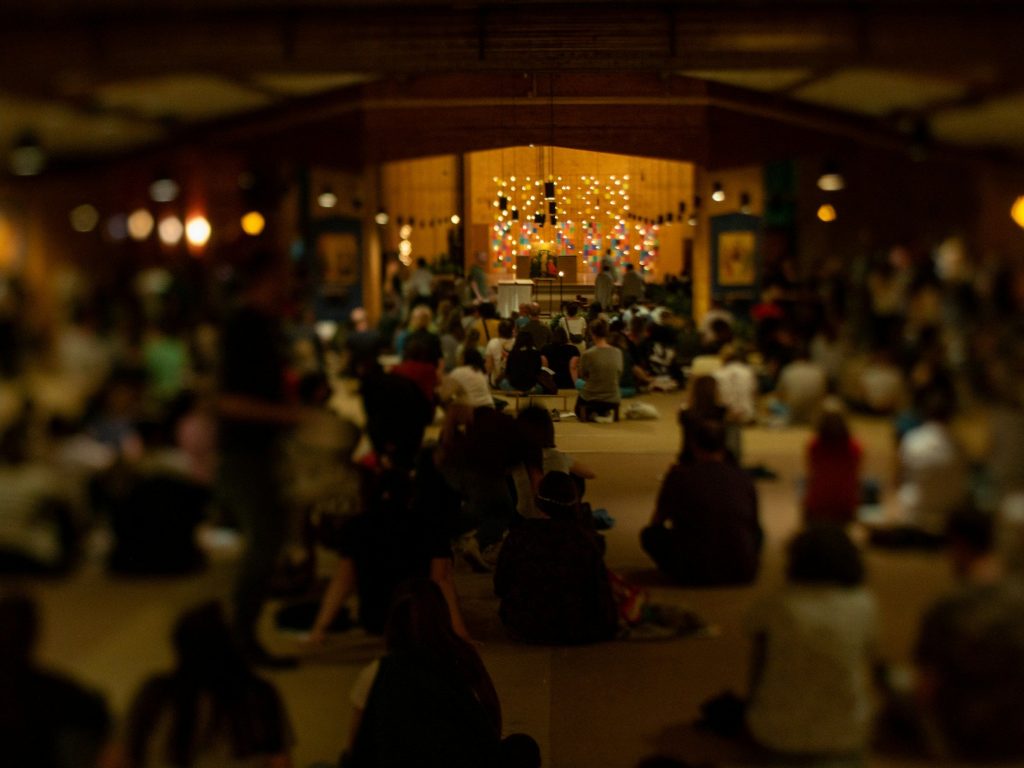
A photo of the Taizé community in worship.
The Taizé style of worship, with its silence and simple chants in a large, dark candlelit room, is unnatural to us. Janet and I are used to emotionally stirring ballads or poppy, energizing songs. On either extreme, our bodies are fully engaged, through tears, or through dancing with our hands in the air. There’s no handsome lead singer and guitarist at Taizé, just rows of monks in hooded beige albs leading us in song. But I feign deep comfort, rocking side to side as I chant with my eyes closed. I’m not an evangelical anymore; I’m worldly, sophisticated. Can’t you tell, Janet?
And when we talk, I throw in statements like “The silence feels so much more liberating than the long sermons. They’re not trying to control us here.” I can’t help myself. She doesn’t say anything, knowing it’s a waste of energy to engage in a back and forth, but her shoulders are tense and I pretend not to notice. Janet and I, being 22 years old, are assigned to the quarters for young people, with whom we eat and sleep. They’re rowdy and mostly from European countries, but it’s the other American who instantly makes his way over to us during our first meal time. Keanne is a Filipino from Hawaii, and he greets us by saying, “Hi, are you American?” We respond, “Yes! How could you tell?” “I saw you guys laughing. Americans laugh with their whole heads.” We throw back our heads and guffaw.
Keanne had arrived just a few days earlier but had already made a group of friends, who quickly join us around the bench. There’s Philippa from Birmingham and Catherine from Yorkshire, Kristoffer from Stockholm, and Roland from the Swiss German town of Bern. Over mini baguettes and pasta with brie, we fall into easy comfort, the summer-camp atmosphere deepening our connection.
We seek each other out at the thrice-daily community prayers, which naturally spill us into the meal lines and the meals themselves. And in true French fashion, there are afternoon siestas, when we stretch out on the meadows drinking cappuccinos from a vending machine — or even wine. The community café sells wine and cigarettes at all hours of the day. Not being much of a drinker up to that point in my life, I nevertheless rise to the occasion. Each afternoon I buy a glass of wine and sip it alongside my Lucky Strike cigarette. Janet never partakes, but she never expresses disapproval either. In the evenings, we stay up playing poker in our bunk rooms. I win a round and they start calling me Bank of America. Kristoffer wins a round and we start calling him Ikea.
Our conversations run the gamut: how Roland’s heart ripped apart after his breakup, which is why he journeyed to Taizé that spring, to recover; Philippa’s righteous anger that the English refuse to call themselves European even though they’re part of the European Union; and how and when Keanne came out as gay. That last conversation feels like a real nudge-nudge, are-you-getting-this-Janet? moment. See? God loves gay people too. Kristoffer doesn’t even believe in God, and nobody bats an eye at any of this!
I don’t ask her what she thinks, though. I don’t know how. Our friendship was built upon a shared religious foundation that shattered for me but which she still stands on. I try really hard to suppress any antipathy in service to what might be left between us, and to talk about fun, pleasant things: how handsome Roland is, how through our new English friends we finally understand what is meant by “dry humor.”
And one morning, with one of those English friends, Philippa, we skip community prayer and take the bus down to the local village. The spring mornings at Taizé are cool, so I’m grateful for my rash decision, the day we flew out, to stuff my cozy rust-colored corduroy jacket into my suitcase. We wander through the outdoor market and feast on the scene. Baguettes fresh from the oven! Fromage in all different shapes, sizes, and ages! Rolls of colorful fabric! I buy a baguette for us to snack on during the bus ride back, and the three of us take a photo in the village square. I’m wearing my corduroy jacket and holding a baguette. We’re standing close together, glowing.
But as we step down from where we took the photo, Philippa trips on the uneven cobblestones and gashes her knee against the edge of a step. Blood seeps through her pants. She can still walk fine, so we take the next bus back to Taizé and sit beside her in the nurse’s office while the nurse cleans and bandages the wound. To be safe, the nurse tells her to use a wheelchair. It is wildly unnecessary, but Janet and I take turns pushing her. On our way to the lunch line, we are spotted by Roland and Keanne across the courtyard. They have this look on their faces like, what the heck happened in the few hours since we last saw you? No words are exchanged. They see us. We see them. And then, Janet, Philippa, and I burst out laughing. We laugh and laugh, and we can’t stop. We laugh with our whole bodies.
The one-week program comes to an end, but we have filled each other’s hearts with a lifetime of memories. We shed tearful goodbyes at the bus stop and promise to write, even visit one another. Mine and Janet’s goodbye is not as tender though; we exchanged some words the day before. I went on my usual spiel about how we were taught such deeply oppressive and controlling ways of thinking and living. I keep thinking she’ll eventually get on board. How can she not? She’s smart. Haven’t her eyes been opened here at Taizé, with all this theological and cultural diversity? I expected her to say something like, “Yeah, don’t I know it,” while we passed a cigarette between us. But instead, she rebuffed me: “My ears hurt whenever you say those kinds of things.” I stopped myself from saying something like, “Then, we don’t have to say anything to each other ever again.”
My friends are gone, and I move my belongings to the intern side of the monastery, and I shift gears, from visitor to host. For three weeks, I rotate work assignments around the campus. One week, I welcome new arrivals to Taizé and give childcare during the chapel services. Another week, I clean toilets and cashier at the candy shop where they sell all shades of chocolate. The other interns befriend one another and hang out during their free time, but I keep to myself. My mind and energy are on other things, like processing what compelled me to abruptly leave a community of people, Janet especially, who loved and cared for me so much.
If the twenties are a time for making mistakes and figuring oneself out, I feel like I’m acing mine. It doesn’t feel good, though. Who am I? What do I believe? I have no idea. I’m completely unmoored. The only thing I’m sure of: I can’t go back to what was, but I have no idea about what’s next. When I share these thoughts with my supervising nun, she recommends that I spend my final week at Taizé doing their week of silence. I don’t know what that entails, never having done a week or even a day of silence. But it sounds soothing. I pack my bags once again and move to the quarters designated for those doing the silent program.
The quarters are about a ten-minute walk away from the main campus and only a handful of people have signed up for the week of silence, so the atmosphere is far more intimate than what I’ve gotten accustomed to at Taizé, with its constant influx of visitors. Our group can comfortably sit around a single wooden table on the dormitory veranda three times a day for our meals. The only program is the one Bible study that’s tacked on to breakfast. Otherwise, we’re free to roam and attend the prayer services as we please.
At our first breakfast together, we gesture to our name tags to introduce ourselves and point when we need things passed. The nun who leads the silent program sits at the head of the table and leads us in the Bible study. It’s a radical departure from the Bible studies I’m used to, full of pens and highlighters marking up my Bible, and a verbose exchange of ideas.
As we slather butter and jam on top of our warm baguette slices and dip them into our coffees, the nun reads a passage from the Bible and follows up with thoughtful questions. That morning’s passage is from the book of Genesis. Hagar, Sarah’s slave, runs away from Sarah because of how poorly she’s treated. Alone in the wilderness, Hagar encounters an angel of God who tells her to return home. He promises to bless her and take care of her back at home. The passage ends with her giving God a new name, to mark a turning point in her relationship with the divine. She names him El Roi, meaning “the one who sees me.” After a short analysis, she ends with “Hagar gave God a new name after her healing encounter with God. Did you know you can give God a name that’s reflective of your relationship with God? What name would you give to God?”
I spend my days wandering through the towns. The Grosne River flows near Taizé and connects the towns of the region through a path running parallel to its banks. I lose track of time in a village with cute shops that sell handmade goods like jewelry and lavender soaps. I pick out gifts to bring home, and when I notice the time, I run back to make the evening prayer service. Every other day, my walks on that path are slow, so slow that not even one sweat bead breaks out; but I do peel off my corduroy jacket and put it in my backpack. On bridges, I linger and gaze out over the river. I’ve never practiced silence for an extended period of time, so I scribble in my journal like crazy. I unload all of my angst into my journals and onto the walking path. No answers, no resolutions, just questions.
The nun returns each morning with a different Bible story, but the first story remains in my mind. Who is God to me now? What name would I give to God that accurately describes the relationship I have with God? I ponder these questions throughout the week. In the past, the name would have been Savior — the one who saved me from my innumerable glaring sins. Then in my young adult years, it would have been Lord — Lord over every aspect of my life, which I turned over to him as my service and for his approval. None of these names fit anymore.
Part of the reason for my confusion is that I don’t know God’s true qualities. But when I listen to my inner voice and allow it to guide me, I hear that God is love and freedom — the one who does not want to burden me, the one who longs for me to live with joy.
I am trying to familiarize myself with this new God — to know this God, to become friends with this God. And then I have it: Friend. Yes, friend. That is the new name for my God. One who does not drag me from ahead or push me from behind, but walks alongside me through all the ups and downs of life. One in whom I can confide in without fear of judgment. One who encourages me to grow into my most authentic self rather than someone shaped to win others’ approval. My whole body relaxes at this recognition. God, you are my friend.
On my final day at Taizé, I pack up my belongings, which no longer fit into my suitcase because of all the gifts I’ve collected. The interns have a table where they leave items they can’t take home, and someone always finds something they forgot to bring. It’s our own little thrift shop. I sort through my things, trying to decide what I can let go of, and finally settle on the corduroy jacket. It is bulky and takes up a lot of space, so removing it makes the most sense. I adore that jacket, but I trust I’ll find another one I love just as much. Fall will arrive in a few months, and I am sure it’ll come in handy for a future intern.
At the final evening prayer, my eighty-third service, I no longer need the songbook to sing along as I did in the beginning. The lyrics and melodies are etched into my soul. The silence is no longer arduous. It’s comfortable, like a long, warm embrace.
I am in the flow when, seemingly out of nowhere, I hear it. The words are silent but crystal clear:
As I am a friend to you, be a friend to others. Tears trickle out, and then pour down my face.
As I am a friend to you, be a friend to others. My heart aches over how I treated Janet, standing above her, judging her from on high.
Lydia, just as I do not judge you, just as I honor your journey and walk alongside you, do the same for others.
People begin to leave, but I don’t notice. I stay for as long as it feels right in this dark, candlelit room where my spirituality is being reborn.
That night, I have a dream. I am late to a wedding and flustered because I have nothing to wear. The only thing in my closet is a tattered dress two sizes too big, but I put it on because I’ve got nothing else. On my way out the door, my outfit magically transforms, Cinderella-style, into an ivory silk blouse and black trousers that fit me to a T. I feel gorgeous.
Many months later, I would sit in an Introduction to the Hebrew Bible class at Yale Divinity School, where I’m pursuing my Master of Divinity. The professor would lecture on a biblical story in which one of the characters changes his clothes. He would explain that this motif runs throughout the Bible, symbolizing a momentous shift in a character’s identity.
Shivers would run down my spine.
Lydia Sohn is a writer and United Methodist pastor whose work has appeared in The New York Times, The Atlantic, and Christian Century, among others. Her debut book, Here: A Spirituality of Staying in a Culture of Leaving (Random House, 2025), explores the power of stability and our capacity to transform our lives from the inside out. She lives in Claremont, California, with her husband and three gorgeously wild children, and can often be found stealing a quiet moment with coffee and a cinnamon roll — preferably with cream cheese frosting.