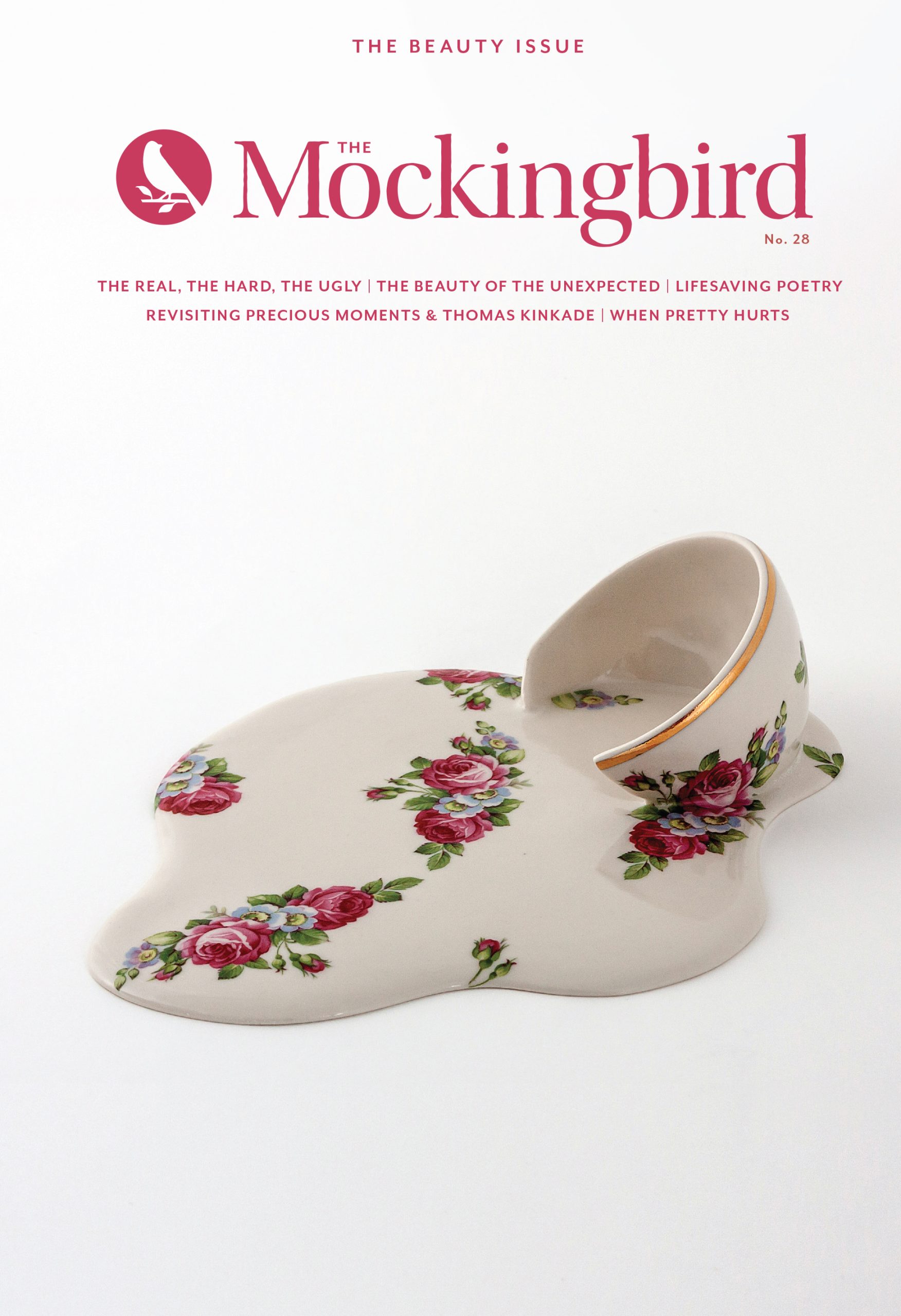
This essay appears in Issue 28 of The Mockingbird magazine, now available to order.
Art historian and curator Aaron Rosen is a visionary thinker who works at the intersection of art, faith, and culture. With a doctoral degree from the University of Cambridge and academic appointments at institutions such as Wesley Theological Seminary and King’s College London, Rosen’s vocation spans teaching, curating, and public scholarship. He is the author of books including Imagining Jewish Art (2009), Art and Religion in the 21st Century (2015), Brushes with Faith (2019), and most recently Spiritual Traces (2025). He also runs The Parsonage, a gallery in coastal Maine that stages exhibitions focused on spirituality, ecology, and creativity.
In this wide-ranging conversation, we reflect on how beauty reveals itself in unlikely places: in the cracks of our cultural narratives, in sacred and secular spaces, and in moments that refuse easy categorization. Rosen shares how beauty is not simply an aesthetic add-on but a transformative conduit of grace that opens new possibilities for connection and meaning. And he asks us to attend to questions like, What would Jesus see? What might we be missing in our hurried culture? And how does beauty ask us to pause, listen, and respond?
— Meaghan Mitts, interviewer
You’ve written several books at the intersection of art, religion, and visual culture. How do you define “beauty,” especially in religious or spiritual contexts? And why do you think beauty (rightly or wrongly) is such a taboo word in the contemporary art world?
I am probably not the person to define beauty. Reading your questions, I realize that I’m probably part of the problem. I’ve avoided questions of beauty like the plague in both my writing and curation. It isn’t that I’ve not examined or exhibited works that are beautiful, but I’ve avoided framing them in this way. I think I’ve done so largely for the benefit of the artists themselves. I think beauty has come to be seen as unserious, insufficiently toothy and dangerous, in contemporary art circles. My own painterly hero, Philip Guston, once asked devilishly, “Doesn’t anyone want to paint badly?” His question is a crucial one for modern and contemporary artists, who have felt the impossibility of reviving the beautiful clarity of the artistic past. But maybe — after so many artists picked up Guston’s gauntlet too badly, without a deep sense of the past — it’s time to redirect Guston’s question: Why doesn’t anyone want to paint beautifully?
Some people are skeptical that beauty has any real moral or spiritual weight — they think it’s just aesthetics. How would you respond to someone who thinks beauty is superficial or even distracting?
There is no reason that something cannot positively shimmer or effervesce with meaning. And it’s easy to turn even the contemplation of the abyss into something trite, predictable, or maudlin. So, I think the perspective of the viewer is what renders something facile or distracting, not necessarily the object itself. Also, what if being superficial — literally on the surface — isn’t as bad as we presume? Perhaps even if beauty somehow only dwells on the surface, it nonetheless has something important to tell us through that quality. Maybe we do not have to accept prima facie the binary opposition between surface and meaning, and thus we don’t need to defend beauty in the way we think we do.
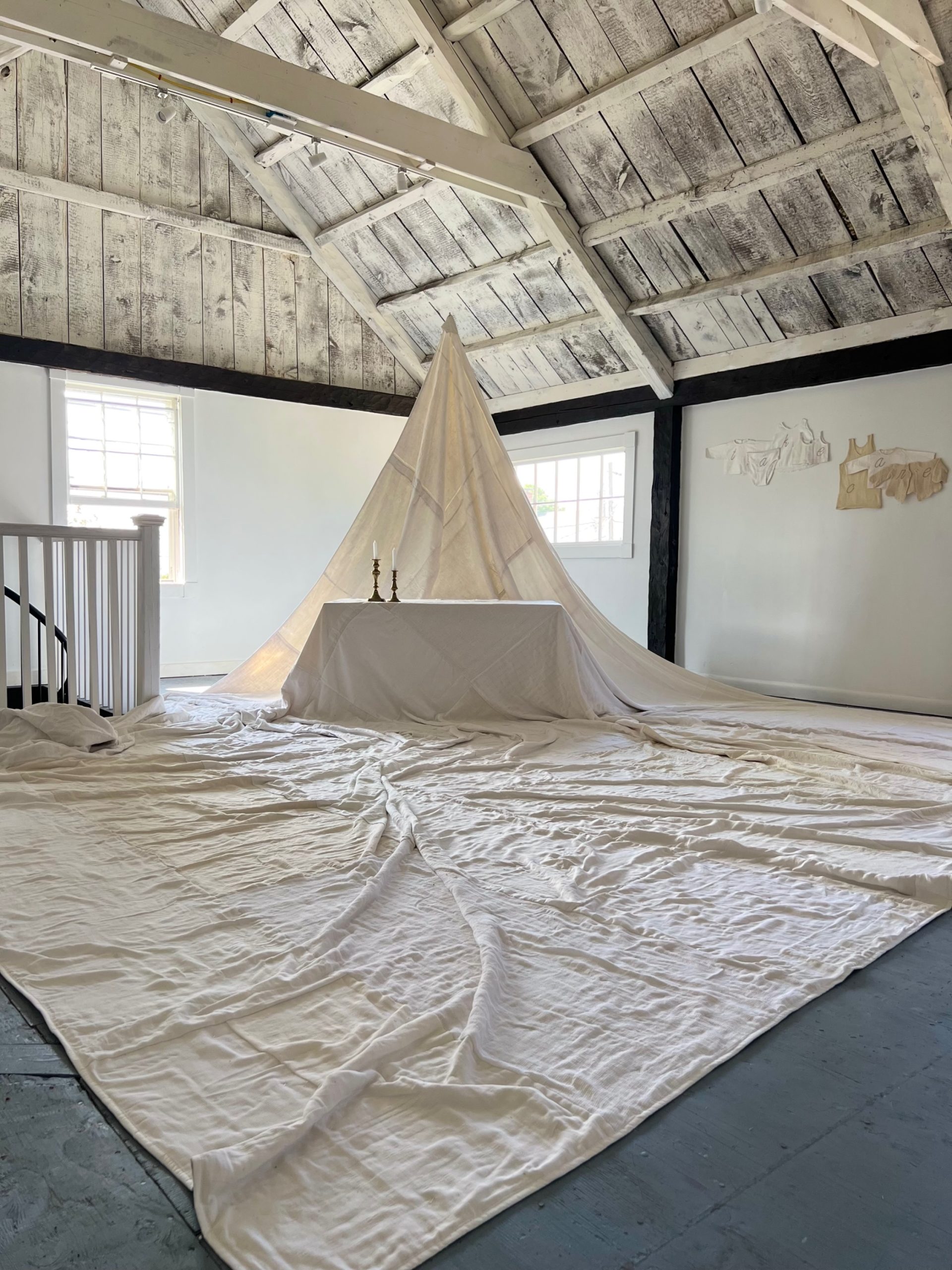
Anne Mourier, Blanketed, 2022. Courtesy of The Parsonage Gallery.
There is a tension between the ideal of beauty and the messiness or brokenness of real life. How do you think art or religious expression can deal with ugliness, suffering, or injustice while still aiming at beauty?
I don’t necessarily see an opposition here. Suffering can be exquisite. This is one of the great insights of Christianity, revealed again and again through its visual heritage. Christianity understood progressively through the centuries not to hide the symbol of torment — the crucifixion — but to instead transform it. This comes out so powerfully even in one of the most overtly grotesque Crucifixion scenes: Matthias Grünewald’s Isenheim Altarpiece. Even as Grünewald maps the myriad, seeping wounds that perforate Jesus’ flesh, there are moments of beauty, especially in the delicate rivulets of crimson that run down his side. One might even say that the paint itself, the very substance of the work, is itself beautiful as paint. It holds the tension unresolved within itself, signifying abject trauma without sacrificing its own material beauty. And of course, I’m looking at the work from my perspective as a practicing Jew. For Christian viewers, this crimson paint bears a more sanguine message — the beautiful promise of salvation — embodied by the lamb at the foot of the cross, who collects the running blood into a eucharistic chalice.
Your book What Would Jesus See? suggests a shift in perspective — what we are missing by not seeing more carefully. What do you think contemporary society is failing to see in terms of beauty? Does beauty matter?
For Jesus, I argue, seeing was a form of doing. At the center of his ministry was a call to look at others, especially the most disadvantaged, with new eyes. I wouldn’t say Jesus was interested so much in calling our attention to beauty in the world as in showing us that the act of empathetic looking — “good looking,” if you will — could be beautiful.
Jesus does give one image which palpably evokes the perils of mere aesthetics. “For you are like whitewashed tombs,” he tells the Pharisees, “which on the outside look beautiful, but inside they are full of the bones of the dead and of all kinds of filth” (Mt 23:27). What is most ugly to Jesus is the mere simulation of spiritual beauty. While it’s commonplace to lament the ethical decay of one’s era, we do seem to be in a period that is remarkably fixated on the performance of virtue, whitewashing more than just tombs. So we need to practice not just looking for beauty — which can easily become ethically self-defeating — but with beauty.
You’ve written about what you call the “hospitality of images.” What does “hospitality” mean in this context, especially when images themselves can be contested or ambiguous? How does beauty help or hinder dialogue across faiths?
I started using this language as a way of shifting conversations about dialogue among the Abrahamic faiths of Judaism, Christianity, and Islam. We so often talk about them as “people of the book,” and I wanted to think about these faiths as people of the image, with profound commonalities — and opportunities for dialogue — rooted in visuality. To illustrate this idea, I took the biblical Abraham’s famed hospitality — his tent open to all sides — and applied it to art.
To me, art is an ideal prompt for dialogue, precisely because of those “contested or ambiguous” aspects that you mention. And, unlike reading scripture together, which can be so overdetermined by dogma and tradition, I think people can oftentimes bring more openness to the interpretation of images. They can, in a real sense, offer us and encourage hospitality.
If beauty has a spiritual function, why should we cultivate beauty in our daily lives and in our public spaces?
I wouldn’t say unilaterally that beauty has a spiritual function; that kind of ontological claim worries me. I’m inclined to the more modest belief that it can have a spiritual function. But I can say that I do personally find that during such unrelenting pain in the world at present I am even more grateful for small, beautiful things and like to share them with my young son Arthur. When it comes to public spaces, I’m more hesitant to talk about beauty. These days beauty shows up in some rather unsavory contexts. Recently, after gutting public funding for the arts and humanities, the federal government announced it would be pouring resources into the creation of a National Garden of American Heroes. It’s hard to think of something less beautiful than vainglory in a moment like this, but it will surely glint and glimmer …
In Art and Religion in the 21st Century you explore how religious themes are revealed in contemporary art. Can you share some examples of important religious themes being communicated in works of art that might not be read as superficially beautiful?
I have a chapter in that book about the sublime in contemporary art. Historically, philosophers and theologians have usually played the beautiful against the sublime, its more serious cousin. And yet this distinction seldom holds up when one looks at actual works of art. So many of the works I discuss as sublime for the ways in which they generate terror, wonder, or a sense of the uncanny also have elements that are beguiling and inviting. Olafur Eliasson’s The Weather Project — which I recall seeing in person in Tate Modern’s Turbine Hall — is a good example, in which strange and captivating sensations can also suggest beauty. Or I think of my friend Michael Takeo Magruder’s New Jerusalem virtual reality work, in which he invites viewers to put on a headset which takes them into a gilded space defined by the staggering dimensions of the heavenly city, as enumerated in the Book of Revelation. The experience is overwhelming, almost literally stunning, in a way that leaves it hard to unpick what is sublime versus beautiful. Either way, bringing the text’s theological vision to aesthetic realization is anything but superficial.
Are there underexplored mediums, artists, or contexts that you believe are especially promising for revealing new dimensions of beauty in the coming years?
Waste. Nothingness. Silence. It’s time to make less of everything and find beauty in what already exists. Two very different artists, who happen to be friends, remind me of this often in their work: Ian Trask and Anne Mourier. Ian intercepts objects from the commercial waste stream, while Anne finds beauty in simple things, traditional crafts, and pared down rituals.