This essay appears in Issue 28 of The Mockingbird magazine, now available to order.
In the run-up to her recent visit to London, my mother and I sent Instagram Reels to each other of things we might do on her trip: an afternoon tea at Fortnum & Mason, a walk through Bloomsbury followed by a pint in a cozy pub, snacking and shopping our way through the impeccably Instagrammable Seven Dials Market, replete with a café where different kinds of cheeses gently travel past you on a conveyor belt.
I feel like I live in two cities: the London I see on Instagram Reels and the real London where I live and work. And sometimes I feel self-conscious that people think I live in Reel London and imagine my life to be more glamorous than it is. It’s not just the reels, but the fact that London is a place that lives in people’s imaginations. In Gilmore Girls, Paris Geller declares that “London is the most romantic city in the world.” And that romance is particularly acute this time of year when London becomes the city of Christmas: of Hyde Park dusted in snow, Regent Street glowing with Christmas lights, ice-skating at the Somerset House, lessons and carols ringing out at Westminster Abbey, and Michael Caine with a Muppet on his shoulder.
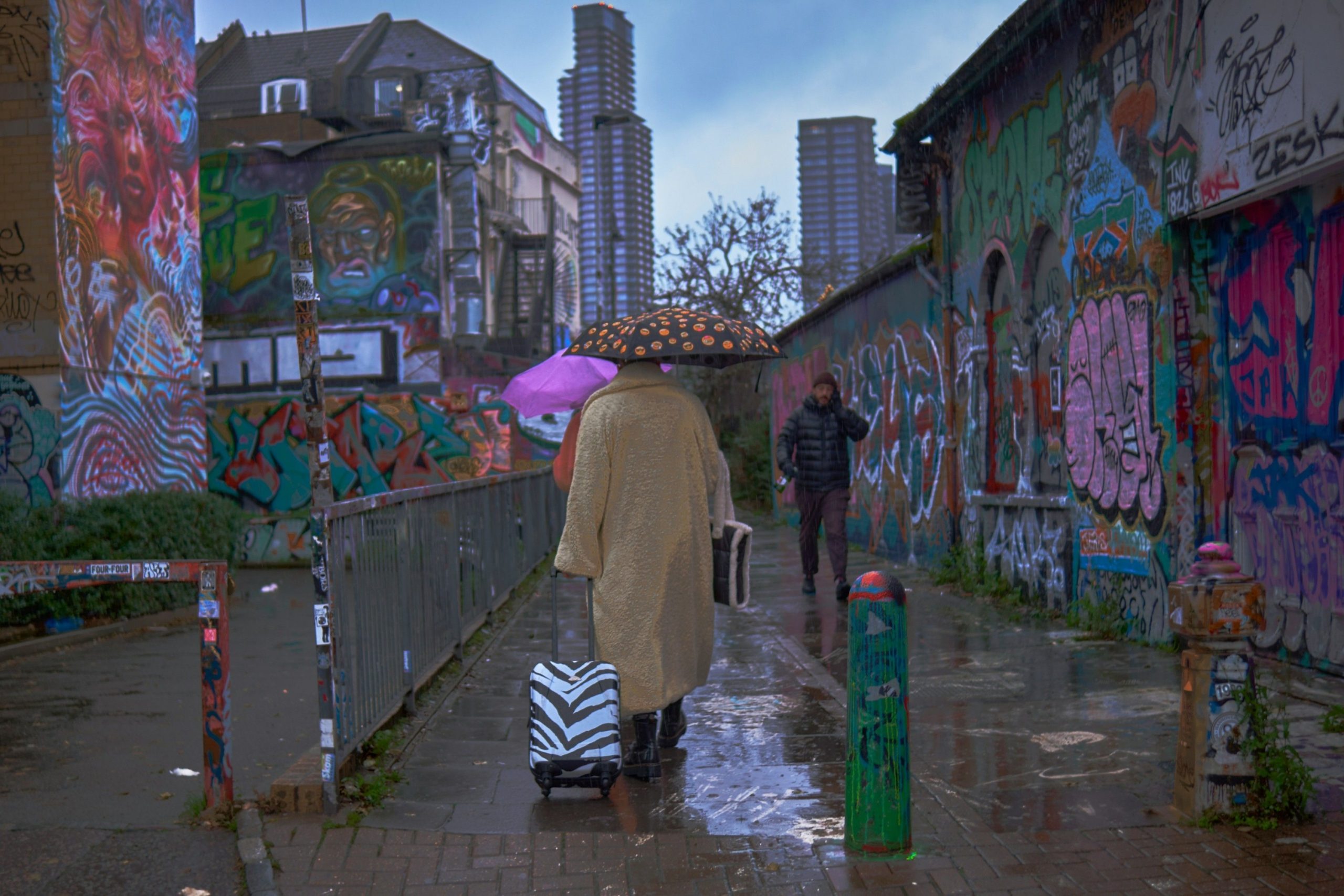
Courtesy of Unsplash user Flavio Vallone.
Some social media users are particularly good at capturing the romance of London. Their lives, shared through a carousel of reels, pictures, stories, and tweets, look so interesting, so aesthetically pleasing. I follow them with interest. They get pastries from the trendiest bakeries; they wear beautiful dresses, tall boots, and sumptuous winter coats; they take pictures of their aesthetic wooden bookshelves in the North London flats; they attend chic events at the London Review of Books bookshop. Sometimes they take pictures of their dinners, a glass of champagne in manicured fingers overshadowing a tray full of oysters. Some of them even post pictures of their children, posed like beautiful props in a Pre-Raphaelite painting as they pick daisies in St. James’ Park. They take their children to art galleries and concerts.
These beautiful vignettes stir up a strange and tangled mess of envy in me that is hard to unpick. I feel both embarrassed by and defensive of how ordinary my life is. I live in East London, a place I find (on a good day) more charming, more comfortable, and even more real in some important sense than the polished images you’ll find on reels. I love a good outfit, but my fashion choices are influenced by budget, comfort, and the need to look professional. I cook and eat a lot at home, both because I love baking but also because London is expensive. I love various corners of my home, but it is also often cluttered, scattered with piles of PDF printouts and bank letters. And this is the case largely because I have a job that I love and demands a lot of my time. In all sorts of ways, then, I choose a less aesthetically pleasing life, a less romantic life than the reels. I chose to live here, for all kinds of reasons that I stand by and feel confident about, but it’s not what lots of people think of when they picture postcard London — or even as they might picture my life as it’s mediated through Instagram or Substack. It’s okay, I tell myself. A life is not meant to be looked at but lived in. And yet I still find in myself this envy, this discontent; I want to live a beautiful life and mine feels so ordinary.
What makes a city romantic? What makes a life beautiful? Over a century ago, in his book Orthodoxy, G. K. Chesterton wrote about Pimlico, a neighborhood that had fallen into poverty and disrepair after an initial attempt at redevelopment:
Let us suppose we are confronted with a desperate thing — say Pimlico. If we think what is really best for Pimlico we shall find the thread of thought leads to the throne of the mystic and the arbitrary. It is not enough for a man to disapprove of Pimlico; in that case he will merely cut his throat or move to Chelsea. Nor, certainly, is it enough for a man to approve of Pimlico; for then it will remain Pimlico, which would be awful. The only way out of it seems to be for somebody to love Pimlico; to love it with a transcendental tie and without any earthly reason. If there arose a man who loved Pimlico, then Pimlico would rise into ivory towers and golden pinnacles … If men loved Pimlico as mothers love children, arbitrarily, because it is theirs, Pimlico in a year or two might be fairer than Florence. Some readers will say that this is mere fantasy.
Shortly after Chesterton penned Orthodoxy (published in 1908), a large collection of paintings by J. M. W. Turner, Britain’s most loved and highly regarded painter, were bequeathed by the artist himself to the National Gallery of British Art (now Tate Britain) in the Pimlico neighborhood in 1910. Like Florence, which is home to the great masters of Italian art, Pimlico became home to the great master of British art, a place to where now over a million people annually make a pilgrimage to see not only Turner’s works but also the best and most beautiful of British art. What Chesterton said some readers would call “mere fantasy” became reality.
And Chesterton went on to say that this is true of all great cities:
I answer that this is the actual history of mankind. This, as a fact, is how cities did grow great. Go back to the darkest roots of civilization and you will find them knotted round some sacred stone or encircling some sacred well. People first paid honour to a spot and afterwards gained glory for it. Men did not love Rome because she was great. She was great because they had loved her.
London is not Rome, nor is it Florence. All these cities all beautiful in their own ways. They became beautiful and have remained beautiful by people dwelling in them and looking after them, making buildings that suit their unique terrains, climates, and sensibilities. If one goes to London to find the Colosseum or the Statue of David, one will be disappointed. These places required different care and attention over many generations to become the cities that they are. One must, then, learn to love

Spot illustration by Ruthy Kim
London as London, and not as a bad imitation of Rome or Florence. I wonder if this is true of lives as it is of cities. Our lives become beautiful as we love every inch of them, every limitation — when we dwell in them as fully as we can, loving them, as Chesterton puts, “as mothers love children, arbitrarily, because it is ours.”
In his book The Call and the Response, French philosopher Jean-Louis Chrétien dwells on kalon, the Greek word for beauty, which is etymologically linked to the act of calling out to someone. Drawing on Romans 4:17 where God “calls [kalountos] into being things that were not,” Chrétien suggests all things are beautiful by virtue of being called into existence by God. For Chrétien, then, beauty is fundamentally relational, even conversational. He writes that “beauty addressing us calls us to ourselves”; we become beautiful merely by being ourselves, responding to the voice of beauty which calls us into being. One of the names Jesus gives himself is the good shepherd (poimen kalos), or rather, the beautiful shepherd, whose “sheep follow him because they know his voice” (John 10:4). The beautiful shepherd calls, and we his little sheep answer. In this light, then, beauty or kalon is not an image we cultivate and curate but a call that we answer.
I find the real London more beautiful than the London of the Reels I send back and forth with my mother. Because real London is not merely a static backdrop with nice music for an influencer’s glamor shot but a place people call home, a place still unfolding, a place whose riverbed is settled with the sediment of a hundred generations. There is something beautiful even in London’s ugliness, because it is a place still in conversation, a place like Pimlico that can be made beautiful by people loving it and calling it home. I don’t think this is some kind of perverse dedication to the simplicities of my own life, but rather it helps me to understand how to love my own life, and even to make it beautiful. London shows me that I make my life beautiful not by trying to fashion it into a poor imitation of someone else’s reel, but by loving the corners and oddities, answering the call of beauty to become who I’m called to be. London is still calling, and I do my best to answer this beautiful city.