




This essay appears in Issue 28 of The Mockingbird magazine, now available to order.
When I saw the foundation poured for a new house on my drive to Target, I knew what was coming. Sure enough, a white planked house rose, week by week, the black trim and black roof arriving like icing on top of the standard modern farmhouse, looking much like the other standard modern houses built around my town, in a style made popular by Chip and Joanna Gaines’ television show and media conglomerate, Fixer Upper. Why are all these houses white? Why do they all appear to follow the same guidelines for exterior decor? Wide eaves, double front doors, lanterns or crookneck galvanized lamps on either side? Why does everything look the same now?
“We pursue aesthetics without ethics,” writes Spanish artist Marina Roca Die. A visual artist, Die laments that social media, by its pixelated nature, has changed the way that we perceive beauty in art. Because the screen smooths artworks and makes them all a certain size, we lose all scale and tone. “Artists now prioritize immediacy,” she writes, “Paintings that work best are decorative, easily understood and as such, forgettable. We are creating undemanding paintings. Immediacy is the term of the decade.”
Aesthetics without ethics could also be called the “flattening” of beauty, in the words of blogger David Perell. According to Perell, our trending idea of beauty is
the gradual homogenisation of aesthetics, architecture, design, and branding into characterless internationalist blob. Ultimately it’s all the same thing: A relentless attack on the particular in favour of the universal generic.
Perell has plenty of examples, like branding by major companies such as Pepsi, whose once distinct logo now looks like a Rorschach test in American colors, the way Yves Saint Laurent, Balmain, and Burberry all use the same black bold-face sans-serif font, and the ubiquitous primary-color-illustrated characters we have come to expect on any technology website, where the bodies are made of simple shapes. Trends dictate taste, and our idea of beauty becomes homogeneous.
This standardization of what’s considered beautiful is also seen in home decor. Decorators describe the trend in interior decor as AirSpace, the homogeneous style and furnishings we have come to associate with Airbnb rentals. In a 2016 essay, journalist Kyle Chayka argues that instead of the varieties of global beauty capturing our interest as we travel, we are bringing our own idea of beauty with us:
It’s the realm of coffee shops, bars, startup offices, and co-live/work spaces that share the same hallmarks everywhere you go: a profusion of symbols of comfort and quality, at least to a certain connoisseurial mindset. Minimalist furniture. Craft beer and avocado toast. Reclaimed wood. Industrial lighting. Cortados. Fast internet. The homogeneity of these spaces means that traveling between them is frictionless… Changing places can be as painless as reloading a website. You might not even realize you’re not where you started.
You can picture it, right? You know the spaces Chayka describes. The ever-present nature of it means we are delighted when something is not AirSpace: bright colors or traditional decor, anything that surprises or startles us into wonder.
Atlantic staff writer Amanda Mull calls it “The HGTV-ification of America.” “These bundled aesthetics,” by which she means gray laminate floors, subway tile backsplashes, glass mosaic tiled showers and open kitchen shelving, “aren’t just coincidences and they can’t be entirely described as trends — at least not in the sense of bottom-up collective favor that the word tends to evoke.” She argues that the priority of all of this is for the home to feel new. “Gray floors and all of their comorbid design phenomena are cool and crisp and modern by comparison even if they’re also crushingly boring and totally character free and really limit a space’s potential capacity to feel warm and alive and like a home.”
I wonder how we got here. Did our moms all have the same art on their walls, the same tiled backsplash, the same sofa that falls somewhere between traditional and modern, I believe the term is “transitional”? I remember the Southern Living and Home Design magazines around the house because my mom was interested in art and design. But it was not this ubiquitous midcentury modern, all white walls, gray floors and neutral colors. My aunts had different styles than my friends’ moms. I don’t think we changed our decor on a regular basis. There was no HomeGoods to refresh my guest bedroom seasonally. My recent trip to my local store reminded me that I do not have nearly enough ghost decor for the Halloween season. I am okay with that.
But perhaps the most dangerous but deepest example of the flattening of beauty is our reshaping of the human body. We have long known the consequences of the strict rules of beauty placed on women and young girls. The Kate Moss look of the ’90s destroyed my generation’s relationship with food and curves. As Jia Tolentino argued in her viral essay “The Age of Instagram Face,” women now strive for
a single, cyborgian face. It’s a young face, of course, with poreless skin and plump, high cheekbones. It has catlike eyes and long, cartoonish lashes; it has a small, neat nose and full, lush lips. It looks at you coyly but blankly, as if its owner has taken half a Klonopin and is considering asking you for a private-jet ride to Coachella.
Tolentino wrote that essay in 2019, before we spent years on Zoom, with its “touch up my face” feature that erased all signs of pandemic parenting stress and sleepless nights worrying about the state of the world. In 2024 Americans underwent 1.5 million plastic surgery procedures and 25 million minimally invasive cosmetic procedures (namely injectables like Botox and fillers). One plastic surgeon told Tolentino that patients once brought in pictures of celebrities as their inspirations; now they bring in filtered photos of themselves, using apps like FaceTune. We watch before-and-after videos, imagining what a facelift or injections might do to the lines we did not notice ten years ago. The flattening of beauty is literally happening to our faces, and technology is making it easier to imagine.
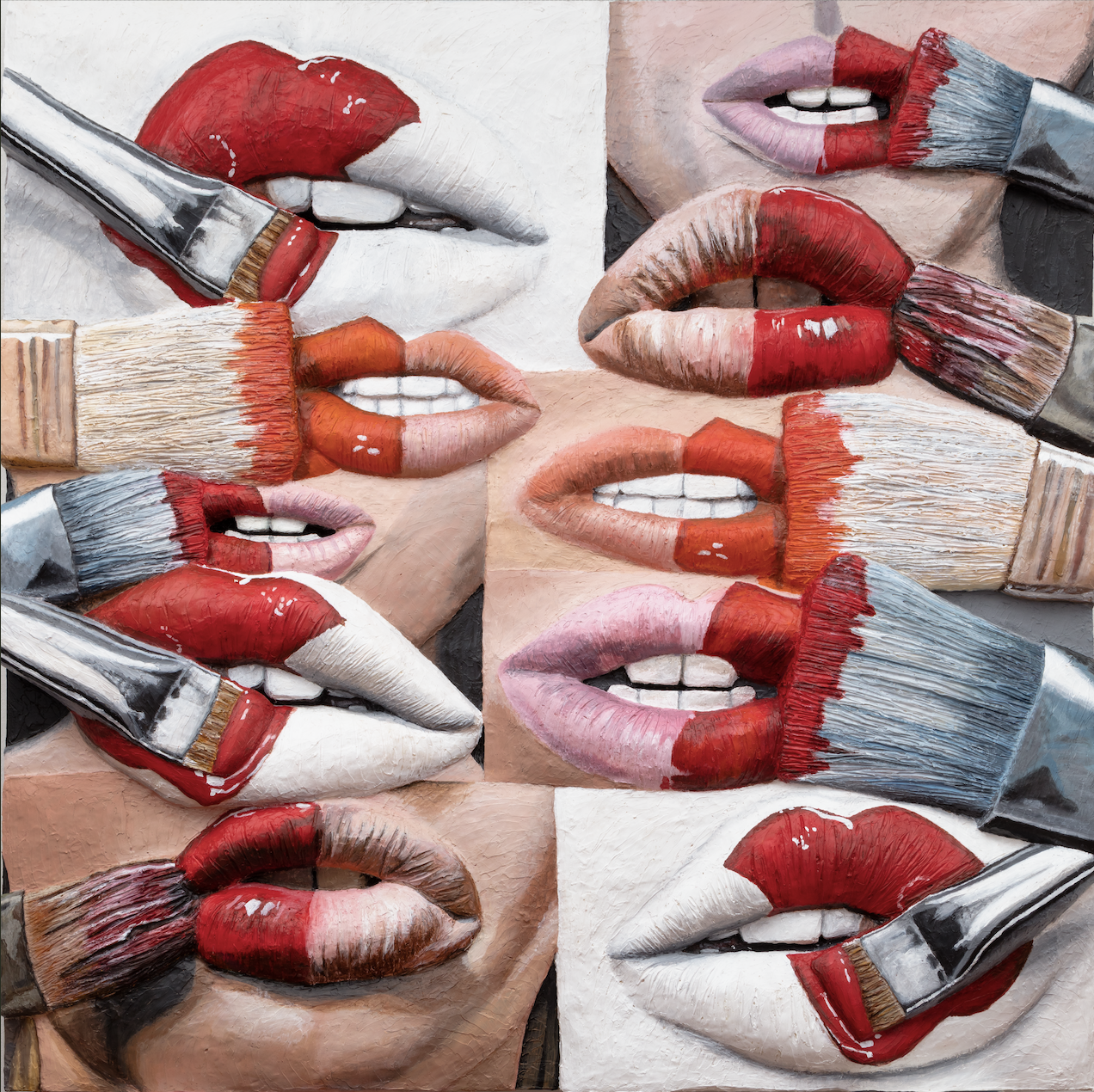
Gina Beavers, Painters Lips, 2019. Acrylic and foam on linen, 72 x 72 in. Photo by Charles Benton.
In the earliest days of the Internet, there was hope that being more connected across distances and cultures would lead to artistic expansion, introducing us to more and more beauty, unlike the beauty we had already seen. The hope was that ordinary people would take advantage of the web’s low publishing barrier to post great things, motivated simply by the joy of open communication. Ultimately, something else has occurred. Creators want to make content that appeals to the largest amount of people, to secure the largest amount of likes, subscribers, and followers. We look to the visual world not to challenge or disturb us, but to lull us into a comfortable sense of belonging, a mind-numbing scroll of seeming perfection.
The good news is we are not left alone in this bland world of cookie cutter content. Art expands us. Madeleine L’Engle wrote, “A great painting or symphony or play doesn’t diminish us but enlarges us and we, too, want to make our own cry of affirmation to the power of creation behind the universe … it is beauty crying out for more beauty.” Artists are those who are inspired to create to bring us back to the beauty around us. Frederick Buechner writes about the “frame” that writers and artists put around everyday actions or moments to make us pause and notice the beauty within them.
Beauty, in its highest, most divine sense, arrests us, body slams us into the present moment so violently we instinctively hold our breath. Beauty is almost never found where we expect it. The problem with the flattening of beauty is that when everything looks the same, nothing can startle us, make us uncomfortable, or bring us into the present moment like the pink-tinged wing of a moth landing elegantly on the arm of my rocking chair, alighting for a few moments, distracting me from my concerns about my future or regrets about the past. This tiny creature with ballet pink wings is all I can contemplate in this moment. Attempting to turn it into content, into something appealing to a large mass of people would require me to move my attention to the future. Beauty is here and now.
In this way, beauty is grace, unexpected, unmerited, pure gift from a loving creator who makes each face wrinkle in its own way, creates each creature from the pink moth to the one discovered by my daughter on our hike yesterday — we know beauty is from God because children are always better at spotting it than we are. As we walked along a dirt path, among the scent of freshly cut cedars and the clicking and humming of the swarms of insects in the late summer heat, my daughter stopped and gasped so suddenly that I prepared for a snake, probably a poisonous one. But peering around her shoulder, I saw that the gasp that might have signaled fear was actually conveying delight in an ordinary box turtle lying in our way. We marveled at the geometric pattern on the shell, wondered at the strange feet of the creature, and the small head pulling back beneath its carapace. Beauty startled us, and we both took a few minutes before picking ourselves up off the mat, unable to be anywhere but here.








I always appreciate your views on art and aesthetics – I believe the beach house interior design has taken over our homes. I personally find any art to cause my neural pathways to dance with serotonin . Yet as in any art, if I don’t move it often it becomes like the modern day interior designs , it fades into the walls or into the air. Much like the Holy Spirit can if I am distracted with monkey mind thoughts
Wonderful as always, Jane!
Lately I’ve been enjoying watching movies that are at least 25 years old (often much much older) just for the faces. The slightly imperfect teeth, the varying noses and cheekbones. I have some hope that maybe we’re past peak-beauty flattening, and beauty as surprise/variety will make a comeback, but we’ll see.