




This essay appears in Issue 28 of The Mockingbird magazine, now available for preorder.
Near the end of our family’s homeschooling journey, one of the graduating seniors in our group asked if I’d be a judge on her senior thesis panel. Her 20-page paper was a defense of Christians being allowed to listen to Emo music.
Because I grew up listening to Christian radio, I had to look up what Emo music was: “a musical genre characterized by emotional, often confessional lyrics.” It was a style of hardcore punk, with “emo” standing for “emotional.” I listened to some Emo. It seemed to be “teenage angst” music. As I read her paper, I noted the particular arguments she was up against — that Emo music causes people to be depressed, even take their own life. In contrast, she laid out the benefits of having an outlet for pain, and the value of art that depicts suffering.
The panel of judges (mostly chosen by the student’s mother) came in with their own agenda. It seemed most of them held the belief that Emo music focuses too much on the ugly. Christians should set their minds higher — on the good, true, and beautiful, not all these sad, emotional complaints.
As the judges kept asking if Emo music fit the description of beautiful, I kept asking: but is it true? And do we consider the truth beautiful, even if it does not bring immediate pleasure? Is there something beautiful in having our pain seen? Furthermore, what does the Bible say about expressing pain? It was a good discussion.
Raising my kids in the classical educational tradition, I often heard that phrase “good, true, and beautiful” in regards to what students ought to study. It’s an idea that comes from Philippians 4, which ironically is a letter the Apostle Paul wrote about suffering. Christians for centuries have understood these three transcendentals as being interlinked and as inseparable as the Trinity.
As I tried teaching my kids about setting their minds on the good, true, and beautiful, I kept circling back to this question personally: How do I teach my children about the ugly? How much do I expose them to it? Is the solution to suffering to just ignore it and think about better things? To just be grateful that you have it so much better than other people? Is the good, true, and beautiful really just code for “Suck it up, buttercup”?
I found there are two distinct ways to understand those transcendentals: looking at what is good, true, and beautiful through our eyes, and looking at what is good, true, and beautiful through God’s eyes.
If we don’t understand that our eyes don’t see well, and our ears don’t hear well, we reduce these transcendentals to pleasure. The phrase repeated in the book of Judges, about the people falling into sin, is, “They did what was right in their own eyes.” In other words, what is good is what is good for me. It puts the “self” as the center and judge. (Interestingly, I’ve found both ends of the theological spectrum — liberal to conservative — do this, but with their own bent, shaming the other side for “doing what is right in their own eyes.”)
We live with a tension between the ideal and the real. There’s the ideal that the world tells us is worthy, and the real world with pain, where we all find ourselves.
To be fair, English isn’t the best language when talking about beauty. English defines beauty as being pleasing to the eye. But there’s a deeper meaning available. Classical educator Andrew Kern talks about beauty along the lines of “harmony.” The entire work of Scripture isn’t one of pleasure but of bringing harmony to discord, resolution to conflict, and perfection to what is broken or incomplete. Harmony is when a painful screech is brought into tune, when a crooked picture on the wall is righted or, dare I say, when the law is fulfilled. Harmony is fulfillment.
The Work of Harmony
As a writer and a mom, I am very particular about the wording I use in teaching my kids how to work. I talk about cleaning a room as “making it beautiful.” I don’t just want the things put away. Especially when my kids get older, I want them to think through how to make the space beautiful. Should they move something to a better spot? Can they create something beautiful for the wall? Is their clothes drawer pleasing to look at? Cleaning up is a chore; making something beautiful is still work, but it comes with a sense of freedom and imagination.
The goal is to train their eyes, not just their hands. I want them to both see what needs doing and have the imagination to take action. It’s one thing to clean off the table. It’s another to add some flowers to a vase and set it there when you’re done. Work is not just utilitarian, it’s restoration.
Albert Einstein saw this need for beauty as the basis for all work — there was a vocational aspect to it. Journalist John Archibald Wheeler summarized Einstein’s three principles for work:
- Out of clutter find simplicity
- In discord, find harmony
- In the middle of difficulty lies opportunity
If we move beyond the English definition of beauty and look at other languages, we find that in Somalian beauty literally translates as “harmony.” In Albanian, it means “a fullness.” Slovenian literally translates beauty as “mercy” or “kindness.” Several languages translate beauty as “grace.” Even in English, grace is a synonym of beauty. “She has a grace about her” refers to elegance, or charm.
Grace is the fullness, the completion, the harmony that resolves the dissonance. Grace is the essence of beauty. It is the work of harmonizing.
It’s for this reason that the Apostle Paul brings up beauty in the book of Philippians. There’s a connection between beauty and sorrow, as the beauty isn’t in opposition to sorrow, but is for sorrow. It is the medicine for the illness. It is what brings the harmony to truth.
Harmony from Suffering
“It hurts to be pretty” was a phrase I heard often in my childhood. It’s something my mom would say every time she brushed my hair. Honestly, it didn’t hurt that much when it was my mom brushing my hair. Only when my older sister brushed my hair did I have to worry. She had the gift of doing a French braid so tight that it would stay in place for a full three days. So the pain was always worth it. In any case, I was raised to accept that beauty comes through pain.
I’ve cycled through that idea, especially as a woman. I want to push back against the various shapes that the culture demands we contort ourselves into in order to have any kind of perceived beauty or value. There can be a toxic, twisted side to this relation between pain and beauty.
I remember a few years ago, our youngest daughter’s cat Tom disappeared. We looked everywhere and checked in with the regional humane societies. Tom was gone, and, due to our living in a rural place, most likely some predator got him. Two years after his disappearance, my daughter was still grieving his loss.
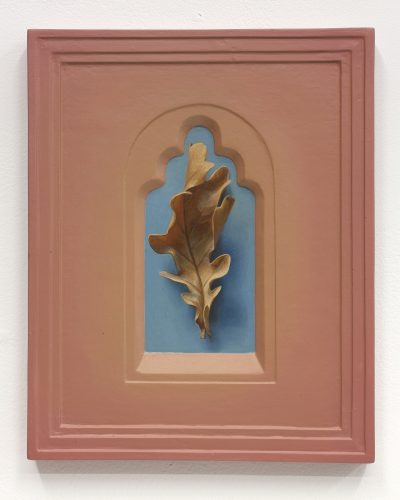
Ben Cowan, Blessing Leaf 4, 2025. Oil and acrylic on cast aqua-resin, 8×10 in.
I was brainstorming how to help her articulate and recognize what was happening, to face her grief head-on and maybe find some resolution. I handed her the book Where the Red Fern Grows. I thought maybe it would help her feel less alone in her grief — help her feel seen in her grief. I told other moms about my plan, and they were horrified. They claimed she would need therapy after that book. I was going to scar her. That is the saddest pet book ever.
But she had already started it, and was loving it. Each day she told me how it was the best book she had ever read. This author really understood animals! He really understood the bond children could have with them! As the days went on, and she got further and deeper into the book, I started to get nervous. She was about to be crushed.
Sure enough, one day she came downstairs with tears in her eyes. She was crying and heaving for breath. I took her in my arms and said, “What happened?” She had finished the book. All the tears came out. I immediately started apologizing to her. I told her I should have never given her that book. She looked at me, dumbfounded. “No, Mom. This is the best book I have ever read.”
In the days following, she couldn’t stop talking about it. I asked her what made her love the book so much. She said, “I used to think that sad was bad. But I learned that sad can be good, when it is true.”
Could it be possible that “it hurts to be pretty” has a thread of truth to it? This truth that the world has twisted and manipulated for the purpose of getting men what their eyes desire? Through pain I gave birth, and through pain my husband farms. For both we have had chemical help, but even that doesn’t take away all the pain. Life is scraped out of pain. It’s the reality God spoke over us at the Fall. A life void of pain is often a delusional one, or rather an empty one.
Proverbs 14:4 says, “Where there are no oxen, the manger is clean, but abundant crops come by the strength of the ox.” You want abundant crops? There’s the shovel to get the manure out of the stall. I think of this verse when my house is clean but my children are gone. If you want the abundance, it comes with mess and work, and even pain.
Beauty comes through pain, just as harmony comes through dissonance. The rising tension of a story makes it a good one. Things are beautiful when they resonate with the truth — even if that truth is sad.
Martin Luther taught that God hides behind his opposite. It’s why the weak are strong, and the kingdom of God belongs to the poor in spirit. This is the upside-down reality of a “theology of the cross” — sometimes known as a “theology of suffering.” But it’s more than just suffering. While sin deceives and panders, the theology of the cross roots us in what is real.
Luther compared it to the “theology of glory,” which is thinking beauty is ours to earn. A theology of glory is spiritual primping. There’s a sappiness to this kind of beauty, like a cheap utopia. There’s no depth to it — it’s not a beauty that has gone down to the depths and conquered it. A theology of glory reeks of escapism. It shuns the emo music and the tears of frustration, and any uncomfortable talk of death. The theology of glory is the Stepford wives, the Miss Umbridge of Harry Potter, the dismissive platitudes. Hold it together, people are watching. Smile pretty. It’s when we ignore the uncomfortable or evil, and just focus on being pleasing. The theology of glory is delusional self-righteousness — often willing to hurt others to have an image maintained.
Becoming a theologian of the cross is being refined through suffering, so we see the truth for what it really is. We find that our illusions have been comforting to us; temporary comfort is our god. So the truth, by comparison, will hurt. But God is with us in that pain, and he is for us in that pain. When we come to a correct understanding of ourselves, we understand the depth and breadth that God’s complete and perfect love is for us. We don’t have to pretty ourselves up. We don’t have to contort ourselves — we are made beautiful in Christ.
My family recently went through a difficult season after the death of my husband’s father, which brought about a flurry of pain from many sides, all in the midst of a build-up to one of the hardest seasons of our marriage. I remember talking to my pastor about it, and saying that I didn’t see any good options. Every way forward involved pain. Every turn hurt. We were just trying to find our way through. Our pastor said that he often called the theology of the cross “the theology of suck” because it faces up to the fact that life is just going to suck for a while, and sometimes there’s no way around it. For some reason, it was so comforting when he acknowledged that.
I’ve often felt this pressure, though, within the Christian Pietism tradition that I grew up in, to cling to the verse “Rejoice in the Lord always” (Phil 4:4). I would read it as a command to fulfill daily. Now I hear a different tone, the same one in the voice that said, “Let there be light,” and the Word was made manifest. I hear it as a proclamation from the One whose word always creates what it says.
The cross is the ugliest thing the world has to offer — but it is true. Sin and death are realities that must be dealt with. Hatred, depression, bullying, failure, and all things painful were bonded to Jesus there on the cross, so that when he died, they all died with him. The beauty of the risen Christ is a beauty that has gone to the depths of evil to destroy it. He touched the sin, the sickness, the death, and overcame it.
When we cling to performative beauty, we miss the depth of God’s patience — his own willingness to long-suffer on our behalf, which is one of the most beautiful things to behold. God did not become incarnate and suffer and die just so we’d have such a great example in our quest for utopia. He did it so he could literally save us. “Greater love has no one than this: to lay down one’s life for one’s friends” (Jn 15:13).
The cross defines beauty as forgiveness, not dismissiveness. It’s beholding, not ignoring. It’s chasing after, not escaping from. Nothing about the cross is pretend or superficial. It is beauty in its rawest form. It shows that all is made beautiful through him — even the cross itself — because it shows us who we really are, and who Christ really is: the forgiven, and the forgiver. The good, the true, and the beautiful.







Opening our eyes to the many forms of beauty, this Letter to America shows that whatsoever is true, whether joyful or painful, is a gift from God. “All things work together for good to them that love God and are called according to His purpose.” Although we may not understand why events are happening, God has a purpose for us to know and experience pain and suffering. Our faith and trust in God are enhanced by adversity ! We can learn from our difficulties and problems and use those experiences to help others with loving counsel from how God has led us through those difficult experiences. In every situation, we can praise the Lord !
Wonderful article! Loved the translations of “beauty”.
There is so much actual, real, helplful wisdom in this one article. I especially loved the observation shared: “The theology of glory is is delusional self righteousness–often willing to hukrt others to have an image maintained. “And then there’s the reality: “The rising tension of a story makes it a good one,” and then the idea of : upside-down reality.” Yep. Like them all. But my favorite one is a secular bumper sticker that is another way of saying some of the statements we are famous for that don’t really help much: “Suck it up, buttercup!” There are, indeed, times when I need to make my way through whatever is going on, but there’s usually a better way to provide encouragement and connection than that one!
With my profound 20/20 hindsight I have come to see that the most difficult times in my life have revealed to me a truth that I can only be described as beautiful. That truth – God is good and God’s love is certain. Thank you for this reflection.
Thanks for this gift to us, my friend Gretchen. It was good, true & beautiful.
I appreciated such gems as: “Work is not just utilitarian, it’s restoration.” “The cross is the ugliest thing the world has to offer — but it is true. …The beauty of the risen Christ is a beauty that has gone to the depths of evil to destroy it.” And to hear “Rejoice in the Lord always” less as command and more as proclamation and provision.
I find this funny considering I started listening to Emo recently, even though I grew up during the time it was popular.
Amazingly Beautiful!!!
So many lovely and beautiful truth nuggets in this article. Thanks for writing it and I look forward to sharing it with many. Sadly, this is not the message being shared in many a church and that truth is heartbreaking.
“Temporary comfort is our god”. Yup. Much to love here. Thank you
Ahhhh, this was just so good.
It reminds me of those great words in 2nd Corinthians for times of suffering:
“We are hard pressed on every side, but not crushed;
perplexed, but not in despair;
persecuted, but not abandoned;
struck down, but not destroyed…”
“Therefore we do not lose heart.
Though outwardly we are wasting away, yet inwardly we are being renewed day by day. For our light and momentary troubles are achieving for us an eternal glory that far outweighs them all.
“So we fix our eyes not on what is seen, but on what is unseen. For what is seen is temporary, but what is unseen is eternal.”
-Cor 4:8-9, 16-18
This was such wonderful piece. And “Where the Red Fern Grows” one of the favorite books of my childhood!
This excellent article reminds me of Gesa Thiessen’s claim in Theological Aesthetics: ‘‘Art, too, has an eschatological dimension since in art we can imagine and express the world as it could or should be,’’ she writes. ‘‘Indeed, one might claim that real art points us in the most diverse ways to a reality that could be and is not yet….In ‘Guernica’ Picasso showed his protest against war by confronting the viewer with its horror, thereby pointing to a world that should be other than it is.’’