




It was after reading J.D. Salinger’s short stories Franny and Zooey in college that I took up praying the Jesus Prayer: Lord Jesus Christ, Son of God, have mercy on me, a sinner.
Weary of the image-conscious posturing of collegiate life, Franny clings to the prayer like some kind of antidote. “I’m just sick of ego, ego, ego. My own and everybody else’s,” she laments. “I’m sick of everybody that wants to get somewhere … I’m so horribly conditioned to accept everybody else’s values … I’m sick of not having the courage to be an absolute nobody.” Franny explains the Jesus Prayer to her boyfriend: “If you keep saying that prayer over and over again — you only have to just do it with your lips at first — then eventually what happens, the prayer becomes self-active. Something happens after a while. I don’t know what, but something happens, and the words get synchronized with the person’s heartbeats, and then you’re actually praying without ceasing.” What’s remarkable to Franny about the prayer is that “when you first start doing it, you don’t even have to have faith in what you’re doing … All you have in the beginning is quantity. Then, later on, it becomes quality by itself.” Her boyfriend tells her to “take it easy” but follows with a question about what exactly is supposed to happen. “You get to see God,” Franny replies.

I didn’t expect all that, but the mantra did weave itself into the rhythm of my breathing when there was nothing else to think or hear. After many years on obsessive repeat when I woke in the night, the final phrase morphed into have mercy on me, a poor child. This revision was prompted by the spiritual direction of Julian of Norwich and her Revelations of Divine Love. As I soundlessly mouthed “child” instead of “sinner,” I could hear the Calvinist patriarchs of my youth reproach me: See, theology goes soft when you let women in. And I would have to tamp it down with Franny’s retort: Oh, don’t be so “hopelessly super-male.”
Julian’s portrayal of us as injured children challenges the idea that God demands we make ourselves low in the face of grace. She indicts this as “sin’s story about itself” and asks us: Is it God’s story about us? [1] Julian spends years scanning the scriptures for an answer and ends up appealing to a distinction between human judgment and divine judgment, saying the former is “harsh and painful” while the latter is “kind and lovely.” Where the human view is mixed and accusing, the divine is unadulterated “mercy and pity.” But how can God see us as blameless and holy (Col 1:22), she wonders, when we are in fact “sinners”?
The Parable of the Prodigal Son presses a similar question and points to an answer we often miss in the usual readings. If you’re unfamiliar with the passage, or want to bring it more clearly to mind, please take a moment with what one commentator calls “the greatest short story ever told”:
Then Jesus said, “There was a man who had two sons. The younger of them said to his father, ‘Father, give me the share of the wealth that will belong to me.’ So he divided his assets between them. A few days later the younger son gathered all he had and traveled to a distant region, and there he squandered his wealth in dissolute living. When he had spent everything, a severe famine took place throughout that region, and he began to be in need. So he went and hired himself out to one of the citizens of that region, who sent him to his fields to feed the pigs. He would gladly have filled his stomach with the pods that the pigs were eating, and no one gave him anything. But when he came to his senses he said, ‘How many of my father’s hired hands have bread enough and to spare, but here I am dying of hunger! I will get up and go to my father, and I will say to him, Father, I have sinned against heaven and before you; I am no longer worthy to be called your son; treat me like one of your hired hands.’ So he set off and went to his father. But while he was still far off, his father saw him and was filled with compassion; he ran and put his arms around him and kissed him. Then the son said to him, ‘Father, I have sinned against heaven and before you; I am no longer worthy to be called your son.’ But the father said to his slaves, ‘Quickly, bring out a robe — the best one — and put it on him; put a ring on his finger and sandals on his feet. And get the fatted calf and kill it, and let us eat and celebrate, for this son of mine was dead and is alive again; he was lost and is found!’ And they began to celebrate.
Now his elder son was in the field, and as he came and approached the house, he heard music and dancing. He called one of the slaves and asked what was going on. He replied, ‘Your brother has come, and your father has killed the fatted calf because he has got him back safe and sound.’ Then he became angry and refused to go in. His father came out and began to plead with him. But he answered his father, ‘Listen! For all these years I have been working like a slave for you, and I have never disobeyed your command, yet you have never given me even a young goat so that I might celebrate with my friends. But when this son of yours came back, who has devoured your assets with prostitutes, you killed the fatted calf for him!’ Then the father said to him, ‘Son, you are always with me, and all that is mine is yours. But we had to celebrate and rejoice, because this brother of yours was dead and has come to life; he was lost and has been found.’” (Lk 15:11-32)
***
A family friend recently died after a long period in hospice. Knowing the end was close, I was sure to text him on his birthday. He texted back that my dad had brought him a copy of my book Prodigal Christ, and he had been reading it. Embarrassed by such an honor, I said something self-deprecating about how he should find a better way to spend the time that remained. He replied, “I want to tell you some day why I identify with the prodigal son.”
My friend is far from alone in identifying with the Prodigal Son — there may not be a better story to conjure in the face of that final homecoming. The impetuous boy is a widely referenced figure for fallen humanity. Many writers take him as a template for their faith journey, especially their conversion story. St. Augustine was the first to cast himself as Luke’s prodigal in his Confessions, and there have been countless representations in history, art, and literature since. From Rembrandt to Rodin to Toni Morrison, artists and authors commonly sympathize with the prodigal’s story. As preacher Barbara Brown Taylor says, it is as if this parable calls to us to “Come on, stand here on our side, on the side of human beings.”
We are asked to see ourselves reflected in this child who is entitled, ungrateful, and careless, who squanders everything, and yet is received back with an unconditional love that says defiantly, “I will match you.” This is grace. This is a powerful story of divine grace. That’s why it has been called “the Gospel within the Gospel.” It is the whole of creation-fall-redemption history condensed down into one compact yet capacious narrative that is moving and memorable.
But something wonderful about parable as a literary genre is that its meaning can’t be exhausted by a first blush reading or reduced to a single message. It’s packed with elisions that evoke questions. We have to make leaps and reread and talk about it. Why does the son leave? Why does the father give him his inheritance early? (Surely he knows that will be bad for him.) Where is the elder brother when this happens? Does he concur? How long is the younger son away and have they had any word from him? Where’s the mother? Where are the women? (My daughter asked me this when, aghast, she saw me making a slide show featuring artworks populated only by fathers and sons. Rembrandt apparently had the same question and, in his famous rendering of the scene, painted women in.)

Rembrandt, Return of the Prodigal Son, 1661-1669. Oil on canvas, 103 in × 81 in.
The parable is as fecund as it is elliptical, engaging our imaginations generatively. We are drawn into the family triangle, aligning ourselves with specific figures, perhaps at different times in our life, as Henri Nouwen does so candidly in his reflection on Rembrandt’s painting, The Return of the Prodigal Son: A Story of Homecoming. Over the millennia, biblical scholars have advanced countless interpretations, filling in the blanks and extrapolating from the details. Well-known in English as “the parable of the prodigal son,” translations in other languages often use the epithet “the parable of the lost son,” which leads us in a rather different direction. Readers have proposed a variety of other titles as well, such as “the parable of the good father,” “the parable of the prodigal father,” “the parable of the powerless almighty father,” “the parable of the rebellious sons,” and so on. This is indicative of the rich polyvalence of the text.
Of all there is to say, two specific features are worth noticing if we’re going to understand the depth of Jesus’ teaching. First, while most interpretations of the parable have stressed the difference between the two sons, their root problem is the same. (This has become a popular claim in more recent years, prompting some to rename it “the parable of the prodigal sons.”) Second, in telling this story, Jesus is implicitly aligning himself with the wayward son.
***
A few examples of the way the figures are usually contrasted helps clear the ground to see their similarity. In the long history of the parable’s interpretation, the elder brother and younger son have been pitted against one another respectively as: righteous/sinner, Jew/Gentile, observant/unobservant (religiously speaking), proud/humble, unrepentant/repentant, law/gospel, judgement/ grace, and — worst of all — reprobate/elect. These are all mapped onto the two sets of hearers identified in the preface (Lk 15:1-2): “Now all the tax collectors and sinners were coming near to listen to him. And the Pharisees and the scribes were grumbling …”
Something we’re less likely to pick up on as modern readers is that this is a story about the classical virtue of liberality. Liberality or openhandedness is the midpoint between the two extremes of excess and deficiency. The reckless spendthrift is too free, too loose and liberal; the eldest child is too careful, too tightfisted. The father strikes the balance in his freehandedness. Like most of Jesus’ parables, there’s an economic thread to pull here.
There’s coherence to all of these pairings. I draw attention to them mainly because I think we are inclined to focus on characters and the way they remind us of ourselves or people in our lives. When I teach this parable in the classroom, I begin by having us locate ourselves. Unsurprisingly, this usually happens vis-à-vis our family of origin. Do you identify with the prodigal son? If so, you are in the excellent company of theologians and artists from across the ages. Are you the elder brother? Although no one wants to sympathize with a character whose bitterness threatens the story’s happy ending — ironically putting us, as readers, precisely in his shoes — he has reasonable motivations and genuine anxieties. What about the father? It feels self-aggrandizing to see ourselves in a role we’ve been conditioned to read as God’s, but we’ve all been in positions where we’ve readily released the past and rejoiced at restoration.
It’s a good habit to take a look at the associations and biases perduring in our reading, because sometimes these can obscure the fullness of the message. As modern readers, we can be pretty character-driven and self-referential. It’s worth remembering that in Jewish or Rabbinic parables of the sort Jesus tells, the meaning is supplied less by the lineup of stock characters and more by the rhetoric, by the verbal structure of the story, and especially by what is unexpected in the dialogue. We need to approach ancient parables a little more like we would prose poetry today. Word choice matters. Repetition matters a lot. Direct speech is telltale.
With this in mind, it’s easier to notice that the sons are two sides of the same coin. The storyteller is indeed drawing a contrast. But it is less between the two sons, and more between the sons and their father, between the way both sons see themselves and the way the father sees each of them.
***
The mischief commences with the younger son’s demand, “Father, give me my portion …” (v. 12). Give me! Disrespectful in any culture, and intensely so in the world of Jesus’ first listeners, this is an insult to his whole family and to the land that is their shared livelihood. However, just as importantly, the boy’s demand tells us something about how he sees himself. It reflects a sense of subjection. Although he’s a figure of prodigality, his request is in fact meager, not excessive but deficient. He’s taking whatever he can get in a fire sale, which is certainly less than his full inheritance (v. 13). (This complicates and inverts standard illustrations of the vices of prodigality and miserliness.) The son demeans himself further by going into a “distant” land, which is to say, a Gentile country, where he can’t keep the law, can’t maintain purity. He breaks ties to family and community, burning his safety net, making his life precarious.
He hits rock bottom when hardship forces him to become another man’s indentured servant. We find him tending a herd of pigs, so hungry he envies their slop (v. 15). This is a picture of poverty and loss recognizable to any reader. But his situation is, again, more heavily freighted with meaning for a first century Jewish audience. It is emblematic of humiliation, captivity and exile, ritual impurity, alienation from the people of God and therefore from God.
The narrative pivots when the wayward son “comes to himself ” (v. 17) and regrets his circumstances. Often we read this as a conversion moment, a sign of repentance. But if we stay close to “the way the words go,” they lead us in another direction as well. Why does he resolve to head home? His speech reveals that it’s because he realizes it’s ridiculous to let himself starve when he knows a man as patently generous as his own father. Even the least secure of his father’s workers (the “hired hands”) have plenty. The boy does not return in search of reconciliation or restoration. Instead, he prepares to admit, “I am no longer worthy to be called your son,” and to implore his father to “treat me like one of your hired hands” (v. 19). He takes for granted that he has been disowned. He conceives of his father’s good favor as something earned and, in his case, now spent, “devoured” (v. 30).
The boy’s rehearsed speech almost echoes the tax collector’s prayer later in Luke 18:9-14, “God, have mercy on me, a sinner,” the origin of what becomes the Jesus Prayer. The difference is, he does not approach his father with humble faith in his mercy. He only seeks the opportunity to work off what little he might reasonably be said to deserve — to survive another day.
Now, his older brother seems to have taken an altogether different path, right? He stayed home. He’s faithful, responsible, and hard-working. He hasn’t jeopardized the whole future of the family. We overlook how fundamentally good all of this is when we summarily dismiss him for being slow to rejoice that the wolf has been readmitted to the sheepfold without any assurance of safety. Yet there are two clear textual signals that the older shares his younger brother’s problem.
First, we find both boys afield, literally. The storyteller situates each of them working in a field. The younger is sent into the field (εἰς τούς ἀγρός) tend a herd (v. 15) and, ten verses later, the elder son comes up out of the field (ἐν ἀγρῷ) after a day’s work (v. 25). The repetition of agrós (Gk., “field”) stresses their shared location. This becomes more explicit in the direct speech that follows on the geographical clue.
Second, their self-perception is servile. Just as the younger son sees himself as, at best, “a hired hand” (μίσθιος) of the father (v. 19), the older son tells his father: “I am slaving (δουλεύω) for you” (v. 29). With artful symmetry the two sons mirror one another. The younger son believes he deserves nothing now, while the older son has spent his whole life trying to deserve what is already his. They view themselves in servile terms, trafficking in an economy of “just deserts,” a sort of familial meritocracy. They can’t get outside a conceptuality of contingent worth, of rewards and punishments.
So while these children may have different behavioral problems on the face of it, their root cause is the same. The real contrast of the story arises with the father figure. The father does not see his sons as earners, as workers or servants. He treats both as free and legal equals, as masters of the household, no less than himself. He gives his younger son all he asks for (v. 12), and when he returns, gives again. The father “has compassion on” him (v. 20). This is the central verb on which the story turns, and there’s a whole sermon in it for another time. [2] A visceral love prompts the father to have mercy, to bypass the usual process of forgiveness and restoration, immediately reinstating him as heir. This is the meaning of the father’s orders, “Quickly, bring out a robe — the best one…put a ring on his finger and sandals on his feet” (v. 22). These objects and gestures are symbolic of ownership or heirship.
According to the law, the firstborn son is designated to inherit two-thirds of the property (Deut 21:17). But in the parable, it’s the younger son who is going to wind up with a “double portion.” (This of course alludes to the long and comical history of younger sons hijacking family inheritance, e.g., Jacob and Esau.) Because of this, people sometimes interpret the elder brother as the reprobate or rejected one. He seems to see himself this way, whining woundedly that “you never gave me!” (v. 29), which echoes his brother’s “give me!” But there is no sign that the father disowns him. In fact, when the boy accuses him, the father speaks just as tenderly to him as to his youngest: “Son, you are always with me, and all that is mine is yours.” What is translated “son” in this instance is τέκνον, a term of endearment or affectionate address. Where the ordinary Greek word for “son” (υἱός) is used elsewhere in the parable, here the father appeals to his eldest gently, inviting him in too, as if to say: Dear boy, neither did you have to earn my goodwill.
Over against the servility of his sons, the father says to them both, “what is mine is yours.” What’s going on with all this ownership language? Why is the father at such pains to stress that they are sons, not slaves? Of course, we balk at words like servant and slave today. But these make a certain point for the audience in the world of this story. To say “son,” to say “child,” is to say “heir.” An heir is the recipient of a gift, a free gift. “Double portion” or “inheritance” is a common scriptural metaphor for salvation. In the language of Galatians 4:7, “You are no longer a slave but a child, and if a child then also an heir through God.”
***
How do we become heirs? This brings us back to the main message of the parable. We said: This is grace, this is a story about God’s grace. But what is grace? Grace is not just something that God does, an activity tangential to who God is. Grace has a name. Jesus is saying: I am the one in whom this happens. I am Grace.
We run into a slight textual problem here though. Where is Jesus in the parable? If Jesus were asked to identify with a character, what would he say? Commentators from Ambrose and Augustine on have sought him in little details: the fatted calf, the right hand of the father, the father’s embrace. Others have suggested Jesus is performing a better version of the elder brother. But according to the great twentieth-century Swiss theologian Karl Barth, Jesus Christ is not hidden in the margins. He is the main character. He is given “in, with, and under” the lost son.
How could that be? Isn’t Jesus always the good guy in stories? This is a common mistake in reading parables — drawing correspondences that are too straightforward. Christ bears no simple identity with the younger son. It is a matter of the way their narrative arcs align. Barth says, “In the going out and coming in of the lost son in his relationship with the father we have a most illuminating parallel to the way trodden by Jesus Christ in the work of atonement, to his humiliation and exaltation” (Church Dogmatics, IV/2, 23). That’s a wild conclusion. In millennia of remarkably prolific freeplay with this story, no one before Barth saw this — except for the 14th century English anchorite, Julian of Norwich. [3]
According to both Julian and Barth, if this parable is genuinely “the gospel within the gospel,” we must recognize that the storyteller is identifying himself with the fallen and wayward son. There are several strong indications that he is doing this. First, the repetition of the words “lost and found” ensures the parables of Luke 15 are taken as a set: the lost sheep, the lost coin, and the lost boy. The triple parables are situated as a reply to the accusation in the preface that, “This fellow welcomes sinners and eats with them” (v. 2). Jesus is justifying his lived fellowship with prodigals to their responsible elder brothers.
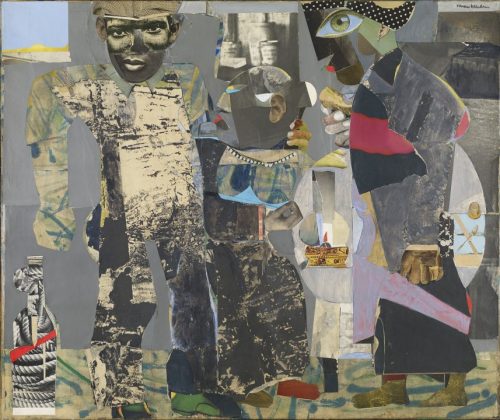
Romare Bearden, Return of the Prodigal Son, 1967. Mixed media and collage on canvas, 50 x 60 in. Collection: Buffalo AKG Art Museum.
This is something else that can slip past our contemporary imaginations. Why is it such a big deal that Jesus is hanging out with “sinners”? We’re so conditioned now by an equalizing account of sin and grace that it’s harder for us to register the clear dividing line — in/out, righteous/unrighteous, clean/ sinner. But the devout who are questioning Jesus (v. 1-2) are genuinely confused, and they should be. His actions run counter to a bunch of fairly compelling biblical injunctions about avoiding corruption and contamination. [4] Meals mean solidarity. Jesus’ rejoinder is not unwarranted.
The repetition of “lost and found” is crowned with “rejoicing” (v. 32). Rejoicing is a key term in all three parables. In the culminating parable of the prodigal son, a banquet ensues — “let us eat and celebrate” (v. 23; cf. v. 32). This is a moment of extravagance, which is a hallmark of parabolic discourse. The meaning of the story overflows its narrative confines, situating itself in real life. Such a celebratory conclusion alludes to a major theme of the Gospels: dining with outcasts heralds the wedding feast of the Lamb.
Second, the emphasis on the word “lost” foreshadows the moment later in Luke when Jesus says to that little prodigal tax collector Zacchaeus — with whom he breaks bread, of course — “The Son of Man came to seek out and to save the lost” (19:10). But how? How does Jesus seek and save? Only by becoming lost humanity; in the language of 2 Corinthians 5:21, even by becoming sin itself. Paul writes, “For our sake, God made the one who knew no sin to be sin, so that in him we might become the righteousness of God.”
The leap from the prodigal son to the Son of God is not so great then, if we remember the rest of the story. Philippians 2 and Romans 5 are decisive intertexts for both Julian and Barth. The eternal Son did not stay home and grasp after equality, like the elder brother. He went into the distant land of human lostness, taking the form of a servant, obedient to the point of death. He became the second Adam, the second prodigal, overriding fallen human identity, making it his own, traversing the same circuit to redirect it, entering exile to overcome exile, lowering himself that we might be exalted (2 Cor 11:7).
The last rhetorical clue is the most conspicuous. Twice the father says, “My son [your brother] was dead and is alive again …” Barth asks if this is “almost too strong to be applied … to the lost son of the parable.” Reading this passage in the context of Jesus’ life, as a gospel within the gospel, the repetition of the words “dead and alive” bring to mind the whole passion sequence, Jesus’ own death and resurrection. The life of the storyteller reverberates within the story, and vice versa. [5]
We moderns have strict boundaries between fiction and life, what’s written and what’s real. But Jesus offers himself as a walking interpretation of the scriptures. [6] He doesn’t go around telling stories peripheral to who he is. He is saying to his listeners, “I am how I live.” With a few key terms, he vividly implicates himself in the prodigal’s story. He enacts the same grace he narrates. In the end, Jesus presses an expectable illustration of the virtue of liberality to its breaking point. In his identification with the lost, he is not perfectly freehanded or moderate. He is the excessive one — gratuitous, even reckless. “He hazards himself,” Barth says. [7] He is the form of the true prodigal.
***
Julian’s retelling of the parable culminates with a beautiful image summarizing the meaning of the parabolic father’s lovingkindness. Over against the doomsayers of her age, she encourages us to imagine the divine gaze not as that of a punishing judge or distant lord but of a tender mother. She says of Jesus,
He wants us to behave like a child; for when it is hurt or frightened it runs to its mother for help as fast as it can; and he wants us to do the same, like a humble child saying, ‘My kind Mother, my gracious Mother, my dearest Mother, take pity on me’… he wants us to take on the nature of a child which always naturally trusts the love of its mother in weal and woe.” (trans. Spearing, 144)
The humility of a child is qualitatively different than that of a servant or a debtor. Julian doesn’t deny the crushing reality of sin and suffering, but she focuses her readers pastorally on God’s perspective. [8] God, like the parabolic father or a wise mother, does not reproach us with “Sinner!” at a distance, but comes close and beckons, “Darling child.” Sin’s story denies God’s pronouncement even as it shrouds its own conviction of undeservingness in devotion. But, Barth explains, true faith is disbelief in our own rejection. [9] It means trusting that we are not disowned or disinherited.
The Parable of the Prodigal Son is indeed the story of grace and mercy par excellence. But we stop short of its radical meaning if we read it merely as an account of human repentance and divine forgiveness. We remain trapped in the old view if we accept the son’s confession, “I am not worthy.” Our place in the household of God is not won through labor or lost through wandering. In the end, we are all like the lost son: Our problem is not that we asked for too much, but that we accepted too little. We are invited back for the rest. What do we “owe” in return? Not the prodigal’s plea to his father, “Make me a lowly wage laborer.” Not the elder’s self-assertion, “I have worked hard for you.” But the posture of an unconditionally secure child who readily avails herself of her mother’s consoling embrace.
And Franny is right — you don’t even have to believe it at first. Quantity turns into quality. The words are self-activating.
Lord Jesus Christ, have mercy on me, a poor child.
This essay was adapted from a chapel talk given at Eastern University in March 2023.








Indeed, “The Father of Prodigals”: that’s us all, not the Father but the prodigals. Indeed, that’s us all.