




This essay appears in Issue 28 of The Mockingbird magazine, now available to order.
When Paul Elie writes a book, he takes his time. His first two, released in 2003 and 2012, were meticulously researched and lovingly composed. Both were nominated for National Book Critics Circle awards. His latest, The Last Supper: Art, Faith, Sex, and Controversy in the 1980s (2025), follows in that pattern, engrossing readers with a flurry of anecdotes slowly braided together into a compelling cultural narrative. His theme? The explosion of “crypto-religious art” in the 1980s. As Elie explains, crypto-religious art
incorporates religious words and images and motifs but expresses something other than conventional belief. It’s work that raises the question of what the person who made it believes, so that the question of what it means to believe is crucial to the work’s effect.
Of course, that effect may be unsettling for some, but for Elie, a Catholic, such art can often be a source of deep spiritual encouragement, and is, in any case, emblematic of today’s religious pluralism. As Elie explains, religion is not so much in decline as it is “surging out of bounds.” Of the dozens of artists profiled in the book (among them Andy Warhol, U2, and Toni Morrison), most, he writes, are not “anti-religious or irreligious. They’re crypto-religious. For them prayer, scripture, image, and ritual are material they claim as their own via the imagination and seek to complicate and deepen, not to do away with.” For those who can appreciate these unorthodox approaches, instead of viewing this variety as “akin to apostasy” to be resisted at all costs, Elie suggests such crypto-religious art may be just the kind of salve we need in our overly explicit, category-obsessed age.
— Ben Self, interviewer
Mockingbird: Paul, your first book, The Life You Save May Be Your Own, is one of my favorite works of nonfiction. It covers the so-called “Catholic moment” of the mid-20th century, interweaving the lives of four great American Catholic writers: Dorothy Day, Thomas Merton, Walker Percy, and Flannery O’Connor. I’m curious how that book may have worked as a set-up or a prologue for this latest book, The Last Supper, which is about crypto-religious art in the 1980s. Are they linked in your mind?
Paul Elie: Very definitely. When I was doing events for my first book, one of the questions I kept getting was who are the successors to those mid-century writers? In effect, The Last Supper answers that question.
When I reflected back on my own experience in the ’80s — I went to college in 1983 in New York City — and that of my generation, I started seeing some of the very tensions at work that had led me to go down the path of reading O’Connor, Percy, Merton, and the like. How do religion and the arts fit together? Why do the arts feel like a particularly authentic or provocative zone for religious inquiry? Why is it that I’m drawn to that kind of work more than to doctrinal or theoretical approaches? But in trying to identify particular successors, I came to think that I was making a category mistake. The artists of the ’80s were dealing with religious subjects differently than in past generations.
The Life You Save May Be Your Own was about writers who, as more or less orthodox Catholics, were close to the center of the church, but in many respects were peripheral in American culture. Dorothy Day was an anarchist who had opted out of the American century in important ways. She opposed even World War II. Thomas Merton had elected a life of silence and decided not to leave a particular patch of ground in Kentucky for a couple of decades. O’Connor lived not just in Georgia, but in rural Georgia. And Percy, who lived in New Orleans for a time, chose the pleasant non-place of Covington instead. Now that those writers are canonical, it’s easy to forget how marginal they were at the time.
Flash forward to the 1980s and the dynamic is inverted. Many of the figures I cover in The Last Supper are right at the center of popular culture: Madonna, Prince, Martin Scorsese, Bono, Morrissey, Toni Morrison, and so on. And yet they are at the peripheries of conventional belief, dealing with religious subjects cryptically.
M: You write that “at the beginning of the 1980s, the postsecular age is at hand.” Broadly speaking, what does it mean to say we live in a “postsecular age,” and what does “crypto-religious art” have to show us about the origins of our postsecular age?
PE: The order in which you put the questions is perfect. The term postsecular is one I know through my Georgetown colleague José Casanova, a sociologist of religion. The dominant narrative, let’s say for most of the 20th century, was essentially that the religion of America is Christianity, and that Christianity is in decline; it’s still robust, it’s all over the place, but it’s not what it once was. And that narrative, which may never have been true, looks reductive or even false once you look at what was going on in the 1980s.
In 1979, three significant things happened in public life. More than three, of course, but I chose three. First, an Islamic theocracy is established in Iran, taking over the U.S.-supported government, and the people associated with that theocracy take Americans as hostages. Suddenly Americans are aware of a formidable form of Islam in a way that they hadn’t been previously. It’s on TV every night: Mullahs, burnings, robes, the Quran. Second, the Moral Majority is founded in Virginia and within a few years will go from being a Christian advocacy group to being something very close to the centers of Republican power because of its role in getting Ronald Reagan elected and reelected. It was notable that the founding of the Moral Majority happened in 1979 because we had a president who was plainly Christian — Jimmy Carter — a Baptist, and whose Baptist character in some ways was meant to help heal the nation. He was a Democrat, but he wasn’t a liberal Democrat because he was from Georgia and he taught Sunday school. But when the Christians side with Reagan instead of Carter in 1980, something is afoot. And third, also in 1979, Bob Dylan embraces evangelical Christianity. Dylan, who was born Jewish, is the most independent, uncooperative figure there is — the voice of the counterculture. Whatever he’s doing, he’s doing it for his own reasons. But why is he embracing evangelical Christianity?
So these three things indicate that religion is not in decline — it’s taking new forms. Religion doesn’t just mean Christianity, and even within Christianity, the landscape is changing. If Dylan is electing evangelical Christianity, it suggests that the energies are somewhere outside of institutional religion — there’s a lot going on apart from the Vatican and the new Pope, or the coalition of mainstream Protestant groups that had organized around the Civil Rights Movement, or Reform Judaism. In other words, the beginnings of this postsecular age can be, more or less, seen in 1979, and it extends to the present. “Postsecular” suggests, again, that religion isn’t in decline; rather, many forms of religion, many religions, and no religion are all contesting together in public space for attention through conflicts that are never fully settled, just ongoing. Instead of a rise and fall, there’s just this fray of different religious positions.
And so what does crypto-religious art have to do with that? A bunch of things. First of all, in the postsecular age the signals are scrambled, so a lot of people have to figure out for themselves, ‘Where do I fit in?’ And we could see this especially among the Catholic artists who are depicted in the book. They were raised before Vatican II [1962–1965]. Scorsese and others who were major artists of the ’70s and ’80s were actually formed in the ’60s, so they have to figure out what all this change means without anybody to really tell them, because the Catholic Church is itself working it out in the aftermath of Vatican II.
By the 1980s, many Christian leaders have also intuited that they are losing their once-esteemed position. Catholic bishops or influential mainline Protestant pastors were moral authorities, but that is no longer being taken for granted. Their half-articulate grasp of this leads them to react or overreact to perceived challenges to their authority — whether it’s a movie [Scorsese’s The Last Temptation of Christ] that undertakes to represent a dream sequence in which Jesus settles down and has a family with Mary Magdalene, or Madonna getting drawn into debates about condom use and safe sex, and so on. The assumption that the Bishop has spoken and that’s the end of the story is no longer the case. And many religious people are caught in the middle. They like the music [e.g., Madonna] and also respect the institution of the church. So how are they going to fit these things together? In some respects that’s still going on today.
M: I like what you said about scrambling the signals, because that really does feel like a lot of what’s going on in the religious landscape today. Everything feels kind of muddled, and in some ways the response of the Religious Right has been to try to reestablish the boundaries and categories and clarify things (moral, doctrinal, etc.) that are not really clear.
PE: Absolutely. And what’s poorly understood is that religious views in the past were less clear than is commonly supposed. It’s just that the people’s dissent and confusion wasn’t permissible speech or it didn’t find its way into public discourse. And that’s another thing that had changed by the 1980s: This stuff was being worked out in public, whereas a couple decades earlier, for example, people in the Catholic world didn’t even talk about sex. Leaving aside one’s positions on sexual ethics, conversations were happening that had not happened in previous eras.
M: The term “crypto-religious” originates with Czesław Miłosz, the great Polish poet, and there are a couple obvious reasons in his case for why he took a cryptic approach to religion. One is that, as he said, he was “in a conflict with the political aspect of Polish Catholicism.” Another is that, when he was in the Soviet Bloc, “secrecy about one’s religion was a means of survival.” But in the book, the reasons for taking this cryptic approach seem to vary from artist to artist. You suggest that, for many of them, the approach stems from their shared disposition as “controverts,” people who are both turning against received ideas in their art, and are also turned against themselves. So could you unpack that a little bit more: why are these artists being cryptic rather than explicit?
PE: It’s a great question, and I’m glad you posed it in a kind of layered way. Miłosz first calls himself crypto-religious in 1958, but he’s an important artistic figure in the 1980s as well. He’s still cryptic, but by then he was a tenured professor at Berkeley, and he’s being invited to the Castel Gandolfo to break bread with the Pope and discuss poetry. Miłosz is cryptic because he’s divided against himself. He’s attracted to faith. He is both steeped in and reverent towards Western Christendom or Christian civilization in its best form. That’s his vocabulary. And he feels almost homeless cut off from that in the Bay Area, with a kind of exile’s nostalgia. But his integrity forces him to recognize that he’s not a full believer, that the act of faith is difficult for him, and he works this out in his journals, in his poetry. So the position of integrity for him is cryptic in its relationship to religion.
Now, I’m not saying that Madonna, for example, is a paragon on the level of Czesław Miłosz, but many of the other figures in the book are raised in the church, they feel possessive about the tradition and its imagery. They’re inspired and emboldened by it, but the actual question of the act of faith is more complicated. In many cases, it’s complicated because of sex. Leonard Cohen was a serial monogamist without ever marrying, so he wasn’t drawn to that aspect of Catholicism, but his work drew heavily on the Jewish, Buddhist, and Christian traditions.
Scorsese, who’d been married several times, saw The Last Temptation of Christ as a working-out of the dual nature of Christ, fully God and fully man, in a way that had fascinated him since he was a teenager. But why should it be so beyond reckoning that we could conceive Jesus having a dream in which he settled down and had what we would call a Christian marriage with a religious woman and children? Why that should have been so scandalous, I think, is worth asking. Why couldn’t the Catholic bishops have sat down and watched the picture with some of their parishioners and reflected on this? That the very proposition was considered so heterodox of course makes Martin Scorsese cryptic rather than something else.
So, I think there’s a whole generation of us who are crypto-religious. I mean, I’m a believing Catholic myself, but I know how much faith and doubt fit together and how tenuous my position is, and I hope saying so to you is an act of integrity. If I’m a believing Catholic, shouldn’t it be something of a problem that one of the best expressions of my tradition in modern times is written by Leonard Cohen, who doesn’t darken the door of a church? That’s a problem, right? Or it should be. Our own religious positions are more complex and ambiguous than we might like to think; we have to acknowledge that we’re divided against ourselves. And I think even the people who strive for utter clarity, there’s usually some pocket of lack of clarity, and it’s often around the exceptions they make for their friends. There are very few people where the lines are perfectly clear. But to bring it back home, I’m 59, I grew up in the ’80s, and I felt affinities with the work that I’m describing, because it felt true and accurate.
M: For sure. That’s one of the reasons why I really enjoyed reading this — some of the same art and music has meant a lot in my life as well. You bounce around between so many interesting subjects.
PE: The book bounces around in part because there are all these affinities between different artists who are working at the same time, like tilling the same field as we’d say in biblical terms, but in slightly different ways. At one point, Cohen is writing “Hallelujah” at the Royalton Hotel in Manhattan, while Scorsese is working in the Brill Building a couple of blocks away doing the editing of The Last Temptation of Christ. And you also have Madonna in New York at that time. There was Warhol. You have the memorial service for James Baldwin where Toni Morrison gave a eulogy. Just the proximity of people, even if they didn’t meet, is one of the things I tried to bring out by putting all the protagonists alongside one another.
M: That’s fascinating. One of the big themes that comes up in the book is the relationship between sexual/carnal desire and religious desire. I’m thinking, of course, of artists like Cohen, the Neville Brothers, Madonna, Miłosz, Prince. At one point you write that “From the Song of Songs onward … a basic religious intuition is of the likeness between carnal and spiritual transcendence.” For Prince, for example, you write that “sex was religious; that is obvious. Less obvious but just as pertinent is that for Prince religion was sexy.” What does that mean? And what do you think the relationship is between those forms of desire?
PE: Prince had a complicated religious background — the Seventh-Day Adventists as well as a Methodist church figured into his upbringing. Also, as someone who had, from a very young age, an encyclopedic knowledge of post-war Black music, he was taking in all this music that was one step away from the church, whether it was Sam Cooke or Aretha Franklin. That generation learned music in church and then brought it over. And that was a question even back in Sam Cooke’s day: How do secular and sacred desire fit together? Many artists have written songs that play it both ways, so a song could be to a lover or to God. “Nothing Compares 2 U,” “I Believe in You,” etc.
There are many ways to answer the question of how sexual and religious desire fit together. Again and again in the book, I say that belief figures into the story as a form of desire. Miłosz yearns to fully believe with something like desire. The yearning, the devotion in U2’s early work — is it a desire for God or for the hereafter or for holy grandeur? It feels like a desire for something that’s not a woman’s body, let’s say. By the time U2 gets to “The Unforgettable Fire,” that song on their fourth record, for the first time it’s a kind of desire in the moment for a person that Bono’s out at a carnival with. Suddenly the desire is very specific.
One of the powerful things about art is that the artists are expressing themselves — they don’t have a thesis that they then try to prove. I don’t know what Prince believed, really. But his expressions of intermingled sacred and sexual desires are, for me, convincing. They seem real. It doesn’t seem like he’s just being ironic or playing for sensation. When he says, “I would die for you,” it’s a person who’s “speaking Christian” in a way that sounds credible. That’s part of his vocabulary. Is he talking to a lover, someone he’s trying to make a lover, somebody that he has a high esteem for? I don’t know, it just sounds credible.
I heard the music of that time, read those books, watched those movies, and found them not only credible, but maybe more credible than a lot of the accounts that were coming out of pulpits at that point. Wim Wenders’ Wings of Desire — it’s a crazy idea when you think about it. It’s in Berlin, the angels wear these big wool overcoats, and they’re kind of handsome and cool but also befuddled. The yearning of those angels is to become human, and then one does become human, and the first thing he does is meet Peter Falk and get a cup of coffee. We laugh, but that’s just the way of art — something that shouldn’t work really works.
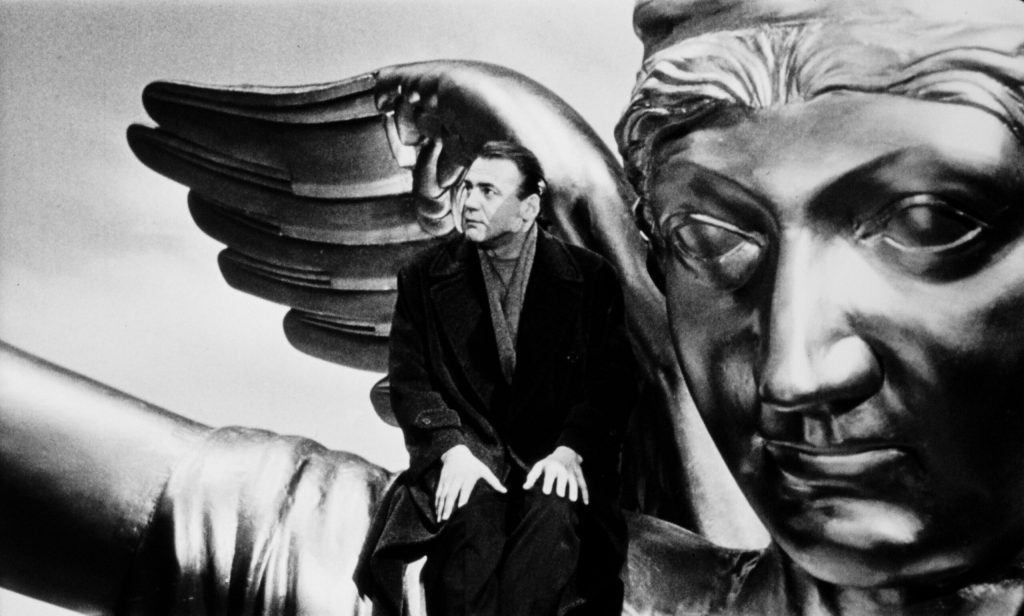
Still from Wings of Desire, directed by Wim Wenders, Argos Films 1987.
M: Of course, there’s also tension between religious desire and sexual desire, right? Going back to Augustine, it’s been there within Christianity for a long time. I think that tension plays out in many of the people you profile — there’s this inner turmoil that you can see when people are caught between different desires. It reminded me of a line in The Life You Save May Be Your Own where you say that Dorothy Day and Thomas Merton, in their earlier, wilder days, were “sinning their way to God, following the downward path to salvation.” It almost spurs their religious development. I feel like some of that tension also is part of what creates the art. Would you agree?
PE: Absolutely, and I think that, first of all, it’s good to be reminded that these two holy figures, Dorothy Day and Thomas Merton, did have complex sexual lives in young adulthood. Dorothy Day had an abortion, and she framed her second relationship to Forster Batterham as a common law marriage, but that designation may have been an attempt to avoid scandal. She lived with men for almost ten years, unmarried. And I love Dorothy Day. I’m just trying to say it’s worth seeing that even back in the ’20s and ’30s, someone who became one of the holy figures of our age struggled with these things.
Merton had fathered a child while a teenager at Cambridge, and then felt terribly guilty about that, and then later struggled with his vows in the ’60s with a nurse who took care of him in Kentucky.
So, yeah, that tension is there. And many or even most of us live in that tension because the strictest doctrine of Catholic Christianity is pretty strict: No sex before marriage, no sex outside of marriage, one marriage till death do us part. At the time of Dorothy Day and Merton, marriage was only to another Catholic, all sex for procreation, etc. Why did I spell this out just now? To suggest just how many people even among believing Catholics are on the wrong side of the line if you draw it that firmly. So no wonder the artists who actually express that tension speak to us, because the “us” here is probably a pretty large “us.”
And then we saw this a lot in Pope Francis’ pontificate, the tension between doctrine and pastoral practice. There’s a scene in the book in which Daniel Berrigan, the famous 1960s Jesuit apostle of non-violence and also a poet and essayist, recognized in the ’80s that actual wars were morphing into culture wars. He began serving at an AIDS hospice in Manhattan and then caring for individual men with AIDS, bringing them soup or a sandwich or whatever. He tells this incredible story of one of the guys he was caring for, who had been raised Catholic. He’s on his deathbed, he has AIDS, he’s ravaged, he’s totally suffering, and his mother sends the parish priest over to give him the last rites, and the priest scolds him out of the catechism in a harsh, vituperative way — scolds this person who’s dying right in front of him. It’s so cruel. I think for many of us the cryptic, ambiguous approach to sex taken in the art of that period was a really important counterweight to the apodictic certitude of the statements coming out of the pulpit of St. Patrick’s Cathedral and other places, that were so distant from the way people were actually living.
M: Right. That section about Berrigan’s ministry to the men in St. Vincent’s Hospital dying of AIDS was actually one of the most powerful parts of the book for me. There’s this point where you write,
Seeing himself through their eyes, Berrigan recognized that he, too, was walking in darkness, in a world where the signs of divine presence were cryptic at best. “He knew nothing of the why of God, or the why of AIDS. And he came to the hospital, and stood with the parents of their dying son. There was a strange kinship here, of ignorance.”
It goes on, but I found that passage really meaningful, because it’s the way we all feel in the face of suffering and evil when it hits us. And yet Berrigan felt that God was present. As he says, “‘Have You [God] really abandoned us, left us to our sorry resources and sorrier outcomes? Or are You really here, in our midst, helping us to find our way together.’” I thought that was powerful.
PE: I’m glad you did. His writing about that experience was very expressive and very at odds with the stereotype of Berrigan as an angry, thundering denouncer of the government — though he was that too.
There’s another scene in the book drawn from my own experience. I was living in the Bronx and I often went to Manhattan and would wind up on the Red Line, which lets out at 7th Avenue between 14th and 12th Streets. You would get out, and there was the waiting room for the St. Vincent’s Hospital emergency room, which has plate glass windows right on the street. And on the wall behind the counter where you check in is a crucifix of Jesus with just a cloth around his midsection — emaciated, suffering on the cross. And right in front of it are men who are checking into St. Vincent’s Hospital with AIDS. By that time, they had a recognizable look: extremely emaciated, pallorous, sometimes with lesions. Some of these men would never leave the hospital. And to come up out of the subway and see the beginning of the end for men not much older than I was, and to look at the beginning of the end represented figuratively through the Christ on the cross hanging right behind them, was to feel the level of mystery we were living in at that moment — to feel that it had a religious dimension, whether anybody liked to say so or not.
M: Yeah, exactly. I want to talk a bit about Andy Warhol’s Last Supper series. From early on in his career, there was a cryptically religious component to Warhol’s art, but then it became very explicit at the end of his life. Of course, he didn’t know he was going to die in 1987, but he spent his last several years working on this massive series based on Da Vinci’s iconic “Last Supper” mural in Milan. So why is Warhol’s series emblematic of the themes that you were trying to develop?
PE: Warhol was raised in the Byzantine Catholic Church in Pittsburgh, which has the physical structures that we associate with Eastern Christianity: icons, an iconostasis or wall between the liturgical space and the space where the congregation is, heavily-texted and chanted liturgy, often in foreign languages. He spent a lot of time in this church. So from the beginning of his career in the early ’60s, there was already a reading of him as a kind of iconographer. He makes flat, bright, colorful works that are stark and silent and demand attention, like icons. Then, once he moved into the realm of celebrity, the whole argument emerged that he’s establishing a kind of cosmology of postwar celebrity culture — celebrities are saints, our devotion to them is akin to religious devotion, and so forth. I think that’s all true, but that’s not the most interesting line of interpretation, because it’s a fairly obvious A-to-B connection.
Warhol wasn’t formed by Vatican II. He had insights contemporaneous with Vatican II that are akin to ones that the Bishops of the Council arrived at by very different ways, which was [1] a shift in the emphasis from works and rituals that were distinctly different from those of worldly life to those that were drawn from worldly life or overlapped with it, [2] a recognition much more broadly of the supernatural presence spilling out across boundaries and not possessed in an exclusive way by the Catholic Church, and [3] a more general rapprochement with modernity. All these things that were going on at the Second Vatican Council were going on in the very same moment in Warhol’s work, and that’s when he became a famous Pop artist. I don’t know whether he was paying attention to the Council at all, but he was a Vatican II Catholic before the fact.
But he was very drawn to the papacy. When Pope Paul VI came to New York and the United Nations in 1965, weirdly, the motorcade brought him right past The Factory, which was on East 47th Street, and Warhol was stupefied by this. He thought it was like the greatest show on Earth. One day only! The Pope in New York City! Come one, come all. The Pope! He saw it as a pop extravaganza.
And you know, I don’t love Warhol or his work. He’s an essential figure for this book, but it’s not as though I accept his every outlook as chapter and verse, right? But for him to see the pop aspects of that visit is to see something. You know, a papal Mass at Yankee Stadium, the United Nations, the white garments, right in the middle 60s, Warhol was right about that. There were pop aspects to it. And when Pope Paul, in answer to some questions, said “Tutti buoni” — “Everything is good” — Warhol said, That’s it! That’s the pop philosophy exactly.
Flash forward a couple of years: a woman attempts to kill Warhol. She shoots him in the abdomen. He nearly dies. He’s almost two months in the hospital, and when he gets out, he vows — his mother, who’s religious, is still living in Manhattan — to get to church every week. Not to get to Mass, but to get to church. And the story of his diaries often involves him getting to church: “Went to church for five minutes.” “Went to church, bought a raffle ticket.” “Went to church and to the flea market.” So, in his weird way, he got there. I say “weird,” but I think there’s probably plenty of people who can recognize that kind of devotion — to be drawn to the church and to the ritual, but also to not be sitting in the front row every week.
What I propose is that he had a religious dimension to his life, and he actually protected that from vulgarization by having it be a cryptic practice. But when he got this commission to do The Last Supper series by a gallery owner who had a space in Milan right across from the actual Last Supper, the money was good, and he took it. And then he got into it. It became more than a hundred paintings, small, medium and large. He did these punching bags with the face of Jesus on them with Jean-Michel Basquiat, who was one of his assistants. But at that moment, literally between the time he took the commission and time he executed it [1984–1986], AIDS took a terrible toll on the gay community of Manhattan, which included substantial numbers of people in the art and fashion worlds, which is where Warhol existed. Many people he knew well died of AIDS or were struck with HIV.
M: One after another. In your book, it just felt like there was this terrible momentum.
PE: His gallerist, the guy who commissioned The Last Supper: AIDS. The guy who had been shot alongside him at the Factory in 1968: AIDS. Valentino and other fashion designers he knew: AIDS. So there was a kind of Last Supper-character at that moment in Manhattan; people were meeting knowing they might not see one another again. So, in the way of an artist, he found a dimension of this classic work that spoke to the present in unguessed-at ways. Then after the series came out, he died. Unexpectedly. “Pop Art King Dies at 58” was the New York Post headline. So The Last Supper turned out to be Warhol’s last works.
But why is The Last Supper the title of the book? Well, in its original context, the Last Supper is both an end and a beginning — the end of Jesus’ earthly life, and the beginning of Christianity. And the ’80s were also the end of one age and the beginning of another, the other being the one we’re still in. It was the end of the long period in which Christianity had pride of place in America and its core tenets went more-or-less unchallenged by courts and the press and law enforcement and so on; and it was the beginning of the postsecular age in which various forms of Christianity and other religions and no religions are all contending together.
M: One of the two epigraphs for your book is a very short quotation from Pascal: “Make religion attractive.” Attractiveness seems like a pretty slippery concept. But then, at the very end of the book you write this:
Religion is cryptic. Its cryptic quality is its animating spirit… Religions are efforts to unencrypt the spirit — to make its paths straight. Happy are those who feel the spirit moving in those efforts… Happy are those whose beliefs make things clear and distinct. But no matter how hard we try to master it, the spirit won’t submit. It will defy the explicit, withdrawing to cave or desert or pillar (those original liminal spaces) to recover the power we call mystery. Crypto-religious art is sourced there. In an explicit age, rich in how-to-do-that and why-this-matters, it reconciles the cryptic quality of religion with the cryptic quality of human experience. It writes straight with crooked lines.
So, to take it back to that original epigraph — “make religion attractive” — is there a way in this “explicit age” in which religion (or crypto-religion) can actually be or could become “attractive” precisely because of its counterculturally cryptic nature? In other words, is there something that’s countercultural about faith in an “explicit age” that actually makes it attractive?
PE: Yes, and I’m so glad you asked this question, because I cut the Pascal epigraph from the final edition of the book, so I’ve had no occasion to talk about it. It is itself a cryptic statement, right? Pascal just puts it in the Pensées — “make religion attractive.” What does he mean? That religion attracts. I mean, of course religious leaders want to attract followers, want to make religion attractive. But there’s another sense in which to make religion attractive means that it could have a good look or could fit in with our general sense of what’s attractive, let’s say. I think there’s a dynamism between explicit religion and cryptic religion that you could read back through the whole history of Christianity.
Just to use the examples from The Life You Save May Be Your Own: the Catholic Worker Movement was, in my terms, cryptic for most of Dorothy Day’s life. People in the church, the everyday parish churchgoers, couldn’t figure her out — wait, she’s an anarchist, but she’s also a Catholic? They’re workers, but they don’t actually have jobs, they just help the workers? And are they a newspaper, or a pacifist group, or a soup kitchen, or a house of hospitality, or …? Oh, and they’ve got farms too. What does all of this have to do with Cardinal Spellman? They called her “the Anarch.” And how about Thomas Merton? Wait, aren’t Trappist monks supposed to be silent? This guy is a best-selling author. Like, this makes no sense if you’re really taking a straight and narrow position. But with time you can see their work became clearer to the public.
I find Beloved a cryptic novel; I like it that way. Toni Morrison said that she, in effect, tried to encrypt it because she wanted to approximate the disorientation that an uprooted person felt during slavery and its aftermath, when the world didn’t belong to them and they were not welcome in it, and they had to find their own coordinates. She wanted it to have a mimetic effect for the reader. So she made the book cryptic. Well, it’s on high school syllabi now, so it’s sufficiently clear for a fair number of people. It’s a canonical work.
Take “Hallelujah” by Leonard Cohen. Here’s this song, he writes 100-plus verses, throws most of them out, keeps the rest. He’s on his knees writing it in a hotel room in New York. Columbia Records, which had put out all his records since 1968, decides this is the one that’s so uncommercial they’re not even going to release it. Nowadays, that’s the song that’s sung in football stadiums, on American Idol, and at the Vatican. So this work that was so cryptic that even his stalwart record label didn’t get it is now the one that everybody gets.
So, to telescope a complex answer, we can see that challenging work seems cryptic when it first comes onto the scene because it’s reordering our sense of how religion and worldly things fit together. Then, with the passage of time or with the power of art doing its thing persuasively, making religion attractive, it becomes much clearer in retrospect. And we’re now living in the retrospect, where the cryptic work of figures like Miłosz, Toni Morrison, U2, Wim Wenders, or Leonard Cohen now seems comparatively clear and direct, and even traditional.








This is a very fine interview. Great work, Ben.