




The following sermon appears in Issue 27 of The Mockingbird print magazine.
You have heard that it was said to those of ancient times, ‘You shall not murder, and whoever murders shall be liable to judgment.’ But I say to you that if you are angry with a brother or sister, you will be liable to judgment, and if you insult a brother or sister, you will be liable to the council, and if you say, ‘You fool,’ you will be liable to the hell of fire … You have heard that it was said, ‘You shall not commit adultery.’ But I say to you that everyone who looks at a woman with lust has already committed adultery with her in his heart. (Mt 5:21–28)
Our reading is taken from what many would consider the most famous sermon ever preached, Christ’s Sermon on the Mount. Even if you’re not familiar with its contents, you’re probably aware of what it teaches. This is where we get the Lord’s Prayer. This is where Jesus instructs us to love our enemies and to turn the other cheek.
Today I want to focus on how it would have been received by those who heard it in person, as that aspect is easy to take for granted. Imagine this: You’re in Galilee, the site of an enormous lake — a sea — surrounded by significant hills. Jesus positions himself on top of one of these hillsides. His reputation piques your interest enough that you’re ready to listen to what he’s got to say. He starts talking, opening not with a joke or personal anecdote — clearly the man did not attend one of our seminaries — but with a bracing and deeply counterintuitive list of Blessed are’s. These have come to be known as the Beatitudes. After some immortal words about salt and light, Jesus goes on, “You have heard it said …” He then quotes a portion of the Ten Commandments.
His listeners would have grokked the reference immediately. He’s talking about Moses. “You have heard it said [by Moses] … but I say.” “But I say” — Jesus is asserting that he speaks with an authority that rivals and even supplants that of the greatest hero of the Jewish faith. A bold move from a man who made a lot of bold moves, and one which he repeats throughout the sermon.
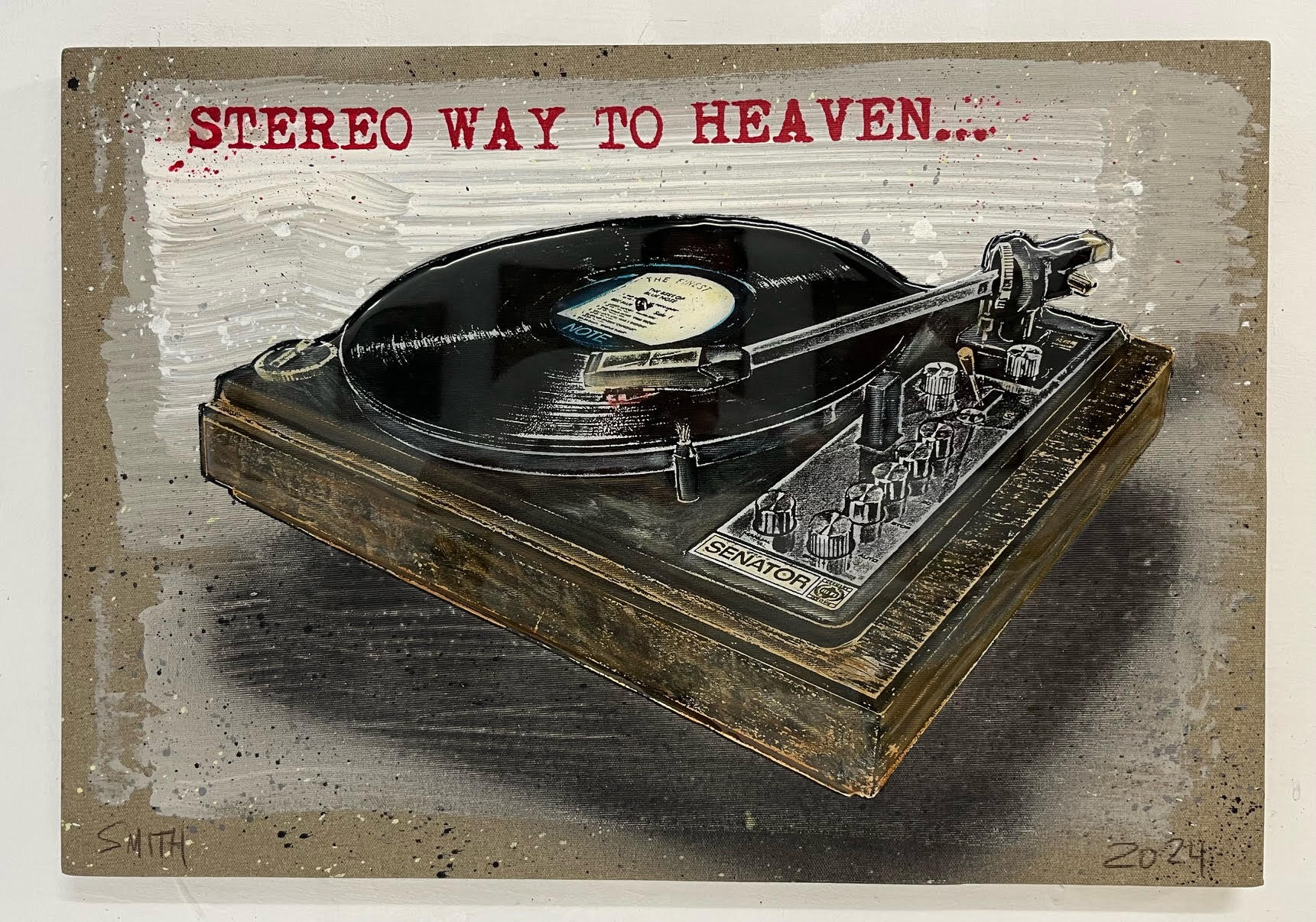
Carl Smith, Stereo Way To Heaven, 2021. Mixed Media on Linen, 22 × 28 in.
Perhaps you remember — or I hope for your own sake that you’ve seen — This Is Spinal Tap, the great 1980s mockumentary which parodies a British heavy metal band touring America. In one scene, lead guitarist Nigel Tufnel, played by Christopher Guest, is showing an interviewer his collection of amplifiers. He stops at his favorite. Unlike normal amps, the volume knobs on this one go to 11. Nigel is very proud of this, bragging, “It’s one louder.” The interviewer is a little puzzled and says, well, why don’t you just make 10 louder and have that be the top? Nigel stares blank-faced, not computing at all. He says, simply, “These go to 11.” Case closed.
Forgive me when I say, with tongue only slightly in cheek, that the Sermon on the Mount goes one louder than the Law of Moses. Jesus turns up the volume. “You have heard it said, thou shalt not murder, but I say, if you have anger in your heart, you’re just as liable to judgment.” “You have heard it said, thou shalt not commit adultery, but I say, if you have lust in your heart, you have already committed adultery in your heart.”
This is a harsh and radical equivalence. Jesus is equating lust with adultery and anger with murder. He’s collapsing the line between action and motivation. If that makes you uncomfortable, it should. Because this is not what you and I usually do. At least it’s not what I do. If I’m lying in bed at 10:30 p.m. and manage not to give in to the Ben and Jerry’s craving, I feel as though I’ve accomplished something. I wake up in the morning with the sense that I’ve won some kind of victory.
I wanted to eat Mint Chocolate Cookie — I had the motivation to consume the entire pint. But I did not go through with it, right? Well, according to the Sermon on the Mount, I did.
But let’s go a little further. Have you ever gotten in a fight with a loved one, and later defended yourself on the grounds that “I didn’t really mean it”? “I never intended for things to get so out of hand.” We think that emphasizing the distance between motivation and action will help us. And maybe it does, in some cases. That line of defense will not work with God.
Alternately, in the aftermath of a fight we seek credit (from ourselves) for having stopped short of expressing our true feelings. “At least I didn’t say what I really wanted to say in the moment.” Phew.
 Unfortunately, Christ does not recognize this distinction. If we take his words in the Sermon on the Mount at face value, then internal realities carry as much weight as external ones.
This means, in the language of small children, it’s not enough to apologize to your sibling. Your remorse has to be sincere. You can say the words, but there’s got to be conviction behind them.
When people say Jesus is a great moral teacher, this is the moral teaching to which they’re referring, inadvertently or not. You could give all of your money to charity, you could care for the sick all day long, and it still wouldn’t count if you did it for the wrong reasons. Unless altruism is altruism all the way down, it doesn’t register as such — at least not with the God who Jesus espouses. Purity of action must be married to purity of motivation.
Let me ask you: how does this make you feel? What is your honest emotional response to this teaching? Because it makes me feel awful. It makes me feel condemned, trapped, confounded, and more than a little resentful. How could you possibly tell me that God is judging me according to such an absurdly lofty standard? What chance does that give me?
When Francis Spufford writes about this sermon in his book Unapologetic, he calls it “thrillingly impractical.”
Jesus makes frankly impossible demands. Instead of asking for specific actions, he offers us general but lunatic principles. The Sermon on the Mount claims that you should give your possessions away, that you should refuse to defend yourself, that you should love strangers as much if not more than your own family, that you should behave as if there is no tomorrow. These principles do not amount to a sustainable program.
And yet, it is also a beautiful program. Imagine a world in which there was not only no murder but no anger. Twitter/X would not exist. Imagine a world in which there was not only no adultery, but no objectifying lust. That would rule out the rest of social media, would it not?
But then imagine a world in which people not only undertook acts of love, but they undertook them because they sincerely meant them rather than because they were trying to get credit or signal something about their worth to the rest of the world. A world where people treated other folks in a loving way because they actually loved them would be a wondrous place indeed.
Alas, that is not the world in which we live. Why then would Jesus outline such a program? Was he being intentionally hyperbolic? Playfully facetious? Or worse, is there something cruel going on here? How do we reconcile this with the Jesus we see elsewhere in the Gospels?
Maybe you remember when 23-year-old Magnus Carlsen, the world champion chess player, check-mated Bill Gates in 79 seconds on national television. My hunch is that Jesus is making a similar move on the chessboard of ethics. One which appears just as swift and one-sided.
First, by making the religious life an internal affair, he is taking aim at the center of our hearts. In his reckoning the inner world is not less important than the outer one. In fact, it might even be primary. This makes sense, since our inner world is where we usually live. You and I are occupied first and foremost by our feelings, by our fears, our anxieties, our hopes. Those are what drive our actions (and keep us up at night). People live inside themselves, not outside themselves.
Secondly, Jesus appears to be doing away with the ranking of sins. In the picture he paints in the Sermon on the Mount, there are no longer sins (plural, actions). There’s just Sin, capital S, the condition. There is one river with many tributaries, but it is all made up of the same murky water. Spufford summarizes this magnificently when he urges readers to extrapolate.
Notice the consequence of bringing the entire human race to the point of moral checkmate. Of having an ideal of human motive and behavior that is not sized for human brains and bodies and lives. The consequence is that everyone fails. Really, everyone: the people who look like they’ve got it all together on Sunday morning, and those who’ve just arrived at prison. Listening to the Sermon on the Mount, we discover that we all stand before God on the same footing, that there is no meaningful comparison to be made between you and the person sitting next to you or the person sitting across whatever divide you feel you’re on … We’re talking here about nothing less than true equality.

Illustrations by Aubrey Swanson Dockery.
Taking the Sermon on the Mount seriously leaves a person with only one option when it comes to God. Only one prayer, you might say, which happens to be the prayer we recite every single week in our worship liturgy: Lord, have mercy. Christ, have mercy. Lord, have mercy.
Let me share with you a brief story, and then I’m finished. In 2011, Otto von Habsburg, the last Crown Prince of the Austro-Hungarian empire, died. He was 98 years old. The Habsburgs, as you may know, are one of Europe’s oldest and most legendary royal dynasties, having ruled continually in central Europe from the mid-15th century until the collapse of the empire at the end of WWI in 1918, six years after Otto was born.
Otto’s funeral began like all those of his lineage: with a lengthy procession through the city of Vienna to the Capuchin Church, where the imperial crypt is housed. Once the procession arrived at the church doors, a representative from the royal family had the following dialogue with the prior of the cloister, which is a version of the same exchange that has occurred at every Habsburg burial since 1632.
The master of ceremony knocks loudly three times on the massive door. Knock, knock, knock.
From behind the closed door, the prior asks: “Who desires entry?”
The representative answers: “Otto of Austria; former Crown Prince of Austria-Hungary; Prince Royal of Hungary and Bohemia, of Dalmatia, Croatia, Slavonia, Galicia, Lodomeria, and Illyria; Grand Duke of Tuscany and Cracow; Duke of Lorraine, of Salzburg, Styria, Carinthia, Carniola, and Bukowina; Grand Prince of Transylvania, Margrave of Moravia; Duke of Silesia, Modena, Parma, Piacenza, Guastalla, Auschwitz, and Zator, Teschen, Friuli, Dubrovnik and Zadar; Princely Count of Habsburg and Tyrol, of Kyburg, Gorizia, and Gradisca; Prince of Trent and Brixen; Margrave of Upper and Lower Lusatia and Istria; Count of Hohenems, Feldkirch, Bregenz, Sonnenburg etc.; Lord of Trieste, Kotor and the Windic March, Grand Voivod of the Voivodeship of Serbia.”
The prior responds: “We do not know him.”
The master of ceremony then knocks again, loudly, three times. Knock, knock, knock.
“Who desires entry?”
The representative answers: “Dr. Otto von Habsburg, president of the Pan-European Union and of the European Parliament, honorary doctor of many universities, member of numerous venerable academies and institutes, recipient of high civil and ecclesiastical honors, awards, and medals which were given him in recognition of his decades-long struggle for the freedom of peoples for justice and for right.”
The prior’s response: “We do not know him.”
The master of ceremony again knocks three times. Knock, knock, knock.
“Who desires entry?”
This time the response is hushed: “Otto, a mortal and sinful man.”
With this, the church doors are flung open. The prior says, “Then let him come in.” You can watch it all on YouTube.
The ceremony derives directly from the Sermon on the Mount. Jesus’s words rob their hearers — robs you, robs me — of any foothold of superiority. They cut through the fog of self-righteousness, which fuels so many of our antipathies. The God of the universe, those Austrians are claiming, does not relate to us according to status, merit and demerit, accolade and applause. The ground at the foot of the cross is level.
In other words, the Sermon on the Mount puts us all in the same category, which is the category of sinner in need of God’s mercy and help.
But the Sermon on the Mount does not leave us there. At least its preacher does not leave us there. As Jesus says elsewhere in the sermon, he has come not to abolish the Law, but to fulfill it. He has not come to diminish, discount, or degrade the ethical and moral standard of God’s kingdom and vision for the world. Nor has he come merely to outline the sublime yet impossible ideals of God. He has come to be that ideal, to love in the way that we are unable to, to forgive in the way that we cannot, and, on the cross, to bear the brunt of the anger we can’t control and face up to the judgement we most dread. He does this so that we might be reconciled to God.
 A few chapters after the Sermon on the Mount, Jesus reiterates this amplified teaching as it relates to money. Tithing, he indicates, is not enough to fulfill the law of God. You must joyfully give away everything you own. The disciples hear these words and, greatly astonished, ask the question that most of us should ask when we hear the Sermon on the Mount: “Who then can be saved?”
Jesus looks at them and says, “With man this is impossible, but with God all things are possible.”
Later on in the same book, Jesus meets a tax collector, namely, Matthew himself. Despite the man’s reputation as a traitorous loan shark, Jesus makes another in his series of bold moves; he invites himself to dinner at Matthew’s house. People are upset; the disciples are asked by onlookers, “Why does your teacher eat with tax collectors and sinners?”
On hearing this, Jesus says, “It is not the healthy who need a doctor, but the sick. For I have come not to call the righteous, but sinners.”
If the Sermon on the Mount levels the playing field and casts us all in the same role of sinner, that means we are placed in the very category of people that Jesus came to save. This is glorious news. Whoever you are and whatever you’ve done, whatever you said but didn’t mean, and whatever you meant but didn’t say — however deafeningly the law may thunder around you — God has gone one louder, booming two simple words in your direction: Come in.
Amen.








Wonderful, thanks for another message of grace!
Well done. Great message
Thank you for this very cool sermon.
Here’s the link to Otto’s actual 2011 funeral – the link in the piece is to a film depicting the funeral of Rulolf, Crown Prince of Austria, from 1889.
https://www.youtube.com/watch?v=9-BBgc_uBZQ