




A few days ago, as the sound of Reveille spread across the campgrounds, reverberating across the emerald river, my eyes frantically searched for her bouncing curls. Rationally, I knew my daughter was about to come barreling down the hill towards me, her skin tanned after a month away at camp, her hair in a questionable ponytail or pigtail situation. Every time a girl burst down the stone steps with a flash of Tejas purple on, my heart leapt, wondering whether she was mine, whether it was Annie. I knew she was somewhere in this sea of woods. I knew she hadn’t lost a tooth this year because I hadn’t gotten one taped to a letter in the mail. I knew, by way of her scrappy penmanship and misspelled words, that King Ranch chicken had again prevailed as her favorite dining hall meal. But my body wouldn’t believe it until hers crashed into mine.
It surprised me. To find myself in this space, this land between what my mind knew and my body trusted. It was as if, almost like Thomas in his own disbelief at his risen Lord, I needed to put my hand in the crimp of her curls before I could fully believe she was alive, that she did, indeed, stand before me. Bodies keep different calendars than our brains; sometimes it takes an anniversary to discover what your body has been remembering all along. It’s been nearly a year since the Guadalupe rose over 37 feet and took 119 lives from Kerr County, including Heaven’s 27, the twenty-seven girls who died while at Camp Mystic.
Nearly four weeks earlier, my hands shook and jaw tightened as I squeezed Annie’s strong body one last time before she climbed the steps, boarding the bus bound for her camp, for Hunt, for the Guadalupe. When I walked back into our home an hour later, I found a dozen sticky notes hidden throughout our home — in silverware drawers, behind the coffee machine, inside the pantry, and hanging from my bathroom mirror — all from my Annie. “I miss you!” … “MWAH!” … “I love you” … “I hope you have a great day!” … “Sup brah” … “Miss u” … “I heart you.”
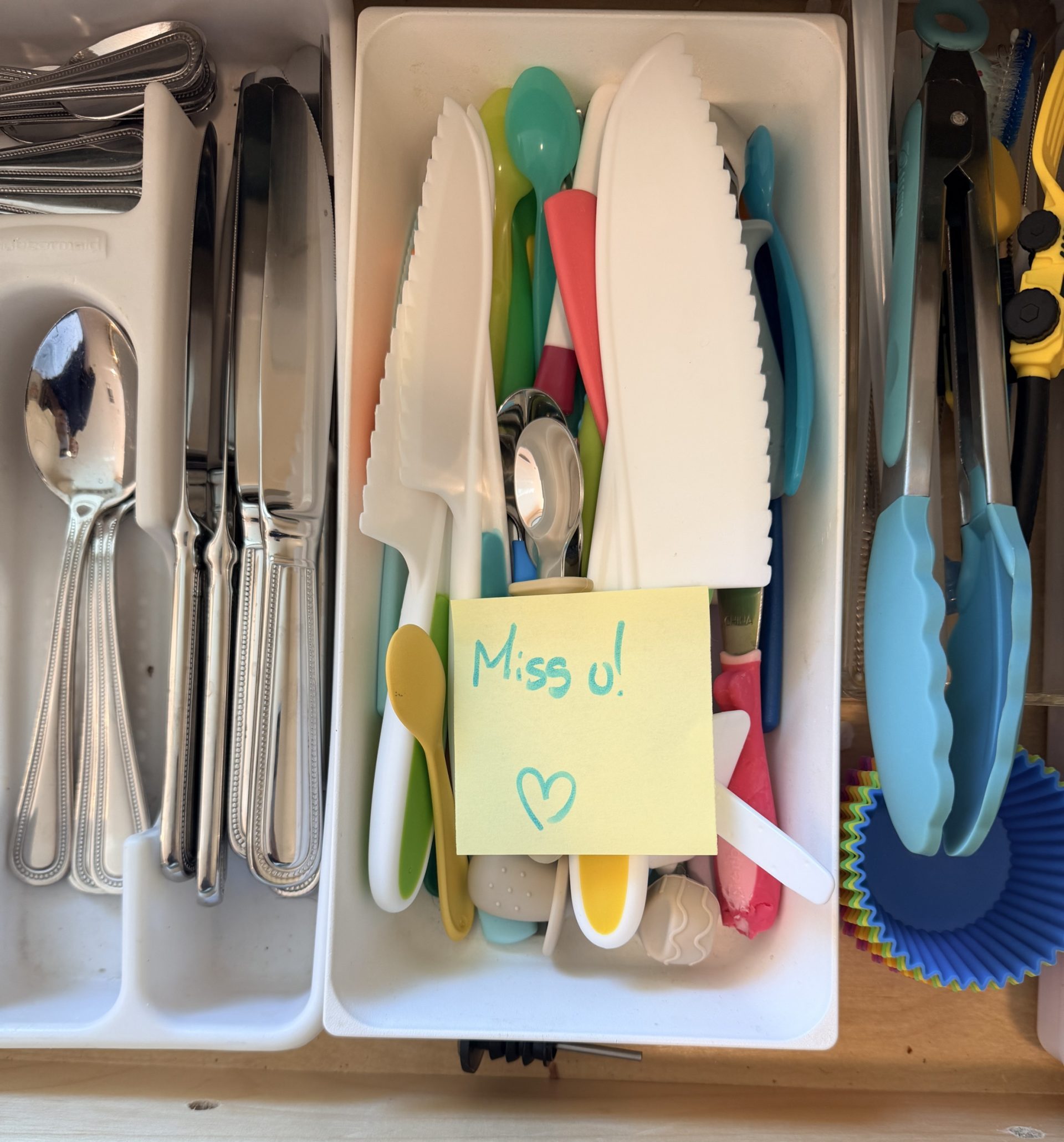
I collected each one and stuck them all in a cluster above our kitchen sink and texted my friend, Sarah: “If she dies, I’m never taking these sticky notes down.” A year ago, twenty-seven girls didn’t come home from camp on that same river. Death simply feels like an actual possibility every day now. Even a few nights ago, as Annie and I laid side by side once again in our bedtime liturgy for the first time in weeks, I tickled her back, marveling at her breaths and braided pigtails. The solidity of her muscles beneath my fingers felt like a miracle to me.
How do we keep sending our children into a world whose fragility we can no longer ignore? How can we be kind to our collective grief as it swells this week in particular? Does Target know that the mere presence of red, white, and blue accessories in the dollar section now makes our bodies remember what we watched unfold the last time we wore beaded USA necklaces around our necks? The 4th of July sales have begun, and our hearts are gutted as we consider all the ways this year should have looked different, all the ways reality is not what was hoped for. The birthdays that arrived without a little girl to blow out her candles. The camp letters that will never again arrive in the mailbox. The friendships that would have deepened. The ordinary Tuesday afternoons no one thought to treasure because they assumed there would be thousands more. The prom pictures that will never be taken. The wedding dresses that will never be chosen. The graduation caps that won’t be thrown into the air. And, more ordinary and perhaps even more sacred, the toots at the dinner table, followed by giggles and ’scuse me’s, that won’t come again. The growing old that will never happen.
Grief does not only mourn the people we’ve lost. It mourns the unrealized future that was swept downriver.
We held visions of a future with and for these 119 people. Beautiful narratives. And God is with us as we mourn the loss of those stories. He receives every should have been and every we had hoped. Yet he gently beckons us to dwell with him here, in the life before us. For the Word became flesh and dwelt among us, the embodied us. Jesus entered into the mess, the grit, the dust, the river itself. He takes up residence with us here. In our present pilgrimage. In the life that is.
God lives in the reality of our flooded riverbeds. He dwells in the reality of an empty chair at the dinner table, in the twin bed that no longer holds the shape of a sleeping child, in the Christmas stocking that won’t be filled again. He takes up residence in the reality of the bodies that have yet to be recovered, in the Halloween candy that wasn’t sorted into neat piles after a night of trick-or-treating, in the story we thought would look entirely different. In a Fourth of July parade where celebration and sorrow now walk hand in hand, a day that no longer feels light but carries instead the weighty reminder that we are dust, and to dust we shall return. The terrible fragility of it all.
And it is in this fragility, in this reality, that we carry our griefs. Grief is love that prevails. It is good, and holy. And sometimes grief speaks the language of should-bes. They should be playing in the backyard with the water hose. They should be out on the soccer field. They should be nervous for their end-of-year dance recital. They should be here. This should look different.
And grief has a way of bridging the chasm between our hopes of an imagined future and the life we actually have. God does not ask us to leave those imagined places before he comes to us. He entered that land himself. Standing outside the house of his friend Lazarus, four days dead, Jesus even knew what he was about to do, to restore his friend to life. And yet, he didn’t rush past the grief. He sat in it. He visited that land between an imagined future and the life before him, and wept.
She should be here is not an unfaithful thought; no, it is love refusing to make peace with the enemy, with death. It echoes the very groans of creation itself in the hope for the world to be as it was intended. It is the cry borne out of a knowledge that somehow this is not the end of the story. And that changes the shape of our grief. Not its depth or its sting. But the space it occupies in our realities. In light of the ultimate defeat of death, we do not grieve as those who have no hope. We grieve as creatures who live in the middle of the story, choosing to trust the Creator, the one who has already written the full narrative. We trust his authorship even when, like the disciples on the road to Emmaus, we do not recognize that he is already walking beside us. It is with an open-handed posture similar to the disciples’ from which our could have beens flow, one which acknowledges and mourns the distance between possibility and reality: “But we had hoped …” We had hoped the story would look so very different. And what does the risen Lord do in response to the disciples’ grief? He begins not by correcting them or shaming them. He joins them. In step. He walks beside them. He meets them in the old story they think they are living before revealing the story they are actually living. Only later, in the breaking of the bread, in the Eucharist, are their eyes opened to recognize the one who had been with them all along.
This week, as parents and family members recall the last earthly hugs exchanged, the last words spoken, the last texts received to and from and with those who died, we remember. We call each individual by name, remembering the families who were washed away. The parents. The siblings. The couples. The one-year-old. The 91-year-old. We honor the first responders, who moved into the water and into the darkness that life might be found. We name, too, those who survived and remember the terror of the night as they waited for dawn, the river residue having been rinsed from their bruised bodies and yet somehow still remains.
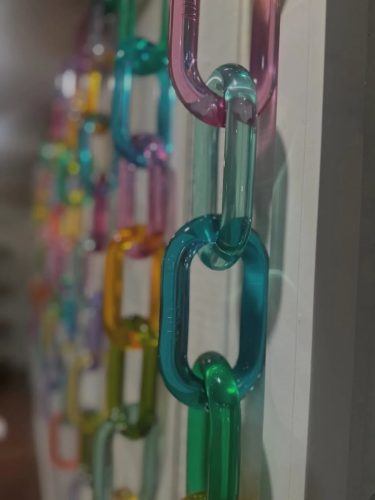
One of the most beautiful acts of remembrance I’ve seen in the past year lives inside Guad and Co., a lovely small shop in Hunt that was itself destroyed by last year’s floods, has spent the year rebuilding, and which now stands reopened both as a brick and mortar and online store. Along the wall behind the register hang 119 interconnected acrylic links, one for every life lost in Kerr County. Each bears the engraved initials of the person it honors and is rendered in a color thoughtfully chosen to reflect something of their story, together catching the light as it passes through. The links are accompanied by a Remembrance Wall, a curated resource which provides each person’s full obituary, and also offers a short description of them, what they leave behind, what they will be most remembered by. May we continue to say their names, to remember, and may we remember as Easter people, stubbornly insisting that death does not get to narrate the final chapter of the story. Because in doing so, our remembrance takes on the character of hope, as we believe in the resurrection of the body, not just in theory, but in the flesh. One day, remembrance will give way to reunion; the names spoken now through tears will answer back, and our bodies will again find one another in an embrace, in a final homecoming and endless collective dance before the throne of God.
Until that day, the land and seasons and creation remembers and points to this story, too. It’s peach season in the hill country. Roadside stands crest the hills, wooden crates filled to the brim with the ripened fruit. We stop and buy a $10 bag. Before we even merge back onto the highway, I dust one off and bite into it, the juice flowing down my arm. Excessive in flavor, a sweetness that surpasses my needs and my own expectations. The flesh of the fruit, easily bruised. And as we wind our way through Hunt and on through Kerr County, sharing with each other in the superabundance of the season’s produce and passing peaches and napkins back to one another, we catch glimpses of the Guadalupe as it runs alongside us. Along its banks, the cypress trees still wear the mark of how high the water rose.
The river remembers. The land remembers. And so do we. Perhaps that’s all I know a year later.
The cypress trees bear their scars. The peaches came anyway.








Beautifully written and speaks to our grief in memory of horror
“How do we keep sending our children into a world whose fragility we can no longer ignore?”
Oof.
“She should be here is not an unfaithful thought; no, it is love refusing to make peace with the enemy, with death.”
Thanks for this beautiful piece, Emily. <3
So lovely, Emily. Thanks for this.
Thank you Emily for this well written article. My eyes welled with tears as I thought about the grief of those who lost loved ones but even more so for the hope that God has given us in Christ. It sparks gratitude that Jesus has defeated sin & death . That the curse will be lifted & there will be a new heaven and new earth!
So, so beautiful. Thank you ❤️
So incredibly written. Thank you.
Thank you Emily for this beautiful and Spiritual description of how many of us feel. The struggle between a painful reality and the freedom we know through Christ will pervade my thoughts this weekend.
Once again, you put into words what many of us have been feeling and laced it with faith. Thank you Emily ❤️
Thank you for your wise and thoughtful words of remembrance. Praying for all of the families and communities in their loss for comfort, peace and HOPE.
Exceptionally well written Emily! It brought tears to my eyes.
Love you,
Dad
“Death does not get to narrate the final chapter of the story,” It’s just so hard to remember sometimes, because death feels so final sitting here on earth, living this life. Beautiful, thoughtful words.
So beautifully written. The number of souls, the ages, the speed, and the holiday. We’ll never forget.
Thank you Emily.
Thank you thank you for putting in words for all who perished and for the ones remaining . 💜✝️