




A short poem by William Carlos Williams goes,
so much depends
upona red wheel
barrowglazed with rain
waterbeside the white
chickens
Informationally, the poem could be summarized as follows: wheelbarrows are important — economically and perhaps culturally — and the physical world is richer and more important than we realize.
What was gained by that summary? Nothing — it just makes explicit some things that were present but implicit in the poem. What was lost? Almost everything. The difference could be expressed in the old writing adage of “show, don’t tell” — Williams shows why those things are true, while the summary merely tells.
But “show, don’t tell” too often gets interpreted argumentatively — as if the reason for showing, rather than telling, is to convince the reader of some proposition. That’s true in some cases (like a pitch to potential investors), but rarely true in literature. Williams isn’t trying to convince the reader of a proposition — “wheelbarrows are important” — but rather trying to render an experiential truth — the type of truth you get in a flash, in a moment, when finally realizing how much your dog meant to you when you lose her or feeling “gusty / Emotions on wet roads on autumn nights” (W. Stevens). It is, so to speak, sub-propositional truth.[1]
This matters more in some contexts than others. In many professional communications, the goal is to impart purely propositional information: On September 24, 2024, the FCC entered an order that, in part, consented to the assignment of 600 MHz spectrum licenses from Horry Communications to T-Mobile. Any humor, illustrations, metaphors, images gesturing towards the meaning of a 600 MHz spectrum license — those would probably be distractions.
In personal communications, by contrast, the sub-propositional truth is the point. If my friend criticizes Tom Brady, I’m not only interested in whether the criticism is accurate or not; I’m also interested in why he’s criticizing Brady, why Brady arouses such strong emotions in him, the specific way he criticizes Tom Brady. None of those things can be reduced to a simple propositional statement. They are richer, livelier; it’s why I would rather listen to my friend criticize (or defend) a public figure than read the “controversies” section of that figure’s Wikipedia page. It’s also why people entertain themselves by watching movies or football games rather than reading textbooks or FCC licensing orders.
One more note on the distinction: propositional truth appeals to our desire to control. A truth that is purely propositional, like the FCC licensing example above or 2+2=4 is dead, inert. You learn it, and it doesn’t change you. In fact, it empowers you — knowing it will snow tonight, knowing it’s okay for Springer Spaniels to eat carrots, knowing the best roux for your mother’s gumbo should be the color of peanut butter — all those things are empowering. They equip you. By contrast, experiential truth makes you passive. A gorgeous sunset elicits feelings in you (if you don’t close yourself off to it). Watch The Philadelphia Story or read “The Waste Land” with an open heart, and you will come out a slightly different person. You can’t control it; you can only (i) close yourself to it or (ii) allow it to operate upon you. For better or for worse. [2] “If once you have slept on an island / You’ll never be quite the same” (R. Field).
Technology, by definition, is meant to empower. So it should come as no surprise that AI, which is shaping up to be the most powerful tool in human history for the individual’s interfacing with the world, promises to strip away all non-propositional truth and leave behind it the bare kernel of information. Articles on the top five features of Microsoft Copilot and the top four features of Apple Intelligence promise the ability to summarize information.[3]
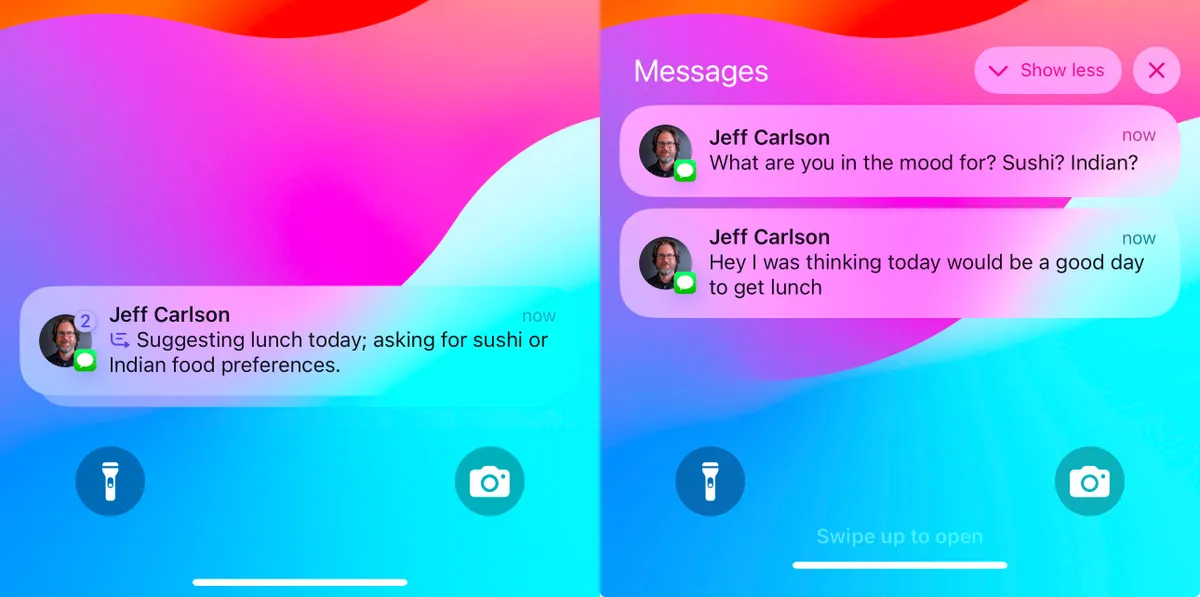
The problem is that not all of our lives are lived in purely professional contexts — like FCC spectrum licensing — or purely social contexts, like watching a football game with friends. The example of an AI summary in the CNET article, pictured above, shows AI helpfully condensing Jeff’s text from 22 words to 10. It gives the bare propositional minimum, with no texture, personality, colloquialism, or quirk. But to me at least, it crosses the line — the reason to get lunch with someone, even in a professional context, is to develop a personal relationship, which, by necessity, involves suffering the particularized self-expression of another human being. To the Old Adam in us, focused on control and autonomy and never being passive, this can feel agonizingly inefficient.
A technology interface is both a barrier and a link. Personal AIs are already serving that function, and the high-powered professionals who decide what features we need of course think in terms of blocking out the inefficient, the extra twelve words of idiosyncrasy and texture in a text trying to schedule lunch, the rants from our political friend who thinks we agree with them a little more than we really do, the group texts. AI is already allowing us to customize, with minimal effort, just what and how much of the outside world comes to us. Maybe most of what would come in through our phone is noise anyway, but one can’t help but think of the filter bubbles, the echo chambers, technological incurvatus in se turned up to eleven. But the tool (AI that can summarize) reflects the predilections of those to whom it is marketed.
There are lots of illustrations of the truth that the most meaningful experiences are the ones that come from outside ourselves — unconstructed and often unanticipated — but a personal favorite comes from the story of the coin in the fish’s mouth, Matthew 17:24–27:
When they reached Capernaum, the collectors of the temple tax came to Peter and said, ‘Does your teacher not pay the temple tax?’ He said, ‘Yes, he does.’ And when he came home, Jesus spoke of it first, asking, ‘What do you think, Simon? From whom do kings of the earth take toll or tribute? From their children or from others?’ When Peter said, ‘From others’, Jesus said to him, ‘Then the children are free. However, so that we do not give offence to them, go to the lake and cast a hook; take the first fish that comes up; and when you open its mouth, you will find a coin; take that and give it to them for you and me.’
So often when we read the Bible, we look for the nugget of propositional truth embedded in it. There’s a long and unfortunate tradition of reading Revelation like an Enigma transmission from God we must decode into our natural, propositional language. Parables without a clear takeaway baffle and consternate us — what does this mean?, we ask, and by meaning we usually mean a one-sentence life lesson or other propositional takeaway.
Context can be useful. For the coin in the fish’s mouth, part of the Law’s claim on every man was in Jesus’ day was the temple tax. The origins of this sacred payment go all the way back to the Exodus from Egypt. God sent a brutal plague that claimed the firstborn son in every household, but God spared the Israelites by instructing each household to kill a lamb, roast and eat it, and smear its blood on the doorposts and lintel of each house. God instructed them that “The blood shall be a sign for you on the houses where you live: when I see the blood, I will pass over you, and no plague shall destroy you when I strike the land of Egypt” (Ex 12:13). The word “plague” doesn’t appear again until chapter 30, when God instructs the Israelites that every male must be registered, and “at registration all of them shall give a ransom for their lives to the Lord, so that no plague may come upon them for being registered. This is what each one who is registered shall give: half a shekel according to the shekel of the sanctuary (the shekel is twenty gerahs), half a shekel as an offering to the Lord” (Ex 30:12). Just as the lamb’s blood protected them from the plague on Egypt, so too the temple offering would spare them from the plague — ransom money to God for their lives. The text continues, “You shall take the atonement money from the Israelites and shall designate it for the service of the tent of meeting; before the Lord it will be a reminder to the Israelites of the ransom given for your lives.”
We often study and hear about the day of atonement, when the priest would sacrifice one goat as a sin offering and send the other goat, laden with the sins of the nation, out into the wilderness. But the temple tax, in its original form, represented everyone’s own personal ransom and atonement to God. To be clear, God’s allowing sacrifices and atonement money to pay one’s own sin was a gracious bargain. But it still had to be paid every time there was a census (and there is some suggestion that in Jesus’ day it might have been assessed more frequently). In a sense the debt was ongoing.
Jesus recasts the narrative to one of tribute: the temple tax exacting tribute from those who are its (God’s, and perhaps in a sense the temple’s or temple establishment’s) subjects.[4] However, just as a king exacts tributes from his subjects but not his children, Jesus tells his Peter they are children of God, so they don’t have to pay. The elephant in the room would be atonement — God instituted this tax. Not ponying up would be analogous to an Israelite in Egypt not putting the Passover lamb above the door — you’d be liable to death when God passed through the land. Jesus blithely ignored that implication. Of course, Jesus’s statement makes sense in light of what happened later: he would make of his body a final oblation and satisfaction for the sins of the world, taking into himself God’s judgment on sin and giving us forgiveness and, as Jesus’s children imagery suggests, adoption.[5]
There, to me, is the story rendered in the kind of explicit, propositional truth we are most comfortable with: a set of statements that, while there is certainly some mystery in them, we can wrap our heads around.
But there must be a reason why the Gospels are so often focused on action rather than teaching. We modern people want the teachings, the theology, the self-help books. The ancients were different: in Greek drama, for example, the main focus was not character or dialogue or a neat moral, but action. As the first study of literature put it, “Without action there cannot be a tragedy; there may be without character” (Poetics). There is valuable meaning in doctrine and propositional theology, but the meaning we most often neglect is the action.
Here, Jesus elects to not “give offense” (lit. scandalize[6]) by going ahead and paying. But he doesn’t leave Peter just with doctrine — instead, he gives Peter action.
It’s hard not to find the story funny. It’s just so random: no one ever could have imagined or expected that particular way of paying the temple tax. It’s also such a dramatic juxtaposition between the one thing Peter was skilled at — fishing — and the one thing no human skill could ever do: land a tilapia with exact change for the temple tax in its mouth.
Fishing is the epitome of passivity — you can prepare exactly the right lure, find the exact right spot — the one where all the fish were biting in exactly the same weather two days ago — throw your lure in, and get — nothing.
Or you might catch a boot, or a crab trap, or the largest redfish ever caught. Your activity can only take you so far, and even the best prepared person is guaranteed nothing, but might get a record-breaking haul.
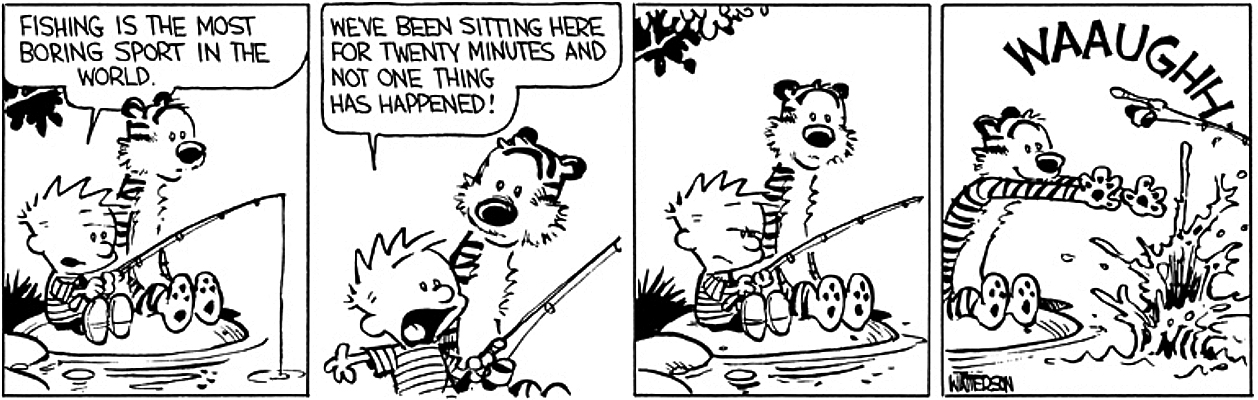
Fishing is inefficient; there is no correlation between input and output. The value of fishing lies precisely in this experience of inefficiency, this waiting where one can do not a thing more than one has already done, where you’ve got to give it at least thirty minutes in this spot, and there’s nothing to do but cast and drift and slowly reel in and cast again and watch the ripples of the sea against the marsh grass. Something may show up, or it may not. It may nibble and bite and take the hook or nibble and swim off. And you reel in and cast again and wait and sip a cold drink and perhaps speculate about why the fish aren’t biting, and then leave off your speculation because you don’t know, anyway.
In a sense the disciples had the perfect backgrounds for what Jesus had in mind; God had prepared them with the knowledge that the sea is unknowable and untamable, and we are in the grip of forces much larger than ourselves. Ultimately, success depends less on our efforts than the inexplicable vagaries of the ocean: sometimes you don’t catch a fish when you should, and sometimes you do catch a fish when you shouldn’t. It is all so unfathomable and almost arbitrary, but there are strange rhythms to it that you can on occasion feel in sync with, though never really, fully harness, or at least not harness for long.
The same holds for faith. Sometimes you find a solace and peace in prayer so deep it is almost shattering; other times you find nothing that you can feel or discern. Relationships are this way: you can do everything for your child, and he will tell you he hates you and storm off to his room; or you can come home frustrated, express that frustration, and be rewarded with an origami boat he made to cheer you up. You can do all the right things and meet frustration or all the wrong things and be blessed beyond your imagining.
But even the fishermen disciples, trained to patience by a lifetime of their trade, struggled with it. Peter was constantly trying to control things: to capture God’s flash of revelation of on the mountain and render it static by building dwellings for Moses and Elijah (Mt 17:4), to keep Jesus from the crucifixion (Mt 16:21–23), to preserve himself through his own devices when his teacher was arrested (Lk 22:54–69). Even those schooled by the ocean have trouble resting on the immense, turbulent, bountiful providence of God.
It should come as no surprise that an early major consumer application of AI is to extract the actionable propositional nugget from the Internet or your friend’s text and block all the personality and texture and sub-propositional humor and idiosyncrasy and beauty and consign it to an endless limbo in the basement of a datacenter in Maiden, North Carolina. We all look to control and optimize and streamline our lives. But that isn’t, ultimately, what we want: when the internet started becoming mainstream, the use-cases its visionaries were most excited about were professional force multipliers like Wikipedia or educational websites. But it turned out that what people really wanted was to connect with others over Facebook and now TikTok — filter bubbles of their own, to be sure, but ones that at least try to scratch our deepest itches, not for productivity or efficiency, but affirmation and belonging and meaning. But even that is like fishing — you put yourself out there and can’t really know whether you’ll get the response you want or not. People are unpredictable and in a deep sense inscrutable.
For all the problems with social media and the silly ways we construct improved versions of ourselves for the Net or for others IRL, it’s at least fishing in the right waters. Our meaning ultimately comes from relationships, which we can’t control more than our side of. That truth is terrifying for those of us who would prefer to take the most valuable things in life by the exercise of our control (I personally used to hate fishing and still don’t love it), but incredibly liberating for those who’ve found our control and efforts aren’t as foolproof as we thought, their fruits — like productivity or professional prestige — less desirable than we thought. The sea of sub-propositional meaning — in faith, film, relationships, nature, music, play, and the like — is unpredictable, often rendering us passive recipients, subject to hope and fear, the ravishes of beauty and ravages of loss. It is also thrilling and abundant beyond anything we could construct for ourselves.
The good news of Jesus is that our hopeful fishing for spiritual meaning is guaranteed to land at least one catch: the big tilapia with temple tax. We can’t force any specific encounter with or gift from God — we ultimately cast and wait for grace — but the money we owe for our sins against God and neighbor has been signed, sealed, and delivered, in a way we never could have imagined. That fish is there in the water, a guaranteed catch anytime we want to cast for it: God’s grace for sinners, being given for us over and over and over again.
If you directed an AI to summarize the takeaway from the story of the coin in the fish’s mouth, I’d hope it would answer: Go fish.
[1] It could even be described more as “experience” than truth, but experience, when it is lived or through art that successfully imitates life, is true.
[2] A lesson from the decline of Christianity’s influence in culture is that Christianity, it turns out, is probably more positive about and open to the influence of art than atheism is (sure, there’s the Index Librorum Prohibitorum, but there’s also the Soviet Union and other atheistic countries, as well as the increasingly puritanical attitude towards art and its creators of our increasingly post-Christian culture). Some of that openness may stem from Christians’ comfort with not being the full-time captains of our souls, and some of it may be connected to the doctrine of evil as privation or corruption of good rather than a thing with its own independent existence.
[3] Whether they can do so with accuracy is a different question altogether. Two-plus years into the AI arms race the computers are still inventing more false statements than not.
[4] There is at least some precedent here for Paul’s later language about captivity to the Law.
[5] Ernst Käsemann’s maxim that “Paul taught what Jesus did” has been helpful over the years. It’s surprising, too, how much Paul taught what Jesus taught, but at greater length and more explicitly. Here, Jesus cannot really discuss the atonement, as it hasn’t happened yet. If he did, the authorities would promptly arrest him on well-founded charges of blasphemy, the crowd dismiss him as insane or impious; at best, his disciples might say, “’This must never happen to you.’” (Mt 16:22). But it is a problem implicitly raised here as in many other places in the Gospels.
[6] The offense of Jesus and the scandal of Paul are the same.








I hope everyone reads this! Not only very perceptive + true but beautifully written. I loved these lines especially:
“It should come as no surprise that an early major consumer application of AI is to extract the actionable propositional nugget from the Internet or your friend’s text and block all the personality and texture and sub-propositional humor and idiosyncrasy and beauty and consign it to an endless limbo in the basement of a datacenter in Maiden, North Carolina.”
+
“The sea of sub-propositional meaning — in faith, film, relationships, nature, music, play, and the like — is unpredictable, often rendering us passive recipients, subject to hope and fear, the ravishes of beauty and ravages of loss.”
Seconding what CJ said, great article, Will!