




We called it AP Sunday School. Back in 2004, in my megachurch Baptist days, our youth group was big enough to give each grade its own Sunday School classroom, each one filled with ten to twelve students. One church dad, an engineer at a nearby nuclear power plant, had volunteered to teach twelfth-grade Sunday School, but only if he could design the curriculum. He was following the New Atheist movement and watching former youth group kids go off to college unprepared for the intellectual challenges it presented. Whereas the other grades did blasé youth group curriculums from evangelical publishing houses, twelfth-grade Sunday School was now about apologetics: the intellectual and rational reasons for being a Christian.
We learned about the philosophical concept of intelligent design and how the world seemed to be perfectly crafted for the development of human life. We talked about evolution and the various ways it wasn’t a threat to the claims of the resurrection. We studied the historical evidence of the reliability of the four Gospels. Contrary to what many experienced in more fundamentalist circles, we even talked about the problems with Young Earth Creationism, how it was OK to trust things like carbon dating, and how the earth being 14 billion years old was a problem for the “monkey-typewriter” theories of biological development. There was even a two-week breakdown of how an analysis of Native American DNA disproves core tenants of Mormonism.
This was 20 years ago, of course, but memories of AP Sunday School came flooding back to me while reading the new book from New York Times columnist Ross Douthat, Believe: Why Everyone Should Be Religious. The same arguments that one passionate youth group dad presented to me at age seventeen have now come to the forefront of public discourse. In those intervening years, the tables seemed to have turned. The New Atheists found public traction in the early 2000s as militant Islam’s global terrorism clashed with political evangelicalism’s advocacy for war in the Middle East. They were able to channel dissatisfaction with the status quo into an effective attack on organized religion. Fast forward twenty years, and now the New Atheist movement has all but petered out, and many are left wondering whether secularism is everything the New Atheists claimed it to be.
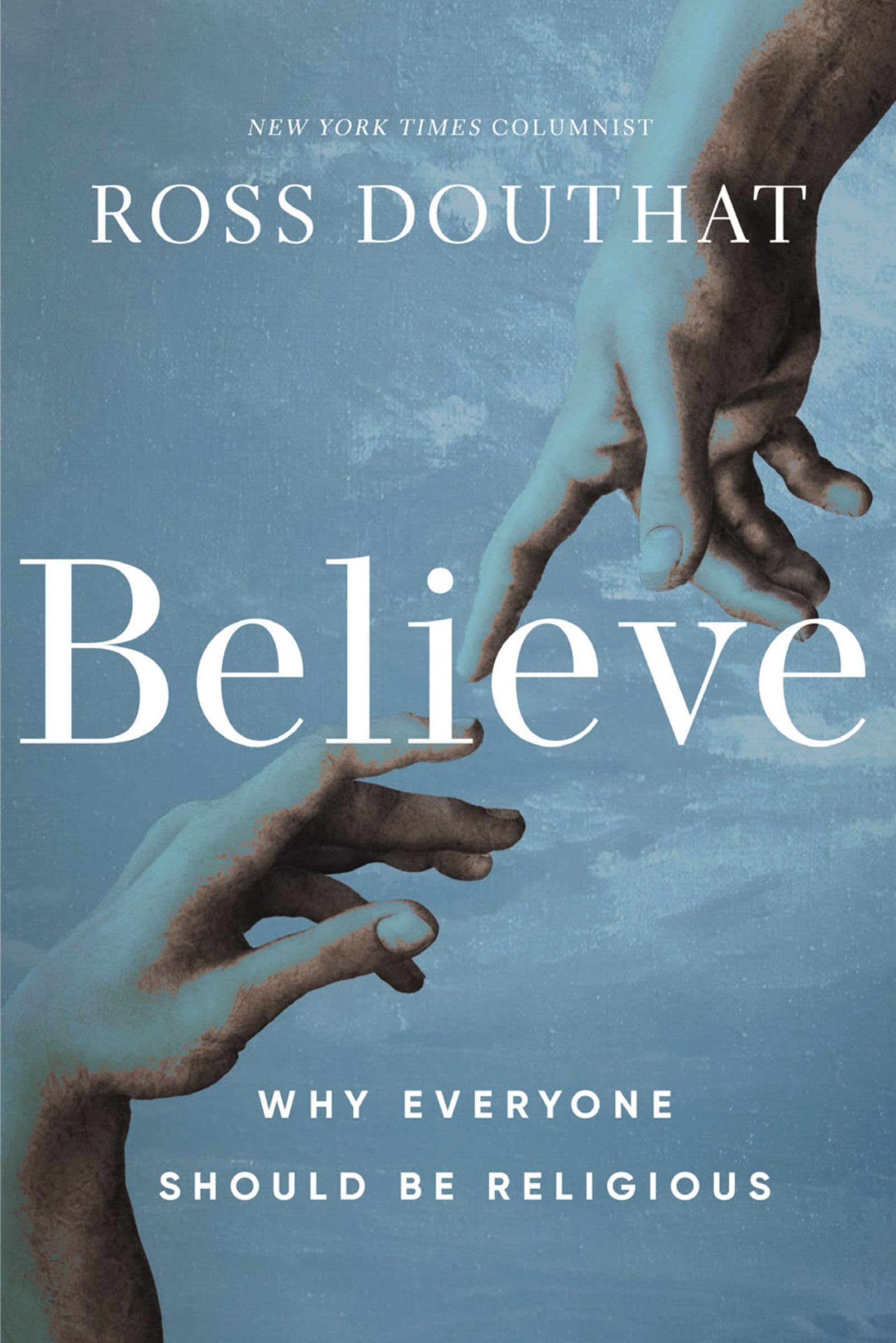
Douthat’s arguments are worth consideration. The very rationality that the New Atheists espoused, writes Douthat, demands belief in something besides atheism. The first third of the book is Douthat’s exploration of three major arguments for the existence of the divine, each buttressed by the latest research and theorizing in astrophysics, neurology, quantum physics, and philosophy. Even though Douthat taps into the same arguments that any student of Christian apologetics would recognize, his gift for writing and rhetoric takes those arguments to a higher level.
My favorite example of Douthat’s argumentation: the secular story tells us that early humans were foolish and proud for believing that the earth is the center of the universe. The Copernican revolution helped lay to rest all sorts of superstition and illogic, cutting through bad models and maths to confirm earth’s orbit around the sun. Except, when we consider the way in which the universe seems fine-tuned to support life, and when we observe the distinct lack of conscious life in every other observable quadrant of the universe, perhaps what was technically incorrect becomes existentially and metaphorically correct: the cosmos may revolve around the earth after all.
Douthat goes on to argue the merits of the world’s four greatest religions: Hinduism, Buddhism, Islam, and Christianity. He addresses many of the hang-ups that religious traditions draw out from the secular elite, such as the problem of evil and the fact that all these traditions limit what is permissible for human sexuality. Perhaps what sets his book apart from other treatments of the matter is it that takes seriously the idea that, if the spiritual exists, it is not necessarily benevolent. Like a good charismatic (and he is very sympathetic to Pentecostalism in this book!), Douthat has no problem talking about demons, malevolent forces, hell, and how important it is to find a spirituality that will care for one’s soul instead of destroy it. It is granted as fact that reports of spiritual in-breaking into the world, such as visions from near-death experiences, UFO sightings, miraculous healings, and meditative epiphanies, are widespread across cultures and continents, and that the ubiquity of such experiences demands consideration. His final chapter describes his commitment to Roman Catholicism and how he has been persuaded into a deeper faith by the evidence of Jesus’ resurrection and the Bible’s helpful historicity.
Frankly, it’s a fun read. But the question with any apologetic work, of course, is not whether it’s convincing to me as an insider in the faith, but whether it convinces outsiders.
The New Yorker, for example, posts an unconvincing but kind review from Joshua Rothman. His take: he is unswayed by Douthat’s interpretation of science, but he deeply appreciates Douthat’s take on the “brute fact” of religious experience.
Why do my attitudes differ so radically from Douthat’s? For one thing, my dad is a scientist, and he raised me in an actively atheistic way, drawing my attention to the hard work required to understand the natural world. When my mom expressed superstitious mysticism, I found it off-putting. I appreciate the religious world: I’m moved when I go to church, I love Alyosha in “The Brothers Karamazov,” I’ve taught devotional poetry to undergraduates. But, although I’ve had many valuable experiences around religion, I’ve never had a religious experience of my own—not even a gentle one. If I’d had a firsthand apprehension of the divine powerful enough to overcome my skepticism, then I suspect I’d find Douthat’s book more persuasive. I’d be coming to it from a different starting point. Who knows — I may have such an experience someday. You can be sure that “nothing, absolutely nothing, awaits you after death,” Douthat writes, in a discussion of near-death experiences, but then “come back from the operating table transformed.”
Though neither Douthat and Rothman have had any of the sort of spiritual experiences that Douthat catalogues, Rothman’s humility to recognize that they exist, and that he may one day have one, is charitable. It’s a thoughtful response, a far cry from the naturalist dismissals of spiritual experiences that the New Atheists of old would have offered back in their heyday.
In First Things, agnostic Kit Wilson criticizes Douthat’s flirtation with the apocalyptic, a tone throughout the book that the decision to engage with a religious tradition carries an urgency. That urgency, says Wilson, undercuts the rationality and congeniality of the book’s arguments.
Then you start to notice, dotted throughout the chapter — but never properly explained — vaguely apocalyptic allusions: passing mentions of “eternal stakes,” of “supernatural destiny,” of “preparation for whatever might be waiting on the other side.” Suddenly, Douthat, a little desperately, seems to be exhorting us just to get over the line, to sign up to something. Christianity, Buddhism, Islam, Hinduism — it doesn’t really matter what. You’ll be “allowed to change your mind and leave,” he assures us — no one is “asking you to join a cult.” It is surely better, he argues, “to face the consequences of even a mistaken commitment or decision than to hear, at the last, the fateful judgment, ‘because you are lukewarm, and neither hot nor cold, I will spit you out of my mouth.’”
In his typically genial way, Douthat then admits, a little sheepishly, that jumping straight to Revelation 3:16 might seem rather intense. Well, yes, I’m afraid it does.
Urgency is a double-edged sword. Sometimes the boat is sinking and people need to find a lifeboat, and sometimes the used car salesman is just trying to earn their commission. That difference between genuine and manipulative urgency is not always so easy to distinguish, and it’s a criticism that Douthat opens himself to by employing this urgency in his call to action (even if I think he’s ultimately right).
In the Atlantic, George Packer offers a firmer rejection of Douthat’s arguments in Believe. Many of those criticisms are rooted in the traditional atheistic rebuttals of these theistic arguments, but Packer’s comment that people are more open to falling in love, rather than falling in line, is his most helpful addition to the conversation:
Douthat guides the reader through the science toward God with a gentle but insistent intellectualism that leaves this nonbeliever wanting less reason and more inspiration. I can’t follow him into his Middle Earth kingdom of angels, demons, and elves just because a book he’s read shows that a universe in which life is possible has a one in 10-to-the-120th-power chance of being random. We don’t fall in love because someone has made a plausible case for being great together. Some mysteries neither reason nor religion can explain.
Reflecting back on AP Sunday School, it wasn’t just the curriculum that was memorable. This nuclear engineer dad decorated the ’70s wood panel room with Christmas lights and Goodwill couches, filled a mini fridge with Snapple, and brought in boxes of donuts or Costco muffins every week. He showed up at big life events, like big sports games and family funerals. He paid us too much money to house sit for him while he was away on vacation, and he gave each student a graduation gift of a personalized book he picked out for our specific life circumstance. It wasn’t enough for us to have big minds: it was also just as important for us to have big hearts, and he was one of the first people we had met who could model both for us.
Douthat did not set out to write an apologetic of the heart, where the affections of Christianity were placed at the forefront for consideration. (That book has already been written). This also isn’t a book that pitches the allure of Jesus, or any other major world religion for that matter. Like Aquinas’ famous five proofs of God or Pascal’s Wager, Believe endeavors to contribute to the trail of breadcrumbs that eventually leads to an encounter with God, but isn’t audacious enough to think that it will catalyze that encounter itself. Douthat’s call to action is that readers would simply get religion, and Christianity is presented as one very good option among them.
The book probably would have been more convincing had it included some level of affective argument, but surely, Douthat made the conscious decision to use a different strategy. We move in different worlds, and the apologetics of neuroscience and astrophysics aren’t as persuasive in my rural community as casserole deliveries, hospital visits, and prayers to start the town festival. Still, if we believe that the heart is the center of human endeavor, then the rational arguments for the faith do more to buttress the faith of the believer than engender faith in the outsider. Logic and love both have apologetic power, and both are stronger when they are paired together.
To that end, as a believer, it is wonderful to see Ross Douthat pitching the faith wherever he goes in support of his book. I’m not sure that, twenty years ago, I would have ever imagined a time when Paley’s watchmaker analogy was given serious airtime by writers in the Atlantic, the New York Times, or a host of popular podcasts and Substacks from well-regarded public intellectuals. To that end, the gospel of theism seems to be gaining traction. One prays that it eventually leads people to the Gospel of Jesus Christ, a prayer that would undoubtedly solicit Douthat’s “Amen.”





Beautiful, Bryan.
I think Catholicism and Pentecostalism have a shared commitment to the reality of spiritual forces. Which I think is really helpful in the face of too much disenchantment.
Also, thank God for people like the nuclear engineer Dad who ran your “AP Sunday School.” What a gift to have people like that in your life, especially as a teen!
Yes. Nuclear Engineer Dad is one of those unsung saints in the church, and I remain grateful for his involvement in my teens.