




Welcome to the fifth edition of Mockingbird’s preacher interview series! Over the past few months, we’ve been interviewing some of our favorite ministers from diverse contexts around the country to find out more about how to do church well (see here for previous interviews). Our fifth interview is with longtime Mockingbird contributors and co-senior pastors of First Presbyterian Church in Salisbury, NC, the delightful Lara and Josh Musser Gritter.
***
Mockingbird: So, I’ve heard of Salisbury, England, but not Salisbury, North Carolina. Tell me about your town.
Josh Musser Gritter: I think it’s about 40,000 people. The county’s maybe 125,000.
Lara Musser Gritter: I’d say Salisbury is a small city in a rural county. It’s a very homey southern place, but we also have a lot of poverty and blight.
M: So how would you characterize your church?
LMG: It’s a historic Presbyterian church, over 200 years old. It’s not the oldest in our county, actually, but it’s old. Our congregation is about 600 people. As far as character, our church has this deep cherishing of family, of caring about each other, a lot of very sweet people who are trying to love each other. That was here the moment we got here. And our church has a passion for mission as well. That’s had lots of different iterations over the years.
M: What does that look like?
LMG: Under the previous pastor, there were a ton of mission trips to Brazil. There was a big partnership at that time. So we still have a youth mission trip to Mexico every year. Our church members are also very involved in the local community, like on the boards of all the nonprofits in town. So there’s a lot of local commitment.
JMG: The homeless shelter in town, Rowan Helping Ministries, basically started out of our church sanctuary basement. It was originally called Jeannie’s Kitchen. This was way prior to us, in the 1970s. And it just sort of came from this sense that we need to start feeding people. It was like, hey, let’s feed people. And it became one of the biggest, most significant nonprofits in town. Homeless people can stay there as a form of temporary shelter. They get three meals a day. It does a lot of great work trying to get people who are in addiction back into work, into housing. It has a really big presence in the community, and all the faith communities here in Salisbury are involved in supporting it in some way, including our church.
So the people who grew up here, they just really care about the flourishing of people in Salisbury. The names of people in our congregation are on the plaques all over town — for the giving of the local park, for serving various nonprofits in the community. So it does feel really homey in that sense.
M: So, I grew up going during summers to a church in a small city, similar to yours, and one of the things I remember was that the church was very generational — I mean, you would have the grandparents, parents, and kids from the same families all going to the same church. So, is your church kind of like that, with many generations of the same families?
LMG: There is some of that, but I wouldn’t say that is a very prominent feature. Some of that is because, like everywhere else, the millennials and the Gen Zers aren’t coming to church the way they used to. But also, in Salisbury, so many young people move away, at least for a time.
JMG: Yeah, the loneliest we’ve probably been in our marriage was when we first started here in Salisbury. We were in that sort of young professional stratum, and there just aren’t a lot of people in their late twenties without kids living in Salisbury. A lot of kids go to college, and they go live in Charlotte or they go to New York. But then a lot of folks seem to return here when they have kids. There are lots of people in their thirties and forties with kids who are wanting to come and live here. Although, I will say, since we’ve been at this church, the demographic has shifted quite a bit. It’s getting younger. And I’m not even saying that’s something we did, but our church is getting younger. I also think, more recently, we’ve had some folks come to our church who are like, “I don’t know anything about Jesus,” and so that’s been interesting. There are a couple of people I have in my mind who are brand-new converts to Christianity, right? And all of a sudden they’re just all in, a huge part of our congregation. And we’ve also had a lot of people visiting who don’t fit the typical Salisbury mold. So that makes it feel very alive to me.
M: Okay, cool. So, I know you have two services on a typical Sunday, right? What’s the rationale behind each service? How are they different?
JMG: We actually had three services when we first arrived, and the funny thing about it, as a new pastor, was that they were in three different pulpits. I called it the triple-header, but it was like, you would have an 8:30 service that was in the sanctuary. It was kind of a smaller, more meditative, abbreviated service. And then an 8:50 service that was a contemporary setting in a different part of our building complex. So you would preach at the 8:30 and then you would magically arrive in the other service in progress — just sort of run up to the pulpit out of breath and start preaching the next one. You’d tear your robe off like you were Superman or something, and just start preaching.
LMG: Yeah, it wasn’t great.
JMG: And then we’d have a third service at 11:00 back in the sanctuary. But during COVID, the 8:30 sort of dissolved, and we moved to just having two services. It seemed to make more sense.
So now our 8:30 service is in a contemporary setting, and then we have the 11:00 traditional service in the sanctuary. But the only real difference between the two services is the music. All of the liturgical parts, the sermon, you know, all of that is the same. And I think that does make it a little less worship wars-y. It’s not like you come to 8:30 to get one thing and then go to the 11 to get something else. Yes, it can still be challenging at times to have two different settings with two different styles of music, but I kind of view it as a boon, a positive. I grew up in a more evangelical-ish, contemporary setting and have had to get used to the more traditional style, the robes and choir and handbells, that sort of thing. So I like that we offer two different styles. I think people enjoy it. Yes, some people kind of have their spot. The 8:30 is more relaxed. It’s a little bit more bring your coffee and less suit and tie, right? And I think sometimes it’s a place where we do try more new things.
LMG: I had a mentor in college tell me, “One mark of spiritual maturity is the ability to worship in any context.” So we’re always trying to invite people into that. Of course, some people are going to love the traditional style more, and some are going to love the contemporary more, but we’re not confusing the style of worship with the object of worship. So we try to encourage people to mix or even try the other service. We also unify the services throughout the summer, and that is again an invitation for people to be open to a style that’s not their typical choice.
M: Typically, when you have a contemporary service, it tends to attract younger people and families. Is that the case in your church?
LMG: Yes and no. Sometimes the 8:30 is booming with kids, and then sometimes the 11 is, and there are certain families that’ll go to either. Sometimes families choose their service just based on the time more than the style. And often, while you might get more young kids at the 8:30 contemporary service, in a lot of families, as their kids age up, they start going to 11. Also, we have a balcony in our sanctuary, and the young families love sitting up there.
M: Haha. So they can run around and be a little louder during the service?
JMG: Yeah. It’s like: Get me as far away from the preacher as I can but still be here.
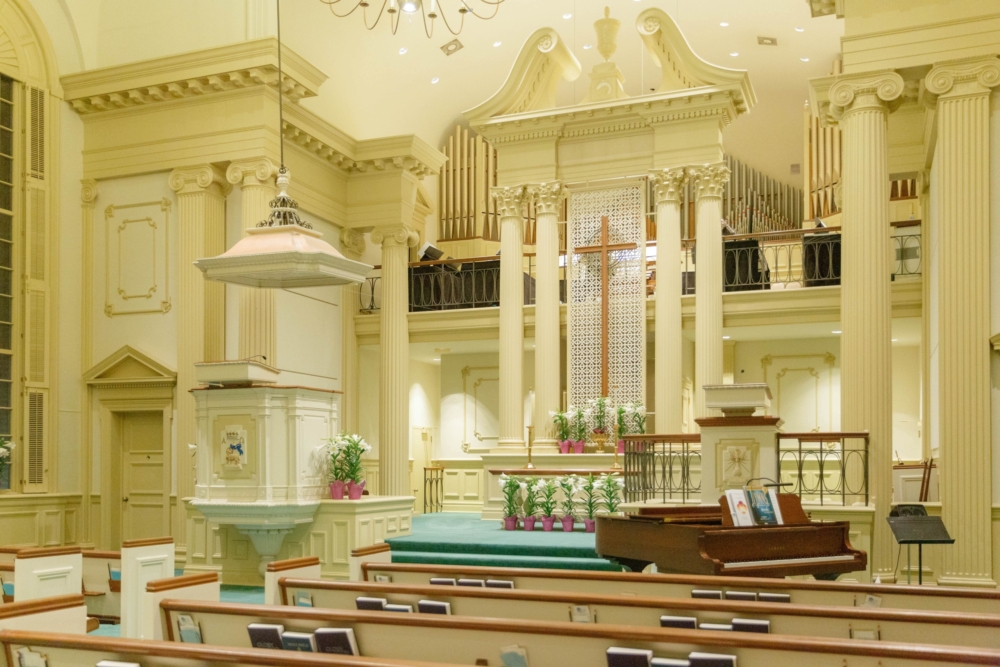
LMG: And it strangely works because the pulpit in our church is so tall. You know, Presbyterians, we love the pulpit. Our pulpit’s almost at eye level with the balcony.
M: So, when you do have a new person who comes through your doors, what kinds of things do you do to encourage them to keep coming back? How do you make them feel welcome?
LMG: The biggest thing is that the preacher goes and introduces themself and learns their name. We work really hard at that. Before worship, we do not sit in the chancel and study our notes or sit and center ourselves — that would be nice — but instead we are greeting people in the congregation until the prelude ends.
JMG: And usually the prelude gets done and we’re still greeting people, and then we’re like, Oh yeah, I have to go say something …
LMG: Yeah, there’s usually a moment where everyone has to wait for the pastor —
JMG: Like a good fifteen seconds of awkward silence where we’re quoting a Psalm or some piece of scripture while walking down the center aisle.
LMG: But greeting our congregation like that is a great way to check in on them because not everyone wants to do the receiving line afterwards. And we are always eagle eyeing for the visitor so we can introduce ourselves. You know, ushers are supposed to do some of that, but we want people to know they are known, and then we work really hard at trying to learn their names immediately.
JMG: And if you really believe that you’ve got the goods — that, like, the church has the goods — then sometimes I think it’s okay to be a little more forthright with people. So I just tend to be like, “Hey, email me and let’s get coffee. I would love to get to know you better. I love coffee. I love buying you coffee. Let’s get together.” And, you know, some people will opt out of that. But some people are actually like, “That would be great.” Because I think we have to believe that there’s a reason that they’re in the pew, right? If you’re in a pew in this day and age, the culture’s not forcing you to be there. So they’re longing for something. They’re desiring something. Their heart is searching for something, for God. For many things. And so, yes, let’s be warm and welcoming, but beyond that, expect that God brought this person to you, and don’t be afraid to be kind of evangelistic about it. It’s a chance to meet them as they are and invite them into more. That’s what we’re in the business of getting to do.
LMG: I think, too — and we both feel this way — the moment they come into our church, we’re their pastor now. They don’t have to join. But God has brought them to us, and we’re going to be their pastor until God leads them somewhere else. Right? Especially with a lot of people who are recovering from church hurt: They sometimes need like three or four visits with a pastor to work through some of their stuff before they might even want to go to a new members class. So we’re their pastor until God sends them somewhere else, you know?
M: Right. So what is the single most important thing that happens in church on a given Sunday?
JMG: Proclamation of the gospel from the pulpit.
LMG: We’re so Presbyterian.
M: Proclamation from the pulpit, specifically?
LMG: Well, honestly, the Iowa Preachers Project has guided both of us on this one. Preaching from the pulpit is a moment where we believe God is speaking through us, often in spite of us, to the congregation. And it has to be a personal word, it has to be a biblically sound word, and it is God’s doing. I mean, we take communion once a month at our church, so our sacramentology is not the highest. And so we do believe that preaching is probably the biggest way God is at work in worship. But I don’t even want to say it that way, because God can be at work however God wants to be in worship.
JMG: Yeah. The sermon is a vulnerable address from a foolish sinner to another. And in the last three to four years, we’ve kind of gone all in on just the message of “God is alive. God is alive. God is alive. God is moving. God will redeem. God will heal.” This is where Andy Root’s work has been helpful to us. If you get the crisis wrong, the way you do ministry might not be addressing the actual existential crisis people carry. So if you think the crisis is just that there are not enough butts in the pews, then everything you do is a sort of strategy to try to fix that. And we tried it that way, admittedly, and it didn’t feel quite right, but we couldn’t put our finger on it. You can even preach in that way. Like, how do I preach in such a way that there are more people who want to be here? Maybe that means preaching that’s more TED-talky or more therapeutic without the cost. I don’t know.
LMG: Preaching is definitely a more ego-driven process in my heart if I’m just paying attention to trying to get more butts in the pew.
JMG: Yeah. On the other hand, if the crisis is that people live in a world where the door to transcendence has been shut on them and where they don’t feel as though a force, a God outside of themselves, is actually acting within history and in their lives for them — if that’s the crisis, then what you’re doing when you get up to preach into that crisis is different. It’s everything. Yes, songs can penetrate that, surely. Liturgy can penetrate that, surely. Communion and baptism absolutely tell that story. But I’ll go as far to say that there is something unique about the alive preached word that is proclaiming that aliveness of God for people, for actual real people who are sinners and in need of saving.
M: I think you’re right. What people need to hear is that God is alive, God is doing something in your life. God’s not just out there somewhere at a distance. And that changes everything.
LMG: After the sermon, we’ve created a moment for reflection, which I think is also one of the best parts of worship. In my dream world, it would just be silence, just space to let God speak, but we play a little soft piano because people can’t stand silence. But that moment is so important because it’s the moment where the Holy Spirit can convey comfort after the word. It’s space that we’ve given in worship just to God.
M: That’s beautiful. Since we’re on the subject of proclamation, what is your best advice on preaching, especially for new or struggling preachers?
JMG: First, get rid of those commentaries. Okay, not “get rid of.” That’s probably too strong, but it’s not a time to plagiarize a scholar who’s not involved in your church’s work. Instead, it’s a time to see what God is saying to you. And once you know what God is saying to you, you know what you need to say to everybody else. Only that which is so particular is universal. So: really struggle with what God is saying to you, how you are being moved. One of my rules for stories and sermons is if this story or piece of music didn’t truly move me and stir my soul, it probably doesn’t belong in the sermon. You know, Robert Frost said “No tears in the writer, no tears in the reader,” and I feel that way about movie clips. So whenever I find myself crying in a movie, I pay attention. I just had this recently with the show Task. Everyone’s been talking about Task lately, but I found myself crying, and I was like, okay, well, something is happening within me right now that is resonant. And if it moves me, I think that means it will move others. So, yeah, what’s God saying to you? And commentaries? Meh.
LMG: Yeah, commentaries: meh. That’s a great summary. I think you’ve got to be crucified by the text you’re reading a bit. You’ve got to struggle with it. Bonhoeffer says that preaching is partly to have the congregation watch the preacher struggle with the text. And so, just struggle with it and really, really dive into it. I would also say that something that has been very life-giving for me — and this might not be true for every preacher, but it certainly has been for me — is to go to great theologians for counsel. Not a commentary, per se, but, like, I use my Church Dogmatics index for every sermon so I can look up, you know, what Karl Barth has to say. Because he’s going to take the story of the Magi and suddenly start talking about where the cult of the stars plays in the Old Testament and what that means. And it transforms what I’m trying to do with the text. Barth helps take the modern reader out of me and make me think. So go to the great theologians.
M: And the great preachers, presumably?
LMG: Yeah. The other resource I like to use a lot is — a retired minister gave me this big set, I’m looking at it right now — 20 Centuries of Great Preaching. You can look up your text, and if it’s been preached on, you can see, oh, so-and-so preached on this — like, Origen preached on this, and here’s what he did with it. And that’s cool. So those things are helpful for me.
JMG: One other thing is, and Lara’s probably better at it than I am, but I just pray. I was recently convicted of this at the Iowa Preachers Project. We were talking about what Bonhoeffer says about sermon preparation, and he doesn’t really talk much about technique. He doesn’t talk much about, you know, here are all the things you need to do. But he says there’s a way to be atheistic about sermon preparation. In the sermon you may be talking about how God is alive, but in your preparation, you’re still like, “It’s all on me. I got it. How can I employ the skills I’ve learned?” And it’s not that the Spirit’s not going to use your work, because the Spirit will, but you really have to pray and open yourself up to the Spirit.
I was given this advice by a mentor of mine. He said, “I get to my office early in the morning on Sundays, I get on my hands and knees and I just say, ‘Lord, please help. May this word not return empty.’” And trust that, by doing so, you are inserting yourself and your sermon into the life of God and then God will respond. The other piece of advice I was convicted by was that after the sermon — instead of going home and just eating all the food because you’re so hungry from the marathon of Sunday morning, and you’re just like relieved it’s all over and you want to set it on fire and never hear about it again — go into your study, your office, and pray then too and invite God to use the sermon how God will. And then just give it away.
M: That makes a lot of sense. So do you guys take turns preaching? I know you have an associate who works at your church as well.
LMG: Well, our associate has been here for two weeks now. She has not yet preached, but she will. But it’s me and Josh most Sundays. We take turns every other Sunday.
M: So you each get two weeks to sit with a text?
LMG: We do. The co-pastor model is wonderful. And one of the many benefits is that we basically form a preaching team, so we don’t have the weekly grind of having to produce a sermon. We get to recover from a sermon and we get to prepare for a sermon for two weeks. And I think that does help deepen our preaching.
M: So, Lara, I read your bio on the church website, and it’s so interesting to me that you grew up going to a church that had that same married co-pastoring model. That’s not super common, in my experience. I don’t want to pry into the nature of your working relationship as a married couple too much, but it sounds like it works. Can you tell me more about it?
JMG: Pry away.
LMG: I’m so glad you asked about that, because my pastors growing up would say it’s as old as Priscilla and Aquila. We’ve just forgotten it’s that ancient. You know, couples have been co-pastoring for centuries. The modern change to it is just that women get to do it now in an official ordained capacity. So I feel so privileged that I get to do this with Josh. The wisdom I have for people is: it either works or it doesn’t with your spouse, and you’ll know. You’ll know quickly if you want to work with them or not.
When he and I met, that was not the plan. I was not fixing to find a co-pastor. But God very slowly led us into it. Even at the end of seminary, we were applying for separate ministry positions. We got to do a residency in Greensboro for two years together to test it out and found out that it works great. And then after that, again, we were still applying for separate positions, and then this church reached out to us as co-pastors. So it really is an act of God that this happened at all. And for us, it is absolutely wonderful. We get to be a team. We get to model for the congregation the mutual self-giving of the Trinity at the top of leadership. It doesn’t have to be one guy at the top being like: I have the final say. It’s us in partnership, which means sometimes we disagree and argue in staff meetings — not vehemently — we keep it light, but we bring both of our selves, and then we are committed to consensus instead of top-down coercion.
M: And there’s a vestry, too, right?
LMG: Oh yes. It’s called our Session. And we take turns moderating the Session meetings. So we’re very much both in tune with vision setting and administration. And they watch out for us.
The risk for a church is that they are betting on our marriage, and that is terrifying. And you can find stories of co-pastors where it all falls apart.
JMG: The thing about being a clergy couple who are co-pastors that I appreciate the most is that anyone who’s reading this interview or reading Mockingbird and is a pastor knows that it’s a lonely job. It just is. There are weird quirks to every profession — we’re not unique in that — but this can be a dangerous business because there are just a lot of pitfalls in ministry. And as a co-pastor, you’ve got somebody watching you. You’ve got somebody caring for you. You’ve got somebody just in the thick of it with you. And in our case, that happens to be somebody who knows us as a spouse knows you.
LMG: And who can call you on your you-know-what.
JMG: Yeah, and I don’t trust my individual will as far as I can throw it. I’m Reformed enough to know that I shouldn’t. But it’s amazing how fun it is to have somebody just in it with you. It used to be that we would try to be so boundaried about “Okay, we’re at home now. We can’t mention church!” But now we just kind of accept, like, look, we’re married. We work together. We pastor together. Our callings, our vocations, it’s all intertwined. And so we’re just kind of comfortable. Like, yeah, we talk about what’s happening at the church at home, and we talk about what’s happening at home at the church. It’s just —
LMG: It’s beautiful.
M: So as a church that preaches grace, how do you deal with difficult people?
LMG: Highly relationally. We have not had toxic-level difficulty, so there’s probably another level that is required for that, that sets hard boundaries, that knows when to say no. For the run-of-the-mill difficult people that we’ve had here so far, it’s really just about loving them to the point of understanding them and knowing you can’t change them. There’s such a hard surrender in ministry and as a Christian in recognizing I cannot change this person. They are going to continue to be difficult. No matter what I do, no matter how brilliant my exegesis of the text was on Sunday … I don’t have that power. That’s up to God. So it’s about understanding them, loving them, and learning their particular quirks and what we can do to help them succeed, especially if they’re a ministry leader. I have to recognize, as important as my role is as the pastor, this church is not mine. And some of these people are going to be here for generations longer than I am. So I’ve got to surrender and remember that God is at work in them, even when they’re tough to deal with.
JMG: I think maybe Bonhoeffer said this too, but we often expect more of people than we expect of ourselves. It’s not our job to view people from the vantage point of what they have done or not done. It’s our job to view people from the vantage point of what their crisis and suffering is. So as a pastor, when somebody is angry or someone didn’t like what I said in a sermon, or, in youth ministry, when one of those kids is acting up, and we want to try to get them on the straight and narrow — there’s another step, or a third way, as a minister, which is to ask the question: “What sort of pain or law or brokenness is going on in this person’s life that makes them make sense right now?” Everybody does actually make sense to a certain degree. And they make sense because what makes us human is that we suffer and we go through hardship, and life isn’t easy. So dealing with difficult people is often about seeing people not just for what they’ve done but for the wounds they carry, and then being their pastor. And sometimes the best approach is just to pray for them. Jesus said, “Love your enemies and pray for those who persecute you,” and I think that’s one of the most uniquely Christian commands in scripture. And sometimes those people are in your parish.
The only other thing I’d say, and it’s a really practical thing: As a people pleaser who wants equilibrium in all my relationships, I have had to really learn how to also trust that I can be vulnerable enough to have hard conversations with people. To be able to say, “Hey, this is how I’m receiving the way in which you’re acting, and I want us to move past this in another way.” It’s hard to do that as a pastor to a congregant, because, you know, you have power — especially in the small-town South. Your words and actions toward them have power. Like, a little offhanded joke to a young person, they could carry that with them for the rest of their life. But still, it’s important to be willing to engage in some conflict in healthy ways rather than just quietly resenting your people, because you just can’t love people that you resent.
M: Yeah, you’ve got to process your resentment somehow. Okay, switching gears: What would you say are some good approaches to fundraising?
LMG: I think the biggest thing is you’ve got to just switch up your approach every so often. Novelty draws people’s attention. I think it’s great to preach that where your heart is, there your treasure is also, but then you’ve also got to preach “Give till it feels good.” And you’ve got to trust that this is their church, not yours, and so the business of it is ultimately their deal, their responsibility.
JMG: Yeah. I would add one very practical thing. If you haven’t started an endowment where you’re inviting people to give after they die, start now. Start small and make it really personal and conversational. Why? Because the pastor 30 years from now will be really grateful to have another source to keep the budget afloat and to keep staff being paid and keep ministry going. But also, if they’re not giving to your church, people are probably going to give to their alma maters, which already have huge endowments. And you know what? Chapel Hill doesn’t really need another $100,000 gift. If you believe that the church is the best thing in town and its mission is so important for today and for tomorrow, then invite people to participate in that as an act of faith and to posthumously pledge. Don’t be afraid to have those conversations. And when you have the conversations, remind people about how significant the church is and where God has met them.
LMG: I also think transparency is very helpful. As a church, it’s important to just be really open with parishioners about what we’re doing with your money, why we need it. Here’s the breakdown of how it gets used. Yes, keeping the lights on and paying the staff seems unsexy, but think of all that the staff does at this church. That’s the ministry. So, we have to be really comfortable talking about the details and being open to any questions. More and more, millennials, zoomers: we’re skeptical, critical people. You’ve got to be open to some questioning.
JMG: And at the end of the day, I still think that the church culture you create and the way you’re talking about the biggest things, like getting the crisis right, is central. If you fundraise because there are not enough butts in the pews or because we just need more money, you’re not actually addressing the main thing. But if you’re trusting God with a word of grace from the pulpit, if you’re reminding people that God is alive, if you’re being a pastor and shepherd to your people and you’ve established a healthy culture for your staff, I think people will give. So, yes, strategies are important, but never let that come before what really matters.
M: Right. Keep the gospel the main thing. So, what do you wish you had known when you first started ministry?
LMG: Oh, I’ve got a good answer for this. This isn’t so much something I wish I had known, but I think it’s an essential ingredient to ministry, at least to ministry as I do it now, which is: When I got out of seminary versus now, I had not suffered in the ways that I have suffered over the last nine years. And that suffering, mostly through some stuff in my personal life, was a refiner’s fire. It had to take some hard things out of me, had to smooth some of my edges, and more than anything, it had to get me literally on my knees before the Lord. And that has changed everything about how I do ministry, how I approach my job. I don’t wish suffering on any new clergyperson, but I do think it is the best school for ministry — to be brought to the end of yourself and then to have God carry you the rest of the way.
M: Right. It must be so hard for a 24-year-old right out of seminary to try to speak empathetically to someone who’s 75 and suffering intense loss or dealing with chronic illness or something like that and not feel like a total fraud, you know?
LMG: And you know what? Even now, the 80-year-old in my church who’s struggling with cancer or whatever, I do have a greater appreciation for the distance between my suffering and theirs. But what I can say with utter confidence is that God is faithful in the midst of it. And I can know that God will work in them and through them, both in spite of me and through me as their pastor.
JMG: That’s good. A couple of things popped in my head. One is — it’s not something you can know, but it’s something you just figure out in the journey — God has called uniquely you to be in this unique place. There’s a reason why the canon has Isaiah and Jeremiah. They were not the same person, they were not called in the same place, they were not called for the same reason, right? The particularities of their story matter. Like, God has called Josh, and for me there’s a comfort in that. So be who you are. Not that you have to chase authenticity, but I think some of the best things in my ministry have happened, ideas I’ve had that seemed to work, have been when I’ve just been like, yeah, I’m just kind of built this way, so let’s go that way. Because if God’s voice came to me, it came to me as me.
Another thing I wish I had known is how much I would need to have a pastor myself. I actually think the evangelical world is much better at setting up this kind of support. Like, you are always discipling and you’re always being discipled. And sometimes you just need another pastor who is going to take you out to lunch once a week and be like, “How is it with your soul?” On sabbatical was when I really realized how much I needed that. And you have to seek that out. You are just going to need people who are farther down the road from you in ministry, who’ve seen it all, to be able to hear you out. So when you’re dealing with those difficult people, you can say, “Man, I’m so freaking pissed off at this person! I don’t know what to do.” And that older pastor can just say, “Man, have I been there before … ” I’ve had a couple of situations in ministry in the last year that have been that way, and what I’ve needed is not a therapist, not my mom or dad, not Laura. I’ve needed a pastor. I need to be pastored.
LMG: Yes, I agree: you have to have a pastor. And/or a spiritual director. Spiritual direction is wonderful because it is helping you listen to God and attune to God’s work in your soul, and it cannot be overstated how important that is. One other thing I would add: If you study the statistics, most young clergy in the mainline churches are more liberal on average than their congregations. So what young seminarians probably need to be told, if they’re not already being told it, is that your congregation’s probably going to be more conservative than you, and you’ve just got to love them.
M: You can’t harangue them.
LMG: Right. You can’t harangue them. You’ve got to love them. These are the people God gave you. And also, know that your job isn’t to make them liberal like you. Your job is to take their hand and God’s hand and put them together and get yourself out of the way.
M: Exactly. I love that. So what is the one thing most churches don’t do but should — or if you want to flip it, what’s one thing most churches do but shouldn’t?
LMG: One of the things I think about often is: What is the thing we can uniquely do as the church? My parishioners come to me with a million ideas of things we should be doing here at our church that is not the thing that we can uniquely do as the church. And it’s not all bad. Fellowship is great. Mission is great. Social witness has its place. But I would still say none of those things are unique to the church. I don’t want to judge other churches, but boy, the most important thing we can be doing is pointing to the living God. But that means imbuing all of our ministry with a slowness that really asks God for guidance. You don’t just take a scripture passage and say, well, I know biblically we’re supposed to do this, so I’m going to do it. Instead, you work on attuning to what the living God is speaking to you right now. That’s so important.
So I’d say: everything is gravy as long as the meat is Christ crucified and risen.
JMG: Two things come to my mind. One thing is I’d love to see more mainline churches invite people in some way to just come up and receive — not just in communion, but to come up and respond and encounter God. Like, on the Baptism of the Lord Sunday, each of the last two years, we’ve put the font right in the middle of the aisle, and we’ve done a reaffirmation of baptism where we’ve had people come down and put water on their foreheads with the sign of the cross. It’s about as close to an altar call as a Presbyterian can get, right? And what has happened is that there were more tears than I’ve ever seen on a Sunday in our church. It’s not that we’re trying to get them to emote, but the tears are saying something. God is meeting them in some way. There are obviously ways to invite people to come forward in church that are uncomfortable or unhelpful. But then again, I did all those church-campy things growing up. I came up and nailed my sins to the cross. I threw my sins in the fire. In fact, I did that at a youth retreat recently, and it crushed.
LMG: Honestly, the answer is more altar calls.
JMG: Haha. No one’s coming to our church after this interview … The other thing more churches need to do is just, goodness gracious, have some fun. We came out of the pandemic and we were like, “Let’s throw the wildest, silliest Christmas party possible.” And that was a strategic decision.
LMG: We got pied in the face. It was fun.
JMG: And look, there’s a huge responsibility that the church has in the world. There’s a cost to discipleship, absolutely. But there’s humor in all of this. Life is a comedy, not a tragedy. So, gosh, have some fun. Be silly. Laugh at yourself and laugh at your people. Bring that into your Session meetings. Don’t just do business. Tell jokes. Pray for each other. I think that silliness, that lightness of spirit can really break people open too.
LMG: I’ve got one more. I only know the Presbyterian context here, so I’m narrowing my focus so that I can feel confident saying this. But we both long for more of the Holy Spirit in our congregation. We went to college in Seattle, and we had two experiences with Presbyterian churches out there that were “Presby-costal.” One church would wait on a word from the Lord at the end of the service before the benediction, and sometimes the congregation would break out into song, or someone would quote scripture, or someone would speak in tongues, and then they would wait for an interpretation. And then, at another church where we did youth ministry, we would do prophetic prayer with youth, laying your hand on a youth, closing your eyes and asking the Spirit to speak to you for that person and speak to them. Our church isn’t ready for all that quite yet, but we regularly pray for an outpouring of the Holy Spirit here in some way, you know, for a little more fire of the Spirit. We don’t want to burn down the church, but I wouldn’t mind getting a little singed.
M: “Presby-costal.” That’s a new one for me.
JMG: Let’s do it. Let’s get weird.
M: Haha. Okay, last question: What aspect of your job do you hate the most, and what aspect of your job do you love the most?
LMG: I remember, growing up, one of my pastors saying offhandedly, “It’s the best job in the world, and it’s the worst job in the world.” For a long time, I thought that meant, “Oh, it’s the best job because you get to baptize babies, and it’s the worst job because you got to do funerals.” But what I realize now is it is the best job in the world because of the funerals, because of the life-and-death nature of what we do. People need a promise from God that in the end “All shall be well, and all shall be well, and all manner of things shall be well.” So getting to handle holy things is just amazing — from the elements of communion to the elements of people’s lives.
The worst part of the job right now is when there is something happening in our country or our world, and people are reacting, responding, and expecting a reaction and response from us. And we’re trying to be very, very deliberate and ask God for what God wants out of us in this moment. And that is slow work. It’s unsexy. It’s often not something that you can point to. It’s not a virtue signal. I hate being like, “Yeah, I’ve got opinions about what’s happening in our world, but faithfulness right now is demanding that I don’t have any public position. I can’t virtue signal anything right now.” God has not given me permission to do that yet.
M: You’re having to take your ego out of it, to some extent.
JMG: Right. I guess the part of our job that I hate the most is just dealing with people’s garbage. I mean, since we’re pastors and since this is a church, we ought to expect that people are going to bring all of their garbage here because they should. When people act up at church and are difficult at church, one response pastors have is “This person’s nuts!” The other is “Well, of course. Where else should you feel safe to bring all your stuff?” But sometimes we become a lightning rod for all that. And you know, it’s not easy to have people hoisting messianic expectations on top of you. It’s not easy to have people use your vulnerability against you and to hurt you with it. And that just happens. That’s what pastors are talking about when they’re getting a beer at the conference. They’re talking about, “Man, you’re not going to believe what this person said to me the other day … ” That’s the stuff we can’t share with anyone else. It just comes with the job.
I think what I love the most, beyond the preaching part of ministry, is just those coffee shop and lunch meetings with people where you sort of think you’re meeting up to get to know one another and talk about this one thing, and then all of a sudden you find yourself reminding someone of what the gospel means for their life. And you can see in real time how the gift of the gospel just absolutely floors them and moves them. I had this happen with a young person last week. We were meeting to talk about something very generic, something happening in the youth ministry, and then this young person sort of lingered behind and I was like, okay … ? And then we had this deep conversation that I completely didn’t expect from a person who I thought never liked me much or the youth ministry. And it was really powerful for me and for them. I got to not only listen to them but to proclaim something to them in that moment about who God is in Jesus for them. And gosh, in those moments, you just feel like if I got to do that a couple of times in my life, it would be a life well lived. And yet we get to do that all the time. It’s the best.
LMG: It is the best.








Thank you both for sharing this with us.
We realize how young you are and can only imagine how often you are asked shocking questions and expected to have all the answers. As if!!! It’s a good thing you have God on your side! Keep up the good work !! We are thankful to have your family in our lives!
Thanks for sharing. It reveals a great deal about our pastors that we might never have known otherwise. I feel that it has brought us closer together. I have always believed that pastors and parishioners have a similar goal. Service to our God is not reserved for ministers, to the exclusion of church members. The two of you in this interview, have indicated to me that you want for us, what we want for ourselves—serving our Lord. Serving God, getting closer to Father, Son, and Holy Spirit, is not reserved for Sunday morning for an hour or two. It is an ongoing way of life. John Wesley got on his knees eight hours a day and said publicly, “Pray without ceasing.” My experience with ministers is varied. I wrote my dissertation on a minister of the 18th century, and I have taught about many types of preachers and their sermons throughout my career. I am grateful to have you in this pulpit, and in the position of co-pastors. I thank God every night for you both. May He continue to bless you, and to bless us with your presence in our lives.
Josh and Lara are great people and great pastors – so glad to count them as friends and colleagues in ministry.