“We’re all imagining it,” she said, “the war; and the one thing you can be sure of is that we’re imagining it wrong.”
“You think it’ll be worse?”
“I think it’ll be real” -Francis Spufford, Nonesuch
Modern wars typically begin with a limited scope, carefully planned timeframes, and the expectation of relatively controlled outcomes. Which is to say, they are brutally effective at exposing our penchant for wishful thinking.
Take, for instance, the Korean War (1950–1953). American involvement officially began as a “police action” to enforce a UN resolution for North Korean troops to withdraw from their southern neighbor. The US later switched its objective to unifying Korea under a democratic government. When the Chinese threatened intervention, American leaders decided that they were bluffing.
They were not. After three years of combat and millions of casualties, the Korean Peninsula returned to an uneasy status quo that still holds today.
Around the same time, Truman sent military advisors to Indochina to assist the French fighting a local communist uprising against colonial rule. This was the first American foothold in what soon became known as Vietnam — which would, over the next two decades, find itself on the receiving end of more than three times as much American ordnance as Germany and Japan combined during WWII.
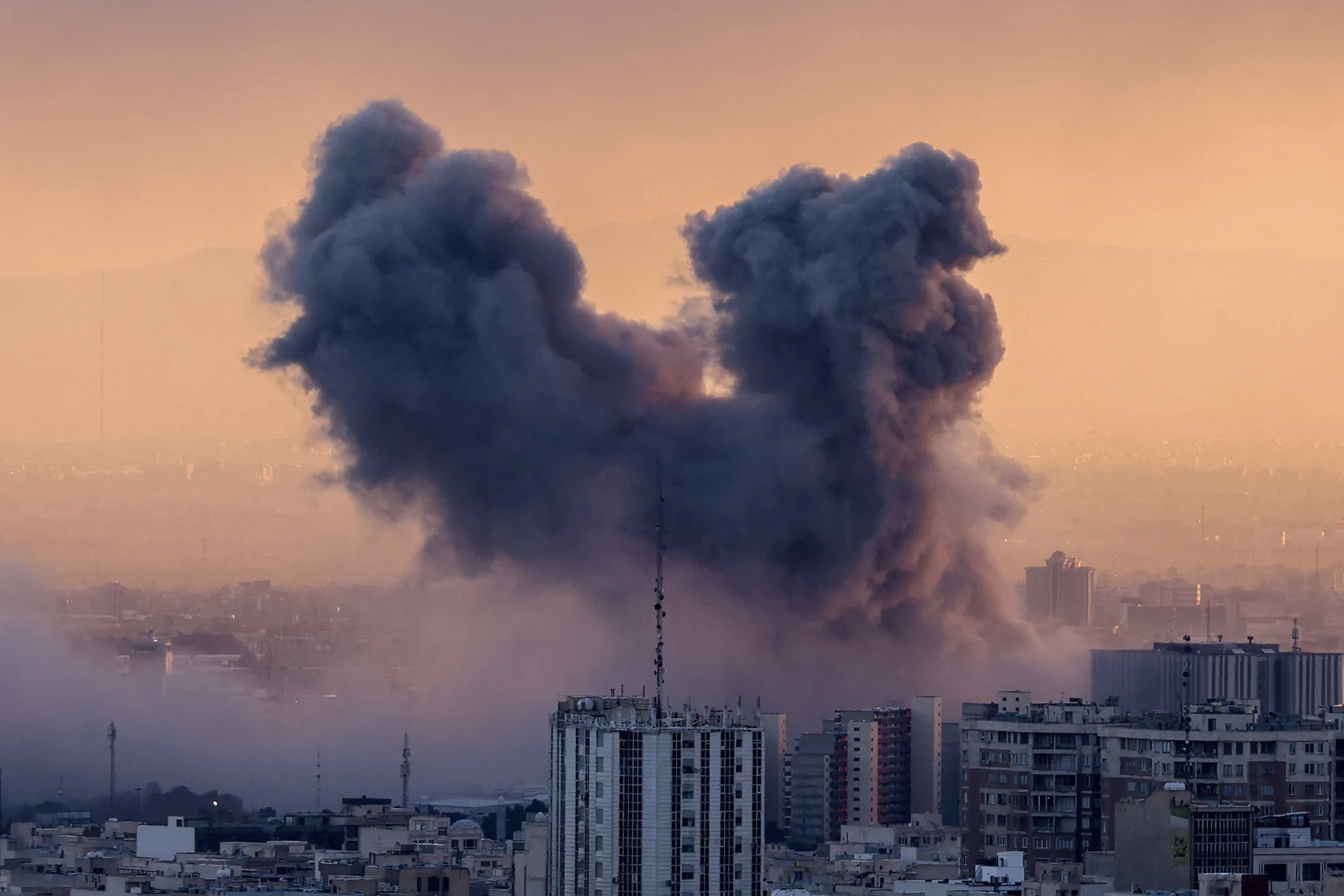
At the time of writing, the same pattern is playing out in Iran. Despite taking massive damage, the Iranian military continues to launch attacks against oil tankers and other civilian targets in the Gulf and beyond. While Trump has promised a swift end to the conflict, Iranian leadership vows to wage “a long war of attrition” aimed at disrupting the oil-dependent global economy.
During the first three centuries of the church’s existence, the pressing question of the day was whether Christians could serve in the Roman military. Otherwise, the question of war itself was more or less moot, as Christians had no say in the state’s actions. War was something that just happened, like famine or earthquakes.
Ever since Constantine, however, Christians — or those privileged enough to have any kind of political influence — have had to reconcile their faith with the hard realities of statecraft, or else consciously refuse that reconciliation.
One of the first Christians who wrestled with the problem of war was Augustine (d. 430), the Bishop of Hippo in Roman Africa, who found himself with a persistent headache in the form of Donatism. Donatists asserted that priests who had surrendered scripture to the pre-Christian Roman authorities could no longer offer the sacraments. A quasi-military faction, the Circumcellions, even took to blinding “lapsed” priests.
Augustine, of course, was aware of Jesus’ dim view of violence and retaliation. But he also knew that the Donatist controversy had spilled over the bounds of “doctrinal disagreement” into physical harm. Reluctantly, Augustine drew a distinction between individual believers, who are to practice nonviolence, and the state, which God permits to wield the sword.
Even the state, however, must observe a set of principles later commentators dubbed “Just War Theory.” Very simply put, JWT stipulates that war is only justified when the state (1) has exhausted all peaceful options, (2) seeks only to correct specific injustices and restore peace, and (3) does not engage in excessive violence.[1]
Fully fleshed-out JWT is a sophisticated moral framework. It’s also poorly suited to the kinds of wars that America has been fighting since WWII, the country’s last “total war.”
Since then, the US has engaged in “limited” wars to achieve specific objectives — cover for South Vietnam until it can fight communists on its own, find Saddam’s alleged WMDs, or re-obliterate Iran’s nuclear program. On the surface, limited wars seem particularly amenable to JWT: Do the job as quickly and professionally as possible and get out.
In practice, however, war typically overflows whatever scope the planners had envisioned. The “specific injustices” being rectified change or multiply or become murkier. The problem is that the war is only “limited” from the superpower’s perspective.[2] For the Viet Cong, the various Iraqi insurgencies, or the Iranian regime, the stakes are existential. And entities fighting for their survival have little interest in keeping war within certain acceptable bounds.
Hence the ships burning in the Gulf, Israel’s invasion of southern Lebanon, and the thousands of Iranian drones and missiles cascading around the Middle East. At the time of writing, Iran has already struck a number of oil tankers. Crude oil hovers around $95–$100 a barrel, and the Revolutionary Guard has stated its aim to bring that figure up to $200. America is now under pressure to “widen the scope” of the conflict by providing naval escorts to tankers or even seizing certain strategic sites around the Strait of Hormuz. As it stands, the timeline for the current Iran war keeps getting pushed back from days to weeks to months to who knows when.
***
When it came to war breaking out, Jesus had clear instructions for his followers: run.
But when you see Jerusalem surrounded by armies, then know that its desolation has come near. Then let those who are in Judea flee to the mountains, and let those who are inside the city depart, and let not those who are out in the country enter it; for these are days of vengeance, to fulfill all that is written. (Lk 21:20–22)
Elsewhere, Jesus lauds peacemakers, forbids retaliation, calls for his people to love their enemies, and claims that his kingdom isn’t the kind that has a defense budget. While he tells his followers to buy swords, he gets irritated when they use said swords — violence only ensures more violence (Mt 26:52). Jesus regards war about the same way he regards politics in general — he doesn’t have time for them. War and politics are beneath him, unworthy of the kingdom of which he spoke so movingly. It’s something other people do, relics of a passing age.
But the age hasn’t passed yet. We still live in a world in which some problems, it seems, can only be solved by violence. Nonviolent resistance works in India against the British (who care about PR). It does not work in Cambodia against the Khmer Rouge (which doesn’t).[3]
Making a distinction between a Christian’s individual ethics of nonviolence on the one hand and a Christian’s involvement in matters of state on the other is a reasonable solution. Doesn’t Paul himself claim that God ordained the Empire to punish evil with the sword (Rom 13:4)? Many follow this route, and not without a degree of coherence.
But like a lot of reasonable solutions, I can’t imagine trying to explain it to Jesus of Nazareth. “Look, Jesus, I didn’t snap back when my colleague insulted me, but we really had to bomb Hanoi. We can’t let the communists take Southeast Asia.”
Appealing to Paul doesn’t help all that much either. In the broader context of his work, it’s clear that, for him, the Empire only had instrumental (and fleeting) value, keeping peace and thus allowing the spread of the gospel before the imminent end of the age. His attitude is almost: “The pagans are going to do this statecraft thing anyway; it has certain advantages for us, so play along.” I seriously doubt he imagined a world in which the believers in his fledgling churches would one day themselves pick up the sword.
All of this is quite distressing to me, and probably to you. I don’t think the arc of history bends toward justice if you just give it time. I don’t think we can reason with some people (I’m rooting for the Ukrainians). When push comes to shove, I find there are circumstances in which I would kill people because I could not bear the alternative.[4] I just don’t have a clear-cut justification for it, at least not one that honors how Jesus told me to live.
If Jesus’ ethic is unlivable in the real world, it’s the real world (with all its clear-eyed pragmatism) that’s insane. This is neither sentiment nor piety. It’s years of watching empires fall, unintended consequences run riot, and cycles of violence repeat themselves endlessly. Jesus doesn’t tell his followers to avoid the ways of the world because he wants them to achieve some kind of detached monastic purity, but rather because the ways of the world are ultimately really stupid, if not deadly.
The good news is that we follow a person, not an ethic. The ethic is, among other things, a way of seeing the idiocy of “living in the real world.” The person is ultimately the way out of the cycle of violence. Perhaps that’s why Jesus healed the centurion’s servant but didn’t first require him to abandon his post. It’s a small gesture of grace, really, but it’s also an awareness that there are some realities of this age that are immovable. That even within Jesus’ unyielding ethics, there is an acknowledgement of our feeble place in the world and the impossibility of being unscathed by its narrow horizons. Because he came to give life to the dead, regardless of whether they perished in a monastery, in a darkened alley, or on the battlefield.
[1] Augustine later found it necessary to complain of the state’s harsh treatment of the Donatists. One is reminded of Luther’s urging the German nobles to slaughter the rebelling peasants only to later condemn those same nobles to hell for their brutality.
[2] I owe that insight to Michael Shurkin’s essay “On Limited War.”
[3] The communist government of Cambodia from 1975–79, led by Pol Pot. It was so viciously homicidal (killing about 25% of the Cambodian population) that their erstwhile communist allies in Vietnam eventually deposed it.
[4] Not incidentally, I have zero interest in criticizing believers for joining the military.