This Sunday with Sarah Woodard
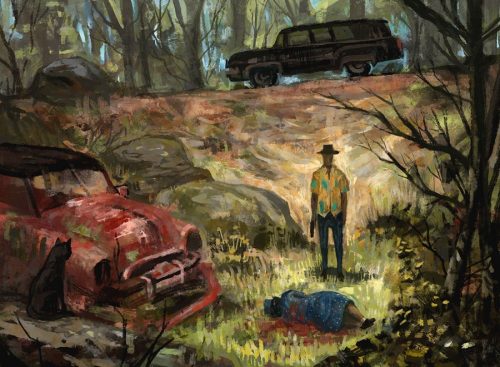
For those who aren’t able to make the NYC conference (and some who are!), we’ve got another wonderful event coming up on Zoom this Sunday: our own Sarah Woodard is hosting the next virtual book club discussing Flannery O’Connor’s A Good Man Is Hard to Find and Other Stories.
“[W]hile the South is hardly Christ-centered,” O’Connor once wrote, “it is most certainly Christ-haunted. The Southerner, who isn’t convinced of it, is very much afraid that he may have been formed in the image and likeness of God.” This Christ-haunted sensibility infuses O’Connor’s unique brand of Southern Gothic storytelling in this classic collection first published in 1955. In our discussion, Sarah Woodard will be focusing on three stories in particular: (1) “A Good Man Is Hard to Find,” (2) “Good Country People,” and (3) “Revelation”. That third story is from a later collection and can be read here.
As an example of O’Connor’s style, the collection’s title story — one of O’Connor’s most famous — features a southern family who get into a car accident while driving on a remote road. Stranded on the roadside, they encounter a gang of criminals led by a recently-escaped convict known as “the Misfit”. One by one, the gang murders the family members until the only one left is the Grandmother, who, in an extraordinary moment of understanding, looks compassionately at the Misfit and says, “Why you’re one of my babies. You’re one of my own children!” She then reaches out to touch him on the shoulder, and he shoots her to death. As O’Connor once explained,
The Grandmother is at last alone, facing the Misfit. Her head clears for an instant and she realizes, even in her limited way, that she is responsible for the man before her and joined to him by ties of kinship which have their roots deep in the mystery she has been merely prattling about so far. And at this point, she does the right thing, she makes the right gesture.
I find that students are often puzzled by what she says and does here, but I think myself that if I took out this gesture and what she says with it, I would have no story. What was left would not be worth your attention. Our age not only does not have a very sharp eye for the almost imperceptible intrusions of grace, it no longer has much feeling for the nature of the violence which precede and follow them. The devil’s greatest wile, Baudelaire has said, is to convince us that he does not exist.
The monthly Book Club meets this Sunday, April 30th, 3:30 Eastern Time.
To receive the Zoom link to attend enter your email below:


Future books, discussion leaders, and dates are:
May 21st — Simeon Zahl, Julian of Norwich’s Revelations of Divine Love (14th/15th cent.) (147 pgs)
June 25th — Will McDavid, Søren Kierkegaard’s Fear and Trembling (1843) (160 pgs)
July 30th — Meaghan Ritchey, Simone Weil’s Gravity and Grace (1947) (248 pgs)
August 27th — Sam Bush, G. K. Chesterton’s The Man Who Was Thursday: A Nightmare (1908) (118 pgs)
September 24th — Jason Micheli, Robert Jenson’s A Theology in Outline: Can These Bones Live? (2016) (152 pgs)
October 29th — Stephanie Phillips, Heather Havrilesky’s Foreverland: On the Divine Tedium of Marriage (2022) (304 pgs)
November 26th — Todd Brewer, T. S. Eliot’s The Elder Statesman (1959)