




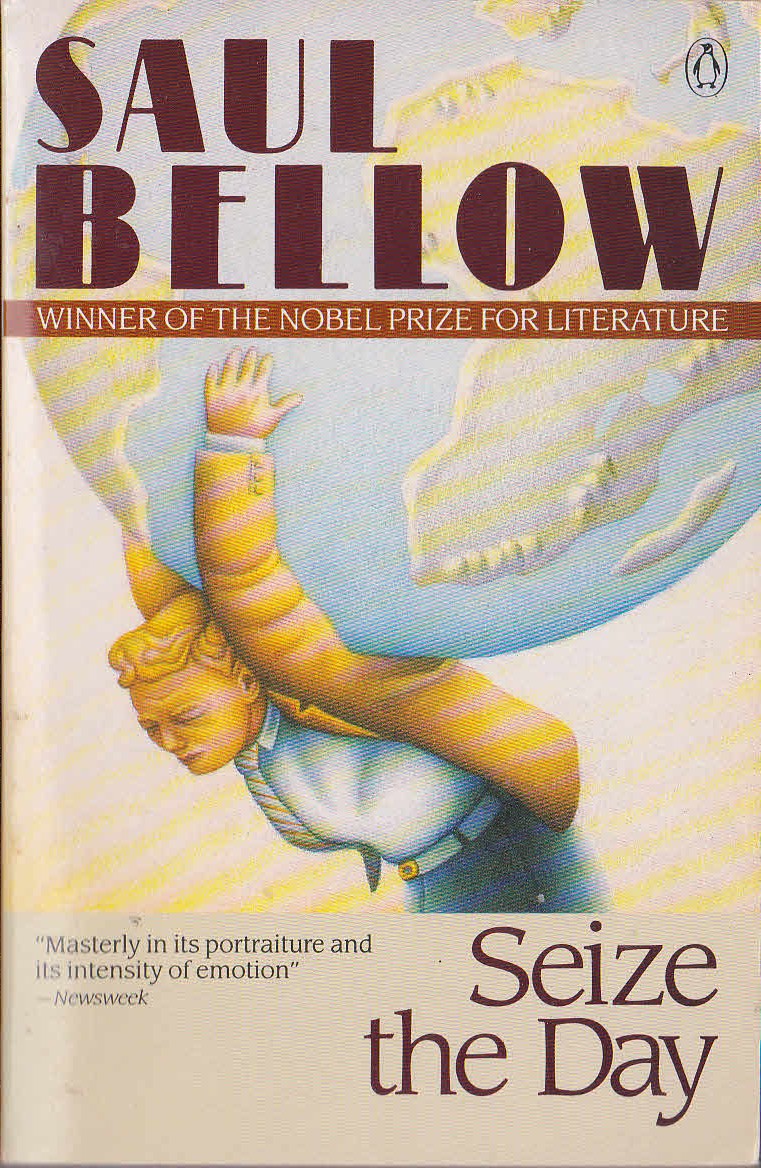
Saul Bellow’s 1956 novella Seize the Day opens with the line: “When it came to concealing his troubles, Tommy Wilhelm was not less capable than the next fellow. So at least he thought …” Thirteen pages later, Bellow circles back: “He was wrong to suppose that he was more capable than the next fellow when it came to concealing his troubles. They were clearly written out upon his face.”
This lack of self-awareness is a recurring theme throughout the book, and what I appreciate about it the most is that Bellow doesn’t assume any malicious intent behind this lack in his characters. Often in today’s world, and maybe especially online, we tend to assume duplicity when a person’s actions don’t align with what we take to be their values or their personality.
It’s much more likely that we’ve gotten stuck in cycles of self-justification that keep incrementally ratcheting up until we’re detached from the person we were at the start. These cycles could be related to an adherence to or reaction against a particular ideology; or even just our having a hard time owning up to the truth of where we’ve landed and the part we played in getting there. It’s frustratingly easy to start on a slippery slope of this kind. We make one concession, and that turns to two, then three, then twenty, and all of a sudden, we’re completely off the map.
 This gradual drift, rather than intentional deception, explains most of what we perceive as hypocrisy or inconsistency in others. Sure, there are “bad actors” out there. However, with each passing year and every new acquaintance, I think more and more that these people, with their purposeful deceptions, are the exception, not the rule.
I’m sure some would say I’m being naive or maybe imputing too much goodwill to people. But I don’t think so, and even if so, so be it. As Thornton Wilder wrote in Theophilus North, “All love is overestimation.” And I’d rather side with love. However, I think there’s a realist’s case to be made for this too, and I think Seize the Day can assist in making it.
For the most part, Tommy Wilhelm, born Wilhelm “Wilky” Adler (he changed his name when he tried to make it in Hollywood as a young man), is not someone most of us would want to emulate. He’s in his mid-forties, and he recently (and rashly) quit his job as a salesman because he didn’t get a promotion he felt he deserved. He’s constantly popping pills to get through his day, more or less estranged from his wife and two sons, and he has a deep disdain for a father he also looks to (on some level) as his savior. At the same time, he’s a character the reader can’t help but root for. As Cynthia Ozick writes in her introduction to the book, “In the large and clumsy Wilhelm there is a large and clumsy shard of goodwill, a privately spoken, half-broken unwillingness to be driven solely by suspicion.” We’re able to have compassion for him because in him we see our own desperate brokenness and skewed goodness reflected back to us.
An example of this can be found in his prayer: “Oh, God, Let me out of my trouble. Let me out of my thoughts, and let me do something better with myself. For all the time I have wasted I am very sorry. Let me out of this clutch and into a different life. For I am all balled up. Have mercy.” Who among us hasn’t prayed or wished something very much like that at some point? The point about being “let out” of his thoughts is particularly telling. The only way to ultimately be “let out” of your thoughts is to die, but that isn’t actually what Wilhelm wants, as there isn’t really any relief in physical death. He’s really asking God to cut the noise in his brain, to change the channel, so to speak, and that requires a shift away from his own narrow internal perspective to a wider external one.
One of the gifts of fiction is that we are more privy to the internal motivations of the characters we read about than we are to the motivations of the people we come across in our day-to-day lives. This is most obvious in third-person omniscient narratives, where the authorial voice can describe to us the character’s thought processes and the subterranean reasons for them. However, even unreliable first-person narrators still frequently end up inadvertently giving us deeper glimpses into their psyches than we ever get from most of the people we regularly interact with. Seeing the world through the eyes of another in this way can help us avoid self-righteousness by getting us out of our own heads and re-adjusting our curved-inwardness outward. Reading Wilhelm’s prayer to escape his own thoughts, we receive something very close to what he’s asking for: the shift to an outside perspective toward something like humility.
Humility reminds us that, unlike God and certain narrators of fiction, we are not omniscient. It shows us that while self-awareness is frequently helpful, it’s not an end in and of itself, because it still resides within us. We need a word from outside to reorient us beyond self-awareness to a deeper awareness. Dr. Tamkin, a kind of guru and foil to Wilhelm in the novella, convinces Wilhelm to use his last $700 to buy shares of lard and winter rye. Tamkin gives a speech to Wilhelm about the difference between the “true soul” and the “pretender soul” that all of us have inside. He says:
Every man realizes that he has to love something or somebody. He feels that he must go outward. ‘If thou canst not love, what art thou?’ Nothing. That’s the answer. Nothing. In the heart of hearts — Nothing! So of course you can’t stand that and want to be Something, and you try. But instead of being this Something, the man puts it over on everybody instead. You can’t be that strict to yourself. You love a little. Like you have a dog or give some money to a charity drive. Now that isn’t love, is it? What is it? Egotism, pure and simple. It’s a way to love the pretender soul. Only vanity is what it is …You are not free. Your own betrayer is inside of you and sells you out … The true soul is the one that pays the price. It suffers and gets sick, and it realizes that the pretender can’t be loved.
Tamkin is grasping at something here, but he can’t quite deliver it. His solution is still self-generated: Identify the pretender, choose the true soul, love outward through effort. I think much of what Tamkin says here is true, or at least adjacent to the truth. We do have to love something or somebody, and that love does have to be directed outward. In his introduction to Dietrich Bonhoeffer’s Spiritual Care, Jay Rochelle names what Tamkin doesn’t quite get: The soul is “that self which is gift and creation of God, not the constructed ego … the person who is named by the Word.” There’s only so much that can come from internal rummaging and self-knowledge. What we really need to hear is the outside word of the forgiveness of sins, which comes
from ‘outside’ to a person in existential doubt and despair, to one who has known the woe of estrangement and the deep, shattering chaos of alienation, that peculiar sense of floating without order or anchor or symbolic handhold in a world which has gone blank of meaning and faintly — if not wholly — hostile of purpose.
A word which “brings new life and future to those who, hearing it aright act on it, live with it, play with it, and stand on it as the grounds for a more meaningful presence in the world.” This is the kind of “self-awareness” that moves the needle. The awareness of sin, desperation, inadequacy, and finitude. The awareness of a need for something outside yourself.
At the end of Seize the Day, upon discovering that Tamkin’s sure thing about the lard and rye has left him busted, Wilhelm chases Tamkin into a church where a funeral’s taking place. He ends up in line to view the body of the deceased. Rather than getting out of line, Wilhelm slowly makes his way to the coffin where he stops and looks down and, upon seeing the dead man, breaks into tears:
Soon he was past words, past reason, coherence. He could not stop. The source of all tears had suddenly sprung open within him, black, deep, and hot, and they were pouring out and convulsed his body, bending his stubborn head, bowing his shoulders, twisting his face, crippling the very hands with which he held the handkerchief … The great knot of ill and grief in his throat swelled upward and he gave in utterly and held his face and wept. He cried with all his heart … The flowers and lights fused ecstatically in Wilhelm’s blind, wet eyes; the heavy sea-like music came up to his ears. It poured into him where he had hidden himself in the center of a crowd by the great and happy oblivion of tears. He heard it and sank deeper than sorrow, through torn sobs and cries toward the consummation of his heart’s ultimate need.
Though Bellow purposefully leaves out exactly what Wilhelm’s “heart’s ultimate need” is, the setting of this in a church opens up the possibility that it is spiritual in nature. What Bellow does show us is Wilhelm’s move through self-awareness to something deeper: the recognition of his desperate need, his finitude, his complete dependence. This awareness of sin and inadequacy is what opens him to grace. His staring in the face of death and finally allowing himself to feel and express his suffering rather than try to stifle it with pills and self-justification leads to a mystical epiphany.
Earlier in the story, Wilhelm’s father asks him what he expects. Wilhelm shouts back, “I expect help!” Up until this final scene, he looks for that help in all the wrong places. But when he finally stumbles upon it in a church, in a broken-down, receptive posture, finally free of his entitlement and misplaced anger, help is exactly what he receives. Not help through self-knowledge or self-improvement but through breaking open to something beyond himself. In surrendering completely, he receives the word of grace he’s needed all along.








Phenomenal. Thank you for writing this.