




Last night, I laid awake, worried over the hem of my mother’s pants. Days earlier, I’d seen it come loose and watched her walk oblivious to the drag of the left leg. That hem — and many more pressing cares — have become my responsibility since our family moved to care for her in her cognitive decline.
If I have learned anything in this time that loops and drags, stutters and stops, it’s that the Alzheimer’s journey is a perpetual Lent. Each day is scarred with the black ash of mortality. Dust to dust, ashes to ashes. I need no reminding of death when my mother forgets the name of my father, dead since 1993. I need no reminding when, at 5 am, she calls me again to ask the time and the date. “Remember that you have a clock by the microwave,” I say groggily. I note it should read morning alongside a brightly lit sun. But I know reminders like these do little good. Even consequential things — like two recent cataract surgeries — go unrecorded or get lost.
My mother’s life is an unraveling, an unspooling, an unwriting. Memory spills and scatters like loose change. She will die — and this is obvious in the most banal ways. At church, when we pass the peace, my mother can’t answer the polite questions of a stranger. “Where do I live, Jen?” she turns to ask me. After the service ends, she wanders off to the bathroom and returns without her coat and purse and Bible, all of which I must find and retrieve. If I’m being most truthful, I can still feel the slight embarrassment of her decline. The blank looks. The social awkwardness. The dragging hem of the pants that I must now remind her to wash. I do not love as God loves.
As I bear witness to my mother’s disease, I realize that Alzheimer’s is a dying by degrees. A Lenten wilderness. A Lenten winnowing. It’s likely true that my mother has had her disease for more than a decade. At first, in cognitive decline, function begins to wear out. Then, skills disappear whole, as if ordinary capacities could be used up entirely. The corners of memory loosen and are lifted — like a web that catches the wind before finally disappearing. There is, for example, a picture my mother routinely takes out of her purse as we sit together in doctors’ offices. “Who is this?” my mother asks, pointing to the twenty-something man at my left shoulder. I date the picture to 1995 in my mind, before the young man’s psychic break. “That’s my brother,” I say. “David,” I add. She looks long at the picture. Then, as if memory has struck a distant chord, it sends back a faint sound. “He committed suicide, didn’t he?” She looks at me plaintively, and I nod, knowing what’s next.
“That’s so sad,” she says.
“It is sad,” I say, as I’ve said many times before.
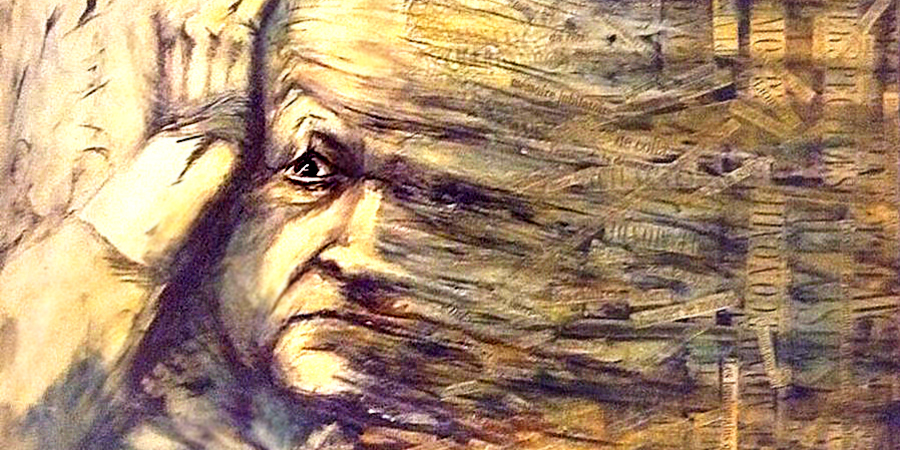
According to Saint Benedict in his sixth-century rule, “The life of a monk ought to be a continuous Lent.” It’s to say that Lent is not the only time in which to persevere. It is to suggest that lament might be more than seasonal heart-cry. This is how I’ve begun to see the striking similarities between the long dying of Lent and the long dying of Alzheimer’s. Both — as seasons of suffering and grief — must simply be endured until Easter.
During Lent, forty days can feel like an eternity when you’re fasting. We aren’t simply mortifying the flesh, as the old saying goes. We’re at the practice for 26.2 miles. It’s demanded that we sustain our attention, that we keep at faithfulness. One thing that dies in Lent (or at least suffers a blow) is human caprice, this ordering of life according to mood. According to Esther De Waal in Seeking God, these are among St. Benedict’s favorite words: steadfastness, endurance, perseverance. St. Benedict imagined a community of Christians outlasting their good humor and sticking with even painful spiritual practice, for a joy set before them.
Longsuffering seems very much to be the mode of my life ever since July of 2022, when our family moved closer to my mother to provide her support. In the language of the Ecclesiastes Teacher, my mother’s disease is a crooked thing not to be made straight. Even when I attempt to problem-solve the daily challenges she faces, I see my efforts thwarted, brought eventually to naught. I’m beginning to see I might be most helped to surrender to the dying and engage, most of all, the practice of compassionate presence. “Do I have Alzheimer’s?” my mother asked a couple of months ago, as we sat together at her kitchen table. “You do,” I said, speaking frankly. We had had this conversation before, each time in exactly the same way. But like a parent with a child, I’ve come to understand what she really means to ask, and I have learned to answer more fully.
“You don’t have to be afraid. We’re here with you.”
I haven’t written much publicly about my mother’s diagnosis. Maybe it’s because I have little critical distance from the story. Maybe because I’m deeply aware that it is not only my story to share. But the members of my local congregation would have been sure to guess the reason for some of my tears as I sat at the back of the darkened sanctuary on the evening of Ash Wednesday. We were singing the words of the old Scottish hymn, Abide with Me, and I was crying softly. It seems the composer, Henry Francis Lyte, composed the hymn while suffering his ill-health and preparing for his death: Abide with me, fast falls the eventide/The darkness deepens; Lord, with me abide! Darkness. Yes, that is Lent, and that is Alzheimer’s. My mother descends into darkness, and the sound of my voice does not call her back.
Lent, of course, is the dark season of 40 days that are meant to prepare Christians to celebrate the most important events of the Christian story: the crucifixion, burial, and resurrection of Jesus of Nazareth. In the seasons of the Christian calendar, the Gospel is dramatized, again and again, bringing us from birth (Advent) to death (Lent) to life again (Easter). Lent, as a season marked out for repentance and renunciation, is a season for naming the disease of sin and our collective need for healing. “There is no health in us,” goes the familiar line from a liturgical prayer, reminding us that sin — like Alzheimer’s — makes impotent any healthy functioning.
Lent intends for us to feel crippling of our hands, the corruption of our hearts, the ways in which only God — by his power and love — can make our lame legs walk and our blind eyes see. The gospel does not improve us: it saves us, rescues us, and effects a wholeness that could never be possible apart from the dramatic acts of salvation played out in the death, resurrection, and ascension of Jesus Christ.
In much the same way, my mother cannot will herself back to physical health. Neither can I, by dint of my own power, hold back the terrible suffering yet ahead. No, like all penitents, we wait on God to act. It is God who will bring her to the swinging door of time. She will leave this world and enter the eternity God has prepared for those who love him and are called according to his purpose. Yes, God’s working a great good for my mother — and she’ll see Easter before I do.
But for now, Lent lasts. And with it, the suffering that produces perseverance. “Everywhere you see suffering being praised, everywhere it is accepted as necessary for us,” wrote the Bishop of Constantinople, John of Chrysostom, when commenting on James 1:2. “For in the world, there is no one who wins a trophy without suffering, who has not strengthened himself with labors and dieting and exercise and vigils and many other things like that. How much more is that true in this battle!” If, in Lent, we “diet” voluntarily in the hopes that sin may die and greater spiritual fruit be born, in life’s suffering, we practice a similar kind of patient expectancy.
One thing I know. If the Lenten journey of Alzheimer’s is darkness, the sun will rise. Morning always comes.








Wonderfully written. My wife Susan was diagnosed with Alzheimer’s Disease three years ago. She is not at your mom’s stage yet. Really appreciated your reference to the Christian calendar with birth, death and to life again.
Thank you, Jen – I read so much to try to help my ongoing grief over my husband’s diagnosis. Your essay was the most helpful over these past months.
I have not yet peacefully integrated the disorientation, hurt, and desperation I descended into watching this most brilliant, articulate, and charming woman that was my mother speak incomprehensible collections of English words into the mirror thinking she was speaking with someone else. I posses the journal in which the English words she had written her whole life in delightfully florid penmanship gave way to the scribbles of a toddler. For both the sufferer and the observing caretaker, the experience is an outrage and an insult.
Thank you. The dust and ashes similes of Lent and life are wonderfully put. I just bought In Good Time and will look forward to hearing more of your journey…which sheds light on ours.
I have a 52 year old niece who is two years into this journey. In an effort to come along side compassionately and effectively, I am seeking articles/books that educate, enlighten and ultimately enable me to be a loving support to her husband, daughters, and mother. If you have suggestions, I would gladly accept them.
Thank you.
Carolyn Alverson – Try “The Second Forgetting,” by Benjamin Mast. Highly recommend. “The 36-Hour Day” is also very popular and has a lot of practical tips.
Thank you! I am the primary caregiver for my mom with Alzheimer’s. She is actually in a Memory Care facility. But I am her earthly advocate. It is hard, exhausting, and I really appreciate your piece. Very helpful
Thank you Jen. My mom is in year 7 of this journey. Your words point me to Jesus, bringing comfort and peace in the midst of a chaotic situation.
Prayers for you and your family this morning,
[…] The Long Lent of Alzheimer’s by Jen Pollock Michel. Seasons of suffering and grief must simply be endured until Easter. […]