




“Friendsgiving” officially became a word in 2020, at least according to Merriam-Webster. For those unfamiliar with the term, it is a meal occurring around the Thanksgiving holiday time where we share a meal with our friends instead of our family. This may happen on Thanksgiving Thursday, as a substitute for a family meal, or may simply function as a pre- or post-Thanksgiving supplement.
I wondered, where did this term come from? Does Friendsgiving have an inspiring origin story? It seems momentum for this “movement” really picked up in 2011, when Bailey’s Irish Cream did a whole advertisement campaign encouraging people to use Bailey’s on Friendsgiving. That same year, Real Housewives of New Jersey also featured an episode in which a main character hosted Friendsgiving instead of attending her family’s Thanksgiving. Apparently — I confess I do not follow the Real Housewives series — the show delved into the subtle and complex emotions that often accompany family gatherings on Thanksgiving.
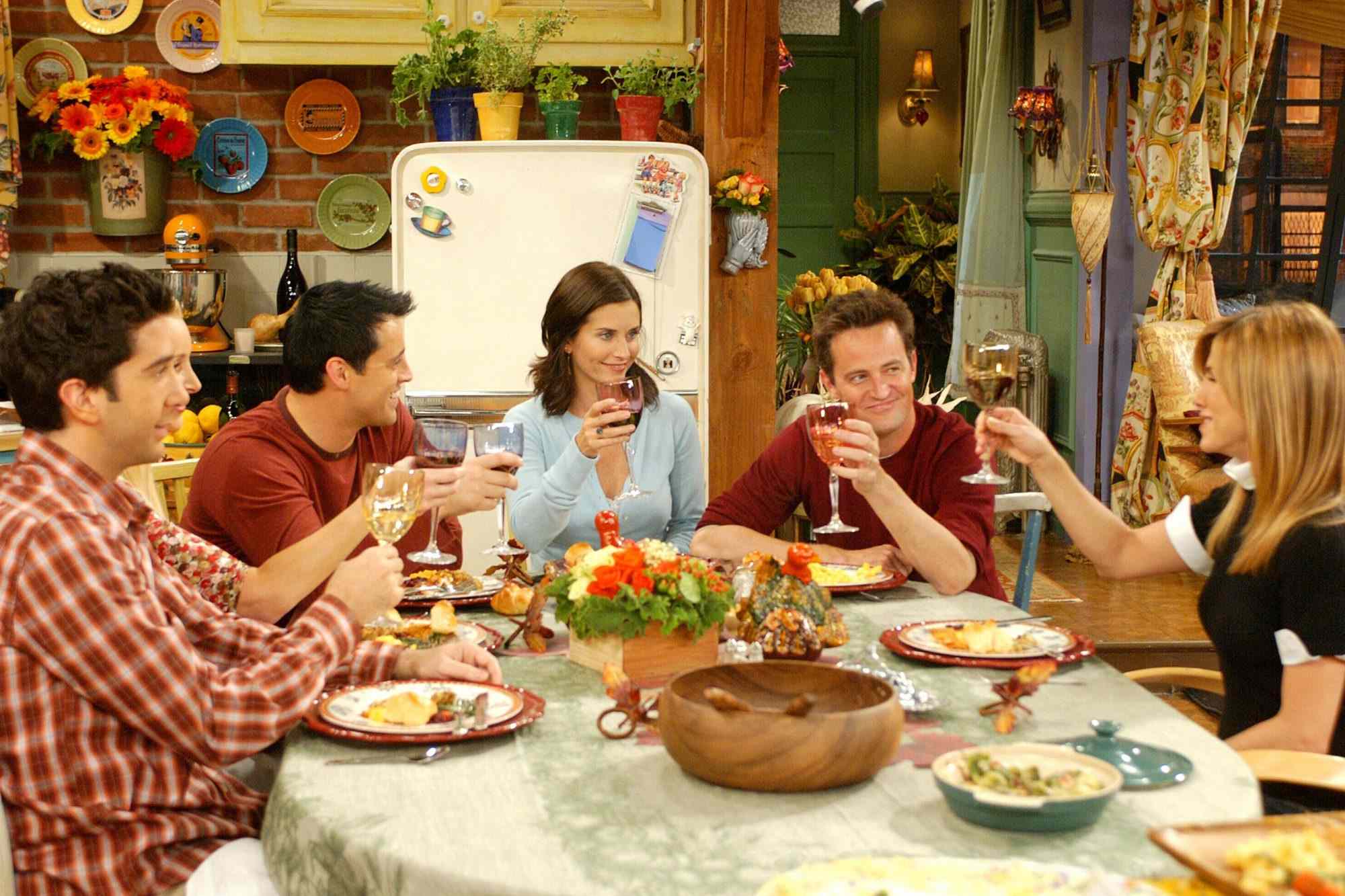
Before claiming 2011 as the year of Friendsgiving, we need to give the twentieth century its due. One might claim that the show Friends popularized the tradition, with its annual episode featuring a Thanksgiving meal shared among friends. Of course, the meal provided the backdrop for the usual set of antics. However, in later years an episode did involve a family member attending. The sister of Rachel, Amy, arrived in town bringing a hot dish of selfishness. The episode moralized: Families are complicated, friends are fun!
We could go back even further to Charlie Brown. In the classic A Charlie Brown Thanksgiving (1973), we meet the hapless Charlie Brown, whom Peppermint Pattie bullies into hosting a Thanksgiving with his friends. This meal ends in mutiny, as Peppermint Patty and others complain about the lack of quality food that Charlie, Linus, Woodstock, and Snoopy have prepared. In this meal, the grandmother must serve as the deus ex machina and rescue Charlie and his friends from a bad meal. One cannot help but wonder if the writers and characters in Friends recalled the Charlie Brown Friendsgiving as inspiration.
However, Charlie Brown may not serve as the first modern Friendsgiving either. The song “Alice’s Restaurant” pays homage to a woman named Alice Brock, the pioneer of Friendsgiving. This countercultural woman who owned restaurants in western Massachusetts would often serve Thanksgiving meals for friends. One of these meals involved a young Arlo Guthrie, who would later celebrate her generous spirit in song. I will give you the joy and opportunity of researching the song, which includes an incident involving trash and a protest against the Vietnam War. Suffice it to say that the original American Friendsgiving likely has its origins in something distinctly countercultural.
Deeper Origins
This quick dive into the past suggests that Friendsgiving arose in the twentieth century from a combination of sociological factors. First, the great social and political conflicts that arose during the Vietnam era made intergenerational family gatherings difficult. It should not come as a surprise that four years after our nation elected Trump, and we once again experienced an era of intense political division, that Merriam-Webster made the decision to deem Friendsgiving a word! Second, as people moved farther away from home for education and career, travel home for Thanksgiving grew increasingly challenging. Planes, Trains and Automobiles could not have been made a generation earlier; so few people would have been experiencing the necessity of such distant travel for Thanksgiving.
Yet I sense the origins of Friendsgiving go even deeper. For Christians, we could say that the first Friendsgiving meal is the last supper of Jesus. This meal takes place during the Jewish holiday of Passover, a meal that often includes many prayers of thanksgiving. Naturally then, during this last supper, Jesus gave thanks. Any church that calls their communion ritual “the Eucharist” essentially calls Holy Communion “thanksgiving,” for the word eucharist means “thanksgiving” in Greek. Almost all Communion rituals still involve explicit prayers of thanksgiving.
But what about friendship? Jesus gave a powerful sermon on friendship before his betrayal (John 15). Some scholars debate when this sermon took place, but the writer, John, clearly wants to put it in the context of Passover and Jesus’ meal with his friends. In this address to his disciples, Jesus distinctly calls them his friends and indicates his friendship will be revealed to them by his willingness to die for them.
What also adds to the Friendsgiving vibe of the last supper is that usually Jewish families would celebrate the Passover together. Yet for this Passover meal, Jesus eats without his family members and, outside of one or two sibling pairs, the rest are not immediate kin. The last supper, then, has a group of friends eating traditional foods on the night of a long-standing family holiday, saying prayers of thanksgiving, and affirming friendship amid life’s darkest moments. That sounds a lot like Friendsgiving!
Found Families
We often imagine family as a well-defined set of relationships that are constant and almost platonic in that they arise out of deep forms in the cosmos. But what if family has never been this neat? The biblical narrative shows family in all shapes and sizes. Outsiders are welcomed in (Ruth) and insiders kicked out (Jacob). Sometimes, there is beautiful redemption (Joseph); other times there are irreconcilable conflicts (Hagar); other times there is shame-induced reunification (Tamar). The Old Testament shows how family is not only a given but also something we create, through marriage, but also through loyalty and love that transcends legal contracts and blood ties. God loves us through biological families; but God also seems all in on found families as well!
Jesus’ own relationship with his family reveals this tension between family as a given and family as a found construct. He clearly loves his mother, yet he grows frustrated with her and leaves home for long stretches of time. Indeed, the family accuses him of bringing shame to their whole family by his actions. At the cross, though, he makes sure his mother has a new son (John). After the resurrection, he reconciles himself to his biological brother (James), who previously was not on board with worshiping his brother. Jesus loves his biological family yet has a mission to bind himself as a brother to all people.
The book of Acts and the letters of Paul serve as a lasting tribute to humanity’s capacity and task to move beyond our biological and even ethnic ties and view the world community as a family. This was a real issue for the early Christian communities, as many of them quickly discovered they had serious divisions across class, ethnicity, and language. Paul consistently writes to these divided people, encouraging them to see how Jesus’ death and resurrection expands the boundaries of family. Indeed, you could say that the letter to the Galatians is written because of a failed Friendsgiving project!
The history of Thanksgiving in our country, and more deeply the biblical story, suggests that every person is going to have a bit of a push away from their biological family and a pull toward found families. As humans, we experience both a deep longing for reconciliation and wholeness within our biological families AND a desire for friendship and fellowship within our found families. I expect it unlikely that November 26 (or whenever Thanksgiving falls in a given year) will mark the day we fully achieve that balance and resolution between the two aspirations.
Perhaps, then, a word of Thanksgiving grace: Let it be a holiday, not judgment day, by whence all relationships are made whole. If you find yourself surrounded by kin, happily passing Grandma’s potatoes, immersed in tradition and love, rejoice and be glad! But if that is not your story this year, that is okay too. As it turns out, there may be a wrong way to cook a turkey, but there isn’t a wrong way to share a meal with people you care about, inside or outside of your family.