




A few conquer by fighting but it is well to remember that more battles are won by submitting. – E. Hubbard
This Thursday, blood pressures will rise across the country, but not only for the high sodium food and excessive alcohol consumption. Thanksgiving has long been a source of stress for families. Whether it’s an empty seat at the table or a seat you wish were empty, it is a time when past hurts resurface, when differences of opinion feel heightened, and when tensions run high. And yet, along with the Tums and Pepto-Bismol, there is a remedy for resentment, an antidote for argument, if you will. It’s called surrender.
Before we jump to the solution, however, let’s first examine the problem more closely. Everybody knows that war is as old as mankind. From Cain and Abel to Joseph and his brothers, family matters have never been settled peacefully. In terms of how the world works, power only ever changes hands by some use of coercion. Status is never acquiesced but rather acquired. This power dynamic is true not only on the battlefield but around the dinner table. Arguments are won and lost. Old wounds are used as evidence to build cases for both the prosecution and defense. Most family gatherings involve some kind of hierarchy. And power is hardly ever handed over freely; it is either lost in defeat or seized.
And yet, as the dust settles after a battle, is there truly ever peace? Is the losing party ever truly humbled, or are they simply humiliated? Is the victor ever truly satisfied with their spoils? In the aftermath of the Battle Waterloo, the Duke of Wellington stated that “nothing except a battle lost can be half so melancholy as a battle won.” His point was that victory can be as equally sad as defeat due to the immense cost in human lives. The old adage often rings true: nobody wins in war.
So it goes with the American family. Battles may come and go with each passing holiday, but wars — between parents and children, husbands and wives, brothers and sisters — can last a lifetime. Past resentments and disappointments that simmer may not rise to a boil at every gathering, yet they remain radioactively potent. Every family has their own battle lines, both active and dormant. The son-in-law who carries himself with a touch of better-than-everyone-else elitism. The grandmother who bears a grudge against her son for that divorce. The sister who tries to desperately to mitigate any unpleasantness with forced cheer. Or the father whom no one can ever please, no matter how hard they try to mollify his whims.
Minor issues may get resolved here and there, but potential uprisings are often just beneath the surface each year. No matter who comes out on top as the winner, the cost is high. So how on earth can there ever be lasting peace?

The first step is refusing to engage in warfare altogether. This is what Tom Nichols was asserting a few years ago in his piece in the Atlantic encouraging his readers, just for one day, to simply disengage. We are constantly being told that our country’s dysfunction is due to the higher powers of our broken world, that our lives would be infinitely better if other people were in office. Likewise, we believe our family would be that much happier if not for our father/mother/sister/brother. Rather than stage a coup, Nichols tells us to not engage and, instead, to let it go:
Instead of trying to straighten out your uncle about rigged voting machines, be cheerful and ask Uncle Ragey if he’d like more pie. Rather than arguing with your insufferable cousin who’s home from college about why Thanksgiving is a racist and genocidal festival, ask Cousin Akshully to help with the dishes and then tell her a story about her family or ask her what dorm food is like these days.
In other words, lay down your arms. Beat your swords into serving spoons and your spears into salad tongs. With God as our arbitrator, we can leave the seat of judgment open on Thanksgiving. With him as our defender, we need not defend ourselves or our causes.
If it is victory you want, then fight all you want. Fight to the death if you must (and you likely will have to). But victory and peace are not the same thing. If it is truly peace that you are after, then you will go one step further than simply refusing to engage. You will surrender. Not only will you not fight, but, rather, you will forfeit. Ninety-seven percent of the time, if you want peace between you and another warring party, the path to peace is surrender.
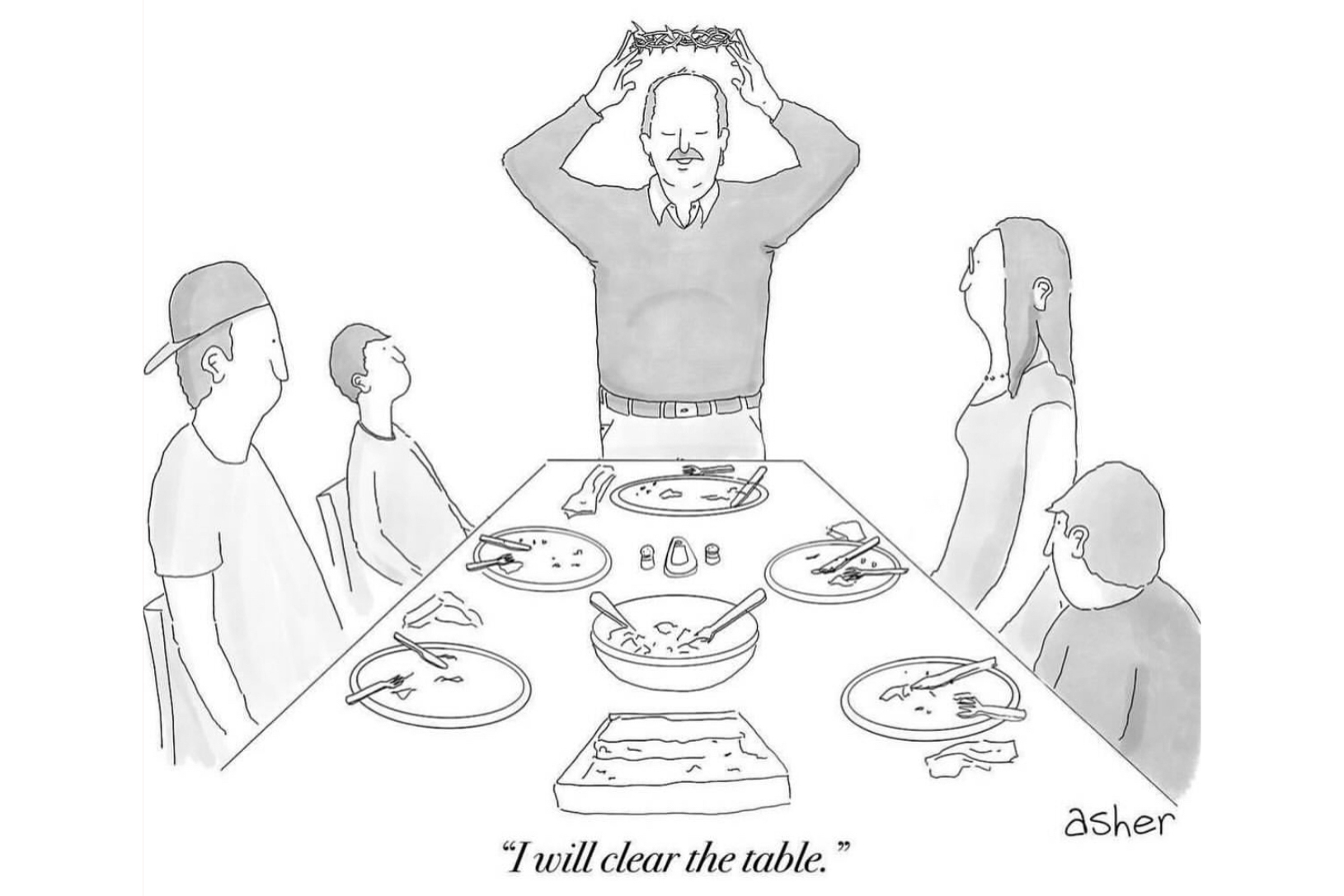
What does it mean to surrender? What does it actually look like to wave the white flag in a relationship? It could look like a number of different things. Surrendering could mean apologizing wholeheartedly. To admit defeat without any explanations or disclaimers. Surrendering could also mean not defending yourself, to take the hit without so much as lifting a finger to protect yourself. Surrendering could also look like a (perhaps unspoken) unconditional forgiveness. If confession is surrendering one’s own sin, forgiveness is surrendering one’s demand for justice. Peace is most fully established when both sides somehow wave the white flag.
Easier said than done? You bet! We are so well trained in the art of self-defense that it is purely a miracle if we ever choose to surrender against a warring party. Which is why our hope is built on nothing less than Jesus who surrendered himself for our sake. He did not desire victory over mankind but rather peace. When God and man were warring against each other — one fighting with righteousness and Law, the other with sin and pride — Jesus saw that the path to peace was surrender. He could have argued with us or explained to us how we were “going about it the wrong way.” But he didn’t. Rather than fight to the death, he gave it all up. He cried “Uncle!” and surrendered himself to our warring madness and thirst for blood. Doing so, however, put an end to the familial strife between God and his children. Because Jesus surrendered all, we are now at peace with God.
As we gather together on Thursday, may God give us the grace to take our napkins in hand and wave the white flag for the sake of peace. Our blood pressure will thank us.








For those who come from families where severe abuse occurred, the way of surrender is to flee proximity to the family that continues its habits of abuse. That’s what giving up the fight looks like for those people, that is the way of peace and forgiveness.
Perfect! This confirms what I believe was God’s wisdom in dealing with this very situation? Grateful to Him for speaking truth through His Words and you!