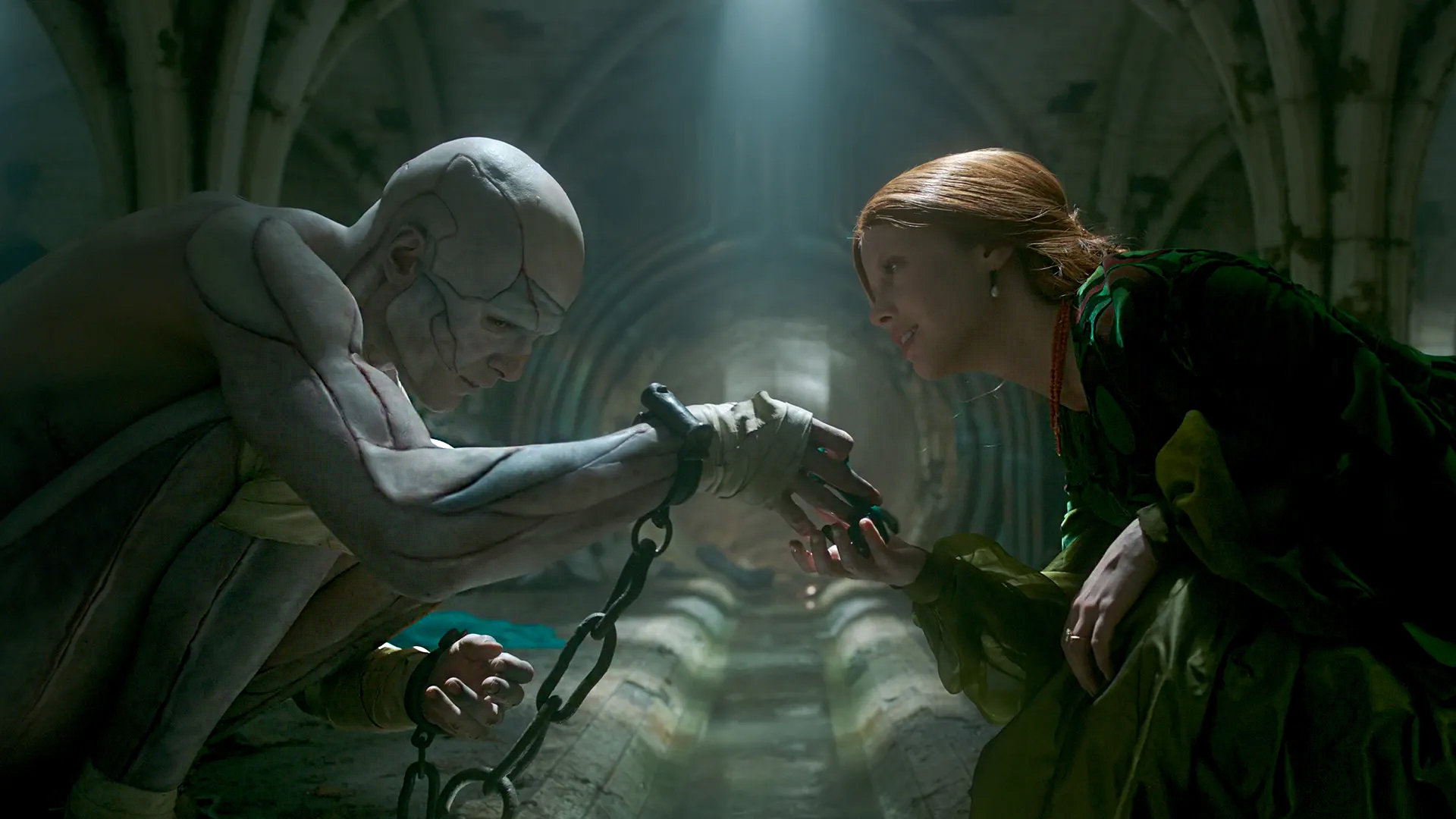
“I never considered what would come after creation,” Victor Frankenstein laments halfway through Guillermo del Toro’s lush and passionate adaptation of Mary Shelley’s Frankenstein.
As it turned out, neither did I. When the time came for me to create life (i.e., have children), I was as arrogant and clueless as the good Baron of Penguin Classics lore.
In del Toro’s hands, Mary Shelley’s renowned tale of “man playing God” turns into something more relatable, if not profound. His Victor Frankenstein (Oscar Isaac, giving off a lot of tech-bro heat) is a man driven to create a human being he can shape into an ideal companion, a misguided project that does not end well, unraveling in a way that many parents should find familiar.
I wonder how many prospective parents realize that Frankenstein is also their story. That in deciding to bring life into this world, fierce rebellion and permanent estrangement are things to expect when you’re expecting.
Because if Frankenstein is about anything, it is certainly about the enormous risks inherent in life-creating endeavors.
Making Friends
We currently have a front-row seat to one such endeavor in the race to develop self-aware artificial intelligence (AI). Specifically, systems that can, in the words of Demis Hassabis, the founder and CEO of Google’s AI effort, DeepMind, “understand you, themselves, and others.”
The goal is for AI to be “agentic,” which IBM describes as exhibiting “autonomy, goal-driven behavior, and adaptability.” In other words, for AI to reach its full potential, it must bear the image of its creator. Its algorithms must operate more and more like human minds, with self-awareness and autonomy. Our tech mandarins are not looking to create passive tools but active partners — and maybe more, as the proliferation of so-called “companion AI” chatbots would indicate.
Is the quest to create life in our image ultimately a quest for companionship? We want to be surrounded by others who are bound to us, not by obligation, force, or programming but by choice. We crave the approving gaze of another like us freely offered. And we believe there is a better chance of achieving that goal with beings of our own creation.
Del Toro’s Frankenstein certainly leans toward companionship as the reason for creating life. Despite Victor’s assertions that his quest to “bestow animation upon lifeless matter,” as he puts it, is purely scientific, the script situates the young doctor’s Promethean work in the context of grief over the loss of his mother. The film portrays Victor’s ensuing journey as a disastrous quest to find a replacement, first in the company of his brother’s wife and then with a creature made in his image.
But with autonomy and self-awareness comes the risk of rebellion. And not surprisingly, things take a dark turn when the Creature (Jacob Elordi in a most soulful performance) proves unable, and eventually unwilling, to fulfill Victor’s expectations and align with his values. The creator, in turn, comes to regret having made a man in his image and attempts to rectify the mistake by bringing down an entire building on his handiwork.
And it was during this moment, watching the unhinged fury in Victor’s eyes as he went about setting the building ablaze, that I felt the hairs in the back of my neck stand at attention. For I now saw Victor Frankenstein for what he really was: a parent — not a very good one, perhaps, but a parent nonetheless. As an imperfect parenting specimen myself, I recognized some of the animating emotions behind Victor’s rampage: the sting of rejection, the dismay at unmet expectations, and the anger at the seeming indifference of our creations toward both.
Because that is the way things go with the free-thinking autonomous beings we create. From the moment they draw their first breath, we cannot help but think of them as belonging to us, immediately setting up unspoken expectations.
In our mind’s eye, we cannot help but catch glimpses of imagined futures. We see our children at school, at work, with their future spouses and children (to which we can also lay claim, seeing as they would be our grandchildren). And perhaps more significantly, we see ourselves in the picture because far above all other expectations is the expectation that we will be in relationship with our creation throughout.
And all the while, the possibility that our creatures may imagine markedly different futures for themselves — even futures where we are not in the picture — remains an abstraction. Until it isn’t.
Moreover, attempts to forcibly curtail the autonomy of such creatures to shape them into ideal companions, fully aligned with our values, often prove ruinous. Because, to borrow from Ian Malcolm (Jeff Goldblum) in that other story of creatures turning on their creators, Jurassic Park: autonomy, like life, finds a way.
If at First You Don’t Succeed
When they were about ten, one of my kids made asked me about the creation story in the Christian Bible. They were sincerely puzzled as to why the creator in the story would willingly make beings he knew would rebel against him. A few years later, in Alex Garland’s 2014 icy science-fiction thriller, Ex Machina, a sentient android named Ava (Alicia Vikander) would pose a similar question about her creator, narcissistic tech developer Nathan Bateman (Oscar Isaac, again).
“Isn’t it strange to create something that hates you?” is how Ava put her question.
My child was, of course, referring to the creation story in the first book of the Bible, Genesis. Its first chapter describes the methodical process by which Christianity’s God created everything we know, culminating with humans “in his own image” at the end of the chapter. All of it done in a manner that, according to some, reveals a creator who places a high value on order and control.
However, as the story goes, by the end of the third chapter, the humans had already turned on their maker, refusing to align with his values. By the sixth chapter, things had gotten so bad that the creator came to regret his creation. And by the end of the seventh, God rectifies the mistake by sweeping his handiwork off the board with a cataclysmic flood.
Except that, even at the moment of most profound regret, God cannot bring himself to part with his creatures completely. He famously spares one human family and a handful of animals. And in an even more remarkable turn, God vows to the survivors that he will never again destroy his creation, regardless of how rebellious his creatures become in the future. He vows to stick with Humanity v1.0 even though the inclination of their hearts remains “evil from childhood” (Gen 8:21).
When I consider all the chaos and suffering humans have unleashed on his meticulously appointed world, I wonder if perhaps there is something that the Christian God values more than order when it comes to his creation, something that could explain why he continues to put up with creatures that hate him — and why the humans he made in his image insist on creating new life despite the risks.
In his 1942 collection of BBC radio talks The Case for Christianity, renowned author and Christian apologist C. S. Lewis hazarded a guess as to what may have been going through God’s mind when he made man: “If God thinks this state of war in the universe a price worth paying for free will — that is, for making a real world in which creatures can do real good or harm and something of real importance can happen, instead of a toy world which only moves when He pulls the strings — then we may take it it is worth paying.”
If Lewis is correct, then it would appear that the Christian God, like our modern AI Prometheuses, was also not interested in creating passive tools. Instead, when it comes to his creatures, God seemed to value autonomy far and above order. Indeed, God appears to hold the autonomy of his creatures in such high regard that he is routinely loath to infringe upon it, even when it leads to chaos and ruin.
From Genesis to Revelation, the picture of God that emerges is that of a creator who gives his rebellious creatures a long leash. He describes himself as “slow to anger” (or “long-suffering,” as older translations put it), often to the dismay of his worshippers, like the prophet Jonah, who grew notoriously angry with God when he refused to destroy the unruly denizens of Nineveh, giving them a second chance instead. Or the author of Psalm 82, who, like many of his colleagues, wonders how long God will “defend the unjust and show partiality to the wicked?”
And then there were all the religious leaders hounding Jesus Christ during his time on earth for being someone who “welcomes sinners and eats with them” (Lk 15:2).
Taking it all in, is it really any wonder we are fascinated with creating life and with stories about creatures turning on their creators? Could it be that all of these tales from Frankenstein to Ex Machina (not to mention The Golem; 2001: A Space Odyssey; Westworld; WarGames; The Terminator; I, Robot; Splice; and Poor Things, to name a few in the cinematic canon alone) are attempts at understanding our own origin story, because deep down we suspect it is not just a story? And if the story is true, does that make us the original Frankenstein’s creature, gifted not only with life but with autonomy — even enough autonomy to turn on our creator?
When I look back on my early years as a parent, I see a young man with a creator’s ego the size of Victor Frankenstein’s. I was convinced that, aided by the latest parenting philosophy fad, I could shape the creatures under my charge to be ideal companions who would never rebel in any meaningful, life-altering way. I would succeed where others had failed and ensure that my family would avoid the fate of so many others permanently scarred by estrangement and dysfunction.
My confidence was bolstered by a parenting advice–industrial complex that was in full swing at the time. The marketplace of ideas (not to mention the actual marketplace) was abuzz with competing philosophies promising some measure of control over the chaos resulting from the creation of life: attachment, helicopter, free range, tiger, and authoritative (not to be confused with the classic authoritarian model, which was also in the mix). Meanwhile, bookshelves groaned under the weight of tomes that held within their pages the secrets to parenting from the inside out, bringing up boys, or shepherding a child’s heart.
If I had to do it over again, Groundhog Day–style, I would seek out less advice on how to control, shape, or shepherd offspring and more advice on how to be long-suffering and patient with creatures capable of turning their backs on me.
Because what I now understand is that every act of bringing life into the world is essentially a wager, a bet, a humbling exercise in glorious and frightening uncertainty worthy of Schrödinger. After all, no parent purports to raise the next schoolyard bully, serial killer, or genocidal dictator, and yet history shows those outcomes have occurred again and again despite the best of intentions. Talk of control, then, whether about raising a particular kind of human or putting guardrails on machines that one day will be more intelligent than us, is aspirational at best.
In the end, maybe the reason humans continue to pursue the creation of life in their image, despite the risks and whether in the womb or the lab, is that we have too much of our father in us. The question is whether we have enough of him in us to respect the unalienable autonomy of the beings we create. And whether we have enough of him in us to patiently work toward, and hope for, reconciliation when these creatures choose to reject us.
After all, if autonomy can find a way, then perhaps so can grace.