




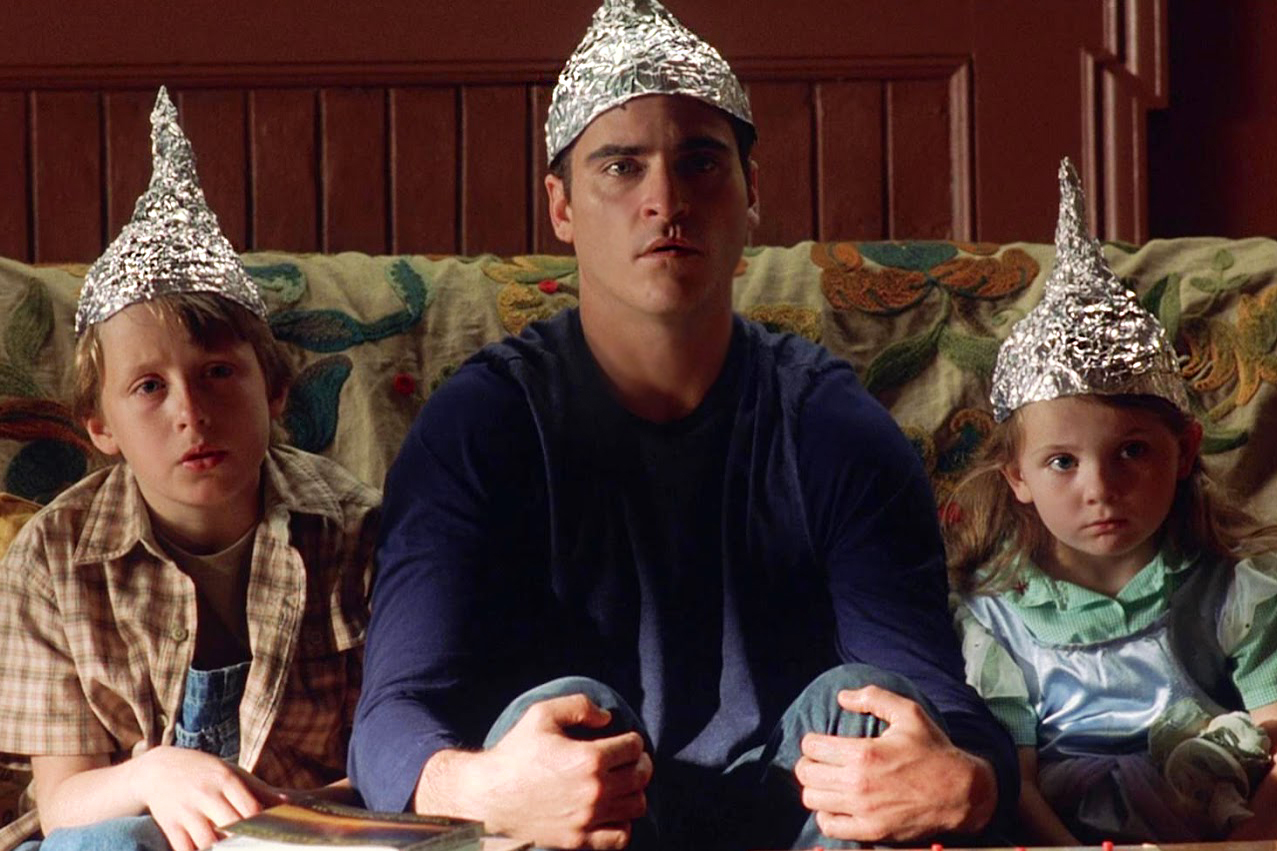
Welcome back, dear friends, to Mockingbird’s Spooky Summer series! In this, our last installment, we will discuss M. Night Shyamalan’s 2002 film — possibly his greatest — Signs. Ostensibly about an alien invasion, Signs examines the signs of God’s providence and shows how we can push those signs away, but at some point we have to reckon with the reality that is battering down our door.
So come on over, have a seat in this imprint in the corn … Huh. That’s a funny shape! Well, I’m sure it’s nothing. But, uh … just in case … would you mind putting this tinfoil hat on? Perfect! Now just grab a glass of water (or twenty) and join us as we press play!
Ian: Caleb, what led you to pick Signs?
Caleb: It’s an all-American summer setting. An erstwhile pastor’s home in a small town with swing sets, baseball bats, and cornfields? It’s the platonic ideal of summer.
But besides the summer connotations, Signs has one of the most unnerving scores I’ve ever heard. James Newton Howard really outdid himself. And it’s still one of the scariest movies I’ve ever seen!
Blake: It made me realize one of my fears, which is looking out a window or door and seeing something or someone there which isn’t supposed to be there.
Caleb: A terrific decision from Shyamalan to give us only glimpses of the threat through silhouettes, reflections, and blurred videotape.
I also caught a detail in this I never noticed before. Toward the end, when Merrill is listening to the radio in the basement, he mentions a theory that they were not there to invade earth but rather to pillage humans from it. To me, that solves a lot of the plot holes around why they would invade a planet covered in “toxic” water.
Ian: For me, once I discovered the death drive, my objections about invading a watery world dried up.
Caleb: Tell me more about that.
Ian: The death drive is Freud’s rediscovery of Paul’s grenade in Romans 7 that we are internally divided and alienated from our own selves and thus undermine our own self-interest, sabotaging our efforts to accomplish what we tell others and ourselves we are interested in.
Since this is a fallen cosmos, I take it as a given that any putative aliens would share in such a split subjectivity as we do, differences notwithstanding, and so would do things that, to outside eyes, are not only stupid but manifestly stupid. Basically, crackhead lack of self-awareness is the norm for speaking beings.
Caleb: I like that insight. And at the end of the day, even if we cannot fully psychoanalyze something so foreign, the idea of a malevolent other still works theologically.
Here is an anti-god. It’s a “bad miracle” to tap into our other alien movie this summer: NOPE. It doesn’t come to commune but to destroy. It spews poison gas but is vulnerable to cleansing and life-giving water. I guess I’m saying that baptism kills it.
Ian: This guy gets it.
Caleb: But then, we have that in common with the aliens.
Ian: That’s right! … If they’re aliens. I’m not sure it’s crucial thematically, but I do wonder if the “aliens” are in fact fallen powers and principalities. *cough* Just like in the real world.
Caleb: I am also obsessed with how “Father” Graham (“Don’t call me that!”) has to listen to so many confessions in this. It starts with the pharmacy clerk, Tracey Abernathy, and her guilty conscience over mundane cussing (which invokes laughter in us) and leads to Dr. Reddy’s heartsick and hell-dreading apology for accidentally killing Graham’s wife by falling asleep at the wheel one night (which invokes tears).
And, although Graham resists listening to all of it, it’s all a part of his healing journey. He gets more and more emotional as he listens to the soul-baring of the people around him, which, in turn, allows him to weep and pray later.
Ian: Absolutely! I think it shows how we don’t get better by avoiding confession, ours or others. We are healed in our sharing one another’s hurt.
Caleb: Morgan and Graham actually both have a moment when they tearfully turn to their Father, who they perceive as not listening to them, and tell them they hate him. But in this, they’re both praying — Morgan at the dinner table, and Graham when Morgan has an asthma attack in the basement without his inhaler. It’s reminiscent of Job or Psalm 88, where God is accused by his people; almost slandered even, but he listens because they are praying to him.
Ian: Yes — Graham is praying at last! To actually address the One you feel and fear is hurting you is to close some of the distance. And on the other side of it, you see that that One was drawing near and drawing forth words out of your depths. That is the turning point of this film.
Ian: Morgan’s address to Graham prompts Graham’s embittered “I will not waste another second praying,” but, it seems to me, also unlocks him to utter his address to God a little later.
Caleb: Thematically speaking, this reminds me of a very different movie, Tokyo Godfathers (2003) which is an animated film about three homeless people in Tokyo finding a baby on Christmas and their journey to reunite her with her parents. Both are stories about the wild, merciful providence of God in unfathomable situations.
Blaine: Caleb! Tokyo Godfathers is a Christmas tradition in my house!
Blake: A couple of things really stood out this time than they had in other viewings. First, we view the yard from an old piece of glass that is warped and distorts the perspective. After the invasion, the window is broken, but the view is piercingly clear. The distortion is shattered, and we are able to see clearly through the lens of suffering, difficulty, and conflict.
Ian: Yo…
Blake: Second, there’s a scene about midway in the movie, a tracking shot from above as the family goes into town to “keep their mind on everyday things,” and if you notice, the tracking shows the shapes present in a bird’s eye view of the town they live near. Each of these shapes, like the crop circles, are signs of the past, the history of development, the history of settlement of people, the history of a community, and similarly a map or navigation layout. That side-by-side is very compelling to me.
Ian: We’ve talked a bit about some specific fears Signs touches on. What is the most frightening thing about this movie for y’all?
Blake: Very few things about this movie DON’T raise up goose pimples. Cornfields, electronic transmissions from elsewhere, things outside doors and windows, and on and on.
Ian: All the Blake Collier classics, right? What about you, Caleb and Blaine? The scariest thing for me is how the footage on the news reminds me of watching shows like Sightings and Encounters when I was much younger and being terrified of alien abduction recreations.
Caleb: I have a distinct memory of watching this movie with my mom in the theater, and she was so terrified she grasped my hand a couple times. My mom being just as scared as me was terrifying! The idea that parents or authority figures are also vulnerable and don’t have all the answers, which is a lot of what Signs is about, shook me to the core.
Blaine: What scares me the most is when it seems like the weight of the happenings (hehe!) are going to cause the family to come apart at the seams. The dinner scene, in particular, is always hard for me to watch. Gibson’s performance captures a pent up sense of guilt, rage, fear, and pain so well. But I also really don’t like it when that tall fella is on the roof.
Ian: Man, I feel that. The creatures pull the veil back, and the rift that opens when we do not love God is exposed.
Blake: I’m curious, what do you guys see here? Luck or a miracle? I take this from the movie in part because I really like that scene between the brothers, but also because if it is a miracle (which I think we would all agree it is), it is a crazy miracle that takes the family through hell and back (if you read the aliens as demons), or at least through a prism of suffering and grief (if they are simply just invading aliens). The grief-strewn miracle is something that has always captured my imagination. It’s something that Walker Percy and Flannery O’Connor were notorious for putting in their stories, and it shows up here as well.
Ian: This is my favorite thing about Signs: nothing was an accident. “Luck” is the way we distance ourselves from the signs of God’s superintendence of all things. It takes faith of a different sort to insist these things were not meaningfully connected by another agent outside the visible scope of what is taking place. Everything is potentially a sign when a wild but good God is at work.
Blake: This film really is a Calvinist wet dream.
Blaine: There’s a title for the piece…
Ian: You know, Blake, I think that joke clarifies for me that Signs is a type of unwelcome good news. Because I think it’s very unpopular right now to say that good can come from suffering. Which is distinct from saying suffering is good. But to a certain way of seeing the world and the self, that sounds like the same thing.
I think that there is so much cultural incentive for victimhood and creating victimhood out of nothing. And, smaller than that, just pretending that the bad things we’ve experienced are the truest and most interesting things about us makes this theme in Signs a powder keg for our warped views of ourselves and our world.
But that is the testimony of this film! Shyamalan is so strange, because when he doesn’t overthink what he’s doing, he delivers profoundly. The transformation of the signs of the title seeming to be the signs of imminent alien invasion but recognized retroactively as the signs of God’s superintendence is skillful, and he’s most skilled when he isn’t preoccupied with how to be a good writer and director.
Blake: Yep!
Ian: So what I love in this movie is that we vicariously experience the sheer exhilaration of finally recognizing how all the parts relate to one another, culminating in that immortal line, “Swing away.” Man. It’s incredible! Even Merrill’s failure is a thread in this fabric, and it is redeemed to rip evil a new one. This is where abstract questions of theodicy give way to “Lord, what would you have me do now?” The luxury of abstraction collapses in the face of the recognition that I am not forsaken or left only to my own resources. And it’s beautiful!
Blake: Theodicy … is that the new Nolan film?
Ian: *rolls eyes* Any parting thoughts on Signs, boys?
Caleb: Don’t you mean any … SIGNoffs?
Ian: Hey! I make the puns here!
Blake: This movie pretty much details all the signs of the times.
Caleb: I think I’d tell readers to … SEE … and maybe even to … SWING AWAY.
Ian: You son of a gun, Caleb. That’s good! I guess I would urge you, dear reader, to remember that this movie is your life projected onto a screen, so you can take courage, here and now, where you are.
Thank you so very, very much, friends, for joining us in this Spooky Summer series! We are grateful for your companionship, and we hope you had even a fraction of the fun that we did. We also hope your perspective on things has graciously enlarged and that the gospel’s applicability has shone all the more brilliantly through the chilling explorations these movies have provoked.
Fear not, friends! It can’t stay hot forever. Enjoy it while it’s here, but we can already hear autumn breezes whispering around the corner, so until the next series: graves and pieces, fiends!







Haven’t read the piece yet but immediately had to drop a comment to let y’all know how excited I am that you’re covering Signs this week — one of my favorite movies of all time & (imo), *the* great late-summer American movie! Can’t wait to sit down with this when I have the time to savor it & see what your perspectives are.
Wow! We’re excited to hear what you think once you have the chance! What a gift is Signs—savor it!