




2025 has been the year of the Golden Age film in my house. As I previously wrote for Mockingbird, I have been devouring the cinema of 1930–1960 with relish, rejoicing at the adventures and misadventures of Bette Davis, Humphrey Bogart, James Stewart, and Barbara Stanwyck. I have seen films of solid gold that give the age its name, and a few duds from which even online reviews could not spare me.
One that has stood out in a good way is 12 Angry Men. It is the only film produced by legendary actor Henry Fonda and delighted critics in its own day. Sadly, it did not perform well at the box office despite stellar performances, an exceptional script, and clever direction from Sidney Lumet. It has been up to later generations to recognize this film for the masterwork it is, partly because so many of us were made to watch it at some point as an introduction to the justice system.
The plot of 12 Angry Men is simple, and thus it managed not only the initial transition from stage to screen, but also numerous recreations in both mediums, often with slight details altered to reflect changes in American society. The story revolves around an all-male jury (the angry men of the title) that must decide the fate of a teenager accused of murdering his father. They are cloistered in a deliberation room on a hot summer afternoon and cannot leave until reaching a unanimous verdict.
At the initial tally, the jurors all vote “guilty” … except Juror #8, played by Fonda. He insists that a matter as serious as sending a young man to his execution requires some deliberation. The other jurors balk at the suggestion, for they believe the evidence is decisive and therefore see no reason for delay. But over the next two hours, as they systematically examine every testimony and piece of evidence, more of them begin to doubt the young man’s guilt.

The deliberations expose the men’s prejudices. Some assume the accused is a criminal because of the neighborhood in which he grew up, while others accuse their fellow jurors of racism. Some have full faith in the police, some put little stock in eyewitness testimony, one will vote in either direction just to make his baseball game, and one has a very personal reason for wanting the young man to suffer. The more time they spend in that hot room, the more tempers flare.
As I watched this film, I could not help but think of my own experience as a juror. While living in Arlington, Virginia, I was selected to serve on a case involving felony car theft. Some aspects of that experience were totally unlike the film: all-male juries are virtually impossible now, no one is allowed to visit the crime scene themselves, and air conditioning is now standard in government buildings. But as in the film, our jury consisted of people from different income levels, personal backgrounds, age brackets, and political leanings.
The trial itself only took two or three hours. We deliberated for much longer, even returning for a second day of discussion. Like the men in the film, we did a better job analyzing the case than the lawyers did. We were able through extended deliberation to identify a key moment in one of the testimonies that created a reasonable doubt. But as in the film, our personal biases came into play. A key witness was the police officer who pursued the stolen vehicle. Some jurors instinctively trusted police testimony, while others instinctively doubted it.
As in the film, the needs of our human bodies affected us as we longed for a meal, some fresh air, and a chance to simply be alone. None of us had asked to spend so much time locked up with strangers we would never have known otherwise. Yet, the last words we heard before entering that room were, “Look upon the accused and hearken to his cause.” If we were to find him guilty, it would not only mean time behind bars. It could affect his ability to vote or get a job for the rest of his life. To have a man’s fate in your hands is an awesome responsibility, and we all felt it.
Reflecting on the film and my own experience as a juror, I am struck by how many of the underlying divides in American society remain the same. The 1957 film considered issues of race, immigration, and law enforcement: all hot-button issues in recent years. But what is also similar is the fact that in virtually no other part of American life would people from such diverse backgrounds be forced to spend a few hours sitting together and talking.
The closest many of us get to sitting and talking with strangers these days is posting on social media, and if there is anything which the explosion of that medium has taught us, it is that having more exposure to one another’s opinions does not necessarily lead to greater understanding and compassion. Instead, it tends to reveal and enhance our anger.
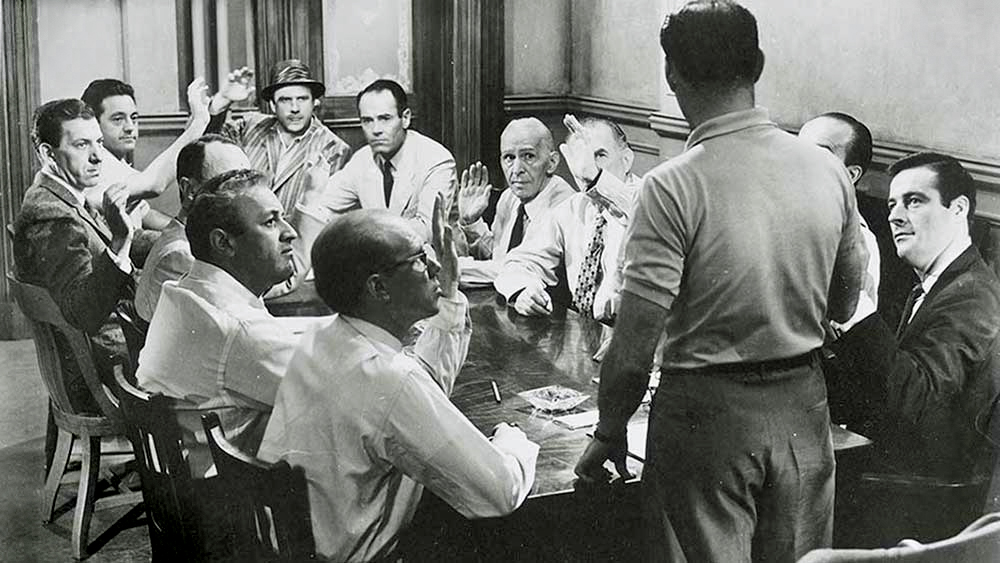
Here I come to a crucial point, for what strikes me most about this film is its title: 12 Angry Men. For if there is anything we have been hearing for the past few years, it is that American men are angry. Of course, anger always has a source, and thus we also hear about the male loneliness epidemic, the decline of traditional manufacturing jobs, the increasingly female population on college campuses, et cetera. We have seen the rise of gurus of masculinity: Jordan Peterson, Joe Rogan, Andrew Tate, and even Bishop Robert Barron are cited as highly varied examples.
Few statistics are more striking in this regard than the results of the 2024 U.S. presidential election, which saw a twelve-point divide between male and female voting patterns. Political candidates, always prone to casting their opponents as the devil incarnate, have increasingly chosen to frame things in terms of gender, i.e., “If my opponent wins, it will be very bad for women,” or “If we don’t vote the right way, men will be set back even further.” The point is not truly who is on which side, but simply that the interests of men and women are perceived so differently, as if life were a zero-sum game, where the flourishing of one gender causes the destruction of the other.
As a woman, I do sense more anger directed at me now than I did a decade ago, but to focus on that would, I believe, be to miss the bigger point. For I do not believe this is simply a men vs. women problem. I believe we are seeing the effects of a world that is shifting away from historic social patterns to new ones geared toward the digital age. This has resulted in a diminishment of community for everyone, but in some ways, women have adapted to it better than their male counterparts.
We have quite simply lost the art of what those twelve men in the film were attempting to do. We no longer understand how to sit down at a table with people vastly unlike ourselves and debate matters of importance in a reasonable manner. Granted, this has never been an area in which human beings excel — even the men in the film had to be forced into such a situation — but the irony now is that while we may not be physically cloistered in a hot room, we are mentally and emotionally cloistered. We have tools at our disposal to avoid contact with anyone who holds unacceptable views. Rather than cultivating patience, grace, and longsuffering in our lives, we hit “mute” or “block.” We cancel, go silent, and ghost.
We want the people we work with, the people we worship with, and certainly the people we date to be in line with us ideologically. Again, this is not a new tendency, but humans have never had such a vast ability to curate their interactions. As we cease to know one another, our ability to have compassion on each other diminishes, so the few interactions we do have are increasingly caustic. We give up on working together to solve problems and attempt to make all the decisions ourselves.
Throughout the film 12 Angry Men, the characters do not refer to each other by name: only by number. It is a sign of their differences — their lack of intimacy. But in the film’s final scene, as they at last depart the courthouse, two of the jurors reveal their names to each other. This seemingly insignificant moment reveals they have moved beyond mere acquaintance to something like friendship.
More Americans than ever live alone. We have fewer friendships than we once did. I cannot help but wonder how much our anger would decrease if we risked the pain and annoyance of friendship to gain its rewards. I also cannot help thinking that God gave us the Church for this very reason. Maybe instead of trying to curate our church experience, we should accept this is a place where we will be confronted with opposing views (and genders and ethnicities), feel embarrassed singing out loud, awkwardly drink from a communal cup, and become dependent on others as they are on us, even as we are sustained by heavenly bread that defies human reason and mercy that offends human justice. For the Church is where God ultimately gives us what we pretend we don’t need: salvation outside of ourselves that is messy, infuriating, and ultimately liberating.







