




It may have been easy to have missed, but buried among the many Oscar nominees was a gem of a short film about a bear and a tree. Which might sound fun enough, but within the drama of the story one finds something far more precious: a visually stunning and moving parable of God’s self-giving love of sinners. Gospel themes in animated films aren’t necessarily uncommon (see also the little guidebook David Zahl and I put together many moons ago), but this one stands head and shoulder above the rest. Every little detail of the film’s 12-minute runtime was thought through in ways you couldn’t imagine.
I recently had the opportunity to sit down with the film’s creators (directors Nathan Engelhardt and Jeremy Spears and composer Josh Garrels) in a wide-ranging discussion to talk about the making of the film, its luminous music, and the theology behind it all. –Todd Brewer
Mockingbird: So I want to say up front that I loved the film and I immediately showed it to my two kids. I knew it was good already, but I knew it was really good whenever I showed it to them, and my five-year-old started bursting into tears when the tree died.
Nathan Engelhardt: It’s funny, I keep hearing about four and five a year old kids just being completely wrecked by it, but then being able to articulate the film’s deeper truths.
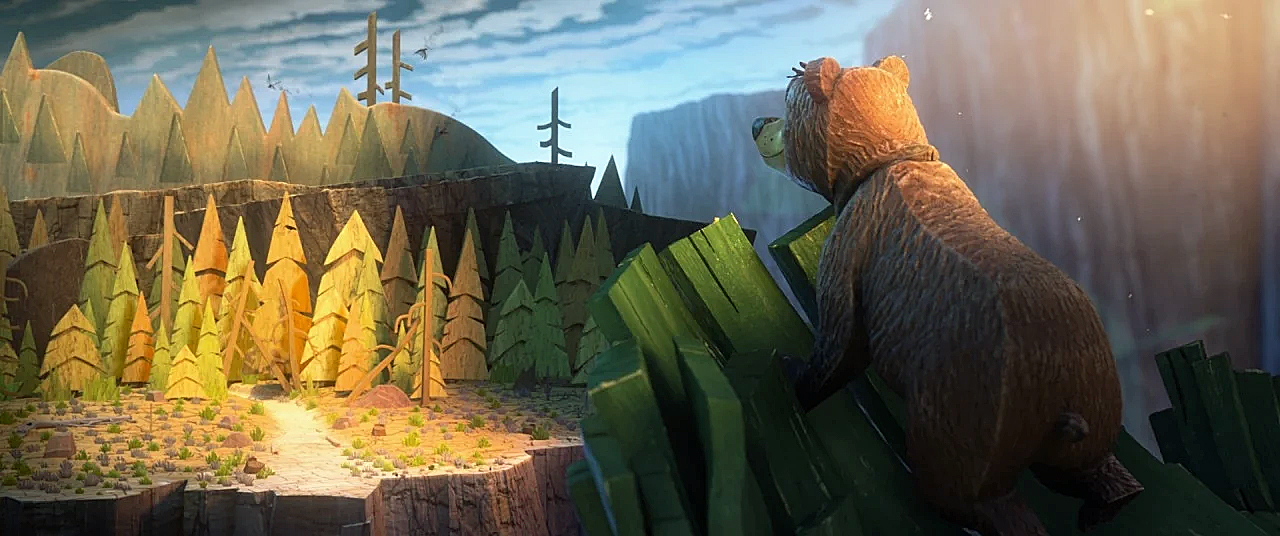
MBird: One of the impressive things that stands out in this film versus others is just how much it looks like stop motion animation wood carvings. Clearly that was a choice. Of all the different styles you could have employed, why wood carvings?
Nathan: I was working on a project with a tree before Jeremy and I came up with Forevergreen. And then once Jeremy came on board, well, he’s also a woodcarver on the side. (He’s a story artist at Disney Feature Animation and I’m an animation supervisor at Disney Feature Animation.) We’ve known each other for a while and we’ve always wanted make something together at some point. But that idea of the tree was always there and Jeremy brought the bear character. And his unique woodcarving aesthetic is so neat. I’ve always thought, “how cool would that be to see an animated version of those characters?” It was really just a nice fit. But a cool style is just a veneer if it’s not grown out of the narrative. It was really important to us that it actually made sense coming out of the story.
We wanted the tree and the bear to look like they were relationally connected, visually connected. And since it is sort of a spiritual allegory for the prodigal son in our faith journey and getting saved by Christ, we wanted it to feel like the Bible verse in Genesis one, where God says that he made man in his own image. We wanted the bear to feel as if it could have been carved from the tree in a sort of allegorical Genesis one kind of way. So that when you see the little cub in the wooden tree hands, it looks like that’s right. The materials match. They should go together. And that’s to juxtapose when the bear is in the antithetical vacuum form plastic material. When he curls up and makes his home there that it should just feel wrong, like he shouldn’t be there.
And then there’s the whole oscillating materials. That also became sort of a heartbeat of the of the character. Computer graphics are really good at making things look bendy and stretchy. For many years being at Disney, we’ve always learned “truth of materials,” and that helps audiences believe it more. You don’t want to be distracted, like “why is that wood bending?” And so one of the things that we do, or we thought at least of this film was, “How would we do this practically, so that you could almost buy that it was one of these old rank and bass kind of stop motion animated films?” And I thought, “oh, wouldn’t it be cool if Jeremy actually did carve each new pose of animation on every frame through the whole film?” Well, that wouldn’t be practically possible. We’d still be working on it right now. Instead, we decided to harness the power of technology and computers and try to make it look as if every frame of animation was a new wood carving that Jeremy sculpted. That was part of why we went down that road, but certainly because of the narrative part.
MBird: Yeah, even down to the crows. I think they look like charcoal. So they’re originally wood, but there’s something wrong. They’ve been burned.
Nathan: Jeremy and I struggled on what that material should be for a while. We were looking at obsidian and some of these other darker colored rocks and things like that. And at that time, I think we were still on the fence of whether the whole world be wooden. And it wasn’t until Jeremy went on a trip to I believe Yellowstone or one of these national parks that we have out here in California. He had a bonfire and then the very next morning he looked into the bonfire and saw sort of the iridescent sheen, almost like what you had seen on oil, the kind of oil slick on a crow’s feather or something. And he pulled it out of the fire and thought, it was almost given to us by God.
We were just scratching our heads, and it seems obvious now when you look back at it, because burnt wood has a great foreshadowing element too for the rest of the film. So it was really perfect. It seemed ominous. It seemed there was a threat there. It was uneasy. It was a new material we hadn’t seen before, foreshadowing what was to come. It was one of those things where the film at some point starts to tell you what it wants to be. And that’s a great example of discovering those wonderful eureka moments along the way.
MBird: I want to ask about the tree, because it’s just a stunning portrait to break the metaphor, of God, right? In this short sequence, you have a tree providing food, shelter, play, companionship, healing, comfort. And there’s more. So, were any scenes cut or is there anything you would add to that? I mean, it’s a two-minute sequence.
Nathan: I think it’s important to note that the tree represents Christ-likeness, unless we have a comparison to our Lord. Yes, people will make that comparison, the benevolent tree. And he’s got all these characteristics. This giving, loving generosity. It may be splitting hairs, but I think it’s important to note that it’s Christ-likeness rather than Christ himself. And of course, we see the picture in the allegory of what Christ did.
But deleted scenes … we did have a scene where you could actually see inside the tree. It was the most adorable moment where the tree actually had like a little cavity or a hole. Because a lot of those sequoias, they’re burned out and the holes in some areas are hollow. And so we had a little cubby hole and the bear cub could climb up in there and he had little shelves and things for his stuff and a little chute for seeds to come down. It was just one more way of showing how he would provide in this really adorable way. Ultimately, it didn’t even make the storyboard phase because when we outlined it, I think we just felt like it was just additional. It was repetition that we didn’t need.
The other one I would point out was that there was a moment where the bear actually broke the tree’s arm off completely in that tussle. And then he was like the one-armed tree for the rest of the film. I think some of the storyboards when he’s reaching across to save the bear, it’s only one arm because we just never had time to go and fix the drawings. But we realized that might be too brutal, that might have gone too far. And then we’re introducing other questions like, “does it hurt him?”
Ultimately, we came up with that little sapling thing later on in the game and was actually a much better vehicle representationally of what we were trying to say. But also it was, I think, the perfect balance of “that was really messed up, but it didn’t cross the line so far that he’s unredeemable,” at least in the eyes of the viewers. I know that’s kind of the point of the grace story, but you want the audience to still be able to watch the film. So I think that was more the threshold we were trying to balance.
MBird: On the subject of Christ-likeness, Hans Frei is a biblical theologian, and he writes about the gospel narratives and compares gospel narratives to other gospel-like narratives like Billy Budd. And he says that Billy Budd is Christ-like, he’s not Christ. Because for him to be Christ is to make a claim that this story is actually salvific. And that’s an important distinction he makes between gospel narratives and gospel-like narratives.
Nathan: That’s right. I think that’s an important distinction because faith comes from hearing and hearing the word of Christ, not the word of Forevergreen, right? Without Christ, it’s not a gospel. Paul makes that very clear in the epistles. So I think that’s really important for everyone to remind ourselves that this is something that can hopefully point to the gospel, something that can point to grace and what Christ has done for us. But it’s not the gospel in and of itself.
Our hope has always been that this be sort of an animated Bible tract that you could share with people. We love seeing the comments where it’s like, “that bear deserved to die.” And yeah, that bear is all of us. That bear is us. That bear is you. That’s the whole message of grace: He got something good that he didn’t deserve. He deserved justice. He deserved what he should have gotten, which was to die. I think that’s where we hope those conversations will emerge.
MBird: I want to ask you about the potato chip bag. The little detail on it, “irresistibly delicious,” is just a brilliant and understated depiction of sin in my book. It’s crazy Augustinian. Did you intend for it to be so thoughtful in that way?
Jeremy Spears: Well, I will say it just seemed like the right thing to put on there. While the film is without any dialogue and there’s no language barriers, we do have the chip bag. It just kind of felt right to us to kind of have those little hidden things to kind of go a little further, just to make that point absolutely clear. There’s another thing, too, and I haven’t looked at the chip bag in a while, but it says– I put on there like “artificially … ,” what was it, Nathan?
Nathan: I have so many versions in my head, I don’t remember.
Jeremy: It’s “fresh artificial flavoring.” When we’re making things up in animation you can do whatever you want. It doesn’t have to follow any rules. You can hide things in there. You can have little easter eggs.
MBird: Well, I loved it. I caught it. It was great. There’s a natural contrast between the two kinds of paradises, right? There’s the artificial paradise and then there’s the real paradise, which is a kind of Eden. And Josh’s music plays a key role here. Can you tell me a bit about what’s going on in the campfire scene? It’s happy music, but still feels off.
Josh Garrels: Yeah, coming from a lifestyle of a lot of sin in my youth, I think of the scripture where it says “Sin is like fun for a season.” Which is why the song is labeled that on the soundtrack, because there is a carnival-like fun to sin. It tastes good, it’s bright, it’s gaudy, it hits all of our senses. It does those things. And on the front end, it’s delightful. It’s like getting a big bag of candy, a big bag of potato chips and all the creature comforts that smell, taste, feel good on the front end.
I kind of wanted to have that carnival-like quality there. Kind of goofy, but fun, but something sort of like ominous under the surface. Like the old Pinocchio film, the island of pleasure. All the fun a little boy we’d want to have, just breaking stuff and eating stuff and staying up late and joking around. But it’s ominous, like the guys who run that place are scary. And then the boys start turning into donkeys. It’s a similar picture, where I wanted it to sort of be fun and goofy, where even kids are kind of laughing like, “oh, this is fun.” The picnic table’s on his back and they wove in all these really, funny sequences in there, but it’s leading toward destruction. Sin is fun for a season, but its end is destruction. So I really wanted it to be fun, yet have a tinge of an ominous quality to it.
Nathan: What an earworm of a song too. That’s one of my favorite tracks as well. It serves the story so well, because once he does something really kind of horrible to the tree, you actually need that levity to bring us back from like a from a story perspective. One of the ways we lure the audience back in is to be like, “Oh he’s kind of a silly I’m fine.” So the audience doesn’t really know that they’re, to borrow a Pinocchio phrase, being puppeted along, the emotions being puppeted along to try to help them not just check out
MBird: I love the moment when the bear is surrounded by fire and reaching up to the tree, but has to let go of the plastic hamburger. It’s such a vivid illustration. Would he rather die with his garbage or be saved with nothing in his hand? Can you talk about how you sort of conceived of that climax? There’s a lot of different possibilities there.
Jeremy: For a while we had talked about the film being that he would kind of go after honey. The initial idea was that there would be honey on the other side. As we kept asking questions and plugging along, we realized that the trash was probably better. It’s a better bear kind of thing as well.
We knew that it was building to this to this climactic moment where the bear would have all this stuff in his hands. So again, the honey probably didn’t work as well to convey that. But there’s a few things going on here. Number one, there is a way to evangelize with people, to share your faith, that you can walk them through the Ten Commandments. This is Ray Comfort, if you know that name. Ray kind of taught me this. It’s a way to say, “have you ever lied before, have you ever stolen, have you ever disobeyed your parents?” They’re simple things, but what it does is it gets you think for a second like, “Oh, yeah I’ve done that. I’ve stolen a pen from work.” It could even be a small little thing, but yet it’s those things that we hold on to. And what Ray does is he uses that to bring you to the foot of the cross to say, “I would be guilty. If I died today, I’ve broken one of those laws. I would actually be guilty.” And then it’s that admission of guilt that brings you to the realization that Jesus Christ steps into the courtroom. You’re guilty. He steps in and says, “I’m going to pay your fine.” It’s telling the bad news before you tell the good news.
And in this scene of the film, all this is set up the entire time. We get to see the bear leaving, going away, going on his own journey. As an audience we realize that the bear isn’t the character we thought he was. So it’s just building to that point where he’s on the edge of that cliff. He’s holding on to all of those items, it really is all about visual storytelling.
It’s also showing that we don’t do our saving. There’s nothing that we do. There’s nothing that we can do to save ourselves. We are stuck and it’s Jesus coming to us to reach across that divide. We see it in our film, the chasm there. But it was just really trying to give a really clear idea what these beats could be — Nathan and I both had that experience, Josh had that experience — in our lives where Christ did that for us. So it’s how do we convey that visually?
It was really quite an exciting moment, actually, because you don’t get these opportunities very often to do that. Getting the shot to where he almost reaches out and he almost grabs on. Then a piece of his trash falls out and so he pulls back and he goes, “No, I’m not going to risk that.” And then, again, it’s stepping it out so that we’re trying to think of how the audience is going to take in this information. Then the flame hits the tree and then they look up and the bear looks up. And now he realizes, “Oh, that went further than I thought it was going to go. I wasn’t thinking that. OK, shoot.” And then he internalizes it and then he goes, “All right, I’m going to let this go.” And even the letting go movement is dramatic. The lighting’s dramatic. The sound effects right there, done by Blake Collins and his team. There’s even an echo-y sound to the food falling away. So it’s all in service of really selling this moment. Then he looks up, and then he can reach up and be safe. Our response is the thing. We don’t save ourselves. So it’s just making that clear.
The other thing I was going to mention was the trash. The trash is actually a vacuum-formed plastic. We trip over these toys all the time in our household. Our kids have them all over the ground in their play kitchens and things like that. So it just felt kind of funny to us, as dads. But it was also to really show that separation of the two different sides. That you have you have the wooden, the natural, versus the man-made objects. Even when the smoke is coming out of the flames, that’s actually a steel wool. It’s a man-made material. We were very conscious about that.
Nathan: I would just add one little thing. We’ve had people say, “All that for some trash?” We love when people ask or say these things. Almost like, “I don’t buy it.” But if you were to zoom out to eternity and look down at the sin that’s fun for a season and the things that we allow are just keeping us back from that gracious gift of salvation, the things that we are holding on to in our life will look like trash objects. They’ll look meaningless in the light of eternity. And I think those are the things that, hopefully, bring profundity to when people actually think about, “Why just this, why this trash, why is he holding on to this?” It was always something that Jeremy and I were aiming for. We want the audience to be yelling, “Get rid of your trash, dummy!”
But how often do we hold on to our trash far too long? That’s another reason why we wanted to really paint that moment very specifically and really think it through. Again, this isn’t the Bible, but we had to think through the theology of what we were saying visually, lest we say something we didn’t intend.
Jeremy: There’s a scene in the Chronicle of Narnia, the Turkish Delight — there’s just something about that as a kid I remember. He gets on the sleigh and he’s tempted by the witch and she’s like, “Oh, here’s this Turkish Delight.” I just remember thinking “I have no idea what that is,” but I identified with that as a kid.
Nathan: It sounds delicious, right?
MBird: Yeah, it needs to be plausibly attractive enough that the bear would leave the tree, but not so valuable that you would imagine that he would ever just want to stay in the camp forever.
So at the risk of over-allegorizing, I’m going to take a stab at something for the sake of conversation, and you can tell me yes or no. Is the sun the Holy Spirit?
Nathan: It might be over allegorizing. We always like to say there’s nothing a man can write that another man can’t allegorize.
Jeremy: But I will say that the sun was very intentional. The sunlight, when we think of the darkness and the light, it’s very intentional that the light is the thing that opens up that pine cone. I think it was just to kind of show, that this story could happen using nature. We could use natural things — a pine cone, planting a seed. It’s sort of like we’re walking along with the Lord and he gives us the pine cone to go plant, but he also provides the rain. He provides the sun. It was more representative of just God’s goodness, as opposed to just the visuals in the film.
Josh: I never thought to ask you guys this. I know there’s some pine trees that require fire in order to Be come to life. Was that part of the thought too?
Nathan: Oh, that was totally part of the thought.
Josh: Yeah, so interesting. That was always in the back of my mind knowing that some pine trees require forest fire in order to germinate or make the seed come alive.
Nathan: What is the verse about if a seed stays in the ground? Unless it remains on its own … like the seed actually has to die. I think that was actually pointing to Christ, how he needed to die to bring life to us all. That was certainly something in the back of our minds, that verse. And also the biblical culture was an agrarian culture. And so when you’re dealing with things of nature, there’s going to be crossover. So I think there’s probably parallels that someone could make or over-allegorize. But I think that’s the beauty of storytelling. When you’re making these things, there’s almost happy accidents on that. But there was a lot of thought everywhere else and lots of tiny details. But I think there’s no one picture that will ever be sufficient enough to truly convey what Christ did for us.
Jeremy: The real basic version of all this is that our intention was really to just show that moment of the bear letting go of his trash, reaching up and being saved, and that Christ did that for us. He gave us that undeserved grace. It can have those allegorized things, but really that’s that was really the core of it — to be able to start a conversation with somebody and point to it and say, “That’s a reflection, that’s a little bit of an image. It’s not as good as the real thing, but it’s a reflection of what Christ did for us.”
MBird: Was it always the intention to end with John 15:13? It kind of frames what the viewers had just seen and offers an interpretation. But it also provides a lifeline to the real world outside of the animated world. It points them to something that’s beyond the story.
Nathan: Oh, yeah, certainly. At the very beginning, we had two verses which were in the pitch deck. And it was John 15:13, which is what we ended up going with, and the other was Romans 5:8: “God demonstrates his own love towards us that while we are yet sinners, Christ died for us.” That one is more on the nose. And ultimately, we chose the John 15:13 verse as a more hospitable route. It also felt that’s literally what the tree did. It even has Disney roots, where Bagheera says this at Baloo’s eulogy, he says that exact verse at the end of Jungle Book.
There was a long time where Jeremy and I were kind of going back and forth on whether or not we should do that [have a verse at the end]. And just very prayerful, asking the Lord whether we should we even put a verse on a fantasy fiction piece. Just trying to have a reverence for the Lord and his word.
And ultimately, we saw that it helped corral the mind a little bit, since people could sort of read into what they thought this film was about. I think that was helpful to show that this has a deeper spiritual meaning. And then the last reason we realized later on down the line, is that this wasn’t just a quote. It was a credit. And it’s the first credit that we give because the Prodigal Son story, which this was kind of loosely based off of, and the story of salvation is a story from eternity past. For us to pay homage, to honor God with that credit was also important. For all those reasons, we ultimately said yes to that, putting that on there.
MBird: Josh, what would you say are the upsides of having your musical score be the voice of the film?
Josh: It’s fun to know that the sounds you’re making are going to really help carry each moment. I’ve had music licensed for TV shows and usually they bring the DB down to where it’s just sort of like a soft jazz under-betting and there’s dialogue on top. Maybe they ramp up for three seconds as the scene changes. You get your whole family around the TV, like, here’s my music and it’s just barely audible underneath everything.
But knowing from the start, that music is in some ways one of the characters of this film, I’ve got to get this right. Because if you don’t get it right at certain segments, it could actually be really detrimental to the story beats and really detrimental to what the viewer, the person taking the story in is feeling. If the music doesn’t land right, it can totally change the emotion of a moment. So for me, the fun challenge was to have it be wordless and convey the emotion, simply through composition.
My songwriting style starts with just melody. I’ll sit on a couch or be playing with synths and pianos or whatever, and just singing melodies and gibberish, searching for a feeling and I’ll know when it hits. I’ll feel the music, and usually it’s connected to something visual, an internal soundtrack. It might be nostalgic, it might be a longing for something I sense is out there, but I haven’t entered into yet. So with something like this, where I’m given the imagery and the images and the story already has feelings attached to it, I get to play with sound and attach melody to these feelings that are already established in the film. Like, oh, this is fun! This is innocent. Oh, things are starting to get a little darker here. Oh, this is ominous. Oh, this is bad. You can start attaching sounds to that.
So I think it was really fun to team up with these guys and kind of be in my wheelhouse of just finding the melody for each of these moments. Let’s reintroduce themes and important moments to remind people. And to do that in melody like they’re doing with their story beats and they’re doing with visual cues. We talked about that a lot. Like, okay, there are these visual cues, whether the viewer knows it or not. We’re introducing most of the visual cues in the first 30 seconds of this film. And so music-wise, theme-wise, instrument-wise, what instruments are we using? Let’s introduce a lot of those in the first minute and then develop those themes and then bring it back in the end. It’s the fun in storytelling with visuals and we tried our best to have those dance together. And I think, I think we succeeded to some extent.
Jeremy: Could you talk about, there’s one scene in particular that I just thought was so incredibly successful. When the bear decides to step on their little sprig that they’ve been growing together, him and the tree, and there your voice comes in there. Could you just talk about that specifically? How did you how did you come to that?
Josh: They’re sort of this tug-of-war between the bear and the tree is he’s wanting to leave. And the tree keeps pulling him back. So musically you’re doing this sort of back and forth, back and forth, but that’s a finality that moment. They’ve been kind of co-nurturing this little sprig of a tree lovingly. We just finished this long fun two minutes of watching this tree grow and watching it learn to tend the forest, to tend this little tree. But the moment that that foot comes down on that little tree, there’s a moment of finality. And you guys did that on purpose — just like there are moments in our anger or in our temptation where you actually cross the line and you do something that is irreversible. And that moment in the film is one of those irreversible moments.
So there’s the tug of war, which actually hasn’t hit and minor keys yet. But the moment the foot comes down, there’s a finality, so everything goes boom. And then vocally, I sort of do this warble, and then it goes down into a minor key because what just happened is final. That little tree’s life is gone and the bears made his decision.
You guys have said that it was purposeful, and after that the bear doesn’t look back. Even when he’s beginning to climb down the cliff, there’s not a moment where he looks back and regret. He purposefully keeps looking away, and I always pick up on that. Even when he’s almost drowned to death and climbed the other cliff, he doesn’t look back. He still lifts up his nose and keeps on in that direction. So that moment he brings his like foot down on that tree is final, not just for the tree, but it’s final for his decision of “I’m going.” And honestly, I’ve known people in sin that have done that. Spouses that have cheated on their husband or wife, and they’ve chosen that course. And it’s almost as though to look back is so painful. Literally they look like that bear. They just continue on. They did this thing that was incredibly destructive, but because they don’t want to look back, they just are continuing. They’ve made up their minds. I think we’ve all known people like that, and we’ve done that in our own ways. I think I saw that in the bear.
Nathan: I love hearing that. It’s always one of our favorites. Jeremy and I are like, “Wow, I love it.” It’s great.
MBird: You guys, this was awesome. The film is brilliant, and to hear you guys talk about it, of all the little details that went into it to support the story emotionally, as well as to support the story’s themes, it’s impressive to hear. Bravo.
Note: this interview has been lightly edited for clarity and brevity.







