




Seeking to escape the purgatory of the present, we strain to tomorrow, but there we find the weird and the eerie ahead of us. As we progress into the future, we find the technology that promised a paradise morphs and mutates us into beings that crave like the bots we build. Robots roam the streets not because they resemble us but because they are us.
In Halloween III: Season of the Witch (1982), Dr. Daniel Challis, an alcoholic doctor estranged from his wife and two children, is working the graveyard shift when a raving Harry Grimbridge stumbles into his hospital, clutching a Silver Shamrock pumpkin mask. Harry has been hounded by mysterious men in suits and while recovering in a hospital bed, his face is ripped apart by another agent. Pursuing the suspect, Dr. Challis witnesses the malefactor self-immolate in his car. Daniel meets Harry’s daughter, Ellie, when she comes to identify the body. Despite the significant age difference and obvious cringe factor, Daniel sidles up to Ellie, exploiting her in her grief because it’s the eighties and this is what we expect of our male protagonists?
Initially rejected by critics and fans alike for deviating from the Halloween formula by not including Michael Myers (well, he’s technically there since he makes a cameo on a couple of televisions since the OG movie Halloween apparently exists in this universe), the movie has been somewhat reclaimed as of late and has risen to the status of cult classic. No doubt you have heard the jingle from the advertisement within the film: “Eight more days ‘til Halloween, Halloween. Eight more days ‘til Halloween. Silver Shamrock.” Ending our film festival with a Halloween themed-movie is fitting because Halloween is a liminal time, a day in which the separation between this age and the age to come is supposed to be the thinnest. And yet also, Halloween precedes All Saints’ Day, a time to honor all belonging to Christ, both the living but especially the deceased. Nothing orients us to the future and to the new heavens and the new earth than by honoring the humanity and mortality of those departed and of those that remain. Sometimes to go forward, you do have to go back.
Aside from Lent (and there are no horror films about Lent — believe me, I looked), no other holiday depicts our own mortality and the frailty of our lives more than Halloween. For that reason, I (someone who struggles with OCD) have found Halloween to be cathartic and therapeutic; it is the mother of all exposure therapies. But, for Daniel and Ellie, while they are imperiled, what they encounter more frequently in the film is the future artificiality, a dehumanizing potentiality. Investigating Harry’s death by slipping over to Santa Mira, Daniel and Ellie shack up at a dingy motel and are not as troubled by the all-too-automaton nature of the citizens spying on them from windows. I mean, forgive the premature reveal here, but the androids in Cochran’s Silver Shamrock factory have nothing on the hollow humans that the couple observe. Daniel and Ellie also are lousy detectives, almost androidic themselves, as they are not troubled by the artificial sound of a laser emitting from a fellow motel customer’s mask that mutilates her face, but they do awake — or are they activated? — when a company vehicle arrives to whisk away the body.
It’s not just the townspeople or the nefarious corporation that our protagonists are raiding, even something about the way actress Stacey Nelkin portrays Ellie feels a little robotic, a little off. And what of Daniel who at every turn shirks his kids and breaks promises (to take them trick-or-treating of all things!) — first for his doctoral duties and later for the sake of his obsession with uncovering what happened to Harry? All for the sake of the job, which is the creed of machine men and not created ones. More vexing than the hypnotizing and brutalizing effects of the masks is the fact that most of the movie is spent with Daniel and Ellie navigating pipes, conveyor belts, and factory rooms, all while we are tantalized by the hope that we will see Halloween night in neighborhoods with kids trick-or-treating (granted we see some, but the screen time is minimal).
The humanity of Halloween, the one night in a year where we open our doors to strangers and welcome them as neighbors, connects me with a sense of community. For the remainder of the year, we are siloed off by our screens and severed from others. In Halloween III, children are mesmerized by the television screen, a precursor to the ones on our phones. Responding to commands from the commercial, the kids are programmed. Even our human protagonist Daniel spits out canned catchphrases like a robot. Also, he shares his bottle of wine with a hobo in an alley. Who does that?
Conal Cochran is the antagonist of our narrative, as he conforms to the mad-scientist archetype and assembles the masks so they will control the kids and cause them to gather around the television on Halloween night. But for what purpose exactly? After the most mustache-twirling of villain monologues (and the most expositional), Cochran explains that Silver Shamrock’s goal is to sacrifice the future generation for Samhain, and the masks even contain pieces of (ahem) Stonehenge in them. It is legitimate to ask, then: is a post-Anthropocene future one which returns to the past and the pagan? Our festive flick does not give a definitive answer or, rather, gives a grim one. When Daniel finally escapes the factory, he is ambushed by Ellie who is (gasp?) an android herself! And then, twist upon twist, our hero scrambles into a shop and dials the television station to beg them to cancel the commercial broadcasts, only to be a minute too late! Indeed, the future ambushes us before we have even caught up to the moment.
There is something of the manufactured as well in Eli Roth’s Thanksgiving (2023). Concluding our festival, Thanksgiving can be understood analogically as prefiguring the banquet we will have in the new heavens and the new earth with Abraham, Isaac, and Jacob where contentment is everlasting. And, unlike the false unity of colonizer and indigenous that Thanksgiving foists on us, the thanksgiving we will have in the new creation is one where every tribe, tongue, and nation will be collected as one for the feast (Revelation 5:9).
For the characters of our final film, their distorted humanity dictates that they follow self-interested urgings instead of observing a season of sharing. In the opening scene, we get a POV shot of Sheriff Eric Newlon arriving at the Collins household with a pumpkin pie for the annual meal. The camera cuts to the Wrights, and we immediately see the discrepancy between the simple dinner of the working class family and the extravagance of the Wright household. Thomas, the patriarch of the Wrights, is the owner of a convenience store called RightMart (get it?). For Mitch Collins, an employee of the superstore, his Thanksgiving is truncated as he is called into work because, as the character comments, Black Friday starts early. Encroaching into our communal time, consumeristic time demands us to fumble to the future, ever bored by the present. By juxtaposing Black Friday and Thanksgiving, the movie powerfully conveys how quick we are to shift from gratitude to greed.
Jessica Wright, the daughter of RightMart’s owner, arrives at the store along with her friends and her boyfriend, Bobby. Outside, an angry assembly throngs together and chants for the store to open. Even in the act of chanting, there is a dehumanizing quality that precludes individual thought. Acting on privilege, Jessica lets her friends into the store early, fomenting the crowd into a mob that stampedes the store. What ensues is brutal and ghastly as the citizens stomp over a glass door and crush a security guard underneath. The faceless pack are bleeping automatons, artificial beings designed to execute orders to buy as well as bulldoze all who get in their way. In a particularly grisly moment, one of these consumers rams someone with a cart and scalps her until she bleeds out. Trampling others to death, the horde rampages through the store, and even Bobby has his arm broken in grotesque fashion by a clomping citizen. Even more horrific is the fact that one of her friends, rather than being a Good Samaritan and helping his neighbors, stands on a checkout conveyor and starts streaming all of the chaos from his phone. His desensitization to his own friends being brutalized in the most gruesome ways indicates how dehumanized we have become.
Thanksgiving (2023) is reminiscent of Scream (1996) in that it is a satirical slasher, but it’s not the horror flick being deconstructed, rather our social media-saturated and divisive society. One moment we are carving a turkey together and the next we are carving up each other. If nothing else, the movie shows how little provocation we need to turn on each other. In our polarizing times, where so many live for likes, clicks, follows, and subscriptions, is there any wonder that we do not see our neighbors as made in the image of God? Embedded within our own language is a sense of artificiality to how we understand our own souls. We even speak of processing a violent or traumatic event.
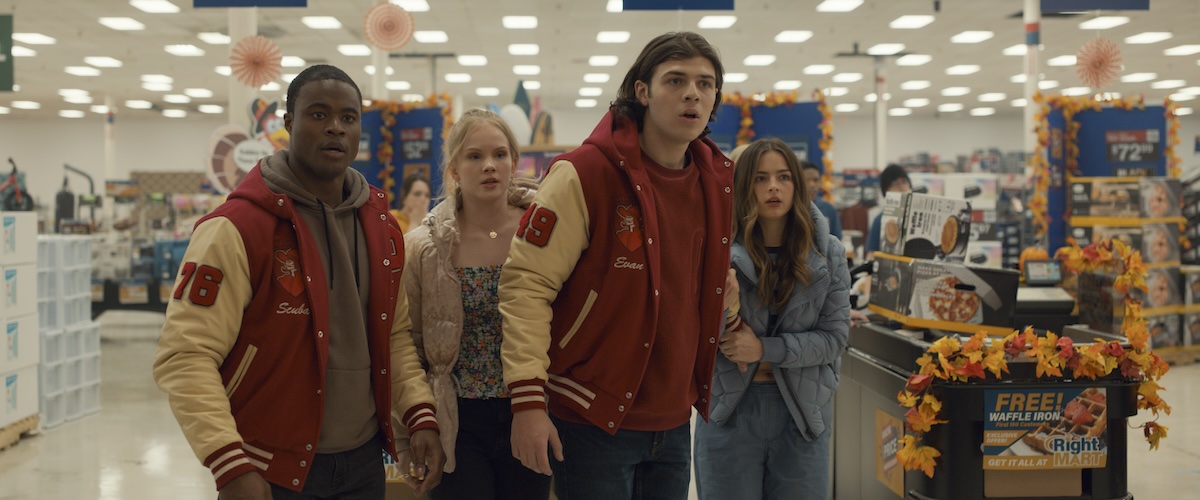
One year later, the town of Plymouth, Massachusetts, continues as if nothing happened. With the exception of Mitch Collins, (who lost his wife, Amanda, on that night), most of the community, in particular the culprits, want to move on. As a caricature of avarice and apathy, Thomas Wright still insists upon opening the store on Black Friday. After all, he donated to some charities, so that should absolve him of any guilt and atone for any wrongdoings, right? Shattering the status quo, a killer wearing the mask of John Carver, the first governor of Plymouth, lumbers after the guilty ones from the previous year’s massacre and mangles them in the most absurd ways. Since John Carver was the first governor of the Plymouth colony, the mask symbolizes that there is violence and greed in the marrow and bones of America, and it is a violence and greed that has spread by disregarding the humanity of others. Besides Jessica, you almost begin to feel that these characters have it coming, but then that would be to succumb to the same twistedness these individuals have. Yet still, the character Evan even dehumanizes Jessica’s second boyfriend by calling him an NPC (non-player character). It is not unintentional that one of the chase scenes occurs among mannequin heads in a cosmetology classroom at the high school.
Artificiality, the kind in which we detach ourselves from the humanity of ourselves and others, eventually malfunctions. At the movie’s conclusion, John Carver is unmasked, and the person beneath is a real human, arguably the most human of the whole cast. I won’t spoil the reveal here as the movie is relatively new (it’s on Netflix; go watch), but the killer’s motives are personal and, unlike the terminations at the beginning, full of passion. That does not make them justified, but it does make them authentic and not artificial.
Every second counts; fighting the future is futile and the sentience of our screens means that technology is not neutral. Scrolling through our search engines rather than strolling through our streets deforms us from humans into droids. While we never fully lose the image of God, when we appendage ourselves with our phones and pounce at the next product, we disfigure ourselves. Falseness and fakeness worms its way into our lives but does not free us from the worm of the grave. Although the masks we wear have the appeal of anonymity, the countdown of the clock calls for us to face each other and tomorrow together.








This was great. I love these movies and it’s a joy to see someone else look at them from a christian worldview.
Aidan,
Thank you for such a generous comment. I love these movies too (clearly), and it was an enjoyable exercise to hold them up as a mirror to our own cultural terrors.