




Deck the halls and cue up the TV! Here’s a near-definitive list of the best Christmas films that are sure to warm your heart this Christmas. Yes, Christmas movies are a veritable cottage industry at this point, but these are the ones we feel are a cut above the rest.
It’s a Wonderful Life (1946) is such a hallowed holiday staple that its very familiarity risks drowning out its confrontational address. George Bailey is worn out with his lifelong holding pattern of deferring his interests to the needs of others. He’s been hemmed in on all sides, shoved into a calling he would never choose for himself (yet never fails to choose for himself!), and his theology of glory reasoning cannot fathom how this can be anything other than the death of him. He’s half right, of course: the pattern of service he’s called to means the death of his ambitions, but in his bitterness he can’t recognize how this can be a merciful gift. The unraveling of George’s illusions, terrifying as it is, is the sweetest gift granted him in the film, for through it he can discern with the eyes of faith that the death of his dreams can actually deliver life. It’s a Wonderful Life never descends into mawkishness: it simply holds us in its embrace of shattering joy, a joy we too often do not dare to imagine. – Ian Olson
The Bishop’s Wife (1947) poses the question: how do hearts change? Can they be changed through jealousy (Bishop Henry); attention and care (Julia); the uncovering of a past (Mrs. Hamilton); or a miraculous bottle of sherry that never runs dry (the Professor)? Cary Grant’s angelic Dudley shows us how the Holy Spirit can work through all of the above — and other, smaller ways: the building of a great cathedral cannot hold a candle to a neighborhood boys’ choir rehearsal in a decrepit, declining church. That the characters’ memories of Dudley are wiped away echoes the work of the Spirit, invisible and unknowable. Whether our hearts are open like Julia’s or hardened like Henry’s, the Holy Spirit, like the hound of Heaven, pursues us still. Praise God! – Derrill McDavid
Come to the Stable (1949): This is an outstanding Christmas classic of a movie! Directed by our (now) true friend Henry Koster, and starring Loretta Young, who was a devout Roman Catholic, Come to the Stable tells the story of two European nuns who come to the US just after World War II and found a convent in southern New England. You won’t even need to give this movie time: it starts right up. Highly recommended! – Paul Zahl
The Holly and the Ivy (1952) centers around an aging rector in the Church of England who, despite being this very faithful guy, has failed in some ways to connect with and convey his faith to his three adult children, who have returned home for Christmas. What’s really going on with each of them and how it all emerges is absolutely as powerful as any new Christmas material I’ve seen within the last few years. – Simeon Zahl
White Christmas (1954): I made my boys watch part of this movie with me recently and they were struck by the vivid colors and how boring it was. I remember feeling that way when I watched it alongside my grandparents, but now I love it. Poor editing (Judy pouring her coffee twice!), fakey backdrops (that “snowy forest”), and contrived conflicts (Betty, JUST ASK HIM ABOUT IT) aside, I look forward to the “Sisters” number(s) each year, and the vulnerability of the General—and his troop’s loyalty to him — gets me every time, as does the ultimate reconciliation of that closing song. – Stephanie Phillips
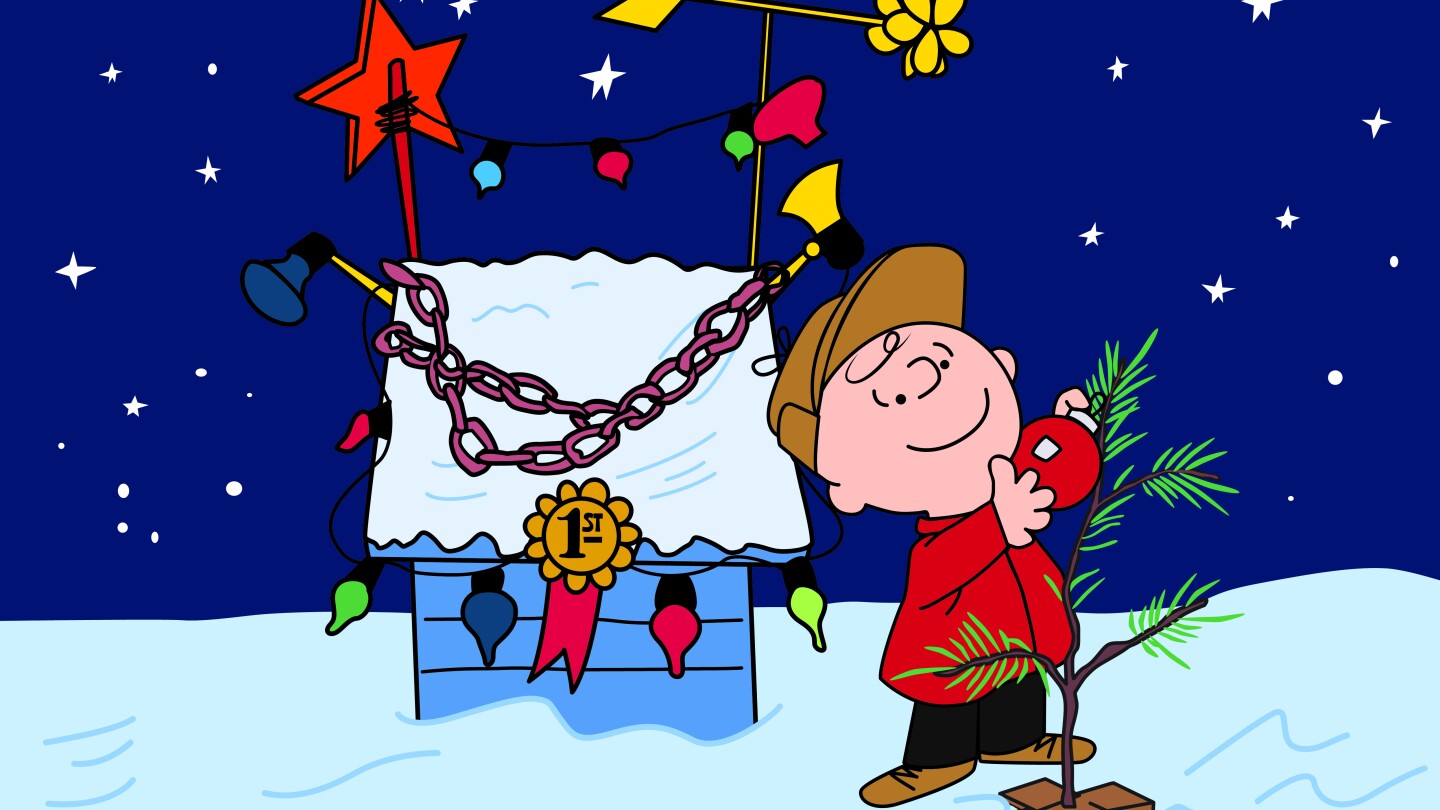
A Charlie Brown Christmas (1965): Talk about a Christmas story that defied all odds. A 25-minute TV special with low-tech animation and real children’s voices for the characters? A depressed kid looking for psychiatric advice as the main character? Jazz and the Bible? Like the Nazareth principle itself, Charles Schulz was onto something when Charlie Brown picked the saddest, most scraggly tree in a lot full of brightly decorated aluminum trees: it was the only tree that was real. Ebenezer Scrooge and George Bailey may point to the spirit of Christmas, but only Linus gives you the goods straight from the source. “And the angel said unto them, ‘Fear not: for, behold, I bring you tidings of great joy, which shall be to all people…” When Schulz pitched the script, CBS executives responded, saying, “The Bible thing scares us.” It felt like a risk that would alienate swaths of Americans. And yet, when it aired, nearly half of the country’s households tuned in. So, next time you’re tangled in tree lights, yelling at your ungrateful children and have long forgotten the true meaning of Christmas, just rely on little Linus to remind you. “Lights, please!” – Sam Bush
How the Grinch Stole Christmas (1966): We lived in Cyprus for a couple years when I was a kid, and we didn’t get TV, but we did have a few random VHS tapes, including this one. Every Saturday morning, I’d sit transfixed about three feet from the screen watching this on repeat, mouthing the words obsessively while my parents slept. I think it contributed more to my moral and spiritual formation than any other movie in my childhood, with the possible exception of Field of Dreams. It taught me this foundational Christmas comfort: that by some strange divine magic we cannot comprehend or control, any human being, no matter how awful, can be redeemed. As they still say in Whoville, “The Grinch’s small heart grew three sizes that day!” – Ben Self
Frosty the Snowman (1969): CBS aired Frosty for fifty-five years straight until, in 2023, NBC acquired the rights to the movie. And for good reason: it’s a classic. As kids, weren’t we all desperately rooting for the man with a “corn cob pipe, and a button nose, and two eyes made out of coal” to “live, and move, and have [a] being” before he melts away? – Meaghan Mitts
A Christmas Story (1983): I think of the protagonist Ralphie not as EveryMan but as EveryBoy — the daydreaming in class, the feelings of being constantly misunderstood and underappreciated by family members, the fear and frustration with bullies, and the manic obsession of that one sought-after Christmas gift that will utterly transform life as he knows it (spoiler alert: a Red Ryder Carbine-action 200-shot Ranger Model Air Rifle). Let’s just all pray that Ralphie doesn’t shoot his eye out! – Larry Parsley
Gremlins (1984): I was eight or nine the first time I saw Gremlins (a rented VHS from my small town video rental place; remember how magical those places were?), and it terrified me. But as I got older, I was able to appreciate just how wonderful and singular this movie is, from great character actors like Dick Miller, Keye Luke, Hoyt Axton, Polly Holiday, and Frances Lee McCain, along with ’80s stalwarts like Phoebe Cates, Judge Reinhold, and Corey Feldman, to the excellent puppets, to the fact that it is obviously filmed on the same Universal Studios backlot set as Back to the Future (except covered in snow), and Joe Dante’s perfect Frank Capra meets Roger Corman meets Chuck Jones (who has a cameo!) direction. And as an Mbird bonus, there is definitely a certain amount of theological anthropology that you could extract from the idea that within Gizmo (the cute “saint” of the Mogwai), there lurks these other Mogwai that quickly give in to all of their most base impulses and turn into monsters (“sinners”). In fact, I think someone should make a YouTube video using clips from Gremlins set to Nick Lowe’s 1994 classic, “The Beast in Me.” – Joey Goodall
National Lampoon’s Christmas Vacation (1989): I know, I know, I went a little highbrow with this one! Being a child of the ’80s automatically makes this nostalgic for me, but let’s be honest, I chose it for the laughs. There are a couple Mockingbird-esque themes in it though. Clark Griswold’s comedic obsession with “making this Christmas the best” is an evergreen problem. But the real action is the Nazareth principle at play. Cousin Eddy is an intrusion, a drain, and a loser, but when he hears Clark melt down over failing to receive a much needed Christmas bonus, he jumps into greater foolishness. He kidnaps the boss, the SWAT team destroys the house, and…the boss apologizes. Didn’t see that coming! If Christmas means God will work final good despite all our folly, then our current laughter is just a start. – Ryan Alvey

Home Alone (1990): Sure, there’s Old Man Marley with the bleeding and bandaged palm (hello, Jesus and his nail-scarred hands!), but my favorite part of Home Alone is the relationship between Kevin and his mother. Since becoming a mother myself, I’ve noticed the maternal aspect of Christmas more than ever (see Martin Luther’s Christmas Book for a beautiful chapter on this), and I can’t help but appreciate that Christmas reminds us that the entry point of our Savior to the world was a willing woman. And come on, is there anything better than Kevin’s recognition of Kate’s voice, followed by his running to her embrace (shades of the Prodigal Son and his father) before the rest of the family crashes in? – Stephanie Phillips
Home Alone (1990): In the end, aside from all of the unrealistic storylines, nostalgic one-liners, and slapstick comedy, it’s the creepy-neighbor-turned-savior motif that always gets me, and maybe elicits a tear or two. Of course, he has his own redemption arc in the movie, but Old Man Marley’s heroics remind me a lot of how my misperceptions of Jesus and my insistence that I can protect myself from the thieves within (thank you very much) mixed with my straight up sinful enmity toward my Creator are no match for his love. – Chris Wachter
The Muppet Christmas Carol (1992): This movie is a miracle! A Christmas movie with an Easter-like back story. Having tragically lost Jim Henson at 53 two years earlier, and fellow Muppeteer Richard Hunt in January of ’92, the future of The Muppets was unclear. However, longtime Muppets writer, Jerry Juhl, came up with a script that was a pitch perfect blend of the classic gently anarchic Muppet sensibility and the pathos of Dickens’ novella (using much of the original text). A newly sober Paul Williams emerged from a personally rough decade to write songs just as incredible as the ones he wrote for The Muppet Movie thirteen years earlier. And Jim’s son, Brian, took on directorial duties with guidance from Frank Oz, who had directed Michael Caine in Dirty Rotten Scoundrels a few years earlier, and cast him as (for my money) the best onscreen Scrooge of all time. Though the output of The Muppets has varied widely ever since, this 1992 classic remains just that, a more than fitting tribute to both Henson and Dickens. – Joey Goodall
The Muppet Christmas Carol (1992): “You are already too old for fairy tales,” C. S. Lewis once wrote to his niece, “but someday you will be old enough to start reading fairy tales again.” The Muppet Christmas Carol is one of those stories — often dismissed for its orientation to children and yet possessing a profound, deeper magic that can change us from the inside, if we’d only let it roll until the credits. Michael Caine’s portrayal of Scrooge, layered with Dickens’ original words, cuts through the noise of the season, reviving within us the possibility of forgiveness and the need for lasting, human connection. Disney’s decision to cut “When Love Is Gone” from the screen mistakenly traded the heaviness of real life for a cheerier tone, but its recent restoration gives us the meaning of Christmas: love doesn’t avoid pain — but heals it by first entering the void and eventually speaking the only word that can provide lasting comfort: “You are forgiven.” – Davis Johnson
Little Women (1994): I’ve been watching Little Women at Christmas ever since it arrived in my little, ten-year-old lap. I knew then I had seen something special, with Thomas Newman’s score weaving throughout. To witness the joys and losses of those women over the years have been a source of deep comfort for me. The nostalgia and contentment with Beth. Jo’s restlessness and passion. Meg’s humble undertaking of being the eldest sister. And Amy. Dear Amy. In her own way, she wants to have the perfect life too. There’s a scene where Teddy is leaving for college, and he turns to Jo and says, “Nothing is going to change.” But we know it does. As the years move on, of course it does. Everything changes as we grow older. There is love and pain, abundant joy and bewildering sorrow. We wish some things could still be the same as we hang lights on our tree year after year; a little older, a little softer, and yearning for the warmth of Home. – Janell Downing
The Santa Clause (1994): This movie is all about how unmerited, one-way love heals relationships. Tim Allen, playing Scott Calvin (S. C.) a divorced dad with a less-than-stellar relationship with his eight-year-old Charlie, accidentally kills Santa one Christmas Eve. After donning the mysteriously vacated Santa, Calvin finishes the night’s job only to find out he’s now Santa. His life devolves as he transforms physically and mentally (albeit not willingly until late) into St. Nick culminating in a judge terminating his visiting rights with his son. However, in the third act of next year’s Christmas, everything changes when Calvin does two things: he convinces Charlie to spend Christmas with Calvin’s ex and her new husband, and then gracefully gives them the toys they always wanted but never got as children. A little bit of grace goes a long way. – Will Ryan
While You Were Sleeping (1995): Move over Tom Hanks! Because Bill Pullman is my pick for rom-com heartthrob of the ’90s. As someone who grew up watching such rom-coms with my mom around the holidays, it sure is fun getting to see Gen Z rediscover the nostalgic coziness of this film. The plot may be a bit ridiculous and unrealistic, but is a rom-com truly a rom-com without a little secondhand embarrassment? Brb, gotta find a man that can make me a rocking chair. – Cali Yee
Dr. Seuss’ How the Grinch Stole Christmas (2000): Nobody made me laugh more growing up in the ’90s and early 2000s than Jim Carrey. He was a master of many characters — Ace Ventura, Dumb and Dumber, Liar Liar, The Cable Guy, The Mask, and then, of course, the Grinch. But I was also a child of Dr. Seuss’ original “How the Grinch Stole Christmas.” Ron Howard’s adaptation is a brilliant amalgamation of the humor and wonder that sustained my childhood. I saw it in the theater, and my 41-year-old sister and I still quote it ad nauseum. And perhaps it’s still worth watching because in a world full of easy answers and technological mastery, everyone longs for a story where hearts are changed by childlike love. – Josh Gritter
Bridget Jones’s Diary (2001): I don’t know if this is always categorized as a “Christmas” movie, but it does involve awkward family gatherings, ugly Christmas sweaters, and of course the questions that holidays tend to bring up such as, “Will I die alone?” and “Who could ever love a disaster like me?” Well, it turns out (following the plotline of my favorite story, Pride and Prejudice) that someone could love a disaster like Bridget Jones…The one she thought she hated and wrote all sorts of mean stuff about in her diary ends up telling her, “I like you very much. Just as you are.” And then he gives her a clean slate in the form of a new diary. That kind of love and forgiveness is what Christmas is all about after all. – Juliette Alvey
About a Boy (2002): Not just my favorite Christmas movie of all time, but perhaps my favorite movie, period. You will never find a more perfect synthesis of humor, music (Badly Drawn Boy), gut-wrenching truth, and cathartic grace. A perfect gospel movie. – R-J Heijmen
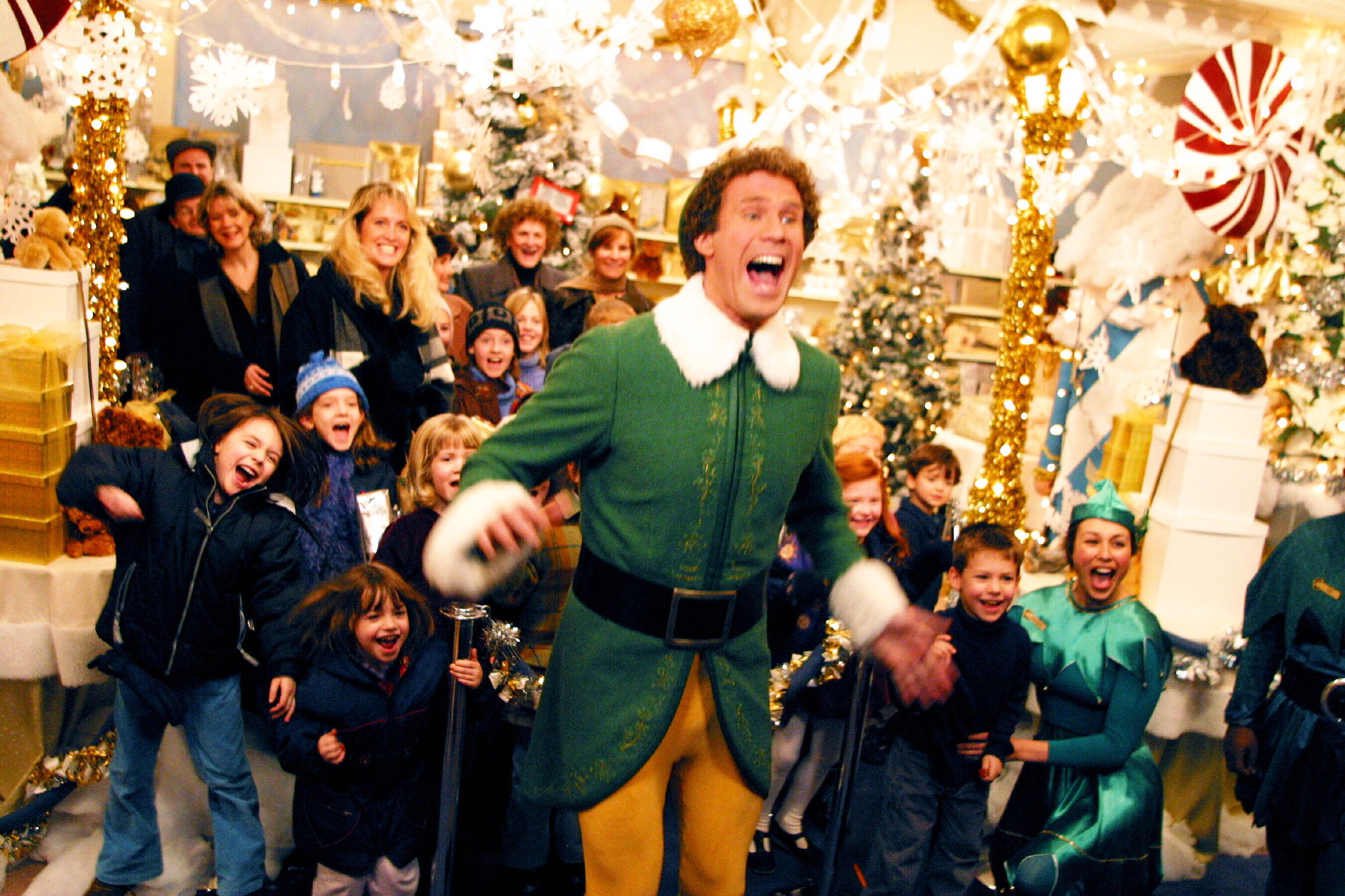
Elf (2003): Sometimes it’s a workout to “get” Will Ferrell’s humor, but his grace-edged comedy is on full display in Elf. Buddy, a misplaced human baby now grown, leaves the North Pole in his Elfwear and finds his biological father in NYC. Basic message: no one is out of the reach of or immune to the beguilingly upside down Word of grace (or candy). – Marilu Thomas
Millions (2004): No treacly Christmas sentiment for me. Nor do I want something where Christmas is incidental (see Die Hard and It’s a Wonderful Life). Danny Boyle’s Millions gives us Damian, a twelve-year-old boy whose family has moved following the death of his mother. He’s a devoted Catholic who regularly chats with the saints in his cardboard hideout next to the tracks. A boon of millions of pounds drops from heaven and changes everything. Faith is taken seriously, as are grief and loss. And Jesus’ appearance makes a difference in the world. – Ken Sundet Jones
Children of Men (2006): I remember being left breathless on the day after Christmas in 2006 in the movie theater from not only the top-notch cinematography, fearless and vulnerable performances, and thrilling action, but from how clearly it communicated the hope of Christmas. In a near future where humanity has become infertile, a refugee in a barely-hanging-on United Kingdom carries the hope of humanity in her womb. Jaded Theo has been hired to help her reach The Human Project. This unlikely Mary and Joseph and confident direction by Alfonso Cuaron near perfectly illustrate the terror and desperation and hope of what it means to carry the salvation of humanity in the fragility of human flesh. – Tasha Genck Morton
Four Christmases (2008): If, for you, going home for the holidays means reacquainting yourself with your faroff (even hidden) wacky and dysfunctional past: Cheese Whiz on Ritz crackers, megachurch Christmas pageants with Dwight Yocum, or your cougar mom’s new young whipper snapper, this is the movie for you. Reese Witherspoon and Vince Vaughn, being classically themselves, will get you through anything that comes down the chimney and remind you that your yuletide could always be more weird than it is. – Meaghan Mitts
Lost, S4E5 (“The Constant”) (2008): This best-of-the-entire-series episode of Lost that takes place on Christmas Eve across multiple timelines shows how undeserved and unconditional love can redeem our past, present, and future. – Tasha Genck Morton
Disney’s A Christmas Carol (2009): When you hear renditions of Dickens’ A Christmas Carol and the Nativity story itself year after year, it’s easy to forget how dark and terrifying they both are, in parts. The very creepiness and intensity of this faithful 2009 animated version of Dickens’ tale — amusingly well-acted by Jim Carrey — is a big part of why it resonates for me above the many other movie interpretations of the story. Of course, if we assume the various ghosts are actually emissaries of grace, it does also suggest that God’s redeeming grace may not always be quite as meek and mild as we’d like. Sometimes, instead of the comforting hymns and glad-handing of a typical church service we get the “hound of heaven” chasing us down the dark alleys of our lives to save us from our miserable selves. As George MacDonald once wrote: “The one principle of hell is — ‘I am my own.’” A Christmas Carol, at its best and creepiest, helps shock us out of that insane, self-destructive illusion. – Ben Self
Klaus (2019): A remarkable animated Santa Claus origin story that somehow undermines the flimsy moral framework of the Santa mythology itself. What begins as a dishonest ploy on the part of a spoiled mailman to bribe kids into mailing letters turns into a stunning example of grace in practice. Instead of a quid pro quo — be a good kid so Santa gives you toys — the film contends that “A true act of goodwill always sparks another.” A dash of grace can cascade into unthinkable social transformation, even in a frozen wasteland. – Todd Brewer
8-Bit Christmas (2021): This is the most recent addition to our family canon of Christmas viewing. What appears to be a lighthearted nostalgia fest at first — the Power Glove scene is worth the price of admission alone! — takes an abreactive turn at the end that elevates it beyond the usual fare. But the ending wouldn’t matter if the other elements didn’t work so beautifully too: terrific casting, a snappy script, and just the right amount of magical realism, not to mention some laugh-out-loud set pieces. Highly recommended. – David Zahl
A Storm for Christmas (2022) is a 2022 six-part series set in the airpot in Oslo, Norway, on Christmas Eve. It’s on Netflix. A bunch of fascinating, curious, and marvelous characters are all working through their stuff and stories amid the holiday trappings of an international airport. Beyond the estrangements, disappointments and weirdness of the various characters’ lives runs an arc of grace. – Tony Robinson
Spirited (2022): Most Christmas movies are fluffy, predictable Hallmark rom-coms that elevate the romance and magic of Christmas but neglect the reality of embodied, messy, real-life people that often make life complicated. Spirited is a blessed exception. A modern parody of the classic A Christmas Carol by Charles Dickens, Spirited follows Will Ferrell playing the Ghost of Christmas Present, who is responsible for “haunting” a preselected mortal every Christmas Eve with the hopes of producing lasting change — preferably someone who can cause a ripple effect of goodness around them. At the heart of the film was one question: “Can people really change?” As much as I’d like to buy into the song-and-dance that we can become a little bit better every day, it’s just an exhausting bunch of choreography to keep up with. What a relief to die to ourselves, die to the belief that we can really change if we just try a little harder, and instead, let the Holy Ghost do his haunting. – Kate Wartak
The Bear, S2E6 (“Fishes”) (2023): I was introduced to the Hulu series The Bear, which follows professional chef Carmy Berzatto who returns home to manage his late brother’s restaurant, via this episode. Imagine being dropped into a chaotic, tense, Christmas Eve dinner being frantically prepared solely by an alcoholic matriarch, played to perfection by Jamie Lee Curtis. The enormous gathering of inlaws and outlaws is full of surges and retreats as skirmishes, and a few outright wars, flare up throughout the evening. Families tend to display extroverted or introverted dysfunction, but whether yours say crazy thoughts out loud or just think them, you’ll find something to relate to here. Grace makes a literal breakthrough at the end of the episode, allowing rock bottom to meet redemption later in the series – what’s more Mockingbird than that? – Josh Retterer
The Holdovers (2023): This surprise Christmas classic revolves around Mr. Paul Hunham (played by Paul Giamatti) — a miserable, hidebound, unwavering classics professor at Barton Academy, an all boys New England boarding school he once attended. Mr. Hunham lives and breathes strictly by the book (both the Barton Student Manual and the stoic wisdom of Marcus Aurelius’ Meditations) as if self-discipline and integrity could be beaten into the lazy, vulgar, rancid boys of Barton. But when he’s assigned to supervise six boys who have nowhere to go for Christmas break, Hunham is caught off-guard by an unlikely friendship with student Angus Tully. The message of grace abounds in this well-written and brilliantly acted masterpiece, but what sets The Holdovers apart is its recognition of a season that is mostly celebrated as joyous but all too often marked by loneliness and despair. The film is a closeup of the darkness into which the light of Jesus was sent to shine. And shine it does! – Sam Bush
The Best Christmas Pageant Ever (2024): As a pageant director myself with more than a few Herdman types in my cast, I laughed out loud as the Angel of the Lord yelled, “Hey, unto you a child is born!” But, at the heart of the movie is Grace, the patient yet overwhelmed coordinator, who reminds her daughter that Jesus came for all of us, even the Herdmans. The radical welcome the Herdmans receive, not only despite their violent and disruptive attitudes, but also their curiosity and general ignorance of the Christmas story, transforms them. They still wreak havoc, but in a simple moment they become the teachers, pointing to the absolute absurdity of the King of Kings showing up in a dirty old manger in a small town. Unto you, this child is born and this movie is one that will not let you forget that. – Jane Grizzle








I would humbly submit DIE HARD:
A Christmas masterclass in the beauties of Unconditional Love in the midst of the mess of a challenging marriage and (SPOILER ALERT) an epic heist. In addition to the more straightforward (yet delightful) arc of John McClain fighting for the women he loves (“she’s the best thing that ever happened to a bum like me”) we see Sgt. Al Powell transformed by the love and brotherhood with John. In the end, because of that love and knowingness that Al experiences he able to overcome his fear and trauma to draw his service revolver and protect his brother.
@Ken, I love Millions!
No Christmas movie listings complete without Miracle on 34th Street. I would also submit Christmas in Connecticut and It Happened on 5th Avenue.
Remember the Night (1939) starring Fred MacMurray and Barbara Stanwick is my personal favorite Christmas movie, chock full of grace, redemption, and a wonderful Christmas spirit. Seek it out!
How about Planes, Trains and Automobiles. My personal favorite.
Personally, I would add this movie to your list:
The Gathering (1977)
https://www.imdb.com/title/tt0076067/
It’s a great Christmas movie.
Gotta make room for CATCH ME IF YOU CAN (“Carl, how is it that we’re always together at Christmas?!?!?”) and ARTHUR CHRISTMAS. The latter is a family staple that gets better with each viewing: technological skepticism + Younger Brother / Older Brother dynamics + father issues + vocational identity issues + lots of hilarity = a must-watch.
Simon Birch is one of my Christmas repeats. Themes of waiting, providence, friendship, faith, and the most “off the hook” manger scene. A lot of theology to unpack here!
How can you overlook “CHRISTMAS IN CONNECTICUT???
Thank you! I love this l list!! Many I’ve never seen. I would also add The Holiday with Cameron Diaz, Jude Law, Kate Winslett, Jack Black…
A beautiful Christmas gem is
Joyeux Noel (2005)
https://www.imdb.com/title/tt0424205/
Thanks!!
The Christmas Star …it is on the Disney Channel. It stars Ed Asner and this movie is full of Grace and Redemption.
Great collaborative work here! Very cheeky throwing a couple of television episodes in the mix, but I can’t think of two better additions to a list of movies.
These are all such great additions. Arthur Christmas is another big family favorite, and Joyeux Noel is a total gem. (So good to see your name pop up, Jim Erskine!)
Whit Stillman’s “Metropolitan”!!
The Shepherd (from Chosen)
The Nativity Story (2006) – Oscar Isaac plays Joseph!
The Polar Express (2004)
Rudolph the Red-Nosed Reindeer (1964)
[…] If you’re like me, you’ve pretty much given up trying to keep up with others and thrown in the towel. But that doesn’t change the fact that being a bad gift-giver can still make you feel like a failure, especially when you’re sitting next to Mrs. Claus on the couch on Christmas morning. There will always be someone who has more money than you, or more time to shop, or a larger stake in the micropolitics of the family dynamic. What to do: Let them win. Let go. Write the sweetest notes on your cheap gifts. Pour another glass of eggnog. And turn on a Christmas movie. […]
2 to add
Nobody’s Fool
The Dead
Nora Ephron’s 1994 “Mixed Nuts” is a grace-filled gem with an all-star cast. I watch it every year to laugh and cry.
[…] Our Favorite Christmas Movies: A survey of 32 grace-filled, theologically rich Christmas movies beloved among the team of writers here at Mockingbird. […]