1. You never know where and how the Spirt is at work. And that is one of the most exhilarating truths about the mystery of faith. Over at the Atlantic, Caitlin Flanagan writes about her family’s deep and unexpected friendship with Seamus and Marie Heaney. Living abroad in Ireland during her dad’s sabbatical year, to her complete shock, Flanagan’s hyper-rational parents (who more easily believed in Santa than God) forced her and her sister to be baptized so that they could go to Catholic school in Berkeley when they returned to the States.
If our parents had told us they were getting divorced, we would have taken the news with equanimity. We would have said, “Hey, you gave it your best shot,” and recommended that they wait until we got back to California, where theocracy would not impede their plans. But religion? There was no explanation for it; they certainly didn’t say they’d had their own conversions.
You can’t jump people into Roman Catholicism after the age of reason; they have to “come to God” on their own, or be in some kind of trouble. We didn’t believe any of it, and not just because of what our parents had always told us. We lay in our beds at night and fumed.
That is, until she learned that Seamus Heaney and his wife Marie were going to be at the baptisms, and not only that, Seamus was going to write an original poem to commemorate the occasion! Maybe she could get on board? The Heaneys were the definition of cool.
When Seamus stood up and read the poem, “Baptism: for Ellen and Kate Flanagan,” I accepted everything — all of it, all at once: poetry, God, and myself. … That winter night in Dublin, Seamus gave me the one thing I desperately needed growing up in that crazy family: my certificate of belonging, in this world and the next.
Flanagan goes on to describe at length the tremendous pressure Heaney faced during The Troubles to turn his poetry into a form of opinion writing and take moral command of the situation. But she explains that he would never have done anything like that.
He was a poet, not an on-call political-versification machine. More than that, he understood that what was happening didn’t fit into a neat rubric of oppression and colonial rule.
And yet his poetry managed to remind the people of Ireland — and the whole world — of what is lasting, eternal, and passed down through the generations. It also managed to remind Flanagan of the transcendent nature of the religion into which he she had been so reluctantly baptized.
Seamus didn’t believe in a force as mere as optimism. He believed in something far greater and more powerful: hope.
Catholicism provides you with something no rational approach to the world ever will: a cosmology of intercessors, saints. It’s a religion that acknowledges, openly and from the very beginning, that faith itself is a mystery. Walking out of that graveyard left me with a bleakness, but I didn’t have time to confront it, because I was already entering the church so that I could light a candle for the dead of my family. … We can’t escape it: losing the people we love and need the most. Each death has to be countenanced as a fact, squared away in the record books. But there are people so well known to us, so loved, that death is one more thing that can be turned to air.
If the world has you completely downtrodden in a season when others seem to have no shortage of joy, consider the unexpected spiritual consolation that might come through a few stanzas of poetry, and walk on air against your better judgement.
2. Now for some Christmas-y stuff.
That first entry was supposed to help you feel hopeful and expectant about God showing up in far off places, when you least expect it, even when with your whole body you’re kicking against the pricks. This next piece by Russell Moore at Christianity Today confronts anxiety (and by anxiety he doesn’t mean the clinical, medical condition from which many people suffer; he means the generalized state of worry and tension that seems so heightened right now) head-on with a trip through the actual Apocalypse as described in the Book of Revelation and the Gospel of Luke — there is no escaping it! Like Flanagan with Heaney, Moore turns to poet David Whyte for a reprieve:
In his new book, Consolations II: The Solace, Nourishment, and Underlying Meaning of Everyday Words, poet David Whyte argues that anxiety describes the way we try to avoid conversing with the things that scare us by worrying about them instead. This kind of constant anxiety, he writes, is actually a defense mechanism for what we are afraid can hurt us.
“Anxiety is the trembling surface identity that finds the full measure of our anguish too painful to bear; constant anxiety is our way of turning away from and attempting to make a life free from the necessities of heartbreak,” he writes. “Anxiety is our greatest defense against the vulnerabilities of intimacy and a real understanding of others. Allowing our hearts to actually break might be the first step in freeing ourselves from anxiety.”
A heightened state of worry feels like doing something, but that kind of hyper-vigilance is exhausting. And it often cuts us off from those things that require vulnerability — the risk of being hurt — to exist: love, affection, compassion, wonder, awe, curiosity, courage, giving of self. Maybe Whyte is correct that what is needed for us right now is not to protect ourselves from heartbreak but to embrace it.
The presence of Jesus in our world is anything but reassuring. It is deeply disturbing to realise that he has not come to vindicate me, but to save me. He has come to reveal to me that my confidence in my status, education, appearance, achievements, identity and possessions is a false confidence. All of these are illusions, a chimera.
For the reassured and the comfortable, Christmas represents a warning. It is a holiday that is meant to disturb us and disrupt our lives. Jesus does not come for our wellbeing — he comes to rescue us from our self-constructed fantasies of personal exceptionalism.
And for Moore, that’s where the Apocalypse — as shockingly good news — comes into focus. The scariest parts of Revelation might, counterintuitively, be the merriest and brightest.
The Apocalypse doesn’t deny that dangerous days are coming, but it makes clear that they are limited — “a time, and times, and half a time” (12:14). On the other side of the sword that cuts through Mary’s heart at the cross (or those that cut off the martyr’s heads in first-century Rome), there’s a weight of glory that cannot be described adequately with words. We can free ourselves to risk heartbrokenness because a broken heart is the beginning of the story, not the end.
Every life is filled with anxiety, and every age is too. Sometimes that anxiety feels more acute than at other times, and the future seems more uncertain than before. This Christmas, let’s look beyond the days and years right ahead of us. Let’s see the Light that shines out of Bethlehem, the Light that shines in the darkness, the Light the darkness cannot comprehend or overcome. Let your heart be broken, but rejoice. All is well in heaven and will be well on earth. Remember the good tidings of great joy. And have yourself a merry little Apocalypse.
3. Like Moore, Michael Jensen thinks we’ve misunderstood the tidings and joy that this season stands to offer us. Because we imagine ourselves as the wrong characters in the Christmas story, we shortchange ourselves of the reality of the divine gift Christmas — it meets not what we want, but what we most deeply need.
We tend to see ourselves in the Christmas story as shepherds and magi, worshipping in awe at the manger, offering our gifts to the new-born king. We do not see ourselves as Herod, threatened by the loss of his ill-gotten hegemony. We do not see ourselves as the Pharisees and teachers of the law, grasping for dear life onto religious authority and control.
For the reassured and the comfortable, Christmas represents a warning. It is a holiday that is meant to disturb us and disrupt our lives. Jesus does not come for our wellbeing — he comes to rescue us from our self-constructed fantasies of personal exceptionalism. […]
There is nothing trite about the “comfort and joy” on offer this season. After all, the birth of the Messiah is an announcement of his journey to the cross, and the gift he will offer is that of his own body, for the sins of the whole world.
4. Last night I had a nightmare (or fantasy?!) that I forgot to buy gifts for everyone at the family gift exchange. If you know me, this is so close to my waking life that the thought could’ve happened without my head hitting the pillow. But alas, this year my ducks are sort of in a row, and the UPS guy, like a wise man, is valiantly ushering gifts to my porch just in time for Christmas. But that doesn’t change the fact that there can be some real holiday drama in the family gift-giving quagmire.
There’s always someone whose gifts trump your non-profit salary homemade cookie tray, scrap book, $20 bird feeder, yo-yo + Slinky + Jacob’s ladder combo.
Finding time to shop (and figuring out how to pay for it all) are the least of our worries. We also have to face the awkwardness of giving a bad gift. The minefield of pleasing picky in-laws. Irritation when a sibling shows up with better gifts. And — horrors! — shame when the look on our teenage niece’s face tells us we’re not as cool as we thought.
If you’re like me, you’ve pretty much given up trying to keep up with others and thrown in the towel. But that doesn’t change the fact that being a bad gift giver can still make you feel like a failure, especially when you’re sitting next to Mrs. Claus on the couch on Christmas morning. There will always be someone who has more money than you, or more time to shop, or a larger stake in the micropolitics of the family dynamic.
What to do: Let them win. Let go. Write the sweetest notes on your cheap gifts. Pour another glass of eggnog. And turn on a Christmas movie.
5. Now, some quick laughs for you before we head back to the Apocalypse.
Q1: So a flick like Four Christmases, is it a movie or a film?! Consider these key three differences:
1. Movies are loud. Films are quiet.
2. Movies are about people fighting with the elements (evil fire, evil water, evil minerals), whereas films are about how it’s O.K. that it’s raining because it tells us something — about society.
3. All movies cost approximately twenty-five per cent of the G.D.P. of the United States of America to make. Most films cost between four and eight Swiss francs, and the majority of that budget goes toward hand-rolled cigarettes for sad fathers.
If you’re seeing it on Christmas Day with both your dad and your kid while the guy next to you eats bottomless popcorn, probably a movie.
Q2: Does your male bestie, husband, or boyfriend spend way more time on Reddit than you do? Yeah, #MeToo. Reddit is the Magic 8 Ball for millennials. Unsure of what something is, or what you should do, or if your pimple patch is actually working, Reddit has the answer. And so it’s no surprise that Chaser reports that Mark,
was thrilled when the strangers who only heard his “side” of the story with no context whatsoever said that his girlfriend is an a**hole for getting annoyed at him for doing something that he heavily downplayed in the post.
Q3: This letter from a provider of Whoville homeowner’s insurance policies adds a fresh layer of comedy to the story.
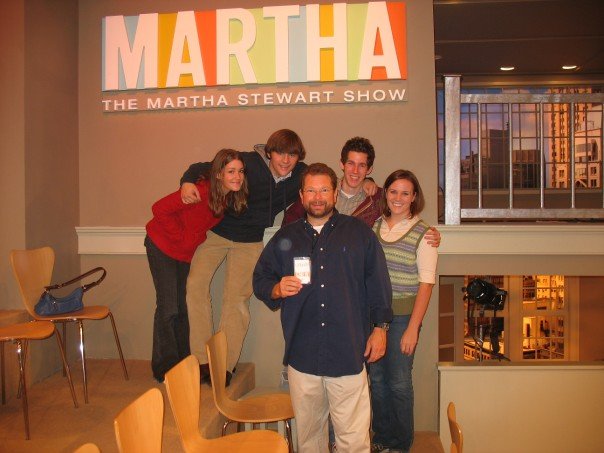
6. I was the kind of middle school-aged girl that came home from school, made a snack, and promptly started watching (in order) Martha Stewart Living, The Barefoot Contessa, bookended by 30-Minute Meals with Rachel Ray. Homework could wait. How bad is that?! In college, when I was living in NYC, the one show I went to a live taping of was The Martha Stewart Show. (It was easy to get tickets.)
 So you can probably guess that I watched the Martha documentary as soon as it dropped on Netflix. This “film” pulls back the curtain on one of America’s greatest self-made icons and the first-ever self-made female billionaire: from her start as a teenage model to her stint as a Wall Street stockbroker to her reign as the grand dame of entertaining and good taste. And of course it doesn’t skip over the white-collar crime that sent her to prison, though it does compel us to reconsider how she was treated by the courts — and the press.
On our own site, Sam Bush wrote about the hyperperfectionism that made it so tempting to glory in Stewart’s demise.
For a while, she achieved perfection, at least professionally … One of her favorite sayings is “If you want to be happy for a year, get married. If you want to be happy for a decade, get a dog. If you want to be happy for the rest of your life, make a garden.” Of course, the difference between a spouse and a garden is that a garden can be controlled. As a fellow stockbroker recalls in the film, “Whatever Martha can control is going to be fine. Whatever she can’t control is going to drive her crazy.” Indeed, Martha had what it took to achieve perfection in the eyes of the world, but at the cost of her personal life.
Martha’s prison sentence and eventual resurrection as Snoop Dogg’s bestie remind Sam of Martin Luther’s “Sermon on Cross and Suffering,” preached at Coburg the Saturday before Easter in 1530:
Just as we cannot get along without eating and drinking so we cannot get along without affliction and suffering. Therefore we must necessarily be afflicted of the devil by persecution or else by a secret thorn which thrusts into the heart, as also St. Paul laments [cf. 2 Cor. 12:7]. Therefore, since it is better to have a cross than to be without one, nobody should dread or be afraid of it. After all, you have a good strong promise with which to comfort yourself. Besides, the gospel cannot come to the fore except through and in suffering.
7. If you spend any time on social media, your halls have been decked with screen grabs of people’s Spotify Wrapped deets. As Belle Tindall notes in Seen & Unseen, there’s often more at stake than a compilation of statistics:
Since 2016, Spotify has offered its users an annual feature that gathers up and presents us with the details of our own usage, allowing us to look back over the year through the specific lens of our listening habits. While this may initially sound more than a little dull, it’s actually quite the piece of marketing genius. It’s the story of our 2024, as narrated by Spotify. The state of our souls, as outed by our devotion to Taylor Swift. […]
Every year, “Spotify Wrapped” becomes more and more of a social ritual.
In fact, this year, people were actively waiting on it to happen, checking their app daily, longing for Spotify HQ to announce its 2024 arrival. News outlets were writing pieces on how to best engage with it — there were actual bets being placed on when the feature might drop.
For most of my time on Spotify, my Wrapped was pretty okay: a decent encapsulation of my weird habit of listening to Ethiopian folk music, the ’70s Americana that my dad baptized our desert road trips in, and the grimy (read sad) alt-country that gets me through the workday. And then a four-year-old came into my life and all semblance of cool quickly vanished. At the top of my husband’s (who is actually cool) list: Phil Collins’ Tarzan soundtrack. Yes, it is one of the best-ever Disney soundtracks, but it is still mostly about a gorilla family. So that’s who we are. We used to be cool; now we are just trying to get through rush hour.
Spotify Wrapped has become a kind of soft-launch of our own brand, a low-stakes way of putting ourselves out there. Over the past days, thousands upon thousands of people have taken the data provided by Spotify and shared it with the world, sort of as a means through which they are sharing themselves with the world. Their top artists, the songs they’ve had on repeat, the number of minutes they’ve spent in the company of their favourite albums and podcasts — their listening habits have been served to us on a lime-green plate.
I’m in no way belittling this. On the contrary, I appreciate it. I think that Spotify Wrapped shows us far more about each other (and ourselves) than how much Oasis we listened to this summer. I’m really grateful that it allows us to drop our façade for a moment, reminding us how much we long to know and be known, see and be seen, love and be loved. I think it’s utter genius wrapped in a guise of triviality. It underhandedly nudges us to acknowledge that we want to belong. And so, I’m not convinced it’s “individualistic” behaviour at all — how about we call it a symptom of “expressive want-to-belong-ism,” instead?
Strays:
- Many Christmas standards were not written by Christians. David Lang explains why composers of any (or no) faith are drawn to sacred music.
- Finding sobriety — and Jesus — in Vietnam’s Christian drug rehabs. The country’s church-run addiction centers are so effective that communist officials are taking notice.
- “Maybe a better title for The Holly and the Ivy would have been ‘Silent Night,’ but no matter what we call it, it is the Christmas movie to redeem all Christmas movies,” writes Peter Tonguette.
- Keep Satan in Christmas?