




Sherlock Holmes’s logical faculty. Hercule Poirot’s little grey cells. Aristide Valentin’s French intelligence.
And now — Benoit Blanc’s altar of the rational.
In Rian Johnson’s third film, Blanc cements his place in the tradition of the well-dressed, accented detective for whom reason, intellect, and deduction are the triune pinnacle of the human mind. As he tells Father Jud and police chief Geraldine, this locked room murder is the “Holy Grail” of cases, and he assures them, “I am incapable of not solving a crime. That moment of checkmate when I take the stage and unravel my opponent’s web … Oh you’ll see. It’s fun!” He continues to tell Jud throughout the film that once he has all the pieces of the case before him, the solution will be found. He will solve the case.
How strange, then, that at the moment he takes the stage — cued in by dramatic Phantom of the Opera notes on the organ and railing about justice and guilt from the pulpit — his moment of checkmate ends not with his victorious naming of the spider at the center of the web, finger pointed down toward the seated members of the flock as the murdered Wicks so often did. No, instead, his moment of checkmate ends with Blanc seated on the steps of the altar, shoulders bowed to the admission that he cannot solve this case.
What has happened to the great detective? What has happened to the ultimate power of the human intellect?
For that, after all, is why we love detective stories and murder mysteries. It is great fun to read Conan Doyle and Christie and all the other writers who have crafted such spectacular puzzles only to reveal the most precise, the most logical, the most reasonable of solutions. And how fun it is for us, as human beings, to witness those minds at work, the great unraveling, the penetration to the heart of the mystery that seems so impossible to resolve. We love the triumph of the intellect, the joy of logic, the domination of reason because it is, in fact, a celebration of ourselves as human beings. The great detective is the great man who outwits all other men using only the strength of his mind.
Don’t we all want to be like that? Isn’t that the seduction, after all, of the murder mystery genre? But what, Johnson is asking us, happens when that greatest of all human faculties meets the deep mystery of faith?
For that, Johnson is under the influence of another kind of detective — one who marries reason and faith and, in so doing, places himself beside and against both a great inspector and a great criminal — G. K. Chesterton’s Father Brown.
At a cheeky point in the film, Blanc even tells Jud, “Go to town, Father Brown.”
Famously, Chesterton’s Father Brown is able to reach intricate solutions to mysteries not because he has the prized “French intellect” of the detective Aristide Valentin but because of his superior knowledge of human nature and the vagaries of the human heart, which he has learned, aptly enough, by spending his life hearing the confessions of his “little flock.” What Johnson does in Knives Out: Wake Up Dead Man is to take the character of the priest and the detective that we find in Chesterton’s stories and weave their roles together so tightly that neither man can walk away unaffected by the other. And in the end, Jud’s action on Blanc and Blanc’s action on Jud result in the salvation of souls.

G. K. Chesterton introduces the character of Father Brown in “The Blue Cross” with the classic writer’s trick of misdirection: “He had a face as round and dull as a Norfolk dumpling; he had eyes as empty as the North Sea; he had several brown paper parcels, which he was quite incapable of collecting … He explained with a moon-calf simplicity to everybody in the carriage that he had to be careful, because he had something made of real silver ‘with blue stones’ in one of his brown-paper parcels.”
This sapphire cross parcel will become the object of the plot as Flambeau, the “colossus of crime … a figure as statuesque and international as the Kaiser” attempts to steal the cross, and Aristide Valentin, “the head of the Paris police and the most famous investigator of the world” follows Flambeau from Brussels to London “to make the greatest arrest of the century.” What follows instead is a story that, in its brilliance, confounds both Valentin and Flambeau, leaving them both, at the end, bowing to their master, the little Essex priest. Father Brown.
Each of these men will come up against Father Brown in subsequent stories, and the difference in their fates illuminates the seeming unraveling of Johnson’s Benoit Blanc. Blanc’s character often appears in Knives Out movies in much the same way as Valentin is introduced in “The Blue Cross”: “His clothes included a slight, pale grey jacket, a white waistcoat, and a silver straw hat with a grey-blue ribbon … He was smoking a cigarette with the seriousness of an idler. There was nothing about him to indicate the fact that the grey jacket covered a loaded revolver, that the white waistcoat covered a police card, or that the straw hat covered one of the most powerful intellects in Europe.”
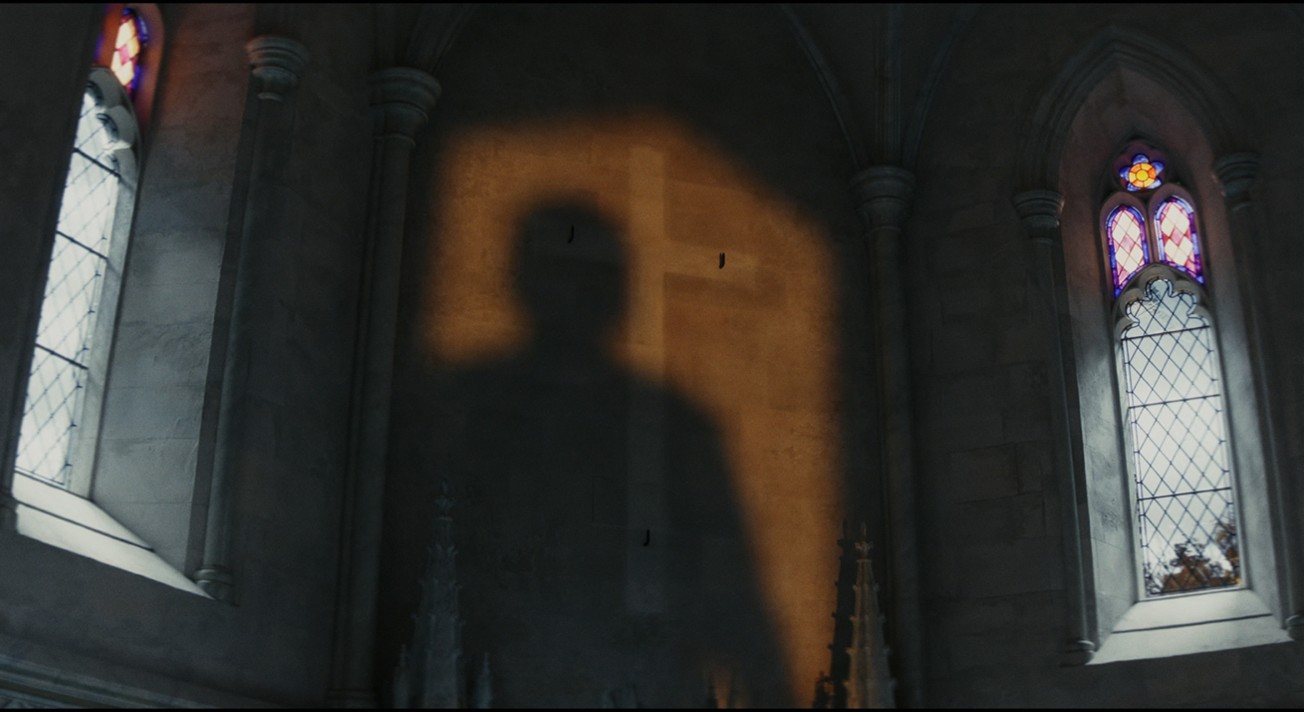
When Father Jud is on his knees, crying to Jesus to show him a way out after Wicks’s death, the door opens, spilling light into the church, on the silhouette of just such a man as Valentin. Only instead of a French accent, he sports a Southern one.
Blanc and Jud engage each other for the first time in the church. Jud has no idea Blanc is a detective; he realizes Blanc is not a Catholic. Blanc replies, “Proud heretic. I kneel at the altar of the rational.” When Jud then asks Blanc how “all of this” makes him feel, Blanc replies, “Truthfully? … Like an ornery mule kicking back, I want to pick it apart and pop its perfidious bubble of belief and get to a truth I can swallow without choking.” This truth, presumably, is that of the rationalist, the truth of the intellect, stripped from the smells and bells of the Catholic Church’s storytelling. Blanc’s own quest for truth is echoed in a quieter character in the film — that of the cellist whose undiagnosable nerve pain renders her wheelchair-bound. Continually, she asks for the truth. Can’t she just be given the answer? Isn’t that what all this is for?
Valentin appears in just one other Father Brown story, “The Secret Garden.” Coming on the heels of “The Blue Cross,” the reader knows Valentin as a masterful intellect and Father Brown as a masterful reader of human nature. The great tragedy of “The Secret Garden” is that the murderer is revealed as Valentin himself, and Valentin subsequently commits suicide. What is it that drives the great detective to take the life of not one man but two? Father Brown tells the assembled characters: “But did you never see in that cold, grey eye of his that he is mad! He would do anything, anything, to break what he calls the superstition of the Cross. He has fought for it and starved for it, and now he has murdered for it.” To prevent a man from giving millions of dollars to the church, Valentin justifies the death of one (and, eventually, two) for the greater good of breaking the yoke of the superstition of the Cross over the many. It is a tragic end to such a man. Valentin becomes the Javert who cannot live in the world of Valjean. His greatest treasure — rationalism — is also his greatest enemy, sealing his fate in his war against the church.
Will Benoit Blanc, worshiping at his own alter of the rational, suffer the same fate?
When one detective leaves the stage of Chesterton’s stories, it is not long before another takes his place. This detective, however, is a very different kind. The new detective that Father Brown finds himself alongside is none other than the reformed criminal Flambeau. It takes only three stories, from the beginning of “The Blue Cross” to the end of “The Flying Stars,” for Father Brown to do his work on the heart of Flambeau. It begins, of course, with the discussion of reason. As Father Brown tells Flambeau in “The Blue Cross”: “Reason and justice grip the remotest and the loneliest star. Look at those stars. Don’t they look as if they were single diamonds and sapphires? Well, you can imagine any mad botany or geology you please … On plains of opal, under cliffs cut out of pearl, you would still find a notice-board, ‘Thou shalt not steal.’” Flambeau tries to object: “Well, I think that other worlds may perhaps rise higher than our reason. The mystery of heaven is unfathomable, and I for one can only bow my head.” But shortly afterwards, Father Brown chastises Flambeau for attacking reason, telling him it is “bad theology.”
Blanc’s altar of the rational is not, in fact, incompatible with God.
In “The Queer Feet,” Father Brown intercepts Flambeau in the act of stealing silver. When Flambeau, not recognizing him, tells him that he doesn’t want to threaten him, Father Brown replies:
“I do want to threaten you,” said Father Brown, in a voice like a rolling drum, “I want to threaten you with the worm that dieth not, and the fire that is not quenched.”
“You’re a rum sort of cloak-room clerk,” said the other.
“I am a priest, Monsieur Flambeau,” said Brown, “and I am ready to hear your confession.”
The other stood gasping for a few moments, and then staggered back into a chair.
Later on in the story, when a character asks Father Brown if he was able to catch the thief, he replies, “I caught him, with an unseen hook and an invisible line which is long enough to let him wander to the ends of the world, and still to bring him back with a twitch upon the thread.”
But it is ultimately in the third story in which they appear together, “The Flying Stars,” that Father Brown pulls upon that unseen hook and that invisible line: “I want you to give [the diamonds] back, Flambeau, and I want you to give up this life … Your downward steps have begun. You used to boast of doing nothing mean, but you are doing something mean tonight. You are leaving suspicion on an honest boy with a good deal against him already; you are separating him from the woman he loves and who loves him. But you will do meaner things than that before you die.”
Father Brown begins his appeals to Flambeau through reason, he preaches to him of the unquenchable fires of sin, and then, finally, he speaks to him of mercy. Mercy for Flambeau and mercy for the boy he has framed. And Flambeau — unlike Valentin — is able to accept that mercy. His heart is transformed by repentance, and in the very next story, “The Invisible Man,” he and Father Brown work side-by-side to solve the mystery.
Father Jud is not Father Brown. Father Jud is, in fact, a man in crisis. A priest who, self-confessedly, is “young, dumb, and full of Christ,” Father Jud finds himself under the pall of suspicion for Monsignor Jefferson Wicks’s murder, facing, perhaps, an expulsion from the priesthood and the loss of the only thing for which he lives — bringing souls to Christ.
During Blanc and Jud’s first meeting in the church, when they discuss the stories of Christianity, Jud asks Blanc if they are merely lies or whether “they resonate with something deep inside us that’s profoundly true?” Blanc responds, “Touché, padre.”
Jud laughs, then sobs.
When Jud breaks down, Blanc’s posture changes. Jud is no longer “Father” but “Son.”
“Son,” Blanc says, “Would you allow me to help you?”
Benoit Blanc’s arc is shifted by his mercy towards another human soul. He still seeks, doggedly, the rational answer to the mystery that seems like a miracle, and throughout the movie, it is clear that Blanc believes Jud will be saved by the truth of the killer’s identity. After Jud reacts against the manhandling of Wicks’s body, Blanc tells him, “If you want absolution, if you want ever to be a priest again, then you need to go through this with me.” Later, Blanc goes further: “You’ve listened to this flock’s stories with empathy and grace, but we’re done with that now.” Jud is caught up in this idea, this Blanc-and-Jud against the guilty, to the point of smacking away Martha’s hand when she accuses him. It is only through the God-given intervention of Louise that Jud realizes how he has been seduced by the plot of the murder mystery, the idea that salvation can be found in human intelligence. Jud has discovered that siding with Blanc has put him against his flock rather than alongside them — the rightful place of the shepherd. Jud confronts Blanc, asking him why Blanc thinks he became a priest. Blanc answers that Jud felt guilt for taking a life (in the boxing ring) and the church must have given Jud a clear method for a sense of absolution.
For Blanc, the church is a process, another procedure for obtaining that which Blanc himself gives when he solves a murder: It frees the innocent from their sense of guilt.
But Jud shows him something else. Absolution is not freedom for the innocent. Absolution is freedom for the guilty. “God didn’t hide me or fix me,” he retorts to Blanc. “He loves me when I’m guilty.”
There are so many moments — clearly frustrating to Blanc — where he must prevent Jud from turning himself in, from confessing to crimes that he did not commit. The interplay between the two men is the interplay of reason and faith. Blanc assembles and interprets the clues, fits the pieces of the puzzle together, and arrives, ultimately, at the correct solution. Jud, through his desire to serve the flock and his confusion with his own role in the events, tries again and again to turn himself in, to take on the sins of the true killer, to sacrifice himself for the sake of the church. And Blanc, at every turn, stalls for more time, trying to save Jud from himself. It is no wonder that Johnson gives us so many shots of Jud opening the doors of the church with the light behind him throwing his silhouette against the empty cross — he is trying to crucify himself. Father Jud longs for his faith and his willing sacrifice to save the church and his flock. Benoit Blanc won’t let him. It is during one such moment that Jud tells Blanc, “I have to do it of my own free will or it won’t mean anything.”
Jud has seen the church under Wicks’s leadership. He has seen the empty space on the wall where the cross once hung, the ominous omen of the absence of grace. He has seen the obsession with the resurrection — from the verse on the notice board to Cy’s YouTube videos to the Lazarus door installed in Prentice’s tomb. But a resurrection without the Cross is the very fairy tale that Benoit Blanc fears when he first speaks of the Christian faith. A resurrection without a death is nothing but trickery and lies, as Martha’s “miracle” proves. Jud knows where the power, the heart of Christianity lies, and in embodying the mystery of faith, he also embodies the piteous, honest boy on whom suspicion falls undeservedly. Benoit Blanc is drawn in by the raw innocence of the boy who is young, dumb, and full of Christ. Jud’s “foolish grace” changes the way that Benoit Blanc plays his game; Benoit’s constant intervention saves Father Jud from himself. And in the marriage of reason and faith, the two men, acting together, save the soul of the true killer.
The climax of the film comes with Benoit Blanc standing triumphantly at the altar, all the characters seated solemnly in their pews before him. “It is time,” he announces, “to break this tawdry façade of miracles and reveal what really happened. It is time for Benoit Blanc’s final checkmate over the mysteries of faith.” He will reveal the machinations of the murder and the machinations of the tomb and, in so doing, bring absolution for Jud and condemnation for the killer. He will revel in the revelation of reason and the faculty of the intellect. He will show, once and for all, that the little grey cells triumph.
And then, the light breaks through the stained-glass window and shines upon his face. And Blanc surrenders.
He sits down on the steps, his shoulders slumped, and he admits that he cannot solve the case.
The flock leaves, and Jud asks Blanc what happened.
“Road to Damascus. Scales fell from my eyes.”
“So what?” the police chief fumes at him (her own faith in Blanc is on the line, after all). “Facts, schmacts? You believe in God and all this mishegoss is real?”
“No, no,” he says. “God is a fiction. My revelation came from … from Father Jud. His example to have grace. Grace for my enemy. Grace for the broken. Grace for those who deserve it the least. But who need it the most. For the guilty.”
Benoit Blanc has finally understood what absolution means.
Blanc’s Damascus moment came, in fact, not from the light that breaks so vividly through the stained-glass window but from the way that Martha touches her lips. He knows the identity of the killer, the solution to all the riddles. His intellect has won, but it is his heart that’s changed. He will not suffer the fate of Valentin.
In the same way that Blanc pitied the innocence of Jud, he now pities the guilt of Martha. Where he allowed space, throughout the film, for Jud to be saved, he now realizes he must do the same for Martha. He puts down his moment of checkmate and allows her to walk through the door without shame (instead of, as Wicks did to so many congregants, forcing her out the door by viciously pointing out her sin). And by taking the mockery of the crowd upon himself — Cy later claims on the internet that he “pwned” Blanc — Blanc allows Martha not only the freedom to walk out the door but the freedom to walk back in.
“Mr. Blanc,” she says, “you know the truth.”
“I do, yes.”
“And you made yourself the fool just now.”
“So that you could do this of your own free will.”
He has learned something from Father Jud, after all.
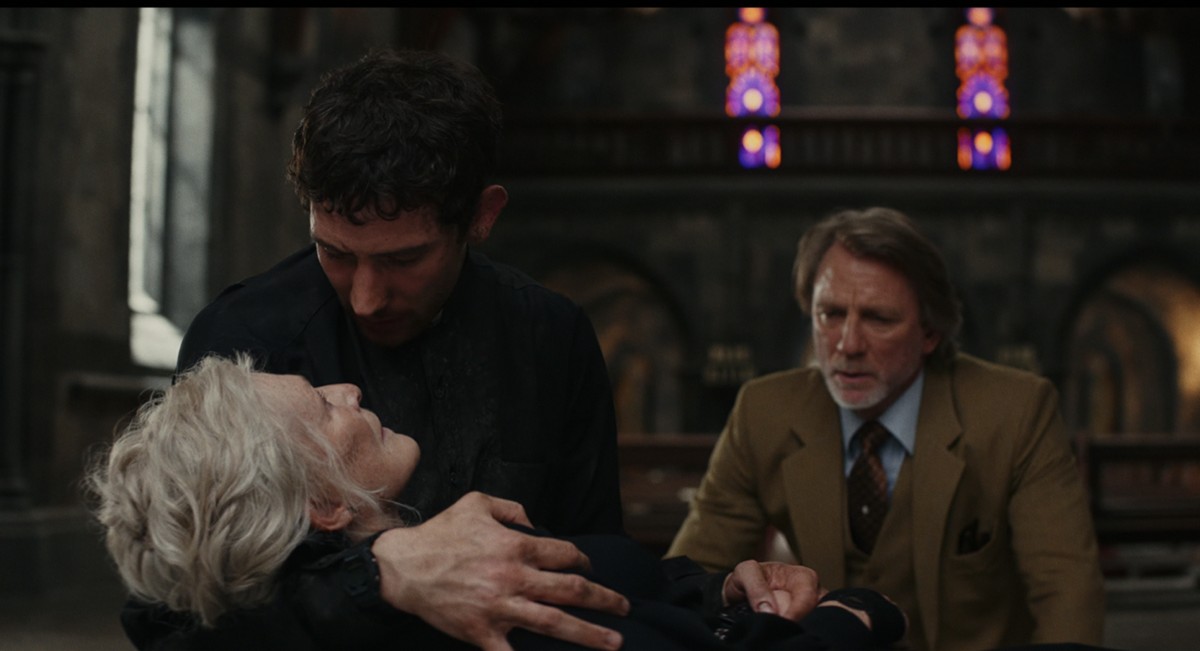
Blanc reveals himself, truly, as the ultimate Southern gentleman. He makes room for something to happen beyond the checkmate of his deductive reasoning. He allows Martha to confess her sins of her own free will, and he urges Father Jud, giving him the space and the room, to receive her confession and pray the words of the absolution over her as she takes her last breath in his arms. It is Blanc who insists Jud does what he was born to do: “Be her priest. Take her confession.”
Is it any wonder that Father Jud and Martha’s pose echoes that of La Pietà? Martha has died to her sins in her final confession, letting go of a lifetime of anger, hatred, and self-justification, letting the jewel of Eve’s apple fall from her hand, its power over her and the church she has served finally broken. Because she is crucified now, with Christ, she will have her resurrection. She dies in the knowledge of that assurance, but her death also fulfills the judgment required for the killings. Blanc’s power of reason has won the day. But so, too, has Jud’s faith.
Blanc, at the end of the film, has not found God. But he has found, through the character of the pitiful, innocent priest, the same thing that Flambeau found. He has found grace. And God and grace, after all, are ultimately united in the person of Jesus Christ, the man who hung on the tree. The man who took on the sins of the flock, the mockery of the crowd. The man who took the apple of Eve and placed it back on the tree, where it hangs, gleaming in the sunlight, washed as clean as his own sacred heart.
After all, be it Father Brown or Knives Out, isn’t Father Jud right, in the end? There is something, deep inside us and profoundly true, that we cannot express any other way than storytelling.







Thank you for this piece. I appreciate how you let the limits of reason remain exposed rather than resolved. The gospel is never anti-reason, but it does insist that truth finally comes to us as gift, not achievement. This reflection honors that tension well, letting grace stand where certainty gives way.