




Don’t just lock your phone, friends, delete all your apps, because Blake, Blaine, Caleb, and I are back, discussing Kiyoshi Kurosawa’s 2001 genre-defining Pulse (not the schlocky American remake). Get ready to feel all sorts of relational ickiness and reconsider how much screen time you allow yourself!
Ian: Welp. That film was prescient!
Blake: Basically this movie was prophesying the loneliness epidemic long before we knew that the internet was going to screw us over.
Caleb: And maybe even its consequences. We have burning cities and airplanes falling out of the sky by the end! I also couldn’t help but notice how it updated Romero’s idea from Dawn of the Dead: when there’s no more room in hell, the dead will walk the earth. I guess the same is true when you run out of server space. The internet has had an apocalyptic way of digging up our skeletons and dredging up our demons. I’d love to know what Kurosawa thinks 25 years later …
Blake: He should be proud of himself — and terrified at the accuracy in which he portrayed the future of the world.
Caleb: What a miserable thing to be right about! It’s always nice when a ghost movie is actually scary, too. The uncanniness of seeing the world through a digital lens is surprisingly akin to seeing shadows on the wall of a gothic manor.
Blake: I will admit, I found none of this scary. Even before I knew the conceit. I found the imagery to be merely depressing and moribund. It’s a bait and switch of sorts. I came to it for an Asian horror that I expected to follow suit with Ringu, Dark Water, etc. and got a gut wrenching tour of modern-day existence.
Caleb: Oh, I had the exact opposite experience! I expected a kind of proto-elevated horror that felt more philosophical than visceral — and while this wasn’t gory, it was deeply upsetting to see.
Blake: The wiry-haired ghost woman attacking Junko was the closest to classically scary it got for me. The “tripping” ghost and the various splotches and projections were deeply saddening to me.
Caleb: That “famous” scene of the ghost woman staggering toward that student was so scary because it was like this horrible existence was being thrust upon him. The irony of a transferable isolation. She wasn’t angry. She wasn’t malevolent. Just utterly ordinary and SO spooky because of it.
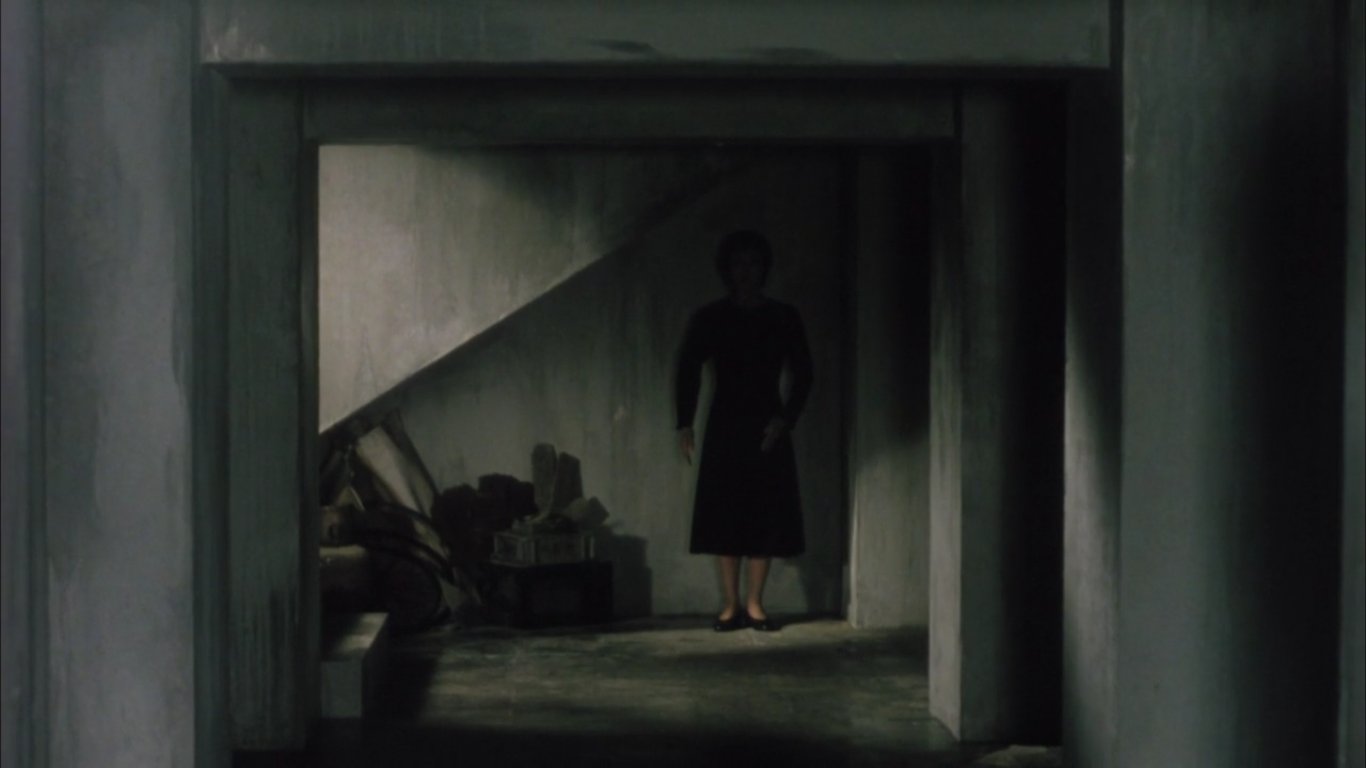
Ian: The way she staggers is so eerie, it bothers even me. I don’t mean to present myself as so hardened and unaffected in saying that; all I’m trying to convey is how that got stuck in my craw in a way that more straightforward “scary ghost” stuff often doesn’t.
Blake: Transference is the key to this movie and the deeply unsettling mirror it holds up to us today. It makes sense that, much like how information gets transferred through machine language over circuits, so does our biological matter become a black mold on the spaces we inhabited. Transference is effectively literal and figurative in this film.
Caleb: That’s interesting. It’s like our online “presence” — if it is anything — is just a kind of sickness or stain more than anything substantive.
Ian: I could not agree more. Our activity online is typically transmission, but not of anything good.
Blaine: One way it does that so well is that it utterly strips both the viewer and character of any agency. There’s no mystery that can be solved, no Sadako to confront — just a steady march toward ceaseless pain and suffering.
Blake: It’s an existence without actually existing.
Ian: Yes, in the film’s language, “dots that never connect.” But beyond failing to relationally connect, it’s also like a one-dimensional ontology: a whole lot of nothing.
Blaine: And when the dots do connect — when the digital and the physical do meet, the latter destroys the former.
Blake: And this is why I think I have such pervasive compassion and empathy for those who fall into conspiratorial thinking. Making shapes in the slew of dots that make no sense. When all is mediation and there is no immediacy or touch, what then is there left to trust? What can be relied upon to anchor our ontology?
Caleb: Absolutely tangential, but it was so funny to me to see this class of high schoolers wearing the same kind of stuff high schoolers today wear. Baggy, boxy streetwear. But that’s the physical, social, traditional world — where things are meant to endure.
Blaine: Also tangential: Do you guys ever watch something and think about how much worse a particular aspect of it would be in the hands of another filmmaker? This time I was struck by how fantastically terrible the plane scene would be in the hands of JJ Abrams.
Ian: I think that’s … most things.
Blake: Way worse … and it wasn’t great here, but it didn’t bother me.
Caleb: Well, Americans did make Pulse 1–3. So I don’t have to imagine too hard.
Blake: I’m curious what you fellas come up with, but considering the first two films in our series and the upcoming one, this seems to be the only film with no seeming hope in it or alluded to within its depths. Did you fellas find hope? I’m not sure I did. I think it largely just hit me like a ton of bricks. And ended.
Caleb: I think only in the ill-fated confession Ryosuke makes to Harue — that they’re both weak, but together they can live. I think that we do need each other. I think that’s true even if we don’t see that bear out here. But otherwise, no.
Blaine: Completely agree.
Ian: That’s what I found. It seemed like the promise of connection was itself the medium of transmission, and the only inoculation was the shop owner’s advice, “Who would want friends like that?”
Blaine: I’m also struck by how Kurosawa depicts the characters becoming ghosts in apocalyptic terms — the shadows on the wall an echo of Hiroshima and Nagasaki.

Blake: We need each other like Taylor needs Travis.
Ian: No. Well, also yes. Blake, maybe you could say a word about Luddites, as this film makes a case for something we care about deeply that is routinely maligned …
Caleb: Yeah, say something for us hopelessly online folks.
Blake: Like the automobile was the first big mistake and it’s only quickened our technological deadening ever since? Or is that too much Russell Kirk?
Blaine: We’re always looking for the ghost in the machine, but it looks like they found us a long time ago.
Blake: Well, unlike industrialism and the variants of tools that were used and coerced on workers, the technological tools being used and forced on workers today are becoming less and less able to be “broken” the way the Luddites did. Because the singularity of tech and Kapital has begun. So in that sense, I think Pulse is compelling and cogent and ends the only way it can … the way our world is residing now.
Caleb: Like how the McDouble is merely a tool of Big Real Estate. Even if you aren’t bah bah bah bah bah lovin’ it — you’ll really never love one company owning some of the prime spaces of all our communities … But also, to insert myself into the place of moral scrutiny — all this rightly directed aversion to “communication” technology will not actually stop me from using it. Like, I can’t leave the haunted house. I don’t really want to, even though the ghosts are torturing me. And so it’s true what Harue says in the movie: “Ghosts and humans are the same.”
Blaine: I think this was the first time I watched Pulse since GenAI took off, and it made me think about instances where people are convinced they’ve contacted a demon through a chatbot. We’re always looking for this sensational, headline-worthy indicator of the ills of certain technologies, but we remain willfully ignorant of the material forces therein that shape our way of being in the world.
Caleb: Spot on.
Ian: This is one of the mistakes of simpletons who use “Luddite” too loosely: technology cannot be lived without in some form. We have always and will always make and use tools. But we are oblivious now to how our tools shape and use us. The real question is which technologies are humane and help us to be human?
Caleb: Also spot on.
Ian: Black spot on. (The wall)
Caleb: Ahhhh!!
Blaine: I feel that if you read our conversation without having seen the movie, you might conceive of it as an A24-style subtext-as-text affair, and I don’t think anything could be further from the truth.
Ian: Do you mean to suggest that what transpires in Pulse isn’t simply a cipher for something more significant than what we see and hear in the film itself??
Blaine: I’ll say that, because I like the way it sounds.
Ian: TAKE NOTES, ARI ASTER! But for you fellas, what are your concluding thoughts on Pulse?
Blake: As my wife oft puts it, this film is one that makes me want to eat my own liver. I might have been scared by it if I hadn’t been so taken aback by the sheer prophetic notes it rang. Notes that make me sad for the state of our world and sad for the future to come.
Caleb: And that Ghost of the Future (like the one in Charles Dickens’ novella) although harsh, does come as a friend — that is, if we heed his somber warning.
Ian: Pulse, to me, shows our era what it is, non-allegorically: haunted by ghosts, haunted by emptiness and the halfhearted desire for connection, and more eager to be consumed by simulacra than to take up the thing in its actuality and with all its cost.
Blaine: The other day my oldest asked me what hell is like. I asked her what she thought hell was like, and she said, “People live sad without God.” That’s precisely how Pulse makes me feel: both terrified by and pity for the spirits in equal measure.
Ian: That’s a wonderful and grave judgment from your daughter, Blaine, and it reminds me of an exchange that I think comes back full circle to Pulse. Apparently, when Stanley Kubrick began pre-production for The Shining, he called Stephen King and at some point said to King, “Ghost stories are fundamentally optimistic.” King was puzzled and asked how that was, and Kubrick said, “Well, because ghost stories mean that we survive death!” And King said (I’m realizing now that I’m siding with King, what is going on?), “Ok, but what about hell?” And Kubrick was silent for a long moment and then sternly said, “I do not believe in hell.” It turns out, then, that survival isn’t intrinsically good, and neither is connection intrinsically good.
Blaine: C’mon, Stanley! Also, Ian defending King … what is happening?
Ian: This really is an apocalyptic disruption, isn’t it?
Thanks for tuning in for this conversation, folks! We hope you will not settle for simulacra and will instead take hold of substantive connection. Now put on your spurs and load your six-shooter for Bone Tomahawk next week. See you then!







