As a dad to two toddlers — silly Phoebe and lively Joanna — I’ve become accustomed to the veritable petri dish that is our house. We’ve got germs coming in from the four corners of the earth. It feels like we’ve been sick about half of the last four years. As such, I’ve revisited a custom of my childhood. When I felt ill, or when I wanted to trick my mom into thinking I was, she would take me to a magical place, an opulent temple to story and fun — Blockbuster.
Aisles of VHS tapes, the vinyl of the film world. And of course, that new release section, and inevitably, those movies that took ten minutes to rewind. And so I’ve gotten in the habit of putting together a list of movies for when I’m sick, often the movies I know my wife wouldn’t touch with a ten-foot pole. For me, that means horror films.
A couple of weeks ago when the stomach virus haunted our household, I popped in the third and fourth installments of the post-apocalyptic series that began with 28 Days Later. In 28 Years Later, we meet a twelve-year-old boy and his father. It’s been 28 years since a deadly virus infected the bones and flesh of humanity. The boy and his father live in a commune located on an island off the coast of Scotland that is connected to the mainland by a narrow path of rocks.
The end of the world has driven humanity back into the ancient rituals of emerging adolescence, and so the boy and his father walk toward the mainland for the boy’s first experience off-island. The world is far more inhumane and dark than the boy imagined in his nightmares. As he and his father fend off a legion of zombies, the boy notices a tower of billowing smoke on the horizon. “What is the smoke for, Dad?”
“That’s the smoke from a raving lunatic, Dr. Kelson. You must never go there.”
Upon returning, just barely, to the island, the boy witnesses his mother’s rapidly declining health. He takes drastic measures, escapes with her to the mainland, and accompanies her to meet this madman of a doctor. When they arrive, they see an arresting sight. As far as the eye can see, there are towers of bones glued together, and at the center, a temple reaching up to the heavens made of human skulls. And there is Dr. Kelson, far more humane and gentle than the myths suggest. “What are the bones for?” asks the young boy.
The doctor responds in Latin, “Memento mori.” Remember death.
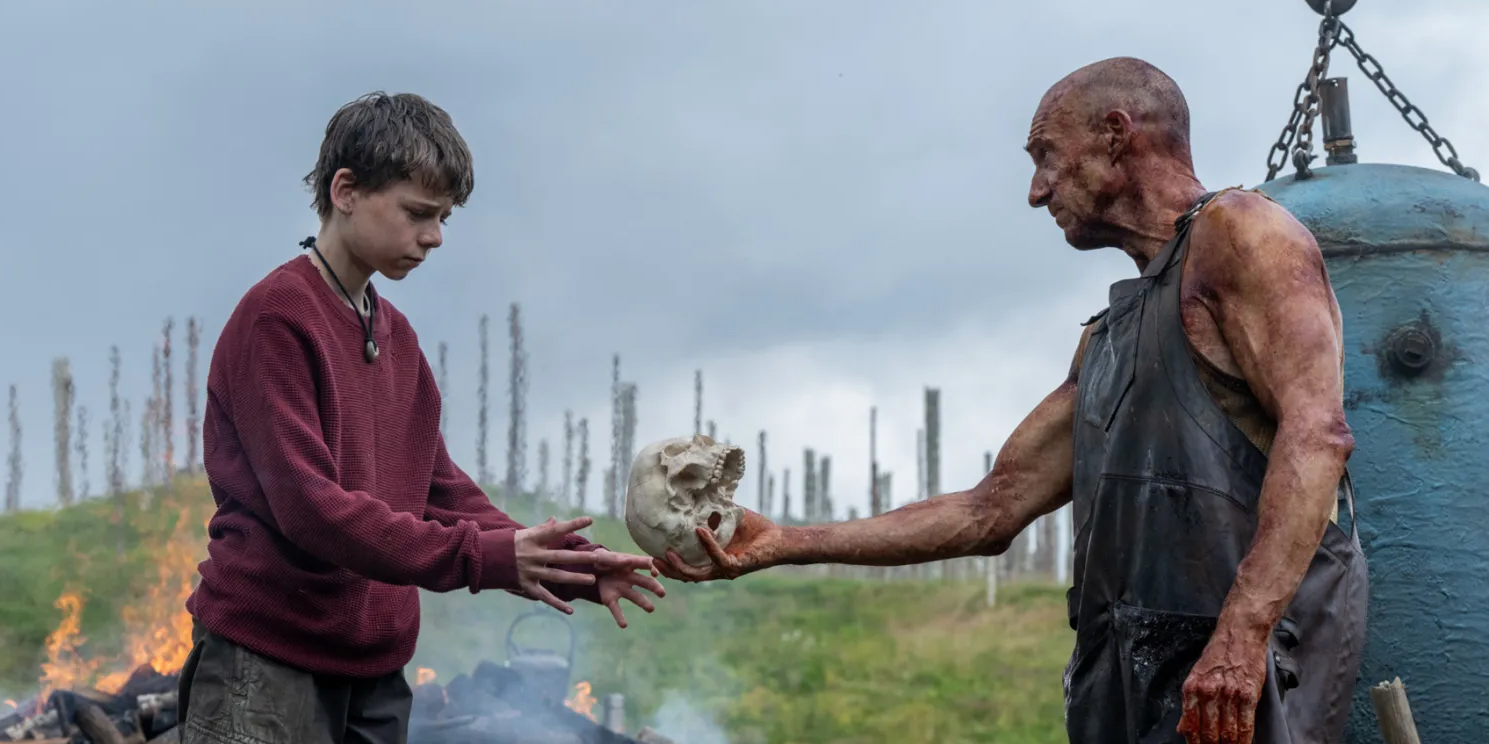
For 28 years, Dr. Kelson has been collecting the dead, erecting an ossuary of their bones. Even at the end of the world, even when humanity has reached its conclusion, Dr. Kelson dares to remember what has been lost. And with a glimmer of hope in his eyes, he dares to believe that death is not all there is.
As a theologian and preacher, I couldn’t help but gasp as I saw in terrifying and beautiful cinematic form the story of Ezekiel and a valley of very dry, very many bones. The prophet who resides in the homelessness of exile is violently ripped away by the Spirit’s hand and brought to a valley of bones where the Lord “walks him amidst all of them.” Zeek knows not what this valley is, nor does he yet know to whom these bones belong. These bones are scattered — in other words, one cannot know which bone belongs to which. It is an image of a devastated and disconnected society — a culture that has come to the end of itself. Memento mori.
And then comes the question upon which the whole Old Testament story, the whole story of humanity, hangs, “Son of Man, can these bones live?” Can all that is lost be found? Is death victorious? Does God keep promises? Do we have a future?
For the first time the Lord speaks, “Son of man [God’s name for Zeek], Speak to the bones, and I will put my breath in them, I will connect their sinews and put skin on their bones, and they shall live.”
The dry bones have ears to hear, and the Spirit’s voice through Ezekiel pierces through their death. Even so, Zeek’s first prophecy is only partially effective, for “the spirit is still not in them.” For his second speech, Zeek speaks directly to the Spirit breath of God. From the four corners of the earth gushes the violent pentecostal wind of God, vivifying the zombies that now stand in the valley of the shadow of death. It is only at this moment that God finally reveals to Zeek to whom these bones belong, “These are the whole house of Israel.”
Zeek sees before him the faces of his friends and family. All he has lost stands before him, bone of his bones, flesh of his flesh. In the moment Zeek finally realizes to whom these bones belong, that this valley is the tomb of his people, he is also given the reason they are there at all. Dem bones speak, “We are dried out completely, our hope is lost, we are cut off completely.”
Withering, hopeless, alone. The anti-trinity of modern times. Many feel as though human society has reached the end of itself. For all our striving and progress, we are utterly disjointed and disconnected. Sinew from sinew, bone from bone, we have lost touch with what makes us human. If the bones in our lives and in the world cried out, what would they say?
As W. H. Auden put it, “We would rather be ruined than changed, we would rather die in our dread than climb the cross of the moment and see our illusions die … we who are bound to die need a miracle. Nothing that is possible can save us.”
Can these bones live? God’s answer is not a fact but a person. God incarnates (enfleshes) into our valley of dry bones. The Son of Man, Jesus Christ, puts on sinew and skin, and with the spirit pulsing through him, he stands for us at the end of the world. Jesus dies not on a mountain but in a valley, a valley called “Golgotha,” the place of the skull and bones. Somehow Jesus is at once the hand that dragged Zeek to the valley and is also the prophet himself, speaking life into withering bones. Three times Zeek spoke into his people’s derelict end, three days Jesus’ bones lay fallow in the tomb. By some miracle, God doesn’t allow our ruinous ways to end us. Our ruin, his. Our death, his. Our bones, his.
As the wild prophet Dr. Kelson reminds the young boy while he places his mother’s skull upon the top of the ossuary, “Memento mori, remember death, but also, Memento amoris, remember love.”
Can these bones live? Impossibly, yes. God’s Spirit lives at our end. These bones shall live. They must. They can. They will. Remember death, but more than that, remember love.