Unlike its high-voltage action-adventure predecessors like Terminator and Alien, Mission: Impossible hasn’t relied on special effects — Tom Cruise is the special effect. He runs at near-Olympic speeds in jeans and boots in M:I 3; wears glass contacts as he hangs from the side of a military plane as it takes off in M:I 5; and jumps a motorcycle off a cliff at such an angle and speed that his body out-launches the two-wheeler, gliding far enough from the cliff to open his parachute. Last but certainly not least — if perhaps not last — the series culminates in the most epic chicken fight between planes of all time in Final Reckoning — a kind of Cirque du Soleil meets hockey-game brawl.
The stunts are increasingly absurd, creative, and liberating, testing the boundaries of what you think is possible. Screw suspension of disbelief: this film series says, “Yeah, you — go ahead and try to wrap your mind around this!” The films may be an increasingly complex collage of bombastic circumstances, explosions, and fights, but they are also increasingly intelligent. The series says “wrap your mind around this” in the same way Martin Luther does with his theology of the cross in the Heidelberg Disputations and speaks with a voice as swift to name evil as Flannery O’Connor. Mission: Impossible is infested with theological landmines — invisible but unavoidable — like the Book of Common Prayer dropped into a dream sequence. The series is littered with theological pressure points — trust, confession, mercy — triggered by the very stunts that make it famous. Follow those pressures and you arrive at a hero of glory giving way to the cross, evil named without flinching, and absolution enacted.
When the Hero Needs Saving
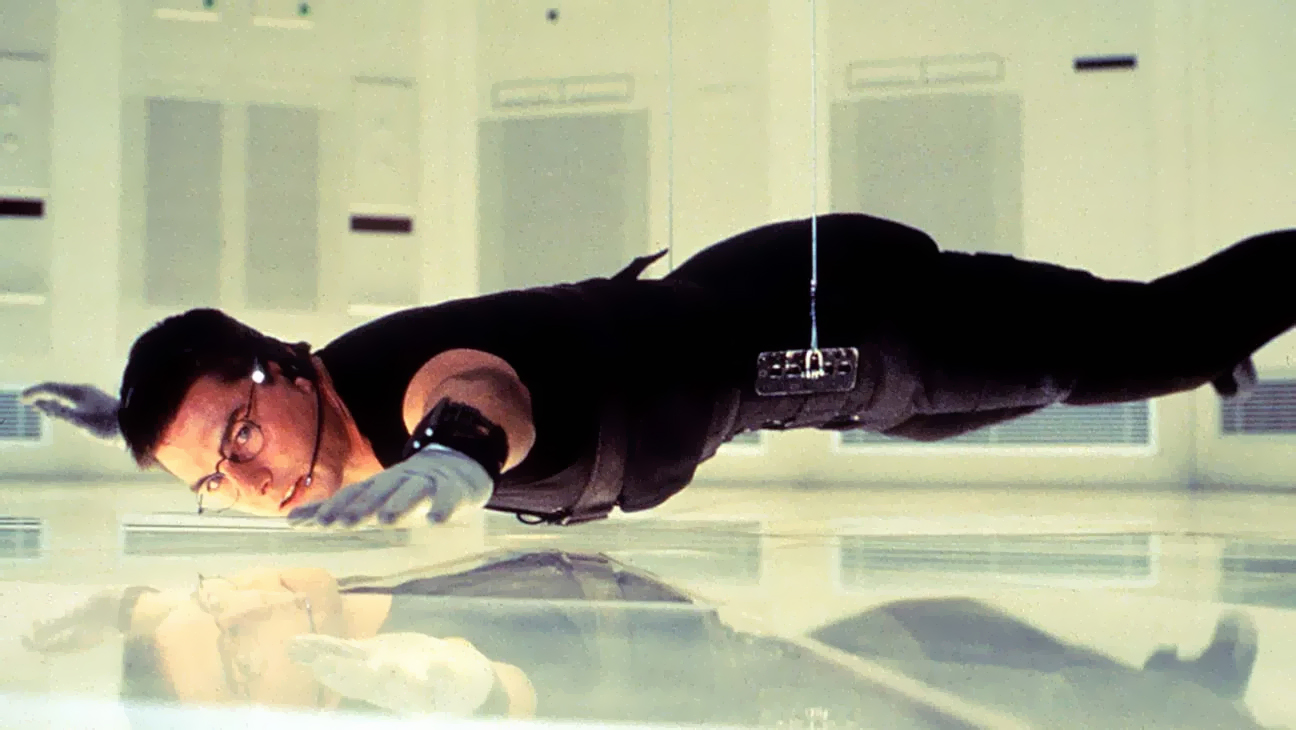
Ethan Hunt is not the “Christ figure” of the typical American action genre. Arrestingly similar to the expectations of first-century Jews, he’s not the military victor or political liberator we expect. His work is often hidden, unnoticed, or inconceivable to the world that benefits from it.
Leather-wearing, gum-chewing Ethan Hunt swaggers onto the screen in M:I 1. His mischievous and highly competent manner has distinguished him from his peers, and so Jim Phelps, his former teacher, pulls him into the Prague mission. Ethan dons bravado with a little help from a theater degree. (Yes, he is said to have studied theater and linguistics, which also explains his fluency in other languages; see the this video for more details, or the M:I 1 DVD bonus features.) We watch Ethan get into impossible situations and work his way out of them — at least initially. As the series continues, Ethan is no longer the ever-capable savior he first appeared to be. In the last scene of Final Reckoning, we see him surrounded by his friends — the ones who have saved his life on countless occasions. From M:I 1 onward, he grows increasingly dependent on others for help — and for salvation. You could even say Philip Seymour Hoffman was that salvation when he appeared as the horrifying villain in M:I 3, single-handedly rescuing the series from the lovesick, bombs-blasting-in-the-distance, poor dialogue of M:I 2.
Most heroes grow into their powers. Ethan sheds his. The more the stakes rise, the less he trusts his gifts and the more he bets on his friends. His skill set is generally stagnant despite the stunts; we don’t actually see him learn anything new. He fails more and more frequently, which shoves him from self-sufficiency to desperate interdependence. In terms of craft, Ethan’s increasing failures are effective screenwriting. Rather than asking, “How is Tom Cruise going to get out of this one?!” we start asking, “Will he?” — a classic example of raising the stakes. We witness a competent special agent become less and less competent in his own eyes. As the villains grow more powerful, Ethan falls into their traps. He suffers at the hands of Hoffman to free his fiancée, the leader of the anarchistic Syndicate outwits him, and “evil Superman” pulverizes him in the bathroom of one of the series’ more notorious party scenes — and he is saved only by his comrade Ilsa’s trigger finger.
By Final Reckoning, Ethan is at his weakest — yes, bearing his burden with extraordinary bravery and technical ability. Still, he’s aware of his total dependency not only on his friends but also on his enemies — his betrayers. He’s not the self-sufficient theater-and-linguistics double major we met in 1996. His journey doesn’t seek to connect with some “true inner self” stifled by circumstance or ignorance — the sort of salvation delivered to us by Freud and riffed on endlessly across contemporary culture. Yes, Ethan is haunted by his past, but he does not experience a gnosis that reconnects him with his origins and empowers his salvific work. Rather, Ethan needs to be reminded — not who he is, but what he is called to, what identity has been given to him. His identity is caught up in something greater, unrelated to accolades or past performances. As his comrade Luther reminds him, he is not made to self-actualize but to let go of himself: to walk in the way of weakness and sacrifice — in the way of the cross.

Unambiguous Evil: The World, the Flesh, and the Devil
Mission: Impossible exposes its audience’s most pressing anxieties. Through the decades, it has riffed off what was happening in the news, what we were in therapy for, and what our nightmares were about, effectively seizing our imaginations. The movies elicit fear and then cathartically release it, as many great stories do. But where many halt, M:I plunges deeper, into the question of evil itself. From the beginning, M:I has ventured to explore the evil within: first within its ranks, then within the inner circle, and most recently within ourselves. It asks, What is evil? Where is the origin of evil? And what we find — what I find in the series — is an unrestrained contemplation on the world, the flesh, and the devil.
The series begins with an emphasis on the “villain”: a singular character who is both the hero’s competitor and evil made manifest — a kind of Satan. This devil’s first appearance originates in the Prague mission, where the big gasp comes when we discover that Jim Phelps, head of the mission and a highly regarded leader in the Impossible Mission Force, isn’t actually dead but alive — and not only alive but defected; and not only greedy but intricately villainous. Enter distrust.
Can we really trust anyone? Can we trust our team? How do we build trust? These are acute, even esoteric questions the movie poses and continues to pose throughout the series, but on the ground they look like Phelps’ secret deception. This man is respected; he’s at the head of the team and, in Ethan’s heart, a father figure. In the real world, we’ve seen people in power conspire for their own benefit, betray their people, and succumb to the warping plague that naturally rises as one rises in power. Call it the zeitgeist: parallel pressures make the films feel timely, whether or not they meant to be. Remember, this was the era of the third wave of feminism and, later, the aftermath of #MeToo, when power was being questioned in a personal way — not just who should be in control, but what particular individuals actually care about and how they use their power.
The film not only mirrors the real-world questioning of the powerful but also names the evil at the heart of power’s corruption. Ethan is the underdog with nothing behind him except his brains, and he searches for those stripped of power. Ethan and his various teams of misfits and ethical border walkers pull back the curtains of Emerald Cities and herald justice. Their justice, abnormal for the action genre, is principally nonviolent. Yes, they blow things up and sometimes kill, but their foremost ethos is to seize justice by way of mercy until left with no other choice. This ethic consistently juxtaposes Ethan (and his team) with the series’ villains, who embody an evil that wields suffering and death as reliable chess pieces in the pursuit of power.
Have you thought about the end of the world lately? The sequel — God bless it — in the lineage of The Andromeda Strain, Warning Sign, and Outbreak, taps into our fear of an unstoppable, fatal pandemic. These are particularly manufactured, ultra-fatal, zombie-like viruses. In the form of the Chimera virus, evil spreads invisibly in this movie, albeit “naturally” (unlike what we see at the end of the series). Evil is woven through the natural world.
M:I is notoriously shot around the globe. The camera’s underwater plunges, drones over the Arctic, handheld sprints into a desert sandstorm, and zip lines between Tokyo skyscrapers embed us in a global community and awe us with the outrageous beauty spun throughout the earth. But within this beauty, as in all good depictions of it, lies terror.
Sea, sky, city, countryside — all are infused with danger. And not only the natural world but also the objects we have made. When Ethan scales the side of the Dubai skyscraper, we’ve already seen an assassin shoved through the very window he climbs through. Technology fails him when his sticky glove malfunctions — not in revolt, as with AI in the final episodes, but by sheer accident. The world not only harbors dangers; sometimes it simply fails us.
It’s easy to view violent natural disasters with rising death tolls as evil, but M:I enlightens us to the everyday evils that coexist with the goodness and magnificence of the material world. This visual suggestion reaches its climax in the two Reckonings. Sweeping shots of the Arctic Pacific paint a landscape gleaming with fresh, glittering snow. Its stunning icescape is the same ice that traps Ethan beneath it and tries to kill him. Then we’re whipped into wonder when the scene breaks and jumps forward in time: he’s safely extracted and pulled back to the land of the living. Outside his tent under beams of sunlight, the snow glitters again, conjuring our initial perception of the land.
The series’ depiction of the world doesn’t simply pin some terrains as villains and others as oases; it gives us a complicated picture where good and evil intertwine, where tares rise with the wheat. Ethan doesn’t subdue this world and suppress it under his command. The world is not Ethan’s footstool. Even when he ostensibly performs the impossible and overcomes individual obstacles, he remains rooted in it and subject to uncontrollable forces.
In modern life, we often don’t notice these forces until a natural disaster is on the news, we slip while hiking and twist an ankle, or our car hydroplanes and spins beyond the reach of our steering wheel. But once the awareness is there, it’s there. Some move on more easily than others, but to some degree we’re still aware: we buy flashlights and generators, we step more carefully across a rocky stream, we drive more slowly in the rain and remind ourselves not to slam on the brakes. Ethan’s scrapes with the natural world are off the bell curve of normal experience, but they remind us — and often force us — to reckon with the way beauty can turn against us and grandeur can become personal in one unsuspecting flash.
The initial films address fears without — the problem of evil that lies in the other or in the land. We have cults — many of them: cults for disavowed agents like the Syndicate and cults for the masses when AI meets environmentalism in the anti-human movement in Dead Reckoning. The embodiments of evil evolve over the series, transitioning from individuals to cults to organizations to artificial intelligence, adapting to technological advancements. Yet as the manifestations change from face-to-face betrayals to systemic proportions, evil becomes more palpably personal. The last films swing hard toward the evil within, and rather than inviting us to condemn evil, they say, “Whoever among you moviegoers is without sin, cast the first stone!” We are forced to see ourselves as the bad guy; our faults are laid bare on the IMAX screen; we see ourselves as co-conspirators in our own demise.
Criticism about social media and artificial intelligence isn’t new terrain. But they may be among the most powerful tools of evil humankind has ever seen. Their manipulative behaviors and life-altering effects on young people are villainous. However, unlike the past, there isn’t one figurehead to blame. Knowledge and power are distributed in complex ways across organizations, companies, lawmakers, individuals, and — above all — technology, leaving us stabbing at air. We can hate and blame all we want, but Mission: Impossible turns our pointing fingers back on ourselves.
M:I portrays humans as quasi-cyborg: technology is an extension of our flesh and thus infused with the good and evil potentials that arise in us. Ethan shouts in Final Reckoning that “AI isn’t thinking.” It hasn’t gained personhood and isn’t playing by its own creative rules. He points out that “everything it’s doing, it learned from us.” We have embedded this technology with our faulted flesh.
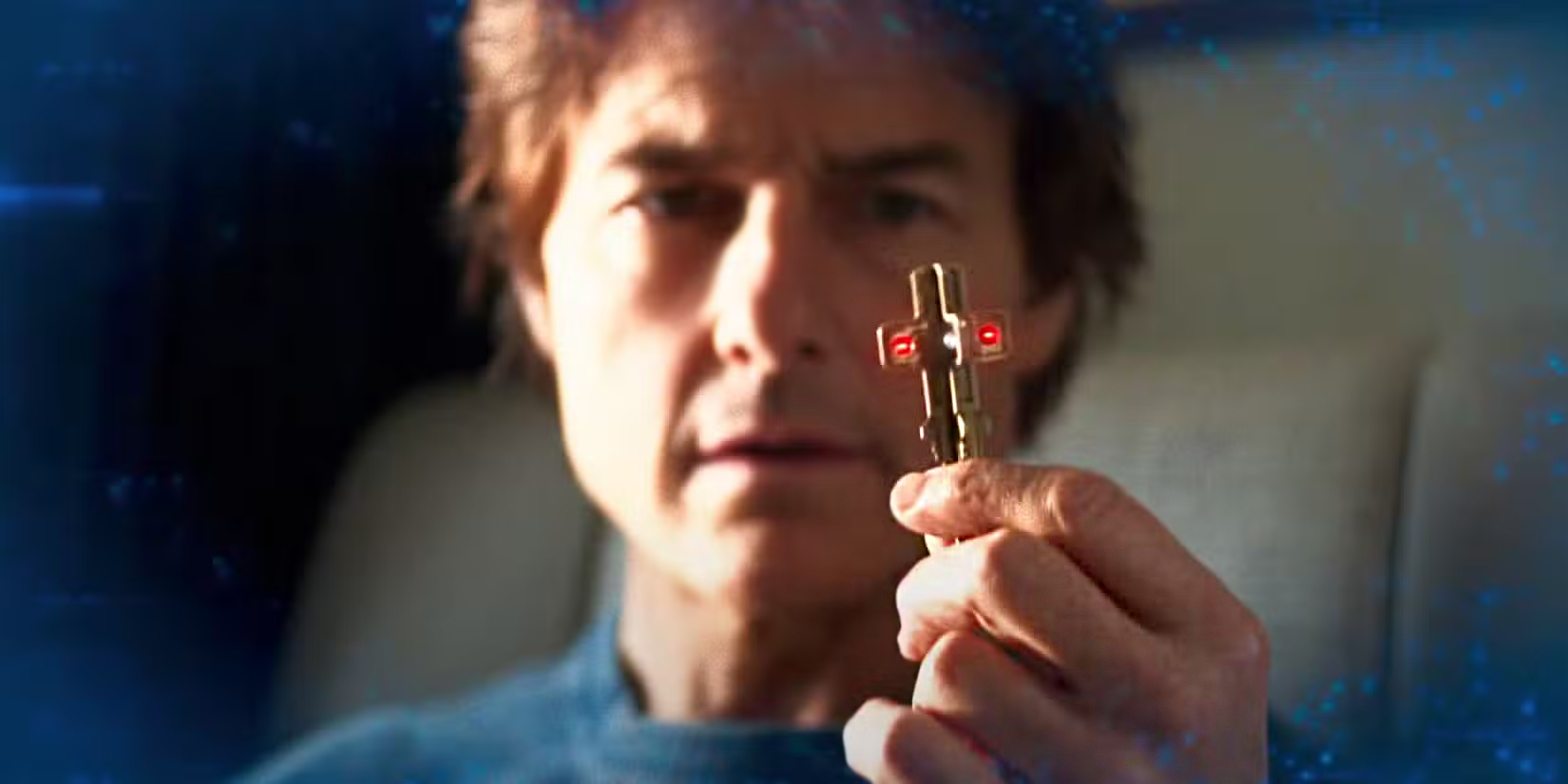
What is the primary tool of destruction the Entity — the rogue AI — employs? Distrust. It sows a mustard seed of skepticism and grows it into a looming, unshakable tree. The Entity infuses people with distrust — of large news media, social media, organizations, governments, and each other, especially those we hold close. As AI becomes more proficient off-screen, particularly at fabricating voices and video, the future of reporting feels nerve-racking. The social media that helped us call attention to commonplace evils is now increasingly capable of creating them and infecting us with sociopathic viruses. Final Reckoning, splendidly, resorts to older modes of verification: a sealed letter with a reference known only to sender and recipient, an emblem identifying the one who dispatched a messenger. These were common in ancient and medieval times but have fallen out of fashion as other modes became “reliable” and we learned to trust technology over people.
Our tools have power. Just as power corrupts in position, it corrupts in possession.
The evil becomes more personal because it always becomes a vivid internal struggle over the temptation to use the Entity “for good.” If only that powerful technology were in the right hands! This notion forgets — or disbelieves — the enchanted nature of reality, embedded with good and evil whether from an outside source or infused by humans.
Ethan recognizes this from the start, and at any moment someone suggests he take the Entity. When Grace, lying in the tent, says essentially, “The only person in the world I trust to do good with this is you,” Ethan says no — not even me. Despite the good he has done and the sacrifices he has made, his low anthropology makes him keenly aware of his own inability. In this movie we also see many people distrust each other — friends and enemies alike — from the Russians on St. Matthew Island to Ethan’s motley crew. Trust is riskier than ever, yet it mirrors the trust and risk in our daily lives. When everything tells us to be stoic and skeptical, this movie says be emotional and (seemingly) blindly trusting; it’s the only path forward. Not mere solidarity, but hope. “Do not be overcome by evil, but overcome evil with good” — and that good is trust on a personal, risk-taking level.
The corruption of the AI Entity depicts — and effects — the corruption not only of human society but also of individual flesh.
Horror has always been good at this: looking evil straight in the face. Not only saying “evil exists,” but also “this is what it looks like — this is who it looks like.” You know that darkness in us Ethan mentioned, the one the Entity learned? M:I embodies this not only in the orb the Entity projects on ceilings and in tomb-like boxes, but in Gabriel, its messenger. Gabriel is more than a messenger; he is a kind of word — logos — of the AI god, a representation of an invisible reality. In Final Reckoning, we meet Gabriel after he is “let go,” so to speak, from his divine job, but that doesn’t change his character. It somehow makes him seem more evil. I pitied him in Dead Reckoning, but I feared him in Final — beyond empathy or pity. He became evil resurrected.
Things Done and Left Undone
In Dead Reckoning, two brand-new characters are introduced and, by Final Reckoning, are conscripted into Ethan’s intimate, long-time team of Benji and Luther. They go from people we’ve never seen to essential players in the final mission. Yes, many characters come and go, but the Reckonings raise the dead. Significant and insignificant figures from thirty years of moviemaking revisit the scene. These “resurrections” make the newly introduced Grace and Paris such mysterious anomalies. They mark what the heart of the series is about. Their two-movie confessions and absolutions draw our attention away from epic, world-ending evil and down to the world-altering power of mercy and grace that visits us at the individual scale.
We meet Grace in the Abu Dhabi airport, stealing half of a key for a client. She’s highly skilled at surviving. She isn’t portrayed as evil or even morally ambiguous. Instead, through a conversation with Ethan, we learn that her pursuit is self-interest, protection, survival. Her job is “just a job.” She’s also the person we’re supposed to connect with — the straight man, the John Krasinski of Mission: Impossible, the one who shows us ourselves on the screen. Her motivations are simple: self-protective and self-sustaining in the most generous way, yet ultimately harmful — propagating a system she knows nothing about, a chain that would destroy the world as she knows it. But she doesn’t know it. She chooses not to.
In the Book of Common Prayer rite of Confession, we pray for forgiveness and acknowledge our sins, “by what we have done, and by what we have left undone.” In a way, by not looking into what’s going on, Grace steps aside. Her sin is one of the things left undone. Her connection with the audience — her seeming unknowing — makes her an unlikely figure to show up in a series that laughs at the name “Impossible Mission Force” and then finds her in a situation she doesn’t understand and cannot manage. We’re meant to relate to her. And this relationship asks a question of us: how often are our “things left undone” motivated by preoccupation with the self?
For Grace, leaving good things undone was an active consent to self-preservation: an aversion to physical danger but, even more, to mental and emotional danger; the protection of a reputation that moves us to step back, to avoid the risk of doing good, to refuse knowledge. It is easier to turn away — to shut our eyes — than to know what’s going on and be forced to reckon with our role, whether that means letting it go and letting it roll on, or jumping in and taking a risk.
Then she’s given “the choice,” the moment that comes when you’re caught — the thing Luther and Ethan have referenced in the last few movies. Hers is an intellectual kind of conversion, born of circumstance rather than apologetic: she has seen good and evil, experienced a salvific moment, and now must confess — a confession we in the audience already know and are nearly certain she’ll accept. It’s the pattern of the story and more: the pattern of irresistible grace performed through the story. She accepts. But that’s not the end for her; it’s barely the beginning.
She enters with a verbal confession and is met by kinetic absolution. No one says, “You’re forgiven; go in peace,” but she enacts absolution — or, better, its effects. Those “things left undone” born of self-preservation are transformed into the final moment, the last obstacle to defeating evil. The whole story comes down to her — her skills, her hand, her action. And she does it.
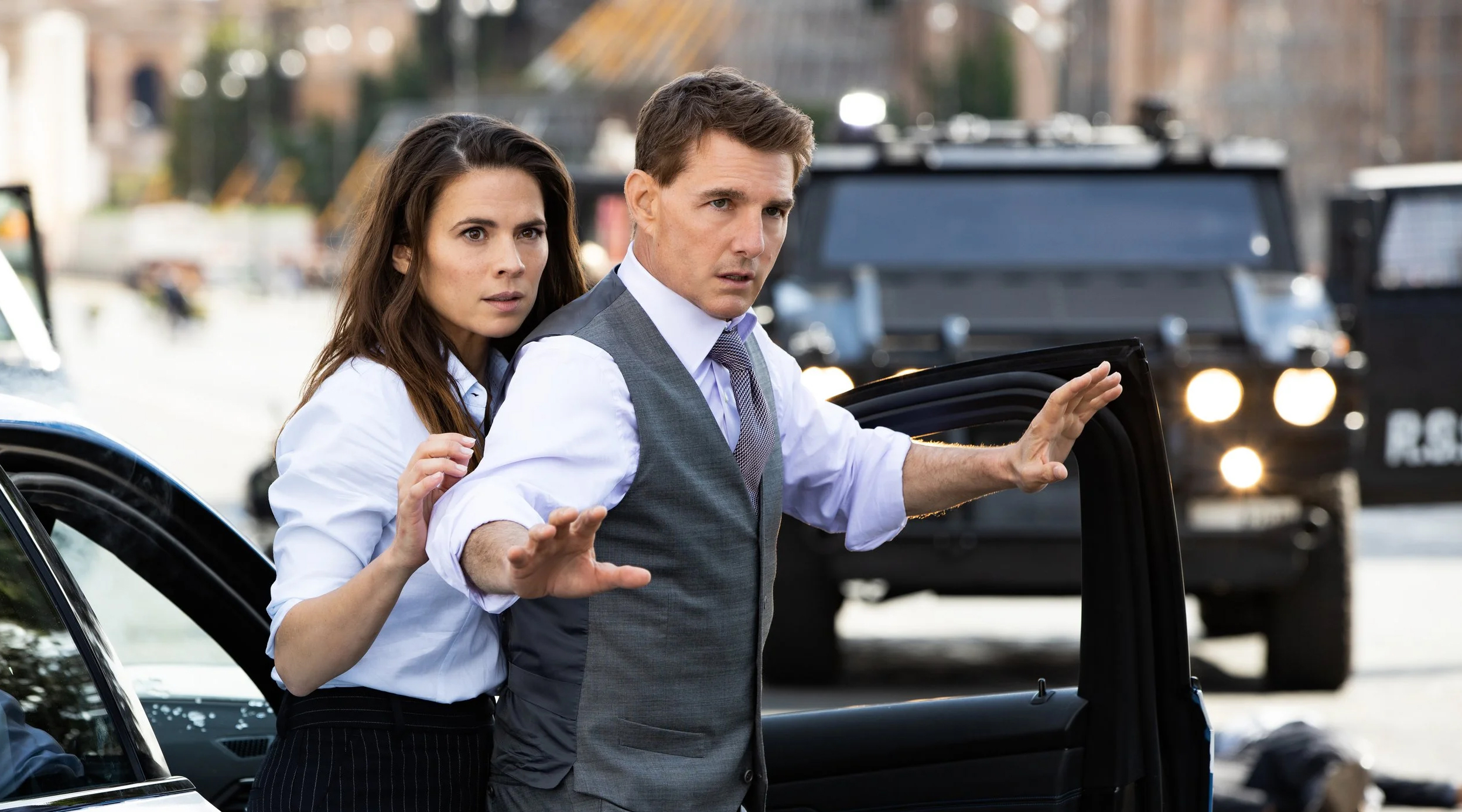
Paris is the Harley Quinn of the M:I series, and we meet her in Paris. Her bleach-blond hair against dark rocker clothing already evokes danger, not to mention her outrageously penetrating stare — a wide-eyed look of crazed ambition at its most extreme. She tears through cobblestone streets in a black Hummer whose revving engine — through the miracle of sound design — shakes the souls of everyone in the theater. She’s a killer. She kills with guns, cars, rods, bricks, and her bare hands via stunning martial artistry. Her sins are the “things done.” We don’t really know what drives her. Her rage of ambition isn’t a simple climb-the-ladder impulse. We eventually see she works for the Entity. We don’t know how she got there, but it feels like possession. Paris’ path is more mystic — mysterious and otherworldly, as she is.
In the final act of Dead Reckoning, Gabriel tells Paris the future: the Entity has prophesied that she will turn on him (and it) and become loyal to Ethan and his mission, because when Ethan had the chance to kill her, he spared her life. Gabriel then attempts to murder her despite the prophecy. Cut to: interior, train car hanging off a cliff. Before Ethan and Grace fall to their deaths, it is Paris’ hand that extends. She saves them. This deliberate, surprising action recalls the Oracle’s question in The Matrix: “Would you still have broken the vase if I hadn’t said anything?” Rather than a neat puzzle of intention or manipulation, perhaps this is better framed by Joseph: “What you intended for evil, God intended for good.” Salvation is largely thrust upon her rather than offered as a tidy intellectual ultimatum. The prophetic word plays a part, revealing to Paris — and to us — that something greater stands outside Paris’ independent, unadulterated choice. Perhaps it is the power of mercy, self-sacrifice, and suffering — the way of the cross — that Ethan embodies.
Her impulsivity and disregard for risk are what make her good at her job; and rather than being turned into a docile, gentle person upon her conversion to the good, these very attributes are harnessed and transformed. Again, we enter a kinetic depiction of absolution. It happens in the final obstacle of the last movie.
Benji — the one who knows how to trap the Entity — is fatally wounded. He looks up at Paris and asks for help — really, he tells her she has to help, she has to do something. This is the moment we see a different kind of possession: a possession by the good, which uses the bizarre characteristics of her personality to preserve a life and, in turn, protect the world. Her brutality is put to use by stabbing Benji in the chest — releasing his collapsed lung — and then caring for him afterward. She used the same motion that once killed to puncture his chest and reinflate his lung. The gesture is the point. Rather than stabbing to kill, she stabs to save.
In Mission: Impossible, things work out in the end. Ethan overcomes the Entity. Paris and Grace are redeemed. Benji lives, and Grace traps the virus. But our world is different. Most of the time, things don’t work out in the end. Even if we try to maintain a positive attitude toward happy endings, why do they seem like anomalies when they occur? Why do they surprise us? Most things don’t turn out the way we intend. Even in moments of salvation — turning toward the good, making the right choice — sometimes it still turns out poorly, and we don’t get to see redemption. Like David Foster Wallace notes, unlike novels or movies, our own lives are stories whose ends we don’t get to see, and because of that, we don’t really make sense of the in-between.
But in Christ we do see the ultimate end: that evil is overcome; that the good, the bad, and the ugly are redeemed; that we are raised to eternal life; and that the chaotic infections in world, flesh, and devil are trapped enemies under God’s footstool. Most of the time that’s hard to believe — to look at our lives, our world, our times, and read them with the revelation of already knowing the end. Most of the time — it’s impossible.
Over the last thirty years, Mission: Impossible has entertained us, made us laugh, and made us feel that maybe we too can jump a motorcycle off a cliff. But ultimately M:I speaks to our affections and revives our trust in God and one another, cultivating our imaginations for the things to come. It shouts to us from the IMAX screen to the laptop in our bedrooms:
On this mountain the Lord of hosts will make for all peoples
a feast of rich food, a feast of well-matured wines,
of rich food filled with marrow, of well-matured wines strained clear.
And he will destroy on this mountain
the shroud that is cast over all peoples,
the sheet that is spread over all nations;
he will swallow up death forever.
Then the Lord God will wipe away the tears from all faces,
and the disgrace of his people he will take away from all the earth.