




(spoilers ahead)
According to NASA, Earth is showered with over 100 tons of dust and sand-sized particles every day. Once a year, an asteroid the size of a car is burned up by the atmosphere before it can reach the surface. And then there’s the every-2,000-year-football-field-sized meteoroid that crashes into the planet. Earth bears the scars of 128 identified impact craters on its surface. We float in a field full of ever present danger from speeding space rock seeking a place to thrust itself into. Our day-to-day lives are not so far off from a similar reality. Every twenty-four hours our personal atmosphere is threated by incoming peril: whether it be the dust of banal existence, the vehicle-sized asteroids of spilled juice on the carpet from pre-warned children or sly comments from those around us, or even sometimes there’s the crater impacting devestation of lost loved ones, financial ruin, possible (likely) complete moral failure … the list goes on.
Wes Anderson’s latest film, Asteroid City, is similar to his other movies in the sense that the audience is left to view the feature in two different ways: 1. Like a diamond cut at multiple angles, creating an increased sparkle, or 2. Like an optical illusion you attempt to understand but end up becoming full of frustration which causes you to disregard the image entirely. And while you can find articles with all sorts of critics either shaming the optical illusion or praising the shine of the diamond, I’d like to put praise or critique of Anderson and his films aside to just tilt the diamond slightly and admire a specific sparkle, if I may. (Although I suppose utilizing the diamond metaphor shows my hand slightly, so be it.)
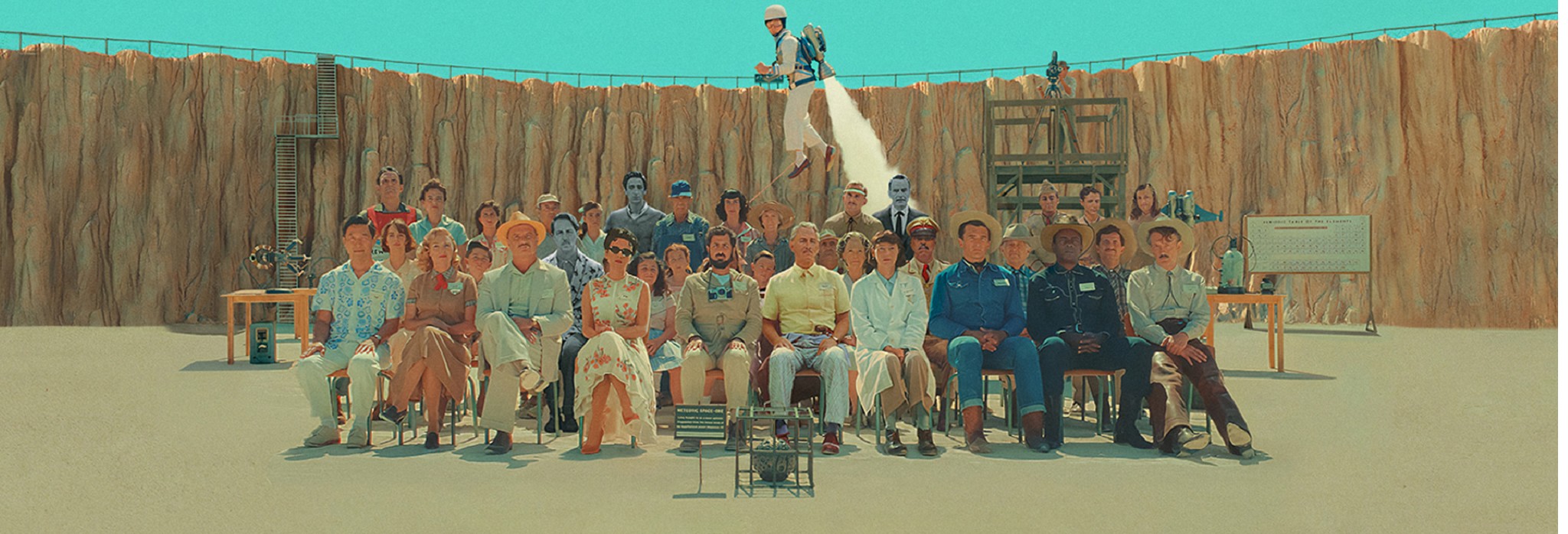
The film has numerous characters with plenty of routes to head down for interpretation. There’s certainly a layer reflecting on performance, acting and the meaning of art, however, the one I’d like to chew on is the theme of grief and how one deals with tragedy.
Augie Steenbeck’s wife has passed away and, as one normally does with a heavy weight of pain, he’s put off lifting it. Hence why, at the opening of the film, the father’s four children have yet to find out their mother has passed even though the death occurred three weeks previous. When he finally does confess to them, he describes his struggle with death and its painful effects. He tells how when he was younger his mother, who he notes was an atheist and only wanted to comfort him, told him about his father’s passing and that he’d gone to be in the stars, but he knew better. He knew his father was in the ground. Of course, this cynicism (and painfully true reality of where used-to-be living bodies end up), leads him to declare that time doesn’t heal but can perhaps be a band-aid at best. He ends up following the pattern his mother set for him and attempts to comfort his children: “Let’s say she’s in heaven, which doesn’t exist for me, of course, but you’re Episcopalian.” It’s then that the setting of Asteroid City begins to make sense.
For what could be a more apt metaphor for dealing with grief than the crater from an asteroid impact of which this town found its namesake. Some utilize the old idea of living with grief as learning to live life without an arm or a leg, but this almost misses the true feeling. It’s not as if you’re missing an appendage but rather have everything operating the same only with a giant hole in your inner self, your core being. And often, this deep pocket within us debilitates us, unable to process this hole’s meaning. This is where our main character finds himself. He’s numb, cold and emotionless. Now, it’s possible this is just a standard Anderson character, but it nevertheless captures the paralyzing affect grief can have.
Augie interacts with Scarlett Johansson’s character, Midge Campbell, who also finds herself leaning towards apathy. At one point she describes to Augie her lack of guilt for being a terrible mother. She knows she puts her acting first and just doesn’t have any feelings about it. Briefly she mentions a history of knowing cruel men, likely the genesis of her craters, and describes herself alongside Augie as “two catastrophically wounded people who don’t express the depths of their pain because we don’t want to.” Anthony Lane in the New Yorker justly comments about these two’s interaction: “Humans can leave a crater, too.”
While Augie’s current crater is a death, these holes aren’t always casket-sized craters. Often they are terminated friendships, a troubling medical diagnosis, dissolved marriages (with a spouse or one’s parents), a fractured parent-child relationship, or the crater left from a variety of sin committed by or against you.
What are we to do with these craters we walk around with? It’s quite frequently cratered people who can easily crater another, thus continuing the cycle. The question can’t be how do we stop the unlimited amount of asteroids speeding by within our atmosphere — we are bound to be impacted by a plethora of space rock. And certainly, although we try in a variety of ways, one cannot fill the crater back up and pretend contact was never made. So, it seems there is only one option: Learn to live with the crater.
This is the option it appears Anderson has chosen to display. Mockingbird contributor, Ryan Cosgrove, recently wrote about Anderson’s characters and films, pointing out that “God always intervenes in Wes’ film in a force that’s beyond control …” He also notes an interview in which Anderson was asked if there’s a God in his cinematic universe and whether said God is aloof or intervenes. Anderson replies, “God intervenes.” And in his latest film, it appears God does so in the form of an out-of-this-world, incarnated if you will, being.
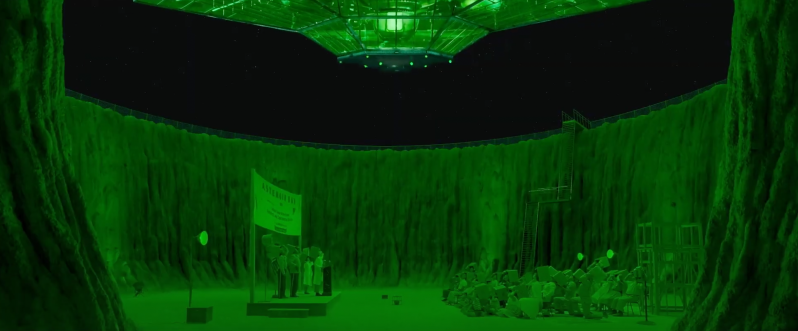
As the cast of characters are stargazing one night in the middle of the crater, a spaceship descends in a glowing green illumination. An alien slowly drops down from the craft, grabs the infamous asteroid and heads back up into the inky dark night. This leads the characters on a journey to understand the meaning of what has occurred. They are subsequently placed in quarantine as the military overtakes the town. Soon, the alien returns and descends once again to put the asteroid back where they found it. Only now, it has writing on it and has been catalogued. It’s been defined in a sense. Eventually the quarantine is lifted and the characters all leave Asteroid City, including Augie, who now has Midge’s contact information and appears to have plans to seek furthering their relationship.
The crater isn’t merely filled in nor is it neglected. Instead it’s been marked, given a name so to speak. And so it is with how we hope to live with our own craters.
In Anderson’s words, we believe God intervenes. While it may not be in the form of an extra-terrestrial in a spacecraft, it certainly is in the fashion of descending and ascending, an incarnation into our world. And surely, His name is written on every asteroid impacting the surface of our being — not to mention the asteroids we’ve sent to crater others. And while this cataloging asteroids work of God doesn’t nullify our pain and confusion as to why we were impacted to begin with, it does grant us the ability to look honestly at our grief and get back behind the steering wheel to drive out of Asteroid City, our impact craters now properly framed. Our asteroids and their corresponding craters, perhaps never fully understood by us, are in the hands of the bewildering and bedazzling celestial mystery in whom we’ve placed our hope. And while the road of grief leading out of town may be long and arduous, often tear-filled, there’s a warm comfort in the palms of the Great Intervener who holds all things together.







Nice!
I love WA’s first three movies, but have been mixed on him since. (I think Owen Wilson as writing partner did a better job of balancing some of Anderson’s less-appealing quirks than Coppola does.)
But this article makes me want to give Asteroid City a chance. Thanks, Blake!
it’s not my favorite one of his but I still thought it was decent. I hope you enjoy it!
What’s your favorite, or top three?
top threes always stress me out but I really love Isle of Dogs, The Darjeeling Limited and The Grand Budapest Hotel. Isle of Dogs might be my favorite as it was my introduction to Wes’ work
[…] film Asteroid City, reviewed by Peter Tonguette (Religion & Liberty Online), Blake Nail (Mockingbird), and Joe George (Sojourners). Andrew Petiprin considers Asteroid City in the context of […]