




I plunked down to watch Home Alone with my kids recently as one of them had it playing in the living room. The movie always seems to be on this time of year. It’s become a Christmas classic across the generations. But the hero of the film isn’t its the character we’re rooting for. He doesn’t crack any jokes or have memorably iconic scenes. The savior of Home Alone doesn’t even make the cut on the movie poster.
We all know the movie’s premise: little Kevin McAlister has been inadvertently left behind (no, he didn’t miss the rapture) as his family rushes off to the airport for their holiday vacation in France. Upon discovering he has been neglected, he realizes he must now do his own laundry, shop for himself, fend for himself, eat junk and watch rubbish, etc. Initially, it’s all fun and games, especially as we see in the famous shaving scene or the comedic interrogation by the grocery store cashier.
Sin, inasmuch as it signifies or entails living for ourselves, is indeed fun at first, to which the writer of Hebrews alludes when referring to the “passing pleasures of sin.” But eventually, it does its inevitable work and we exhaust ourselves running the course of what we consider to be the ideal life: independence, freedom, no law, no rules, (in this case) no parents around — the ultimate, “I can do what I want” manifesto fulfilled. Indeed, such autonomy appeals to the flesh in the same way Adam and Eve were seduced by the serpent’s lie, essentially promising them, “you can be your own boss”. The siren call of our individualistic culture insinuates that we must find ourselves, be ourselves, fully know ourselves, justify ourselves — i.e. don’t be a bum working a nine to five making someone else rich. We quickly find out though living for ourselves isn’t all it’s cracked up to be.
When the infamous wet bandits chance upon Kevin for the second time in the film (of note is that Harry is literally disguised as ‘the law’ in their first encounter), he realizes he is in trouble and knows he must come up with a scheme to defend the McAlister household. Cue, the hilarious Angels with Filthy Souls scene as he creatively finds ways to convince the burglars he’s not actually alone (I love that he hides under scarlet colored covers when they initially attempt to break in). Harry and Marv eventually see through the ruse and commence their plan to break in.
Where we approach the film’s crux though is the iconic moment where a wearied Kevin attends a church service. He is accosted by their mysterious neighbor, Old Man Marley, whom Kevin’s older brother, Buzz has insisted is a misanthropic recluse with sinister inclinations (The South Bend Shovel Slayer). They begin a conversation that is pivotal to the narrative. After Marley asks, “have you been a good boy this year?”, Kevin cannot definitively answer in the affirmative. Marley graciously responds, “I figured” and what unfolds is an entire confessional moment that becomes the most somber point in the film — further heightened by the background music in which we hear the ethereal echoes of an angelic youth choir. Mutual encouragements to forgive family members abound, replete with allusions to redemption.
Immediately after this scene, something happens — as Kevin makes his way home, Christmas lights literally turn on as he runs past them, signifying the proverbial lightbulb igniting in his mind. In short, he has emerged from church ready for battle, and consequently brandishes a literal blueprint, a battle plan, consisting of the intricately devised booby traps he plans to set for the burglars.
It’s noteworthy that the one place in the entire movie where Kevin is actually safe is at church, where he incidentally interacts with a strange and mysterious neighbor. Marley intimates the church’s capacity as a sanctuary with the poignant line, “you’re always welcome at church”. Ironically, Kevin is alone in his parents’ wealthy home in an affluent suburb, yet he’s not safe — his dwelling place is not impenetrable. Yet, when he emerges from church, he feels ready to face adversity and opposition because after all, he now has the battle plan! At that moment, the tempo of the music (Carol of the Bells) becomes more upbeat and contemporary as we transition away from the serene singing of the angel choir. The implication is unmistakable: our protagonist has found the answer to his problem — he now knows ‘what to do’.

What transpires in the final act is that for which Home Alone is most famous. When we think of Home Alone, we remember the blow torch incinerating Harry’s scalp, the heated doorknob burning his hand, the swinging cans of paint, the iron that falls on Marv’s face, crooks slipping on hot wheels (wow…this is exceptionally violent for a so called family film, lol), etc. These slapstick antics remain the signature trademarks of Home Alone. Kevin’s elaborate plan is what Robert Capon (and Martin Luther) would refer to as right handed power. Much like the Corinthians whom Paul chided in two New Testament epistles, we love displays of strength and power – i.e. ‘the wisdom of this age’ which indeed is foolishness to God (cf. 1 Cor 1:27-29) and antithetical to the Cross of Christ.
Kevin is the little guy who belittles the buffoons, an underdog who uses what he has to overcome evil. It’s an old glory story that is sure to sell tickets. In an age in which “the nerds now rule the world”, we yet place them on a pedestal alongside the action heroes. We love ‘flex’ – whether it’s virile or intellectual in nature! We are drawn to extravagance and excess in our entertainment.
While we memorialize Kevin’s ingenuity in nearly outsmarting the wet bandits, we miss the fact that when when it all comes down to it, what ends up vanquishing the presence of evil or bringing resolution to the storyline is not in fact the booby traps. In the end, Kevin’s plans actually fail and the villains ultimately get the upper hand as Harry states, “now we’ve outsmarted you”.
Our best efforts and best application of spiritual disciplines and principles (even in tandem with the power of God), are not going to succeed. It’s not our wits or cleverness or goldy piety that ‘save the day’. How is the proverbial day saved in Home Alone? At the decisive moment, the creepy old neighbor whom nobody wants anything to do with intervenes with a rescue. Not unlike, One from whom people hide their faces and who was despised, yet who came to bear our sins. Marley has been ousted and made a pariah by the community (“There are a lot of rumors going around about me, but none of it is true.”) much like Christ who bore our shame “outside of the city gates”. Marley, whom the film humanizes in the brief church scene is the one who comes at the unexpected moment to bring deliverance and salvation. He does not wield a blowtorch, paint can, or well-placed nail on the stair, but a snow-shovel.
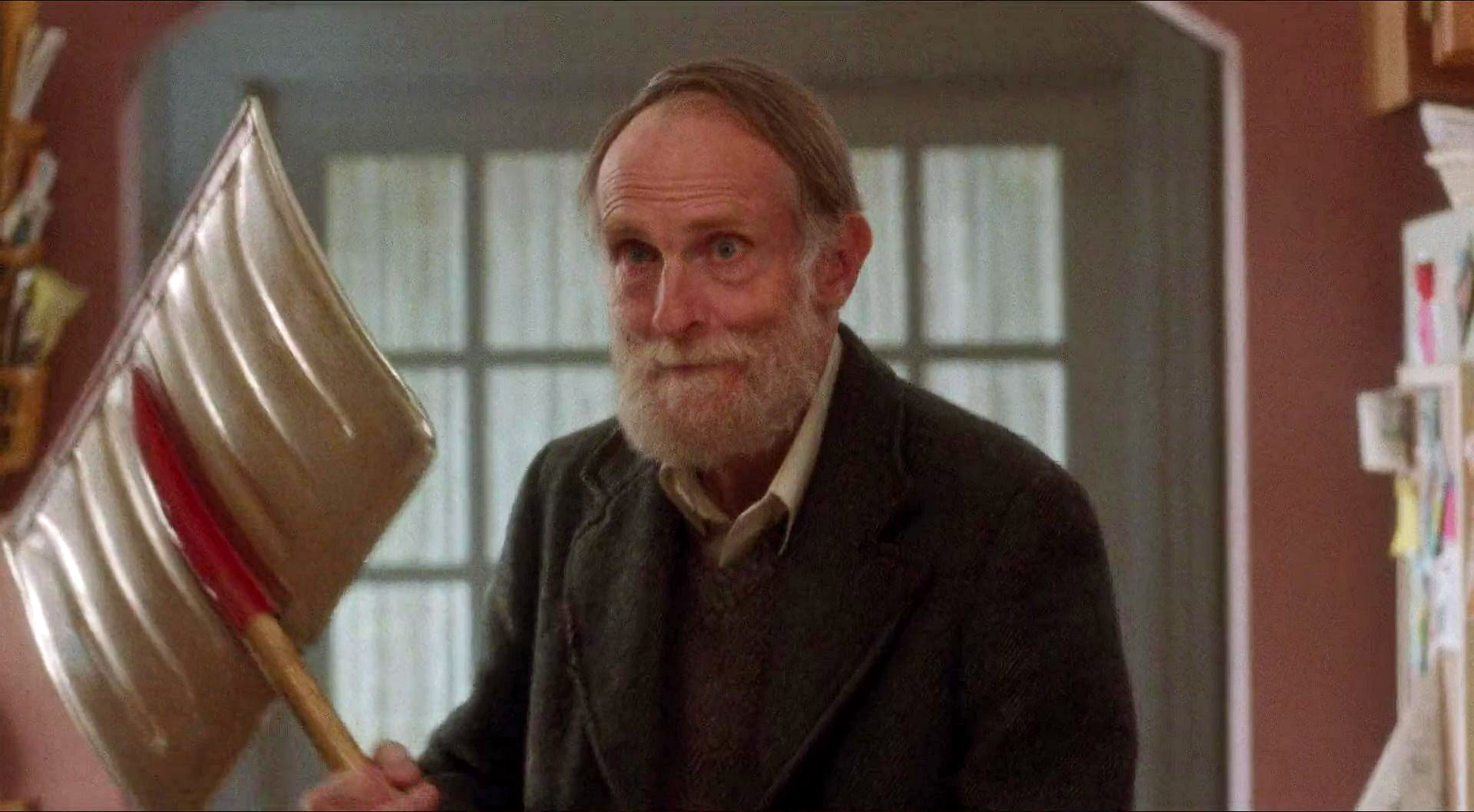
Grace always comes as a surprise. The Messiah wasn’t supposed to come into the world as a baby. Christ wasn’t supposed to rise on the third day after His brutal death. Sinners aren’t supposed to receive mercy — they’re supposed to receive their just due. Grace is untimely, as the old gospel song proclaims, “He may not come when you want Him, but He’s always right on time …”
We miss the subtly of grace and focus more on strength, spectacle, or the public indiscretions of hapless miscreants … We miss grace because it’s hidden and subtle. When you consider the coming of redemption from creation to the birth of Christ, there’s this consistent thread you can trace in which grace is at work in spite of and in the midst of the abundance of human error. The hero is never the one we expect.
In his commentary on Jesus’ parables, Robert Capon opines talks about the subtlety of grace, a grace that moves quietly and unbeknownst to us because we are fools steeped in the delusion of our assumed righteousness.
Left to our own devices, we would probably have likened the Word’s advent to a thunderclap or to a fireworks display or to something else we judged sufficiently unmistakable to stand in for our notion of a pushy, totally right handed God. Instead, this parable says that the true coming of the Word of God, even if you see it, doesn’t look like very much – and that when it does finally get around to doing its real work, it is so mysterious, that it can’t even be found at all. … [Jesus] as the Word comes to His own and His own received Him not. He is despised. He is the stone the builders rejected. He is ministered to not in His own recognizable form, but in the sick, the imprisoned, and the generally down-and-out. And to cap His whole ministry as the Word sown in the field of the world, He dies, rises, and vanishes.
Kevin wanted to live on his own, for his family to disappear. Like the prodigal son, he got his wish and for a day or two he lived he always wanted. But his newfound freedom also placed him in the crosshairs of the Wet Bandits. Kevin mustered as much ingenuity and resourcefulness as he could, but he was in over his head. He needed the left-handed power of the snow-shovel wielding outcast to save him. He, like us, was desperate for an unnoticeable grace that upsets our categories of right and wrong, fair and unjust, checks and balances, power and weakness. A grace that, as Mary sang to the angel, “brings down the mighty from their thrones and exalts those of humble estate.”








“He needed the left-handed power of the snow-shovel wielding outcast to save him.” That’s an amazing line!
was just watching this with my son the other day. I love the church scene! great assessment of the whole movie, thank you for this piece